
Table of Contents
What You Need to Know About the August 31 2026 ITR Deadline
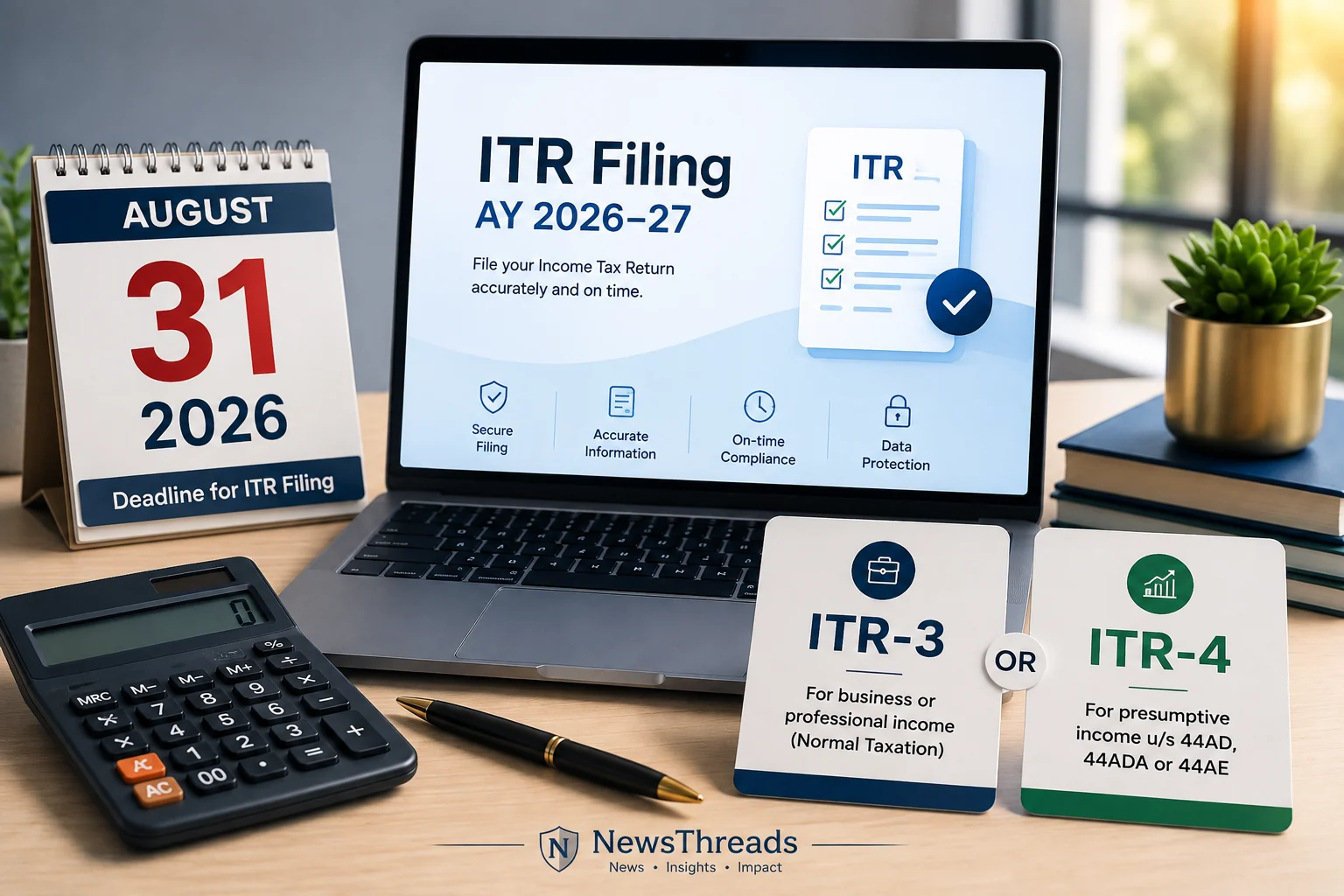
ITR deadline August 31 2026 is an important filing date for eligible taxpayers with non-audit business or professional income for Assessment Year 2026–27. But the date does not apply to every taxpayer, and using the wrong deadline or return form can create avoidable filing problems.
For individuals and HUFs earning income from a business or profession, the main question is often whether to file ITR-3 or ITR-4. The answer depends on how the income is computed, whether presumptive taxation applies, the taxpayer’s total income, capital gains, losses, foreign assets and other eligibility conditions.
ITR-4 is meant for eligible presumptive-tax cases under Sections 44AD, 44ADA or 44AE, while ITR-3 is generally used for broader or more complex business and professional income situations where ITR-4 does not apply.
This guide explains who the August 31 deadline applies to, who can use ITR-3 or ITR-4, the key presumptive-tax rules, Form 10-IEA requirements, late-filing consequences, verification timelines and the important AY 2026–27 changes taxpayers should know before filing.
Quick Answer: Who Has an ITR Deadline of August 31, 2026?
For AY 2026–27, eligible taxpayers falling under non-audit business or professional cases generally have until August 31, 2026 to file their Income Tax Return.
Eligible taxpayers using presumptive taxation under Sections 44AD, 44ADA or 44AE may be able to use ITR-4, while individuals or HUFs with business or professional income who do not qualify for ITR-4 may need ITR-3.
Is August 31, 2026 the ITR Deadline for Everyone?
No. The August 31 deadline should not be interpreted as a general extension for all individual taxpayers.
CBDT’s AY 2026–27 filing framework distinguishes non-audit business cases from ordinary non-business returns. Taxpayers whose income does not include business or professional income may fall under a different due date depending on their return category and circumstances.
This distinction is important because simply seeing “August 31 ITR deadline” in a headline can lead taxpayers to incorrectly assume that their earlier filing deadline has automatically been extended.
Why Has the ITR Deadline Changed for Non-Audit Business Cases?
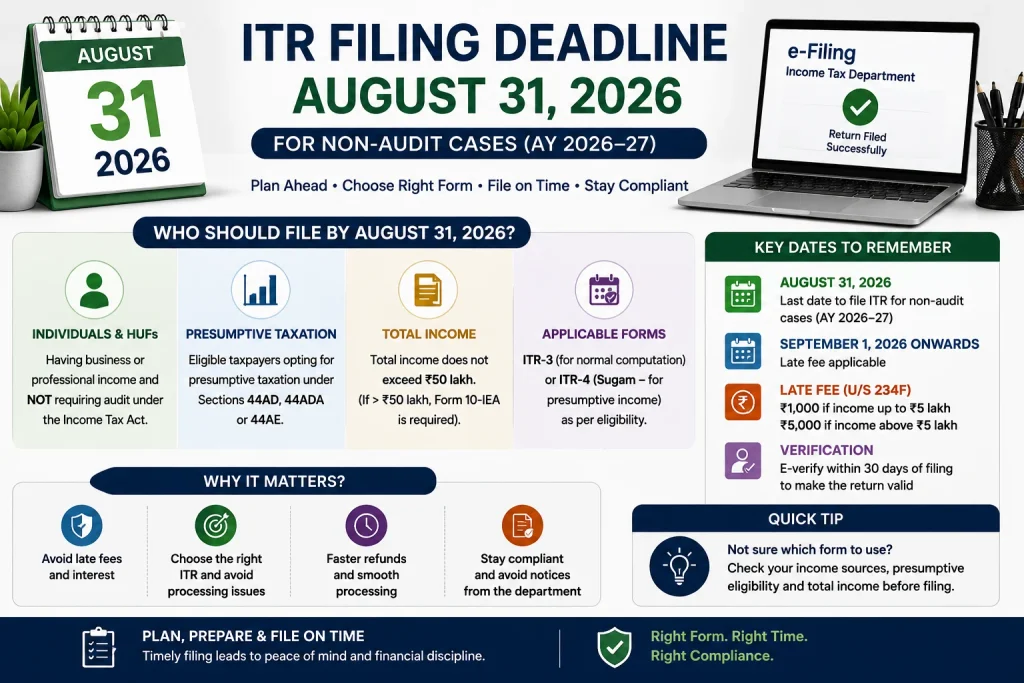
The staggered filing timeline gives eligible non-audit business taxpayers additional time to prepare their financial information and complete return-filing requirements.
Business and professional returns can require reconciliation of turnover, gross receipts, business income, expenses, tax payments, AIS information, Form 26AS and other records. The additional filing period recognizes that these returns may involve more preparation than straightforward salary-based returns.
ITR-3 vs ITR-4: What Is the Main Difference?
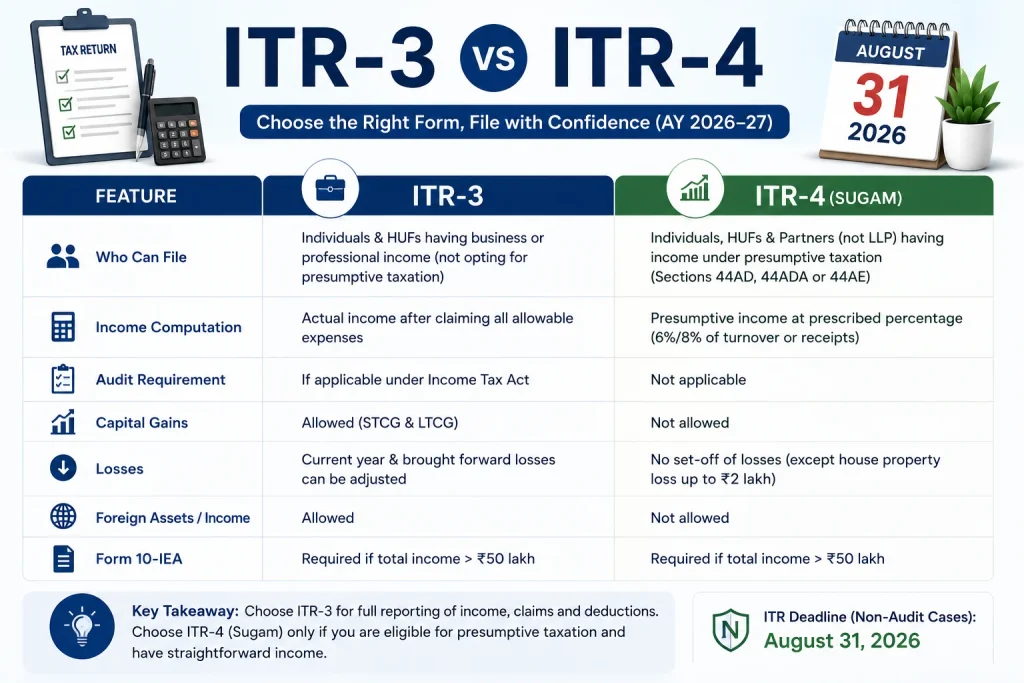
The basic distinction is straightforward:
ITR-3 is the broader return generally used by individuals and HUFs having business or professional income who are not eligible to use ITR-1, ITR-2 or ITR-4.
ITR-4 (SUGAM) is a simplified return available to eligible taxpayers whose business or professional income is calculated under the presumptive taxation provisions of Sections 44AD, 44ADA or 44AE, subject to all other eligibility conditions.
Who Should File ITR-3 for AY 2026–27?
ITR-3 is generally applicable to an individual or Hindu Undivided Family (HUF) who has income from a business or profession and is not eligible to file ITR-1, ITR-2 or ITR-4.
In practical terms, ITR-3 is usually the appropriate form when the taxpayer has business or professional income that cannot be reported under the simplified presumptive-tax framework available through ITR-4.
For example, an individual running a proprietorship may need to examine ITR-3 if taxable business profit is being calculated on the basis of actual income and expenses instead of declaring income under an eligible presumptive taxation scheme.
ITR-3 may also become relevant where the taxpayer has business or professional income along with other circumstances that make ITR-4 unavailable.
These can include:
- short-term capital gains;
- foreign income or foreign assets;
- income exceeding the eligibility limits applicable to ITR-4;
- losses that need to be carried forward;
- business or professional income that does not qualify under Sections 44AD, 44ADA or 44AE;
- more complex capital-gain transactions; or
- other situations specifically excluded from ITR-4 eligibility.
Does Every Business Owner Have to File ITR-3?
No.
Having business income does not automatically mean that ITR-3 must be filed.
An eligible small-business owner using presumptive taxation under Section 44AD, for example, may be able to use ITR-4 if all other conditions are satisfied.
Similarly, an eligible professional using Section 44ADA may also qualify for ITR-4.
The correct return therefore depends on how the income is computed and the taxpayer’s complete income profile, not merely on whether the person describes themselves as a business owner, freelancer, consultant or professional.
When ITR-3 Is More Likely to Apply
ITR-3 is more likely to be relevant when a taxpayer:
- reports actual business profit after accounting for income and allowable expenses;
- maintains detailed books of account;
- has business income together with capital gains that are not permitted in ITR-4;
- needs to report or carry forward eligible losses;
- has foreign income or assets;
- does not qualify for presumptive taxation; or
- fails one or more of the conditions required for filing ITR-4.
The taxpayer should therefore review all sources of income for the year before selecting the return form.
Choosing ITR-3 or ITR-4 solely on the basis of occupation can result in the wrong return being filed.
Who Can File ITR-4 for AY 2026–27?
ITR-4, also known as SUGAM, is a simplified income tax return available to certain taxpayers who declare business or professional income under the presumptive taxation provisions.
For AY 2026–27, ITR-4 may be used by an eligible:
- resident individual;
- resident Hindu Undivided Family (HUF); or
- resident firm other than an LLP,
provided the taxpayer satisfies all applicable conditions.
One of the main conditions is that total income should not exceed ₹50 lakh.
The business or professional income reported through ITR-4 must generally be computed under one of the following presumptive taxation provisions:
- Section 44AD – for eligible businesses;
- Section 44ADA – for eligible professionals; or
- Section 44AE – for eligible goods-carriage businesses.
What Other Income Can Be Reported in ITR-4?
Subject to the applicable conditions, an eligible taxpayer may also report certain other sources of income in ITR-4, including:
- salary or pension income;
- income from up to two house properties;
- specified income from other sources;
- agricultural income up to the permitted limit; and
- eligible long-term capital gains under Section 112A within the prescribed ITR-4 limit.
For AY 2026–27, current Income Tax Department guidance allows eligible Section 112A long-term capital gains of up to ₹1.25 lakh to be reported in ITR-4, subject to the remaining conditions of the form.
Is ITR-4 Compulsory If You Use Presumptive Taxation?
No.
ITR-4 is a simplified return available to eligible taxpayers, but the taxpayer must still satisfy all conditions applicable to the form.
A person should not select ITR-4 merely because their business or profession appears small or because the form is shorter than ITR-3.
The taxpayer must first check:
- whether the business or profession qualifies for presumptive taxation;
- whether total income remains within the ITR-4 limit;
- whether any capital gains make the form unavailable;
- whether there are foreign assets or foreign income;
- whether any losses need to be carried forward; and
- whether any other ITR-4 exclusion applies.
Quick Eligibility Check
A taxpayer is more likely to qualify for ITR-4 where all of the following broadly apply:
- the taxpayer is an eligible resident individual, HUF or resident firm other than an LLP;
- total income does not exceed ₹50 lakh;
- business or professional income is being declared under Section 44AD, 44ADA or 44AE;
- there are no short-term capital gains;
- there are no disqualifying foreign assets or foreign-source income;
- there are no losses that need to be carried forward; and
- all other ITR-4 eligibility conditions are satisfied.
The final decision should always be based on the taxpayer’s complete income profile, not just on turnover or professional receipts.
Who Cannot File ITR-4 for AY 2026–27?
ITR-4 is designed for relatively simple presumptive-taxation cases. Even if a taxpayer has business or professional income, the form cannot be used if certain disqualifying conditions apply.
For AY 2026–27, a taxpayer generally cannot use ITR-4 if they have:
- short-term capital gains;
- long-term capital gains under Section 112A exceeding the permitted limit for ITR-4;
- total income above ₹50 lakh;
- foreign assets or a financial interest in any entity located outside India;
- income from a source outside India;
- signing authority in an account located outside India;
- unlisted equity shares held during the relevant year;
- certain deferred tax liabilities relating to ESOPs;
- brought-forward losses; or
- losses that need to be carried forward to a future year.
A person who is a director in a company is also generally not eligible to file ITR-4 under the current conditions.
Capital Gains Can Make ITR-4 Unavailable
One of the most important checks is capital gains.
For AY 2026–27, ITR-4 can accommodate eligible long-term capital gains under Section 112A up to ₹1.25 lakh, subject to the other conditions of the form.
However, if the taxpayer has short-term capital gains, ITR-4 is not available.
This distinction is particularly important for taxpayers who invest in shares, equity mutual funds or other market-linked assets.
A person may otherwise qualify for presumptive taxation but still become ineligible for ITR-4 because of the nature of their capital gains.
Foreign Assets or Foreign Income Require Extra Care
ITR-4 is generally not suitable where the taxpayer has reportable foreign assets, foreign-source income or signing authority in an overseas account.
Examples may include:
- an overseas bank account;
- shares in a foreign company;
- foreign brokerage holdings;
- overseas property;
- income received from a foreign source; or
- certain financial interests outside India.
Such cases usually require more detailed disclosure and should be reviewed carefully before selecting the return form.
Losses Can Also Affect ITR-4 Eligibility
A taxpayer who has a brought-forward loss from an earlier year or wants to carry forward an eligible loss may not be able to use ITR-4.
This can become relevant in cases involving:
- business losses;
- capital losses; or
- certain other losses allowed to be carried forward under the Income Tax Act.
This is another reason taxpayers with trading, investment or business losses should not automatically choose the simplified return.
Important Filing Principle
The fact that a taxpayer qualifies for presumptive taxation under Section 44AD, 44ADA or 44AE does not by itself guarantee eligibility for ITR-4.
Presumptive-tax eligibility and ITR-4 eligibility are related, but they are not identical.
A taxpayer must satisfy both:
- the conditions of the relevant presumptive-tax provision; and
- all the separate eligibility conditions applicable to ITR-4.
If even one disqualifying condition applies, the taxpayer may need to examine ITR-3 or another applicable return form instead.
Presumptive Taxation Explained: Sections 44AD, 44ADA and 44AE
Presumptive taxation is a simplified method of calculating taxable income for certain eligible businesses and professionals.
Instead of determining taxable profit only through a detailed calculation of actual income and expenses, the taxpayer can declare income according to the presumptive rules prescribed under the relevant section, provided all eligibility conditions are satisfied.
For taxpayers considering ITR-4, the three most important provisions are:
- Section 44AD for eligible businesses;
- Section 44ADA for eligible professionals; and
- Section 44AE for eligible goods-carriage businesses.
These provisions are different from one another, and taxpayers should not assume that every small business or freelancer automatically qualifies.
Section 44AD: Presumptive Taxation for Eligible Businesses
Section 44AD is intended for certain eligible small businesses.
Under the current rules, the normal turnover or gross-receipts limit is ₹2 crore.
This limit can increase to ₹3 crore where cash receipts do not exceed 5% of total turnover or gross receipts, subject to the prescribed conditions.
For eligible businesses, presumptive income is generally calculated at:
- 6% of qualifying receipts received through specified banking or electronic modes; and
- 8% of other qualifying turnover or receipts.
A taxpayer may declare a higher amount if the actual income is higher.
However, Section 44AD is not available to every business activity.
For example, certain agency businesses and persons earning income in the nature of commission or brokerage are generally excluded from the scheme. Goods-carriage businesses are covered separately under Section 44AE.
Section 44ADA: Presumptive Taxation for Eligible Professionals
Section 44ADA applies to specified eligible professions.
The normal gross-receipts limit is ₹50 lakh.
Where cash receipts do not exceed 5% of total professional receipts, the limit can increase to ₹75 lakh, subject to the applicable conditions.
Under this scheme, presumptive professional income is generally taken at 50% of gross receipts, or a higher amount if the taxpayer chooses to declare more.
Specified professions can include areas such as:
- legal;
- medical;
- engineering;
- architecture;
- accountancy;
- technical consultancy; and
- other professions specifically covered under the Income Tax Act.
This is particularly important for freelancers.
A person may work independently and call themselves a freelancer, but that does not automatically mean Section 44ADA applies. The underlying nature of the professional activity must fall within the eligible categories.
Section 44AE: Presumptive Taxation for Goods-Carriage Businesses
Section 44AE applies to eligible taxpayers engaged in the business of:
- plying;
- hiring; or
- leasing goods carriages.
The scheme is subject to specific conditions, including limits on the number of goods vehicles owned during the year.
For AY 2026–27, the relevant framework generally applies where the taxpayer owns not more than 10 goods carriages at any time during the previous year.
Presumptive income under Section 44AE is calculated using prescribed monthly amounts based on the type and capacity of the goods vehicle.
Which Presumptive Section Applies to Whom?
| Section | Mainly applies to | Key eligibility concept |
|---|---|---|
| 44AD | Eligible small businesses | Turnover within prescribed limit |
| 44ADA | Specified professionals | Professional receipts within prescribed limit |
| 44AE | Goods-carriage businesses | Ownership of eligible goods vehicles within prescribed limits |
Important: Presumptive Taxation Does Not Automatically Mean ITR-4
Even if a taxpayer qualifies under Section 44AD, 44ADA or 44AE, ITR-4 can be used only if the taxpayer also satisfies all the separate conditions applicable to the form.
For example, a taxpayer may qualify for presumptive taxation but still be unable to use ITR-4 because of:
- short-term capital gains;
- foreign assets or foreign income;
- total income exceeding the ITR-4 limit;
- losses that need to be carried forward; or
- another disqualifying condition.
Presumptive taxation determines how eligible business or professional income can be computed.
ITR-4 eligibility determines whether that simplified return form can actually be used.
Both tests must be satisfied.
ITR-3 vs ITR-4: Side-by-Side Comparison
The difference between ITR-3 and ITR-4 becomes easier to understand when the two forms are compared directly.
| Particular | ITR-3 | ITR-4 |
|---|---|---|
| Applicable to individuals | Yes | Yes, subject to eligibility |
| Applicable to HUFs | Yes | Yes, subject to eligibility |
| Resident firm other than LLP | No | Yes, if eligible |
| Business or professional income | Yes | Yes |
| Presumptive taxation required | No | Yes, for business/professional income under Sections 44AD, 44ADA or 44AE |
| Total income limit of ₹50 lakh | No equivalent ITR-4 ceiling | Yes |
| Short-term capital gains | Can be reported where applicable | Not allowed |
| Section 112A long-term capital gains | Can be reported as applicable | Permitted up to ₹1.25 lakh, subject to conditions |
| Foreign assets or foreign income | Can be relevant | Generally makes ITR-4 unavailable |
| Brought-forward/carry-forward losses | Can be reported where applicable | Generally not permitted |
| Detailed business reporting | Yes | Simplified |
| Best suited for | More complex business/professional cases | Eligible presumptive-tax cases |
Which Form Is Simpler?
ITR-4 is generally simpler because it is designed for eligible presumptive-taxation cases.
However, the simpler form should never be selected merely to reduce filing effort.
A taxpayer who does not satisfy the ITR-4 conditions should use the return form that correctly reflects their actual income and circumstances.
Which Form Is Better?
Neither ITR-3 nor ITR-4 is inherently “better.”
The correct form is the one that applies legally to the taxpayer.
For example:
- an eligible small trader using Section 44AD may find ITR-4 appropriate;
- a professional reporting actual income and expenses may need ITR-3;
- a taxpayer with business income and short-term capital gains may need ITR-3 rather than ITR-4;
- an eligible professional using Section 44ADA may be able to use ITR-4 if no other disqualification applies.
The choice should therefore be based on eligibility, not convenience.
Can Freelancers File ITR-4?
A freelancer may be able to file ITR-4, but freelance status alone does not determine eligibility.
The key question is whether the taxpayer’s activity qualifies under one of the presumptive-tax provisions, particularly Section 44ADA for specified professions.
For example, an eligible professional providing qualifying consultancy, engineering, medical, legal, accountancy or other specified professional services may potentially use Section 44ADA if the applicable receipt limits and other conditions are satisfied.
However, not every independent worker automatically falls under Section 44ADA.
A person may describe their work as freelancing but legally earn:
- professional income;
- business income;
- commission income;
- agency income; or
- another type of taxable receipt.
The tax treatment depends on the actual nature of the activity.
Example: Freelance Professional
Suppose a resident professional earns ₹32 lakh from an eligible profession covered by Section 44ADA and satisfies all the other ITR-4 conditions.
The taxpayer may be able to use the presumptive scheme and file ITR-4.
Example: Freelancer With Short-Term Capital Gains
Suppose the same professional also sells shares and earns short-term capital gains during the year.
Even if the professional income qualifies under Section 44ADA, the presence of short-term capital gains makes ITR-4 unavailable.
The taxpayer may then need to examine ITR-3.
Key Point for Freelancers
Do not choose an ITR form based only on the word “freelancer.”
First determine:
- what type of income the activity legally produces;
- whether presumptive taxation applies;
- whether the applicable turnover or receipt limits are satisfied; and
- whether any other income makes ITR-4 unavailable.
Which ITR Should a Sole Proprietor File?
A sole proprietor does not have a separate legal identity from the individual who owns the business for income-tax return purposes.
However, that does not mean every proprietor files the same ITR form.
An individual proprietor may potentially use ITR-4 if:
- the business qualifies under Section 44AD or another applicable presumptive provision;
- the relevant turnover conditions are satisfied;
- total income remains within the ITR-4 limit; and
- none of the ITR-4 exclusions applies.
ITR-3 may instead be relevant where the proprietor:
- reports business profit using actual accounts;
- does not qualify for presumptive taxation;
- has short-term capital gains;
- has losses that need to be carried forward;
- has foreign income or assets;
- exceeds the ITR-4 eligibility conditions; or
- otherwise needs more detailed business reporting.
Example: Small Retail Business
Suppose an individual runs an eligible retail business with turnover within the Section 44AD limit and chooses presumptive taxation.
If all other ITR-4 conditions are met, ITR-4 may be available.
Example: Proprietor Reporting Actual Profit
Suppose another proprietor maintains detailed books, reports actual sales and expenses, and calculates taxable business profit using the normal method.
In that situation, ITR-3 may be the appropriate form to examine.
Important Principle
The correct ITR form for a proprietor depends on how business income is calculated and what other income the proprietor has.
Being a sole proprietor by itself does not automatically determine whether ITR-3 or ITR-4 should be filed.
Explore the iPhone Air and iPhone 17 lineup, including India pricing, specifications, features, colors and availability.
Salary Plus Freelance or Business Income: Which ITR Applies?
Many taxpayers earn income from more than one source.
A person may receive a salary from an employer while also earning income from consulting, freelancing, tuition, professional services, online work or a small business.
In such cases, the existence of salary income does not automatically mean ITR-1 should be filed.
The return form must take into account all sources of income.
Salary + Eligible Presumptive Professional Income
Suppose a taxpayer receives salary income and also earns qualifying professional income under Section 44ADA.
If all ITR-4 eligibility conditions are satisfied—including the total-income limit and absence of disqualifying income—ITR-4 may be available.
Salary + Normal Business/Professional Income
If the side business or professional income is being calculated under the normal method rather than an eligible presumptive scheme, ITR-3 may need to be considered.
Salary + Business Income + Capital Gains
If the taxpayer also has capital-market transactions, the correct form becomes more dependent on the nature of those gains.
For example, short-term capital gains prevent use of ITR-4.
This makes it important for salaried taxpayers with side income to review their complete financial activity before selecting a return.
What If You Have Share Market Income?
Share-market income can significantly affect ITR eligibility because investment and trading transactions may be taxed differently.
A taxpayer may earn income from:
- delivery-based share investments;
- equity mutual funds;
- intraday trading;
- futures and options;
- dividends; or
- other securities transactions.
The tax treatment depends on the nature of each transaction.
Short-Term Capital Gains
For AY 2026–27, a taxpayer with short-term capital gains cannot use ITR-4.
If the taxpayer also has business or professional income, ITR-3 may need to be examined.
Section 112A Long-Term Capital Gains
Eligible long-term capital gains covered under Section 112A can be reported in ITR-4 up to ₹1.25 lakh, subject to the remaining eligibility conditions.
If the gains exceed the permitted ITR-4 limit or the taxpayer has other disqualifying transactions, a different return form may be required.
Intraday and F&O Transactions
Intraday equity trading and futures-and-options activity may be treated as business income rather than ordinary capital gains, depending on the nature of the transaction and applicable tax rules.
Such taxpayers can also face issues involving:
- business loss reporting;
- turnover calculation;
- tax-audit requirements;
- carry-forward of losses; and
- detailed business schedules.
For these reasons, active traders should not automatically assume that ITR-4 applies merely because another source of income qualifies for presumptive taxation.
Where trading activity is substantial or classification is uncertain, obtaining professional tax advice can help avoid an incorrect return.
Old vs New Tax Regime: Why Form 10-IEA Matters for Business Taxpayers
For AY 2026–27, the new tax regime is the default tax regime. However, eligible taxpayers can still choose the old regime if they satisfy the applicable conditions.
The process is especially important for taxpayers having business or professional income.
Unlike many taxpayers without business income, an eligible taxpayer with business or professional income who wants to opt out of the default new regime generally needs to submit Form 10-IEA within the prescribed due date under Section 139(1).
For an eligible non-audit business taxpayer whose return is due on August 31, 2026, this means the Form 10-IEA deadline can also become linked to that date.
What Is Form 10-IEA?
Form 10-IEA is used by eligible taxpayers with business or professional income to exercise the option relating to the old tax regime under the applicable provisions.
The form is separate from the income tax return itself.
This means a taxpayer should not assume that simply selecting the old regime while filling the ITR is sufficient in every business-income case.
Where Form 10-IEA is required, it should generally be furnished before or within the applicable statutory due date.
Can Business Taxpayers Change Tax Regimes Every Year?
Taxpayers with business or professional income do not have the same flexibility to switch between regimes every year as many taxpayers without business income.
Once the relevant option is exercised, restrictions can apply to subsequent changes.
For this reason, the decision should ideally be made after comparing:
- taxable income under both regimes;
- deductions and exemptions available under the old regime;
- applicable slab rates;
- business deductions;
- investments and eligible tax benefits; and
- the longer-term implications of switching regimes.
Taxpayers should avoid selecting a regime solely because one option produced a lower tax bill in a single preliminary calculation.
Documents and Information to Check Before Filing ITR-3 or ITR-4
Preparing the correct information before filing can reduce errors, mismatches and the need for later revision.
The exact documents required will vary depending on the taxpayer’s income sources, but business and professional taxpayers should generally review the following information.
PAN, Aadhaar and Personal Details
Check that:
- PAN details are correct;
- Aadhaar details are properly reflected where applicable;
- name and date of birth match official records; and
- contact information is current.
Incorrect personal details can create unnecessary difficulties during filing and verification.
Bank Account Details
Verify all relevant bank accounts and make sure the account selected for receiving an income tax refund is correctly validated.
Bank-interest income should also be reconciled with available tax information statements.
Form 26AS and AIS
Taxpayers should review both Form 26AS and the Annual Information Statement (AIS) before filing.
These records can contain information relating to:
- tax deducted at source;
- tax collected at source;
- advance-tax payments;
- self-assessment tax;
- interest income;
- securities transactions;
- other reported financial transactions.
A mismatch between the return and information already reported to the Income Tax Department can lead to questions or processing issues.
Business Turnover or Professional Receipts
Business owners and professionals should verify their:
- gross turnover;
- gross receipts;
- cash receipts;
- digital/banking receipts;
- sales records;
- invoices; and
- relevant books of account.
This is particularly important when claiming eligibility for the enhanced thresholds available under Sections 44AD or 44ADA based on limited cash receipts.
Expenses and Books of Account
Taxpayers filing ITR-3 under the normal method should make sure that business expenses are properly supported and classified.
Depending on the case, records may include:
- purchase invoices;
- rent;
- salaries or wages;
- electricity and utility expenses;
- professional charges;
- depreciation schedules;
- loan-interest information; and
- other business expenses.
Capital Gains and Investment Transactions
Review transactions involving:
- listed shares;
- mutual funds;
- property;
- bonds;
- other securities; and
- any other capital assets sold during the year.
Capital gains can directly affect whether ITR-4 remains available.
Tax Payments
Check:
- TDS;
- TCS;
- advance tax;
- self-assessment tax; and
- any outstanding tax liability.
A return should not be submitted without reconciling these amounts with the available tax records.
Other Important Information
Depending on the taxpayer’s circumstances, also review:
- salary Form 16;
- house-property details;
- rental income;
- home-loan interest;
- dividend income;
- agricultural income;
- foreign income or assets;
- brought-forward losses;
- deductions claimed;
- tax-regime selection; and
- Form 10-IEA status where applicable.
What Happens If You Miss the August 31, 2026 ITR Deadline?
Missing the original filing deadline does not always mean that the taxpayer can no longer file the return.
For AY 2026–27, an eligible taxpayer who misses the original due date can generally file a belated return up to December 31, 2026, subject to the applicable provisions and completion of assessment.
However, late filing can have financial and procedural consequences.
Late-Filing Fee Under Section 234F
The late-filing fee can generally be:
| Total Income | Maximum Late-Filing Fee |
|---|---|
| Up to ₹5 lakh | ₹1,000 |
| Above ₹5 lakh | ₹5,000 |
The actual tax impact can vary according to the taxpayer’s circumstances.
Interest May Also Apply
If tax remains payable, interest may become applicable under the relevant provisions.
Therefore, the cost of missing the deadline can be more than just the late-filing fee.
Some Losses May Not Be Carried Forward
One of the more important consequences of late filing involves certain losses.
A taxpayer who wants to carry forward eligible:
- business losses;
- capital losses; or
- certain other specified losses
may need to file the return within the original statutory due date.
This issue can be particularly important for business owners, investors and traders.
Other Practical Consequences
Late filing can also create:
- delayed return processing;
- delayed refunds;
- additional compliance work;
- restrictions relating to certain losses; and
- increased possibility of filing errors when the return is completed hurriedly.
For taxpayers with complex income, filing before the applicable deadline is therefore preferable whenever possible.
Why Filing on Time Matters If You Have Business or Capital Losses
A taxpayer who reports a loss should not assume that filing late has the same effect as filing on time.
Under income tax rules, certain losses can generally be carried forward only when the return of loss is filed within the prescribed due date.
This can be significant because carried-forward losses may help reduce taxable income in future years, subject to the applicable set-off rules.
Example: Business Loss
Suppose a proprietor incurs an eligible business loss during FY 2025–26.
If the taxpayer wants to carry forward that loss for adjustment against eligible future business income, timely filing may be necessary.
Missing the original return-filing deadline could affect that benefit.
Example: Capital Loss
Suppose an investor sells shares or another capital asset at a loss.
Capital losses can potentially be carried forward and adjusted against eligible future capital gains, subject to statutory rules.
However, timely filing of the return can be essential for preserving the right to carry forward such losses.
Important Exception
Not all losses follow exactly the same rule.
For example, certain house-property losses have different treatment under the law.
Taxpayers with significant losses should therefore examine the relevant provisions carefully rather than assuming that every loss will automatically be preserved after late filing.
Don’t Forget to Verify Your ITR After Filing
Submitting the return on the e-Filing portal is not the final step.
The return must also be verified.
Under the current verification framework, taxpayers generally have 30 days from the date of filing to complete e-verification or submit the signed ITR-V where physical verification is used.
Common E-Verification Methods
Depending on eligibility and availability, taxpayers may be able to verify the return through methods such as:
- Aadhaar OTP;
- net banking;
- bank-account EVC;
- demat-account EVC; or
- other methods available on the Income Tax e-Filing portal.
What If the ITR Is Not Verified Within 30 Days?
If verification is not completed within the prescribed period, the return can face consequences.
Where verification takes place late, the effective filing date may be affected, which can potentially lead to late-filing consequences.
An unverified return may ultimately be treated as invalid unless appropriate relief is available under the applicable procedure.
Final Filing Check
After submitting the return, log in to the Income Tax e-Filing portal and confirm that the status shows the return as successfully e-verified or otherwise validly verified.
Do not assume that receiving an acknowledgement immediately after uploading the return means the entire filing process has been completed.
AY 2026–27 vs Tax Year 2026–27: Don’t Confuse the Two
The transition to the Income Tax Act, 2025 has created a new source of confusion for taxpayers in 2026.
The return currently being filed for Assessment Year 2026–27 relates to income earned during Financial Year 2025–26, that is, from April 1, 2025 to March 31, 2026.
By contrast, Tax Year 2026–27 refers to income earned from April 1, 2026 onward under the new tax-year framework.
These two periods are not the same.
Simple Comparison
| Term | What It Refers To |
|---|---|
| FY 2025–26 | Income earned from April 1, 2025 to March 31, 2026 |
| AY 2026–27 | The assessment year for which that FY 2025–26 income is now being reported |
| Tax Year 2026–27 | Income earned from April 1, 2026 onward under the new framework |
| Return for Tax Year 2026–27 | Generally part of the next filing cycle |
This distinction is important when reading tax updates in 2026 because some official guidance may refer to AY 2026–27, while newer provisions may refer to Tax Year 2026–27.
For the return being discussed in this article, taxpayers should focus on AY 2026–27, which covers income earned during FY 2025–26.
ITR-3 or ITR-4? A Simple Decision Guide
If you are still unsure which return form may apply, use the following sequence as a starting point.
Step 1: Do You Have Business or Professional Income?
If no, ITR-3 or ITR-4 may not be relevant merely on that basis.
If yes, continue to the next step.
Step 2: Is the Income Eligible for Presumptive Taxation?
Check whether the income qualifies under:
- Section 44AD;
- Section 44ADA; or
- Section 44AE.
If it does not qualify, ITR-3 may be relevant for an individual or HUF.
If it does qualify, continue.
Step 3: Is Your Total Income Within the ITR-4 Limit?
If total income exceeds the applicable ITR-4 limit, ITR-4 cannot be used.
If it remains within the limit, continue.
Step 4: Do You Have Short-Term Capital Gains?
If yes, ITR-4 is not available.
If no, continue.
Step 5: Do You Have Foreign Assets or Foreign Income?
If yes, ITR-4 is generally unavailable.
If no, continue.
Step 6: Do You Have Losses That Need to Be Carried Forward?
If yes, ITR-4 may not be available.
If no, continue.
Step 7: Do Any Other ITR-4 Exclusions Apply?
Check issues such as:
- company directorship;
- unlisted equity shares;
- specified foreign interests;
- deferred ESOP tax situations; or
- other conditions listed in the current return-form instructions.
If none of these apply, ITR-4 may be available, subject to the complete facts of the case.
Quick Decision Table
| Situation | Form to Examine |
|---|---|
| Eligible presumptive business income and all ITR-4 conditions satisfied | ITR-4 |
| Eligible presumptive professional income and all ITR-4 conditions satisfied | ITR-4 |
| Normal business/professional income reporting | ITR-3 |
| Business income plus short-term capital gains | ITR-3 may apply |
| Foreign assets or foreign-source income | ITR-3 or another applicable form |
| Losses requiring carry-forward | ITR-3 may apply |
| Complex business/professional income profile | ITR-3 may be more appropriate |
Important
This decision guide is intended to help readers understand the broad framework. The correct return form should ultimately be selected after considering the taxpayer’s complete income profile and current Income Tax Department instructions.
Frequently Asked Questions
What is the ITR deadline for non-audit business cases in 2026?
For AY 2026–27, eligible non-audit business cases generally have an income tax return filing due date of August 31, 2026, subject to the applicable legal category and conditions.
Is August 31, 2026 the ITR deadline for every individual taxpayer?
No.
The August 31 deadline should not be treated as a blanket extension for every individual taxpayer. Different return categories can have different due dates.
Taxpayers should determine their correct filing deadline based on the nature of their income and the applicable return provisions.
What is the main difference between ITR-3 and ITR-4?
ITR-3 is the broader return generally used by individuals and HUFs with business or professional income who are not eligible for ITR-1, ITR-2 or ITR-4.
ITR-4 is a simplified return available to eligible taxpayers whose business or professional income is computed under presumptive taxation provisions such as Sections 44AD, 44ADA or 44AE.
Who can file ITR-4?
Subject to all applicable conditions, ITR-4 can generally be used by an eligible:
- resident individual;
- resident HUF; or
- resident firm other than an LLP,
with total income within the prescribed limit and eligible presumptive business or professional income.
What is the total-income limit for ITR-4?
The current ITR-4 framework generally allows eligible taxpayers with total income up to ₹50 lakh, subject to all other conditions.
Can a freelancer file ITR-4?
Possibly.
A freelancer may be able to file ITR-4 if the underlying activity qualifies under an applicable presumptive-tax provision, such as Section 44ADA for eligible professionals, and all other ITR-4 conditions are satisfied.
The word “freelancer” by itself does not determine the correct ITR form.
Can a sole proprietor file ITR-4?
Yes, an eligible individual proprietor may be able to use ITR-4 if the business qualifies for presumptive taxation and all other ITR-4 conditions are met.
If the proprietor reports normal business income, has disqualifying capital gains, losses, foreign assets or other complexities, ITR-3 may instead be relevant.
Can ITR-4 be filed with short-term capital gains?
No.
Short-term capital gains generally make ITR-4 unavailable.
A taxpayer with business or professional income and short-term capital gains may need to examine ITR-3 or another applicable form.
Can ITR-4 include long-term capital gains?
For AY 2026–27, eligible long-term capital gains under Section 112A up to ₹1.25 lakh may be reported in ITR-4, subject to the remaining eligibility conditions.
What is the turnover limit under Section 44AD?
The normal turnover or gross-receipts limit under Section 44AD is ₹2 crore.
The threshold can increase to ₹3 crore where cash receipts do not exceed 5% of total turnover or gross receipts, subject to the applicable conditions.
What is the professional-receipts limit under Section 44ADA?
The normal gross-receipts limit under Section 44ADA is ₹50 lakh.
It can increase to ₹75 lakh where cash receipts do not exceed 5% of total gross receipts, subject to the applicable conditions.
Is ITR-4 compulsory if a taxpayer uses presumptive taxation?
No.
ITR-4 is a simplified return available to eligible taxpayers, but the taxpayer must satisfy all conditions applicable to the form.
Presumptive-tax eligibility does not automatically guarantee ITR-4 eligibility.
Do business taxpayers need Form 10-IEA to choose the old tax regime?
Eligible taxpayers with business or professional income who want to opt out of the default new tax regime generally need to furnish Form 10-IEA within the applicable Section 139(1) due date.
This makes the original return-filing deadline important for regime selection as well.
What happens if the August 31, 2026 deadline is missed?
A taxpayer may generally still be able to file a belated return up to December 31, 2026 for AY 2026–27, subject to the applicable provisions.
However, late filing can lead to:
- a late-filing fee;
- interest where tax remains payable;
- possible restrictions on carrying forward certain losses; and
- delayed processing or refunds.
What is the late-filing fee for AY 2026–27?
The Section 234F late-filing fee can generally be:
- ₹1,000 where total income does not exceed ₹5 lakh; and
- ₹5,000 in other applicable cases.
Can a filed return be revised?
Yes, subject to the applicable rules.
For AY 2026–27, the revised-return timeline has been extended to March 31, 2027, subject to completion-of-assessment limitations.
A revised return filed after December 31 can also attract an additional fee under the applicable provisions.
How long do I have to verify my ITR?
Taxpayers generally have 30 days from the date of filing to complete e-verification or submit ITR-V where physical verification is used.
Filing should not be considered fully complete until the return has been validly verified.
Final Takeaway
The August 31, 2026 ITR deadline is particularly important for eligible non-audit business taxpayers filing for AY 2026–27.
However, meeting the deadline is only one part of correct tax compliance.
Taxpayers should also make sure they:
- select the correct return form;
- understand whether presumptive taxation applies;
- check whether ITR-4 eligibility conditions are fully satisfied;
- reconcile AIS, Form 26AS and income records;
- report capital gains and losses correctly;
- review the old vs new tax regime decision;
- file Form 10-IEA within time where required; and
- verify the return within the prescribed period.
For a straightforward eligible presumptive-taxation case, ITR-4 can provide a simpler filing route.
For individuals or HUFs with more complex business or professional income, ITR-3 may be the more appropriate form.
The correct choice should always depend on the taxpayer’s complete financial situation, not on which return appears shorter or easier.
How NewsThreads Verified This Article
NewsThreads reviewed current primary-source guidance from the Income Tax Department and the Central Board of Direct Taxes (CBDT) relating to AY 2026–27.
The review covered:
- the August 31, 2026 filing deadline for non-audit business cases;
- ITR-3 and ITR-4 eligibility;
- Sections 44AD, 44ADA and 44AE;
- AY 2026–27 ITR-4 changes;
- Form 10-IEA;
- belated and revised returns; and
- the current ITR verification timeline.
Tax rules, filing utilities and procedural guidance can change through notifications, circulars or portal updates. Readers should therefore check the latest position on the official Income Tax e-Filing portal before making an important filing decision.
Editorial Disclaimer
This article is intended for general informational and educational purposes only and should not be treated as tax, legal, accounting or investment advice.
Income-tax treatment can vary depending on:
- residential status;
- income sources;
- turnover or gross receipts;
- profession or business activity;
- audit requirements;
- capital gains;
- losses;
- foreign assets or income;
- tax-regime choice; and
- other individual circumstances.
Taxpayers with complex or uncertain cases should consider consulting a qualified Chartered Accountant or tax professional before filing their return.
How NewsThreads Verified This Article
NewsThreads reviewed current primary-source guidance published by the Income Tax Department and the Central Board of Direct Taxes (CBDT) for AY 2026–27.
The verification covered the August 31, 2026 filing deadline, ITR-3 and ITR-4 eligibility, Sections 44AD, 44ADA and 44AE, Form 10-IEA, belated and revised return rules, and the current ITR verification timeline.
Tax rules and filing procedures can change through notifications, circulars or portal updates. Readers should check the latest information on the official Income Tax e-Filing portal before making an important filing decision.
Editorial Disclaimer
This article is intended for general informational and educational purposes only. It does not constitute tax, legal, accounting or investment advice.
Income-tax treatment can vary depending on residential status, income sources, turnover, profession, audit requirements, capital gains, losses, foreign assets, tax-regime choice and other individual circumstances. Taxpayers with complex or uncertain cases should consider consulting a qualified Chartered Accountant or tax professional before filing their return.