The salesperson points to a five-star badge. Your family sees reassurance; you see a decision becoming easier. Before you book, there is one more question worth asking: does that assessment apply to the exact car and variant on your quotation?
As you compare new launches and buying offers, a safety rating is useful evidence—but only when you read its scope. The report, assessment date, variant coverage and equipment list provide more information than a badge cropped into an advertisement.
Quick answer: Find the vehicle on the official Bharat NCAP website, read adult and child occupant results separately, and check the rating-applicability section against your variant. Confirm equipment in the manufacturer’s current specification sheet. A star rating summarises defined assessments; it is not a guarantee of safety in every real crash.
What Bharat NCAP is assessing
Bharat NCAP describes assessments covering adult occupant protection, child occupant protection and safety-assist technologies. Its reports are intended to help consumers understand relative safety performance through published testing and evaluation.
That is different from an all-purpose judgement about which vehicle is the best purchase. The crash assessment does not decide whether a particular seat suits your posture, whether your child restraint fits as intended or whether the vehicle is manageable on your usual roads.
Use the rating to improve the shortlist. Then use the exact report, specification sheet, manual and a careful showroom visit to answer the questions that remain.
Read adult and child results as separate information
Adult Occupant Protection, often abbreviated AOP, and Child Occupant Protection, or COP, should not be collapsed into one vague claim that the whole car has “the highest safety.” Read both the outcome and the supporting facts supplied by the programme.
Bharat NCAP’s rating-usage guidelines require accurate representation of both adult and child ratings and restrict their use to covered vehicles and variants. For a buyer, this makes a practical checking rule: ask for the full report rather than relying on a single favourable number.
Do not compare raw point totals across unrelated test programmes as though they share one scale. A larger-looking score can be meaningless without the maximum score, criteria and version of the assessment. Keep the programme and test context beside every comparison.
The variant line is where a useful check begins
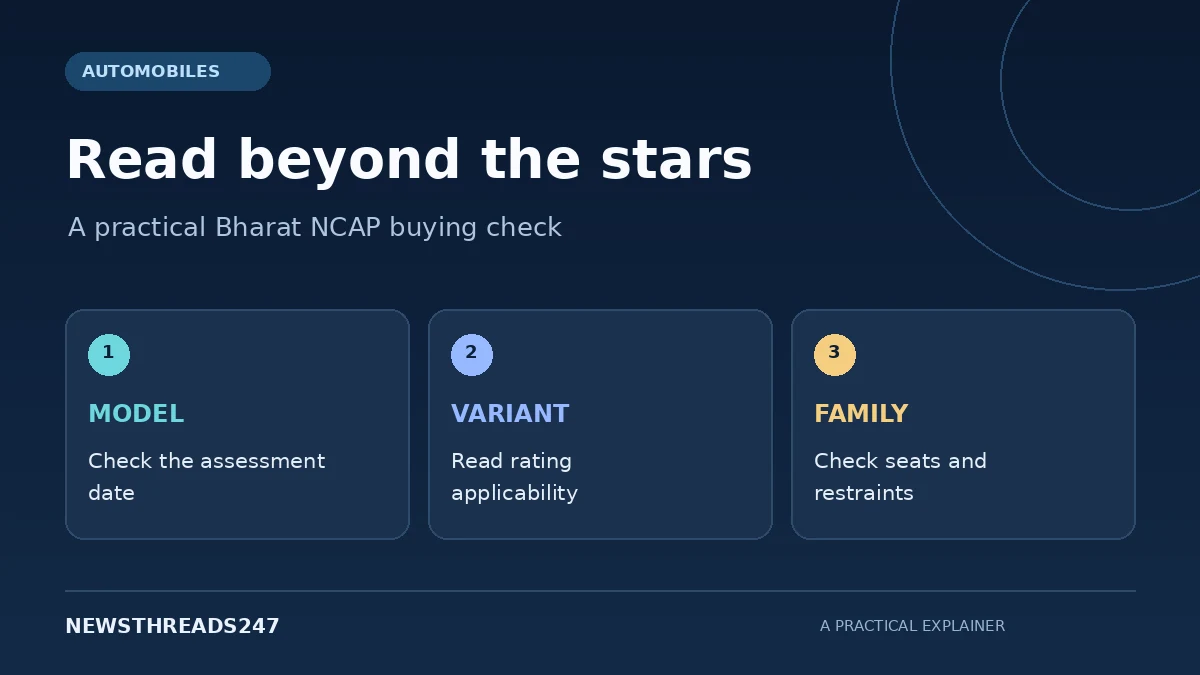
A model name can cover several engines, transmissions and trim levels. Find the report’s tested variant and its separate applicability information. The tested vehicle and the range to which the rating applies are related, but they are not necessarily the same single entry.
For example, the official Renault Duster assessment page lists tested variants, adult and child scores, safety equipment and rating applicability. This is an example of the fields a buyer should inspect, not a recommendation to buy that model.
Copy the exact variant wording from your quotation before opening the report. If you cannot confidently match the powertrain or trim, ask the dealer and manufacturer to identify the applicable entry in writing. Do not fill a gap by assuming that two cars with similar names must have identical coverage.
Assessment dates matter more than a fresh advertisement
Record the publication or assessment date and any effective model period shown on the report. A newly posted advertisement may refer to an older test. Equally, an older assessment is not automatically irrelevant: the question is whether its stated coverage matches the vehicle being sold.
If a facelift or equipment revision has occurred, look for explicit information about how the assessment applies. Changes in body appearance do not by themselves prove that a rating has transferred, and the absence of a new photograph does not by itself prove that it has not.
For readers following a launch story such as our Tata Punch facelift coverage, treat launch information and crash-assessment evidence as separate records. Recheck current specifications and official rating coverage before a purchase.
Build a comparison sheet you can actually use
| Field | Write down | Why it matters |
|---|---|---|
| Car on the quotation | Exact model, engine, transmission and trim | Prevents a model-name-only comparison |
| Assessment | Programme, date and report link | Keeps the rating in context |
| Occupant results | Adult and child outcomes separately | Avoids a one-number summary |
| Applicability | The report entry covering your variant | Confirms the scope being claimed |
| Family fit | Restraint, seating and access checks | Connects the report with actual use |
Fill the same fields for each shortlisted car. If one field is unknown, label it unknown. This is more useful than assigning a personal safety score that mixes crash results, parking cameras and convenience features without a defined method.
Check equipment without substituting a feature count for evidence
Read the manufacturer’s current variant-wise specification sheet. Ask which restraints, airbags and assistance systems are standard on the car you are buying. Do not rely on an advertisement that combines features from several variants.
A useful question is specific: “Does the quoted variant include the equipment listed here, and where is that shown in the manufacturer’s document?” A less useful question is “This has many airbags, so it must be the safest, right?” Equipment matters, but counting items does not reproduce a crash assessment.
Also read the owner’s manual for seating and child-restraint instructions. A showroom demonstration should follow the vehicle and restraint manufacturers’ guidance. If you cannot install your child restraint as required, resolve that before purchase rather than improvising a fit.
Bring your real passengers into the decision
Think about who regularly travels in the car and where they sit. If possible, take the actual child restraint and check its permitted installation with competent assistance. Look at belt access, usable seating positions and the practicality of getting passengers in and out.
For an older passenger or someone with limited mobility, entry height and door access can affect everyday usability. These are personal fit checks, not new crash-test claims. A vehicle that looks impressive on paper still needs to work for the people using it.
Discuss the final choice with all regular drivers. A shared understanding of controls, seating and the manual is more useful than assuming that an electronic feature can compensate for every mistake.
What a star rating cannot promise
Real collisions vary in speed, angle, vehicles involved, road conditions and occupant behaviour. A controlled assessment supplies valuable evidence about the tested conditions and scope. It cannot guarantee the outcome of a particular accident or make protective habits optional.
Avoid using the badge as permission to speed, ignore seat belts or fit an unsuitable restraint. The reasonable decision is to combine the best applicable safety evidence you can obtain with appropriate use and responsible driving.
Frequently asked questions
Does a model’s rating automatically cover every variant?
Check the report. Bharat NCAP publishes applicability information, and its usage guidelines restrict claims to covered models and variants. Do not assume universal coverage from the model name.
Are five stars under two programmes directly equivalent?
Not automatically. Check the programme, protocol, year and assessment scope before comparing. The same-looking stars are a summary within a testing framework.
Should I ignore a car without a published rating?
A missing report is a gap in the evidence available to you, not proof of a particular crash outcome. Acknowledge the uncertainty and seek current official information rather than inventing a rating.
Before paying the booking amount
Keep the quotation, current specification sheet and applicable safety report together. If the dealer’s claim cannot be traced to the exact report entry, resolve the mismatch first. The most useful badge is the one you have verified for the car you will actually receive.
Sources and scope
Checked on 23 October 2026: Bharat NCAP; Duster assessment and applicability page; March 2025 rating-usage guidelines. Showroom checklist and examples are editorial guidance. We have not crash-tested vehicles, endorsed a model or reproduced Bharat NCAP’s visual identity.