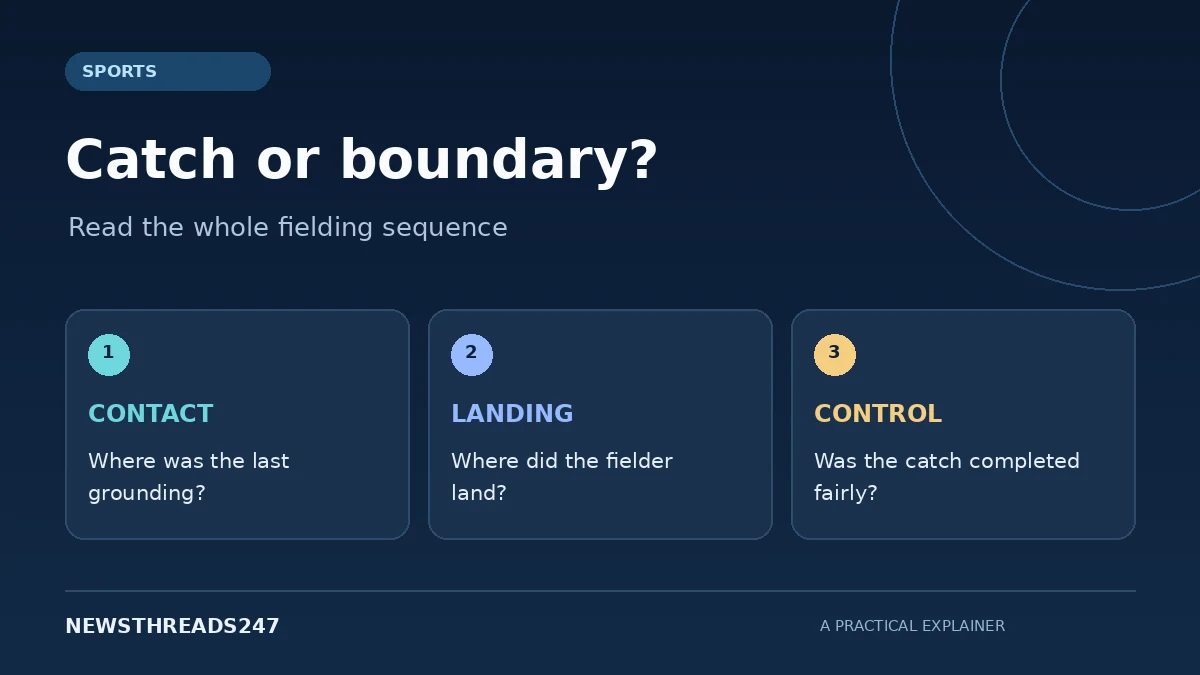
The fielder leaps, tips the ball back and a teammate finishes the catch. The crowd celebrates. Then the replay follows the first fielder’s feet—and the decision changes. Near the rope, keeping the ball airborne is only part of a lawful fielding effort.
MCC’s new Laws edition took effect from 1 October 2026. Some changes had already appeared in ICC playing conditions, which explains why viewers may remember the same restriction from international matches before October. Boundary catching is a useful example of why the date and competition rules matter.
Quick answer: A fielder’s first airborne contact must satisfy the inside-the-boundary grounding requirement. After an eligible first contact, a fielder who jumps from outside for another airborne touch must then land and stay inside until the ball is dead. Repeated outside “bunny hops” are not allowed. A catch also requires control of both the ball and the fielder’s movement.
Start with the rules for the match you are watching
MCC maintains the Laws of Cricket, while competitions can apply playing conditions that modify or supplement them. ICC publishes format-specific conditions. Before applying a new interpretation to an old clip, identify the match date and the rules used in that competition.
The ICC playing-conditions page now links October 2026 documents. For this explainer, the current men’s T20I document provides a concrete reference for the boundary and caught clauses. Do not assume that an informal local match has independently checked and adopted every international condition.
The first touch begins with the fielder’s grounding
Under clause 19.5.2 of the October 2026 men’s T20I conditions, an airborne fielder’s last ground contact before their first ball contact must have been entirely within the boundary. A player cannot establish a valid first touch simply by jumping from outside and reaching over the rope.
That is why a screenshot showing the ball above the playing area is insufficient. For the airborne first-touch question, the official also needs the earlier frame that establishes where the fielder was grounded.
What changed about the outside jump
MCC’s summary of the 2026 changes explains the removal of repeated “bunny hop” catching. After a valid first contact, the fielder gets one airborne touch after jumping from outside, then must be wholly back inside for subsequent grounding during the delivery.
The restriction also matters when the ball is sent to a teammate or back onto the field. A successful relay does not remove the first fielder’s landing requirement. Watch what that player does after releasing the ball, not only where the next catch is completed.
The ICC announced this boundary-catch change in June 2025, ahead of its inclusion in the Laws. It is therefore misleading to label every similar decision in 2026 a brand-new restriction introduced during that match.
Read the replay as a sequence
| Stage | What to watch | Common mistaken shortcut |
|---|---|---|
| Before the first touch | The fielder’s final grounding | Only checking where the ball is |
| Contact | Ball, body, rope and ground relationship | Only checking the catching hand |
| Outside airborne touch | Whether the permitted sequence is satisfied | Assuming endless hops remain possible |
| Landing and continuation | Where the original fielder next touches ground | Following only the teammate |
| Completion | Control of ball and movement | Treating the first grip as a finished catch |
Illustrative situations: what decides the outcome?
A first jump begins outside the rope
A fictional fielder is standing outside, jumps and makes their first touch while airborne. Landing inside afterwards does not repair that initial grounding problem. In a straightforward case where the ball was struck by the bat and had not bounced, the boundary outcome is six rather than a catch.
A valid first touch is followed by an outside jump and an inside landing
Suppose a fielder first touches legally, releases the ball before stepping out, then makes the permitted airborne touch from outside and lands wholly inside. That sequence can preserve a lawful fielding effort if the remaining requirements are met. The catch still needs valid completion; the jump alone does not decide everything.
A teammate catches, but the original fielder lands outside
Under the updated restriction, the relay does not make the outside landing irrelevant. The original fielder’s required return inside remains part of the sequence. This is the detail a short clip may omit by switching its focus to the teammate.
The fielder keeps the ball but touches the rope before completing the catch
Holding the ball is not a defence if the boundary conditions are breached before a catch is complete. In an uncomplicated struck-and-unbounced example, that produces a six. For a ball that has already bounced, or other scoring circumstances, apply the relevant boundary provisions rather than calling every failed attempt six.
These are teaching scenarios, not rulings on a particular disputed match. Actual incidents require the complete evidence and the applicable competition conditions.
A catch is more than a momentary grip
MCC’s January 2026 clarification following a Big Bash incident emphasises control of both the ball and the player’s own movement. It explains why touching the ball on the ground while still tumbling can mean the catch was never completed, even if the ball stayed in the hand.
This is a separate issue from the updated outside-jump restriction. One concerns where a fielder may make contact and land; the other concerns whether the act of catching has finished. Several requirements can apply to the same replay.
For a viewer, a better question than “Was it in the hand?” is “Had the player completed the catch before the ground or boundary contact?” That question helps explain why celebrations and close-up stills can be misleading.
Why old clips make arguments harder
A 2023 explanation can accurately describe a 2023 decision while being a poor guide to a match under October 2026 conditions. Preserve the original date when sharing a clip, and avoid presenting an old legal sequence as proof that a current umpire must allow the same action.
Also distinguish the actual rule from a commentator’s short summary. “You cannot go outside” is too broad; “the ball never touched the ground” is too narrow. Use the official provision to resolve which part of the sequence matters.
A useful habit for players and coaches
Review boundary awareness with an appropriately qualified coach and a safe training setup. The point is not to encourage spectacular dives near hard surfaces or spectators. Agree on the competition’s rules and explain the complete sequence before discussing a particular dismissal.
For spectators, keep the full replay and relevant clause together. It makes a disagreement more informative than a cropped frame and an accusation about the officials.
Frequently asked questions
Is every relay catch near the boundary illegal?
No. The sequence, grounding, landing and catch-completion requirements decide legality. Passing the ball to a teammate is not itself a violation.
Does the first fielder have to stay inside after the outside airborne touch?
Yes, under the updated requirement discussed here, subsequent grounding must remain inside until the ball becomes dead. The teammate completing the effort does not cancel that obligation.
Is every unsuccessful boundary catch a six?
No. Whether a boundary is four or six also depends on the ball’s path and the scoring provisions. The common six example assumes a ball struck by the bat without first bouncing inside.
Sources and scope
Checked on 23 October 2026: MCC’s implementation announcement; MCC’s major-changes summary; ICC men’s T20I conditions, October 2026, clauses 19 and 33; ICC’s June 2025 announcement; MCC catch-completion clarification. Examples are hypothetical. This article does not overturn an official match decision.