
A film has a popular star, a cheerful song and a trailer your child wants to watch again. Then the booking screen shows UA 13+. Is that a ban on younger children, a recommendation, or something different from the number shown on a streaming app?
The Ministry of Information and Broadcasting listed revised film-certification guidelines on 18 September 2026. The attention around certification is a useful reason to understand the labels families already encounter. The UA age markers themselves are not a new invention of that September listing.
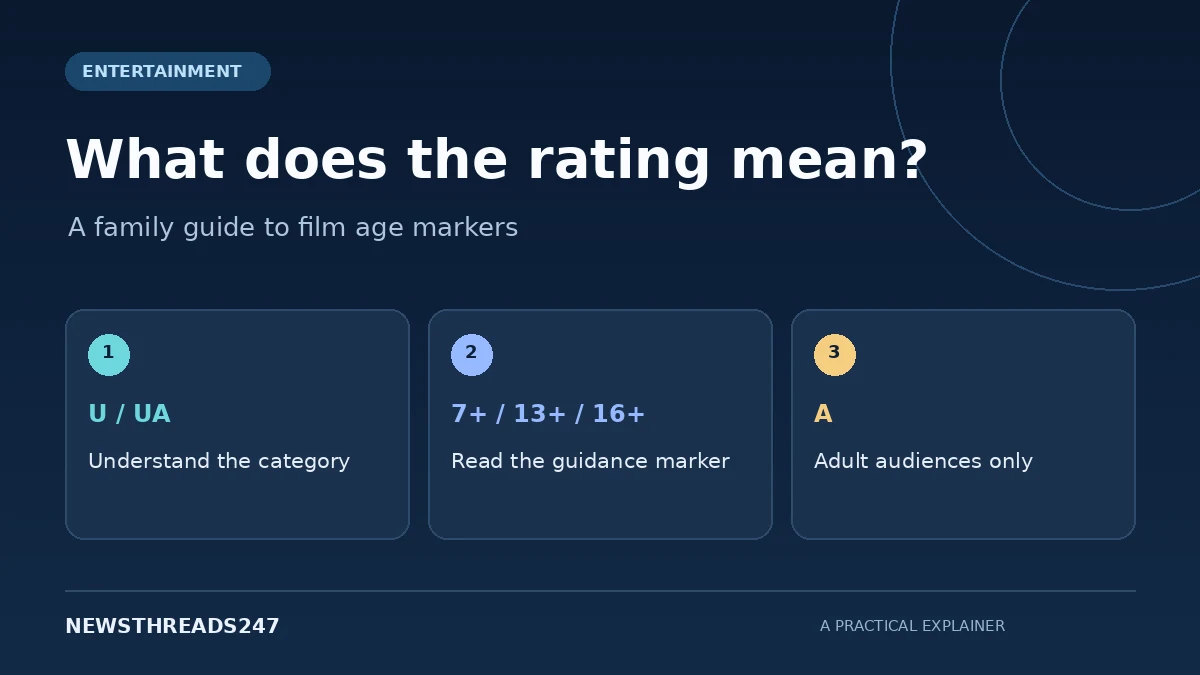
Quick answer: CBFC lists U, UA with markers 7+, 13+ or 16+, A and S. A UA marker calls for a parent or guardian’s consideration when a child is below the indicated age. It is different from A certification, which restricts exhibition to adult audiences. A rating does not tell you everything about a child’s likely comfort with the film.
Read the certificate before the review score
The Central Board of Film Certification’s current FAQ lists the categories used for certification. These concern exhibition and audience classification, not whether the film is artistically good, commercially successful or worth its ticket price.
A five-star review and a UA 16+ certificate answer different questions. One is a reviewer’s judgement of the film; the other is a classification that should inform the viewing decision. Do not substitute a high user score for checking the actual certificate.
| Label | Basic meaning | Family question to ask |
|---|---|---|
| U | Unrestricted public exhibition | Will this particular story and presentation suit my child? |
| UA 7+ | Parental consideration for children below seven | What content makes guidance relevant? |
| UA 13+ | Parental consideration for children below thirteen | Does my child need more context or a different choice? |
| UA 16+ | Parental consideration for children below sixteen | Have I checked the themes and intensity? |
| A | Public exhibition restricted to adults | Choose another film for a child |
| S | Restricted to a specified profession or class | Check the specific restricted audience |
Why a UA marker is not the same as an adult certificate
The Cinematograph (Certification) Rules, 2024 describe UA certification as unrestricted public exhibition with caution about viewing by children below the relevant marker, for a parent or guardian to consider. The rules separately describe A certification as restricted to adults.
This distinction matters when two families make different choices about a UA film. The marker gives an age-related caution; it does not establish that every child above the age will enjoy the film or that every younger child will react the same way.
Check the cinema’s current booking and admission instructions as well. Resolve uncertainty with the venue before buying tickets. Do not treat an explanatory article as permission to evade an adult restriction or a venue’s lawful checks.
A trailer is a preview, not a complete content guide
Trailers are designed to present selected moments. A light scene or a familiar actor does not establish the intensity of the full story. Look for a clear, non-sensational description of content before deciding.
Useful questions include whether the film contains sustained threat, realistic violence, frightening imagery, sexual material, strong language or emotionally difficult themes. These are questions for your own viewing research, not claims that every film with a particular marker contains every item.
If you need to avoid a specific theme, find a source that addresses that theme directly. A vague review saying “family entertainer” may not answer whether an animal is harmed or whether the plot centres on a bereavement.
Use the marker together with your child’s actual needs
A rating is one input. Your child’s response to loud sound, suspense, separation scenes or complex themes is another. Think about previous viewing experiences without assuming that an age label can predict the reaction of an individual child.
Consider a fictional family choosing a UA 13+ adventure film for an eleven-year-old who enjoys fantasy but dislikes realistic peril. The useful next step is to check the kind of threat depicted. Simply arguing that the child has already watched a long film does not answer that question.
Another family may have a sixteen-year-old who does not want to watch an intense drama. Meeting an age marker is not an obligation to watch. Choosing a different film is a reasonable outcome, even when friends are enthusiastic.
A simple way to choose without turning it into homework
Start with the exact title and language version on the booking page. Read the certificate, then consult a concise content description from a source that has actually reviewed that version. If an important point remains unclear, wait or choose a better-documented option.
Ask the child what interests them about the film. A song, character or social conversation might explain the request, and may suggest another way to enjoy that interest. This also creates space for the child to say what they do not want to see.
Finally, decide how you will handle discomfort. Agree that a child can ask to step out. You do not need to describe a film as bad or shame a child for reacting differently from the people around them.
Cinema certification and OTT labels are not one identical process
Streaming services can display similar-looking age bands, but online curated content has its own classification framework. The ministry’s background note on the digital-media rules describes age-based self-classification and access controls for OTT content. Do not assume every number on an app is a CBFC theatrical certificate.
For home viewing, check the label and content descriptors shown by that service for the exact title or episode. Review its parental controls and profile settings through its official help page. An adult profile left open on a shared television is a different problem from misunderstanding a cinema marker.
If you are paying for a streaming service, our UPI AutoPay and subscription guide explains why service cancellation and payment permission need separate attention. The viewing label and billing arrangement should each be understood on their own terms.
What to check when different websites show different ratings
First check whether they refer to the same film, language, cut and release context. A streaming label, foreign classification, old article and Indian theatrical certificate are not automatically interchangeable. Prefer the relevant official certification information and the actual provider or cinema listing.
If a listing is ambiguous, contact the venue or platform. Do not invent an explanation from a poster or assume that the most permissive label is the correct one. Keep the source and context with any rating you share with another parent.
Frequently asked questions
Does U mean every child will be comfortable?
No. Unrestricted exhibition is not a personalised promise about interest, comprehension or comfort. Check the film’s content and your child’s needs.
Can a parent’s permission turn an A film into a children’s screening?
No. A certification is an adult restriction, not a UA marker. Select a different film for a child.
Are UA 13+ and a 13+ label on an OTT app necessarily the same certificate?
No. Identify which classification process and release context the label belongs to. Similar numbers do not prove identical certification.
Choose for the evening you actually want
The aim is not to find a technical argument for watching every popular film. It is to choose a story your family can enjoy with enough information and an easy way to change course. Read the certificate, check the content and let the viewing decision reflect the people coming with you.
Sources and scope
Checked on 23 October 2026: CBFC FAQ; Cinematograph (Certification) Rules, 2024; MIB’s September 2026 guidelines listing; MIB digital-media background note. Viewing examples are fictional and family-choice suggestions are editorial guidance, not personalised developmental or legal advice.