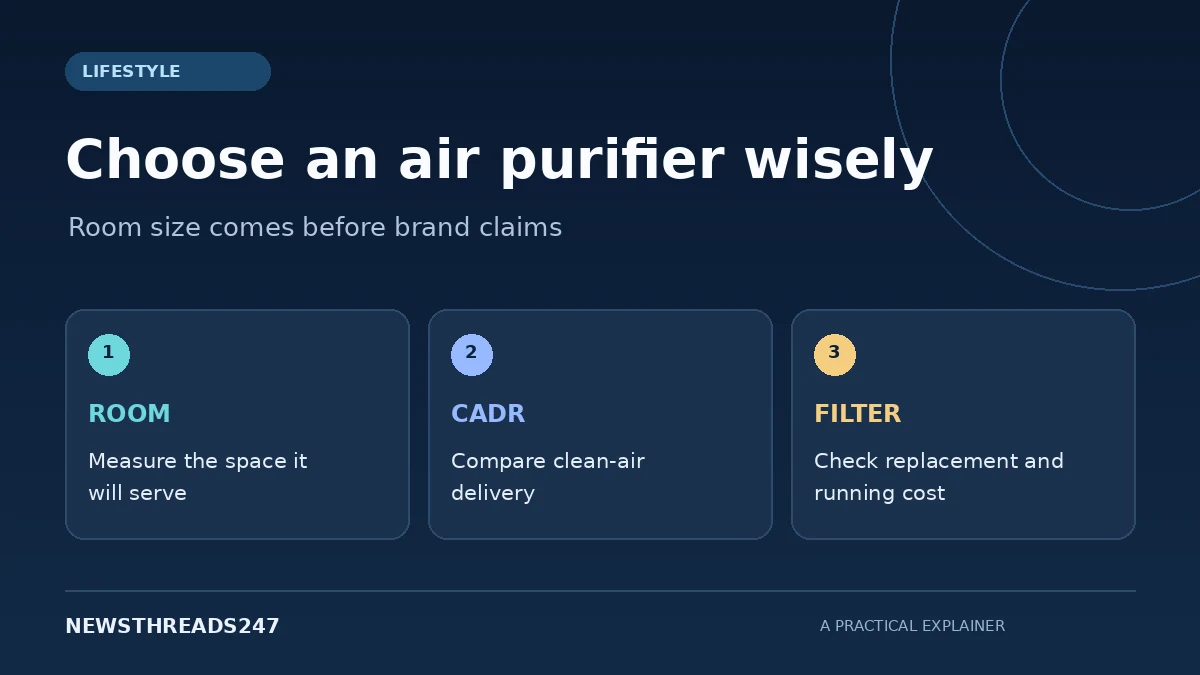
An air purifier can look like a simple purchase until the specifications arrive: HEPA, CADR, room coverage, ionisation, smart sensors and a long list of promises. The most useful starting point is less glamorous. Which room will you use it in, and can the machine clean enough air at a setting you will actually tolerate?
For households reviewing indoor-air arrangements ahead of winter gatherings, this is a more durable question than which product has the loudest discount. A suitable purifier is part of an indoor-air plan, not a reason to ignore the sources of pollution.
Quick answer: Measure the space, compare particle CADR using the same units, check the conditions behind coverage claims, and price replacement filters. Consider noise and electricity use at realistic settings. Avoid devices that intentionally generate ozone in occupied rooms. No purifier removes every pollutant or guarantees protection from illness.
Measure the space the purifier must actually serve
Write down the room’s length, width and ceiling height. If the room opens into another area that will remain connected, include that in your planning. A bedroom used with the door mostly closed and a living room connected to a hallway are different situations.
For a fictional example, a room 12 feet long and 10 feet wide has an area of 120 square feet. With a 9-foot ceiling, its volume is 1,080 cubic feet, or roughly 30.6 cubic metres. These are geometry calculations, not a prescription for the purifier a particular household needs.
Keep these measurements beside every product you compare. A headline saying “covers 500 square feet” is incomplete if you do not know its assumed ceiling height, air-change rate and operating speed.
Understand what CADR does—and does not—measure
The US Environmental Protection Agency’s consumer guide explains clean air delivery rate, or CADR, as a useful way to match particle removal to room size. Compare the same pollutant measure and units. Some specifications use cubic feet per minute; others use cubic metres per hour.
A figure of 200 cfm is approximately 340 cubic metres per hour. It is not smaller than 300 cubic metres per hour simply because 200 is the lower-looking number. Always convert or standardise units before comparing.
CADR describes particle-cleaning performance. It should not be read as a general certification that a machine removes every gas, odour or chemical. Ask which performance claim is actually being measured.
Use air changes to question the coverage claim
A theoretical clean-air-change rate can be estimated by dividing CADR in cubic metres per hour by room volume in cubic metres. For the fictional 30.6-cubic-metre room, a hypothetical 153-cubic-metre-per-hour CADR gives five equivalent clean-air changes per hour under the simplified calculation.
That example explains the arithmetic only. It does not mean five is the required target for every person or room, and it does not predict the actual pollutant concentration. Open doors, incoming pollution, placement, mixing and the speed setting can change real performance.
Ask the seller: “At what speed and air-change assumption is this room coverage stated?” If two products use different assumptions, put them on a comparable basis before judging value.
A filter label is not the whole appliance
A filter’s stated capture efficiency and the amount of air the whole purifier delivers are different things. EPA’s technical summary distinguishes efficiency from effectiveness in actual use. A good filter needs sufficient airflow and appropriate operation to help the room.
For buying purposes, ask for whole-device performance information and filter availability, not just a photograph of a filter layer. Check whether a replacement is the correct part for the exact model. A cheap machine with unavailable filters may become an expensive idle appliance.
Be careful with sweeping “kills everything” or “hospital-like air” claims. Ask what was tested, under which conditions, and whether the result concerns a filter sample or the complete device.
Check gases and ozone separately
Particle filtration and gas removal are separate tasks. EPA’s consumer guidance notes that gas-removing media such as activated carbon need an appropriate amount of material; a particle CADR does not establish gas-removal performance. Do not treat a thin dark layer in a product photograph as proof that every odour or chemical will be removed.
EPA also advises against intentional ozone generation in occupied spaces. Its air-cleaning guidance warns that ozone can irritate the airways. If a device offers an ionisation, plasma or other electronic mode, ask for clear information about emissions and whether the mode can be disabled; do not infer safety from the name.
Noise changes the value of a high maximum CADR
A purifier that is too loud to use at night may spend most of its life on a much lower setting. Ask which CADR, power and noise figures apply at each usable speed, especially if the product advertises maximum performance beside minimum noise.
For a bedroom, decide where the machine can stand without blocking movement or airflow. Think about display brightness and routine controls as well. These are usability questions you can assess without pretending to have performed a laboratory test.
If possible, obtain the manufacturer’s sound information at the intended setting and understand the return policy before purchase. A shop-floor demonstration in a noisy showroom is not necessarily a good guide to how it will sound beside your bed.
Calculate ownership cost, not only the discount
Add the purchase price, estimated filter spending and electricity for your intended use. For illustration, a machine drawing 40 watts for eight hours a day over 30 days would use 9.6 kWh. At a hypothetical ₹8 per kWh, that is ₹76.80. Your tariff, runtime and actual power can differ.
Suppose a replacement filter costs a fictional ₹2,400 and lasts six months in the conditions assumed by the manufacturer. That would imply ₹4,800 over a year at the same replacement frequency. It is an example for budgeting, not a lifespan claim about any real product.
Ask whether filters are washable, replaceable or intended for a specific cleaning procedure. Follow the model’s instructions. Do not wash a component merely because another purifier’s pre-filter can be washed.
Treat filtration as one part of indoor-air management
EPA’s overview of home air cleaning places filtration alongside source reduction and ventilation with clean outdoor air. A purifier does not make indoor smoke desirable or resolve the cause of a damp building.
Look at what is creating pollution in the room and what can reasonably be reduced. When deciding about ventilation, account for outdoor conditions rather than assuming more outdoor air is always cleaner. Seek appropriate professional help for persistent dampness or a significant indoor-air problem.
A comparison sheet for your shortlist
| Check | Record before buying |
|---|---|
| Space | Area, ceiling height and connected rooms |
| Performance | Particle CADR, units and stated operating speed |
| Usability | Noise, placement and controls at the intended setting |
| Consumables | Exact filter part, price and availability |
| Claims | Gas-removal evidence, emissions information and limitations |
| Support | Warranty, return policy and service access |
Frequently asked questions
Can one purifier clean the entire home?
Do not assume so. Portable units are generally intended for a room or defined area. Judge the actual connected space and the device’s performance, not just the number of bedrooms in the home.
Does an air purifier replace medical treatment?
No. It is not a treatment plan or a guarantee against respiratory illness. People with symptoms or specific health needs should seek qualified medical advice.
Is the highest advertised CADR always the best buy?
It is only part of the decision. Compare performance at usable settings, filter cost, room fit and support. A maximum figure is less helpful if the appliance will rarely run at that setting.
Sources and scope
Checked on 23 October 2026: EPA consumer guide; EPA technical summary; EPA home filtration overview; EPA air-cleaning and ozone guidance. This is a researched buying framework, not hands-on product testing or a brand endorsement. Numerical examples are hypothetical.