
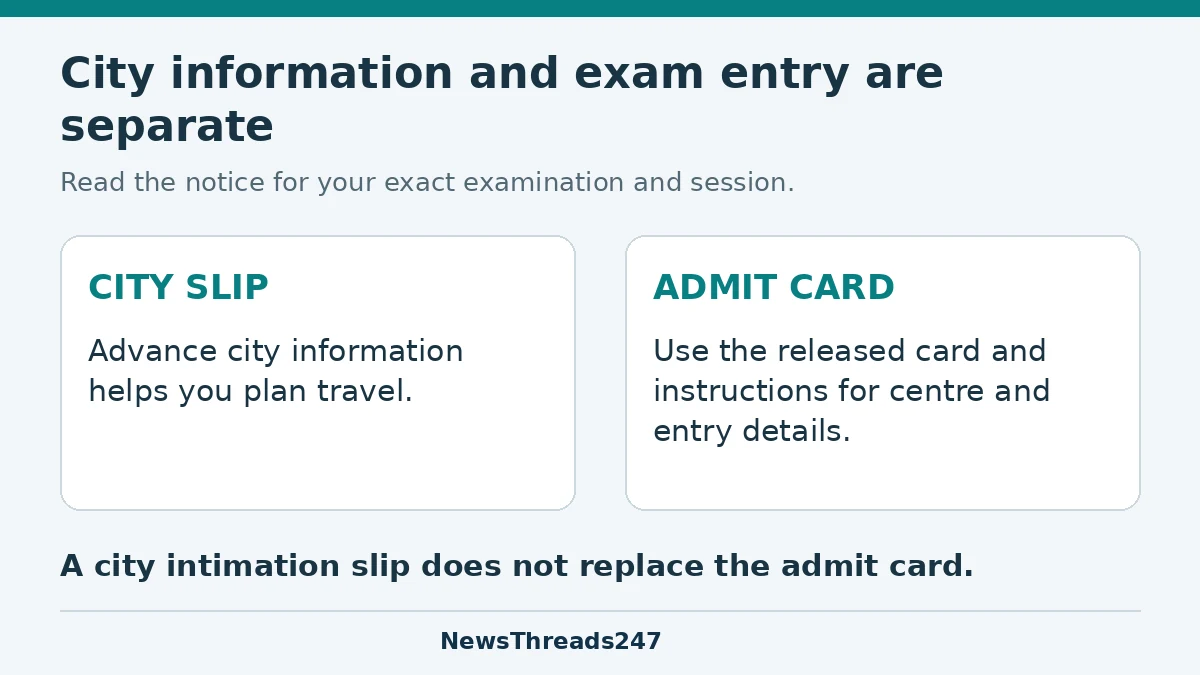
A city intimation slip tells you where to start planning your journey. It does not replace the admit card. For an examination that issues both documents, use the released admit card and the examination’s instructions to establish your allotted centre, date, shift and entry requirements.
The distinction is easy to miss when a search result labels every download an “admit card.” It can become expensive if a family books accommodation beside a guessed venue or arrives with only the advance city slip. Treat travel planning and exam-day document preparation as two connected stages.
This explainer concerns Indian examinations, with National Testing Agency documents as examples. It was checked on 24 October 2026. The dated examples below explain the process; they are not announcements of a new city-slip release, a live application window or an upcoming test date.
What the advance city slip actually establishes
An NTA notice dated 11 December 2025 for SHRESHTA (NETS)-2026 explicitly separates advance city information from the admit card. It says the slip provides the allotted examination city and that the admit card would be issued separately. Notice the chronology: the examination’s “2026” label appears in a notice issued in December 2025. A year in an exam’s name is not sufficient proof that a search result concerns a current event.
Read the heading on your own downloaded document. Is it advance city intimation, a confirmation page, an admit card or a different notice? Check the examination, session, stage and candidate details. If the document says it is not the admit card, printing it more clearly does not change its purpose.
The official NCET portal lists city intimation and admit card as separate candidate activities. Such links may remain visible after an examination is over. Their presence alone does not mean a new document has just been released or that every candidate’s document is currently available.
What to take from the admit card
The JEE (Main) 2026 information bulletin, section 5.2, directs candidates to the centre, date and shift or timing allotted on their e-admit card. It also says the card is issued provisionally, subject to the stated conditions. That makes two distinctions important: the card identifies the allotted examination arrangements, and its issue does not settle every later eligibility check.
Build your own short extraction sheet from the actual card and all accompanying instructions. Include the candidate and application details, examination name and paper, date and shift, full venue address, reporting arrangements, any gate-closing instruction, and the documents or items required. Where a field is not on the card, read the linked instructions rather than filling the gap from an unrelated examination.
Reporting time and the start of the test are different operational details. Do not calculate your arrival from the test start alone. Read whichever reporting and entry instructions apply to your session, allowing for the journey from your accommodation to the actual venue.
Plan travel without guessing the examination centre
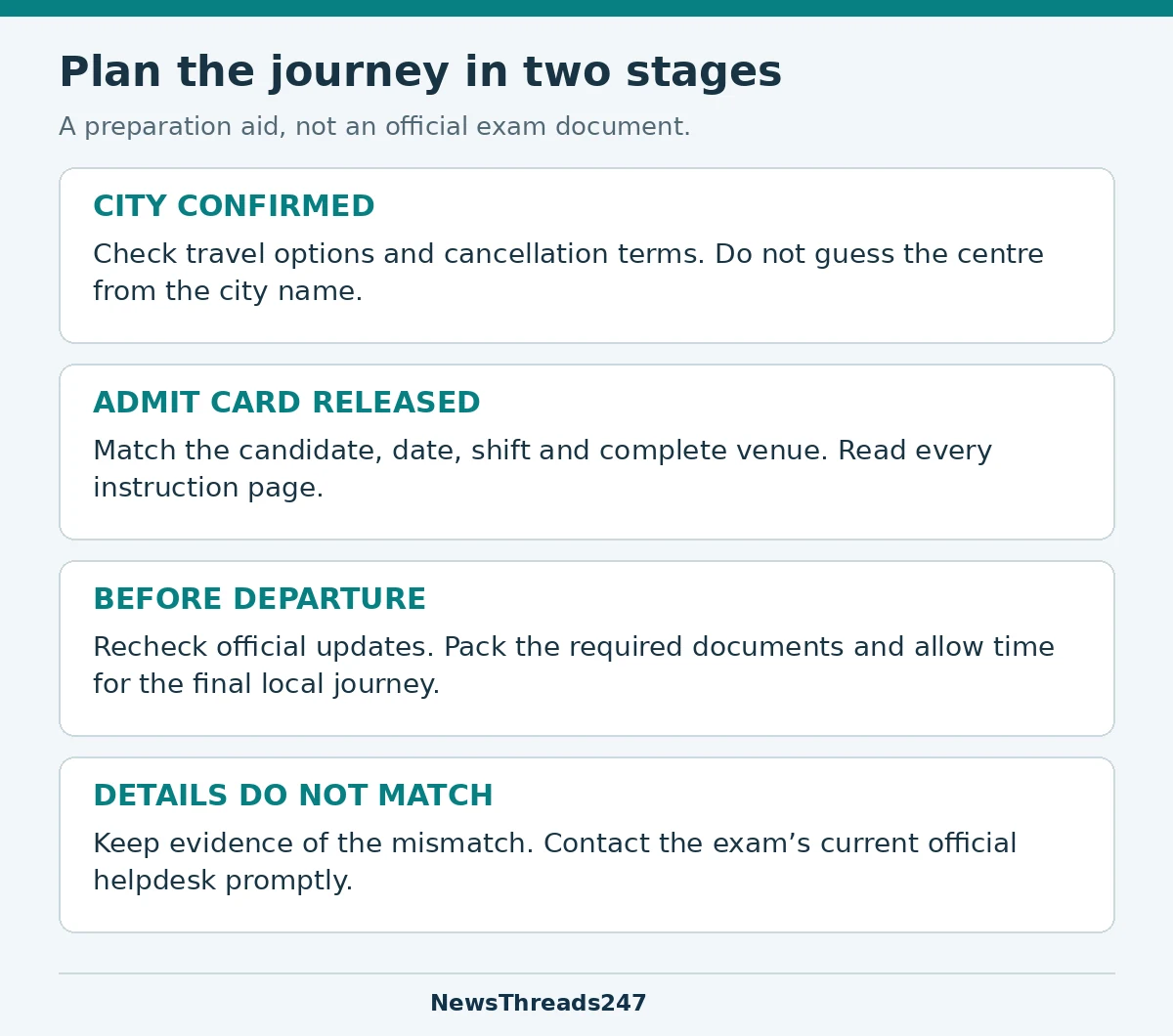
Once a city is confirmed, compare transport options, arrival times and booking conditions. If the venue is still unknown, consider how much flexibility you need before committing to accommodation. A cheap non-refundable booking beside a popular coaching centre may be poor value if the allotted venue is elsewhere.
After the admit card is released, replace the city-level plan with an address-level plan. Match the complete address, locality and centre identifier where provided. Cities can contain institutions with similar names, and a map search for an abbreviated name may show several results. A map is a navigation aid, not the authority for your allotted centre.
For a fictional example, a candidate has a train arriving at 7:00 AM and a test beginning at 10:00 AM. It is tempting to call that a three-hour buffer. But the useful calculation depends on the actual reporting requirement, station exit, local journey and time needed at the venue. Without those details, “three hours” is just the gap between two clock readings.
That example does not prescribe an arrival time or imply that a same-day train is suitable. It shows why the final local journey must be checked after the exact venue and reporting instructions are available.
Use a document checklist made for your examination
The NTET 2026 bulletin, chapter 6, illustrates how detailed the requirements can be: it specifies a downloaded admit card with the self-declaration, a photograph and an authorised original valid identification document, alongside other listed requirements. That is an example from NTET, not a universal packing list for all NTA examinations.
Read your own examination’s current list for print format, photographs, identification, permitted stationery, prohibited items and any declaration. A phone copy may help you retrieve a file, but do not assume it substitutes for a required printout or original document. Equally, do not carry additional equipment because a different exam permitted it.
- Save the complete PDF, including every instruction page, rather than only the page showing your photograph.
- Check that the printout is readable and complete. Keep the source file available in case a replacement print is needed.
- Compare the identification and photograph requirements with what you actually possess before travelling.
- If you require a scribe, accessibility arrangement or other approved assistance, check the relevant notice, approval and document requirements separately. Do not infer approval from the city allocation.
- Check the current official notices again before departure for an instruction that changes your earlier plan.
If the details are wrong, do not edit the document yourself
A wrong photograph, mismatched name, missing page or conflicting examination detail needs prompt attention through the current official helpdesk for that examination. Preserve the downloaded file and a clear description of the problem. Include the examination, session and application reference through the secure official channel, together with the relevant discrepancy.
Do not share your password, one-time code or full admit card publicly to obtain help. Do not modify the downloaded card to make it match another record. Ask the authority what to do and retain the response. The NTET bulletin expressly instructs candidates to contact NTA about discrepancies and prohibits changing entries on the card; the applicable instructions must be read for your own exam.
A concise help request is easier to handle than “my admit card is wrong.” State which field differs, what the confirmation page or other relevant record shows, when the file was downloaded and what the portal currently displays. Keep the reference number so a follow-up can be linked to the original request.
If the download is unavailable
First distinguish “not yet released for this examination or stage” from “released, but I cannot access mine.” Read the release notice and follow the link from the official examination portal. Check that you are using the correct session and the credentials requested on that particular login page; they are not identical across every exam.
For a persistent error, retain the exact message and time, check the official contact route and report the problem promptly. Avoid repeated payments, third-party “unlock” services or a promise that someone can change an allotted centre for a fee. A search result or social post cannot authorise a change to your examination arrangements.
Start from the NTA website and the relevant examination portal. Read the notice’s issue date, examination name and session before acting. The safest final check is specific: “Do I have the released card and complete instructions for my own allotted test?”
When your result is issued, a different distinction matters: a percentile is not a percentage of marks. Our NTA score explainer covers that later stage of the examination process.