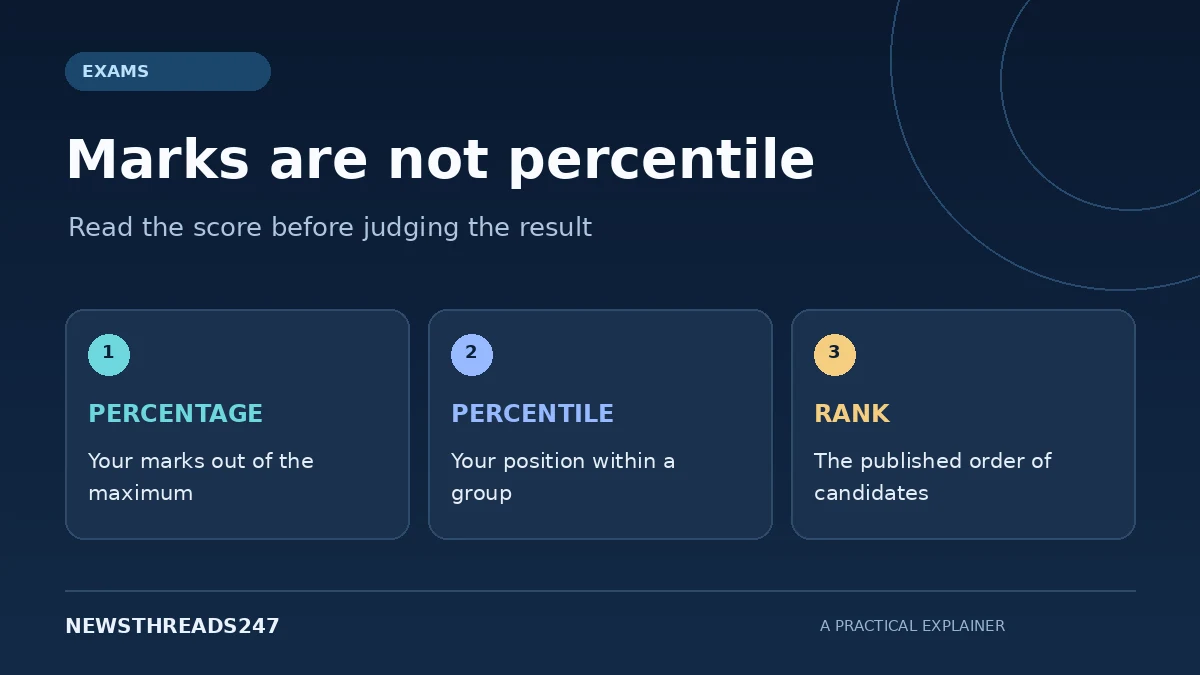
You open an entrance-test scorecard and see 95. It feels like a percentage—until someone with different marks reports a similar number. The confusion begins when one word is overlooked: percentile. It measures your position in a group, not the share of questions you answered correctly.
Quick answer: Percentage compares your marks with the maximum possible marks. Percentile compares a score with other candidates in a defined group. In NTA’s published JEE Main explanation, a candidate’s percentile uses the number of candidates in the same shift who scored equal to or below that candidate. It is not the candidate’s percentage marks, an admission guarantee or a universal rank-conversion formula.
The difference in one worked example
Suppose an illustrative test carries 200 marks and you score 150. Your percentage is 150 divided by 200, multiplied by 100: 75%. No information about other candidates is needed for that calculation.
Now suppose 1,000 candidates appeared in your shift, and 950 scored at or below your score. Under the equal-to-or-below percentile method, your percentile would be 950 divided by 1,000, multiplied by 100: 95. These figures are invented solely to explain the arithmetic, not to predict an actual entrance result.
Both statements can therefore be true for the same candidate: 75% marks and 95 percentile. The first describes marks earned; the second describes relative standing within the specified comparison group.
| Term | Question it answers | What it does not establish |
|---|---|---|
| Raw marks | What score did the marking scheme produce? | Your position across all candidates |
| Percentage | What fraction of the maximum marks did you earn? | Your percentile |
| Percentile | Where does your score stand in the specified group? | A guaranteed admission or exact rank |
| Rank | Where are you placed in the published ordering? | Eligibility for every course or seat |
Why multi-shift exams need careful comparisons
Candidates sitting different papers do not necessarily face identical questions. NTA’s published JEE Main FAQ explains percentiles within a shift, rather than calculating them by first pooling everyone’s raw marks. Its discussion distinguishes measurement of marks from statistical comparison across examination sessions.
The important practical consequence is that an online “marks versus percentile” table is an estimate unless the examination authority has published that exact relationship for the relevant population. A score that corresponded to a particular percentile in one shift or year need not do so in another.
For your preparation, raw marks can still help identify subjects to improve. For the declared result, however, read the score definitions in that examination’s own information bulletin. Do not replace the official procedure with a social-media table because its numbers look more favourable.
How the equal-to-or-below calculation works
For the illustrative method described above, use 100 × candidates scoring at or below your raw score in the shift ÷ candidates who appeared in that shift. NTA’s JEE Main FAQ describes these components. The comparison group and treatment of equal scores matter as much as the formula.
Consider a second fictional shift with 800 candidates. If 720 scored at or below a candidate’s score, the calculation gives 90 percentile. It does not tell us how many marks that candidate obtained: we would need the score distribution to know that.
If several candidates share the top raw score, each can have 100 percentile under this method because all candidates scored at or below their score. That does not automatically give all of them the same final rank. The authority’s ranking and tie-breaking rules address the ordering.
Percentile and normalised marks are not interchangeable
“Normalisation” describes a process for making results comparable; it is not a promise that every examination uses one identical formula. NTA has also published a CUET 2022 procedure involving percentile and an equi-percentile method. That is a historical example of why one examination’s score-processing method should not be assumed for another test or later year.
If your scorecard shows both a percentile and a score in marks, retain the labels when you write them down. A counselling portal asking for a particular score should receive that value, not whichever number is larger. When instructions are ambiguous, seek the authority’s clarification before submitting.
It is also unsafe to average subject percentiles and call the result your official overall percentile. Use the combined score or total that the examining body actually publishes and defines.
Why a percentile cannot guarantee your rank
Rank depends on the population being ranked and the rules used to order candidates. Session merging, multiple attempts, category lists, tie-breaks and subject combinations may matter depending on the examination. Read the applicable bulletin rather than carrying assumptions from a different test.
For a simplified intuition only, imagine 10,000 candidates and a percentile near 90. Thinking about the top tenth may help you understand relative position. It is not an exact rank calculation: equal scores, rounding and the actual ranking population can change the result. Do not enter such an estimate where an application asks for your declared rank.
A result-reading routine that prevents avoidable mistakes
First, identify the score. Write its full label alongside the number: total raw marks, normalised marks, NTA score, percentile or rank. Include the examination, year and paper so that a later comparison has context.
Next, read the official result notice. Check whether the score is provisional or final, whether a correction or grievance process exists, and which document supplies the ranking rules. Save the notice and your scorecard, rather than only a cropped image of the number.
Then check eligibility separately. Qualifying a test, meeting a board-mark requirement, becoming eligible for counselling and obtaining a seat can be separate stages. A strong percentile does not waive other conditions.
Finally, use comparisons for planning. If you examine past admissions, match the course, institution, category, quota and counselling round. A previous closing rank can inform a shortlist; it is not a commitment about the current year.
What to do if the score seems wrong
Begin with the published marking scheme and final answer key where available. Keep your response sheet and distinguish a disagreement with a marked answer from a misunderstanding of percentile. Follow only the current official challenge or grievance route and its deadline.
If you are reviewing an answer-key process, our SSC GD answer-key explainer illustrates why the response sheet, fee and objection window need to be checked together. It is not the rulebook for NTA examinations; always follow the authority conducting your own test.
Frequently asked questions
Does 99 percentile mean 99% marks?
No. Percentile is relative standing in the defined candidate group. Percentage is marks earned out of the maximum. One cannot be converted into the other without additional information.
Can the same marks produce different percentiles?
Yes, when the comparison groups have different score distributions under a percentile-based process. Consult the applicable examination method instead of assuming one fixed nationwide conversion table.
Is a qualifying cutoff the same as a college admission cutoff?
Not necessarily. An examination may have one threshold for a later stage, while institutions and counselling processes use separate eligibility and allocation rules.
Use the right number for the next decision
Your result becomes useful when you connect each number to the question it answers. Use marks to analyse performance, the official score and rank for the process that requests them, and verified admission rules to decide what to apply for next.
Sources and scope
Checked on 23 October 2026: NTA JEE Main FAQ, especially its percentile discussion; NTA’s historical JEE Main percentile explanation; CUET 2022 normalisation procedure. Numerical examples are fictional teaching examples. This is a concept guide, not a notice announcing a new result or a prediction of admission.