The message looks convincing: a company logo, a promising salary and a recruiter who already knows your name. Then comes the condition—pay a small verification charge before the interview. For a jobseeker, the difficult question is not whether employment scams exist. It is how to check this particular offer without losing a genuine opportunity.
Quick answer: Verify a job offer through the employer’s independently located careers page and contact details before paying or sharing sensitive documents. The National Career Service says its registration, applications and interview processing are free. A logo, offer PDF or listing on a familiar platform does not replace verification of the employer and vacancy.
First, separate the job from the person contacting you
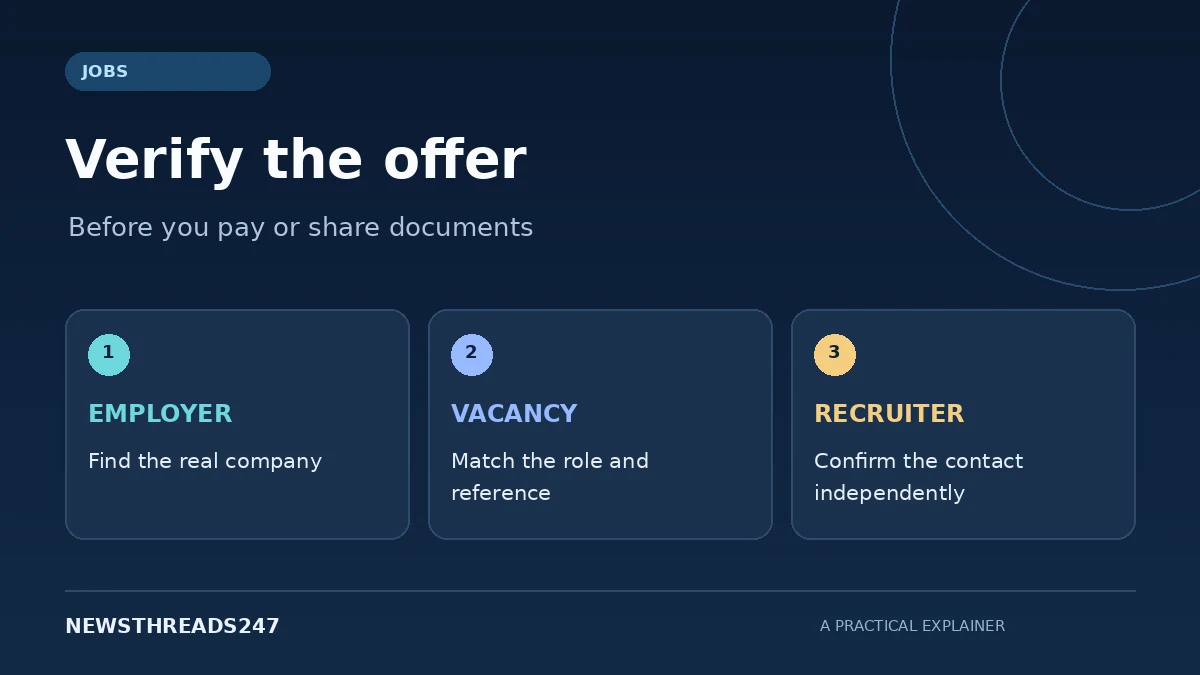
Treat the vacancy, employer and recruiter as three separate things to check. A real company may have no connection to the person using its name. A genuine vacancy may be copied into a misleading message. An authentic recruitment agency may also be impersonated.
Start with a simple note containing the role, location, employer’s legal name, vacancy reference, recruiter’s name and contact address. If the sender cannot provide these basics, do not compensate by supplying more information about yourself. Ask for a public job reference or confirmation from an independently verified company contact.
This approach is useful for freshers, experienced applicants and people returning to work. It also reduces the pressure to decide whether a polished message merely feels trustworthy.
What the official NCS warning actually says
The National Career Service portal, an initiative of India’s Ministry of Labour and Employment, warns about people and websites falsely claiming an association with NCS and using its logo. It states that NCS does not charge for registration, job applications or interview processing. Its published support routes include the helpline 1514 and support.ncs@gov.in.
That statement concerns NCS services. Do not turn it into the inaccurate claim that every examination or recruitment process in India has no application fee. A recruitment board may specify a fee in its official notification. Verify the particular notice, payment portal, category exemptions and receipt instructions directly with that recruiting body.
A practical verification sequence before you respond
1. Find the employer independently
Open a fresh browser tab and locate the organisation’s official website yourself. Use its careers or recruitment section to look for the role and reference number. Do not rely solely on a link inside the message: it may lead to an imitation page.
If the opening is not listed, that alone does not prove fraud. Some hiring happens through agencies or referrals. The useful next step is to ask the employer’s published contact or recruitment team whether the sender and opportunity are authorised.
2. Compare the details, not just the logo
Check whether the location, qualification, application method and closing date agree across the original listing and the message. A mismatch deserves an explanation. Look at the actual email address and website address, rather than only the display name.
A company-domain address is one helpful signal, not a guarantee. Likewise, a small business using an ordinary email provider is not automatically fraudulent. Independent confirmation matters more than a single visual clue.
3. Ask what each requested payment is for
Pause if the sender demands a security deposit, account activation, refundable training payment or equipment purchase before explaining the employment terms. Ask for the legal entity receiving the money, the written policy and the official channel where you can verify it.
Do not transfer money to a personal UPI ID simply because the sender says the vacancy will otherwise disappear. A deadline can be real, but it does not remove the need to establish who is collecting the payment.
4. Share documents in stages
A CV and a portfolio may be enough for an initial conversation. Before sending identity, education or bank documents, ask why they are needed, who will receive them and what stage of recruitment requires them. Send only what is relevant through the employer’s verified process.
Do not share your passwords, authentication codes or payment PINs with a recruiter. If an assessment requires software, verify it through the employer’s official instructions before installing it. A request to grant remote control of your phone or computer deserves particular caution.
How to judge common situations
A WhatsApp-only offer: Ask for the original vacancy and independent employer confirmation. Messaging apps are used legitimately, but a chat history does not establish a company relationship.
A guaranteed government appointment: Locate the recruitment notification, selection stages and issuing authority. A private contact’s assurance cannot replace the documented process.
A work-from-home task offer: Ask what work is being purchased and how payment is calculated. Stop if continuing the work requires repeated deposits, account top-ups or payments to unlock earnings.
An agency hiring for another company: Confirm both the agency and its mandate with the employer where possible. Ask which organisation will issue the contract and pay the salary. Do not assume the agency’s existence proves its connection to the advertised role.
A short message you can send to the recruiter
“Thank you for sharing the opportunity. Please send the official vacancy reference, employer careers-page link, role location and selection process. Please also confirm the employing legal entity and provide a company contact through which I can independently verify the recruitment. I will share the required documents after that confirmation.”
This is a verification request, not an accusation. Keep the exchange factual. If the sender reacts by increasing pressure, threatening a blacklist or refusing basic details, you have a reason to pause rather than rush.
If you have already paid or shared information
Act on the risk that has actually occurred. Contact your bank or payment provider through its official support channel if money has been sent. Preserve the transaction reference, recipient details, original message, website address, offer document and timeline. Do not send an additional payment to someone promising to recover the first one.
For suspected financial cyber fraud in India, report promptly through the National Cyber Crime Reporting Portal and the official 1930 helpline. Reporting does not guarantee recovery. If an account password was disclosed, change it through the service’s real website or app and review active sessions. Contact the relevant institution if sensitive documents were misused.
Keep screenshots for context, but retain original emails and attachments too. A one-page timeline—when the approach began, what was requested, what was shared and what was paid—can make a support complaint easier to understand.
Frequently asked questions
Does a job on NCS guarantee selection?
No. Access to a job-search platform is not an appointment letter. Read the employer’s requirements and verify the opportunity. Treat claims that payment can guarantee selection with caution.
Is every recruitment fee a scam?
No. Some official recruitment examinations charge application fees. The important distinction is whether the amount and collection method appear in the recruiting body’s genuine notification. NCS itself says its employment services are free.
Should I send bank details before an interview?
Ask why they are required at that stage and confirm the employer first. Payroll information may be needed during genuine onboarding, but the existence of that later requirement does not justify every early request.
What if I cannot verify the offer today?
Request more time and keep looking through independently verified channels. An unverified opportunity is a question to resolve, not a commitment you must protect by paying.
Keep this rule for the next offer
Before you give a recruiter money, sensitive documents or access to your device, obtain confirmation through a channel you found independently. A genuine opportunity should become clearer as you check it. Your next step should be based on that evidence, not on the pressure in the message.
Sources and editorial note
Sources checked on 23 October 2026: National Career Service: official service information, fraud warning and support contacts; National Cyber Crime Reporting Portal. The verification sequence and example message are NewsThreads247 editorial guidance, not a government-issued checklist. This article does not verify any individual employer or guarantee a job or financial recovery.