
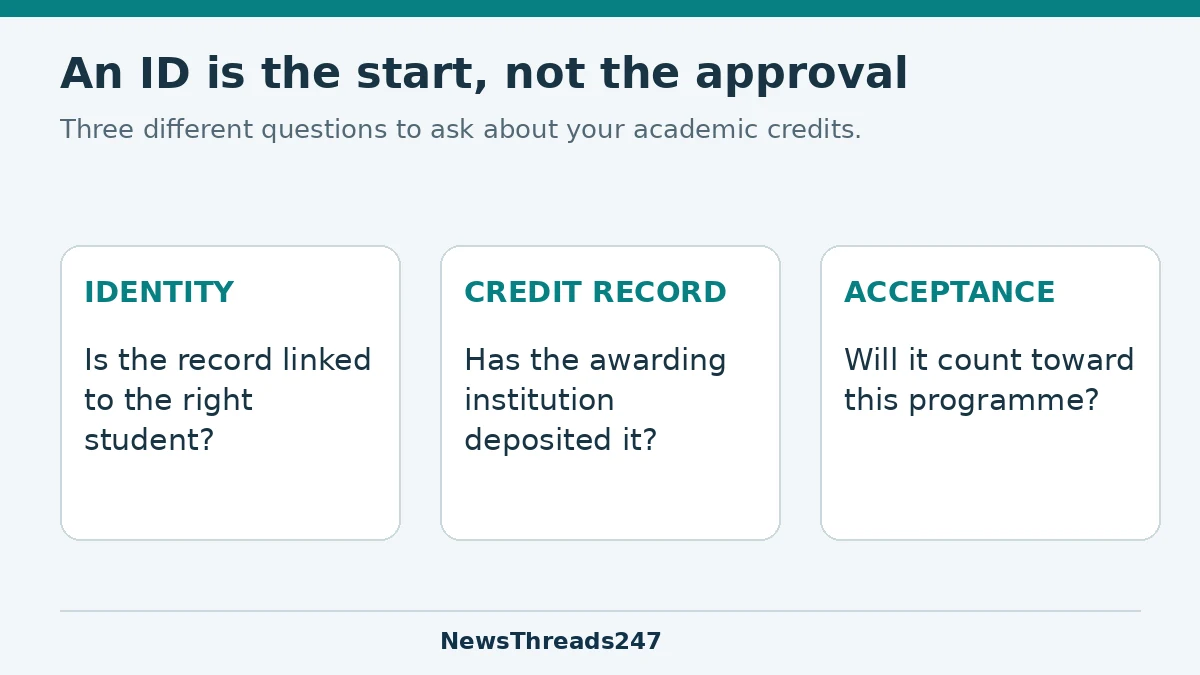
Creating an ABC or APAAR ID does not mean that a course will automatically count toward your degree. The ID helps identify the learner; the credit record shows what an institution has awarded; the institution granting the qualification still has to accept the learning under the applicable programme rules.
That distinction matters before you pay for an outside course, switch institutions or return after a break. A credit visible in an account is useful evidence, but it is not the same as a written decision that it replaces a particular degree requirement. The safest next step is to obtain that decision from the receiving institution before relying on the transfer.
This is a guide to India’s Academic Bank of Credits framework, checked against official material available on 24 October 2026. It does not establish eligibility for a specific university or imply automatic recognition by a US or other foreign institution.
What ABC and APAAR each do
The Ministry of Education’s 4 July 2026 factsheet describes ABC as the system for storing, managing, transferring and redeeming academic credits. APAAR—Automated Permanent Academic Account Registry—is the linked 12-digit student identifier. The factsheet describes the former ABC ID as renamed APAAR ID; students may therefore encounter both labels in institutional instructions.
Think of these as related parts of an academic record, rather than two competing degree schemes. The practical question is whether your institution has linked the right identity to the right learning record. Creating another identity because a credit is missing does not answer why the original record is absent.
The official APAAR terms say students should provide their identifier to the institution’s ABC nodal officer. They also say credit-course documents are accepted from the registered academic institution granting the credits, rather than directly from students. A student can flag a missing or incorrect record, but uploading a self-prepared certificate is not a substitute for the institution’s authenticated deposit.
Why the university still has a decision to make
The UGC framework reproduced in its regulations compendium preserves institutions’ powers to award qualifications and prescribe required credits and essential study components. ABC authenticates and helps manage records; it does not independently decide that an outside course satisfies every requirement of every degree.
A course can be academically worthwhile without replacing the particular subject you hoped to avoid repeating. A general introduction to data analysis, for example, might not match a programme’s laboratory component or advanced methods course. Course titles alone cannot settle the comparison. Ask about learning outcomes, level, syllabus, assessment and the programme component against which recognition is sought.
SWAYAM’s explanation of ABC makes the same distinction for online learning: the learner, host institution and parent institution participate in transfer, and the parent institution’s rules determine the actual policy. An APAAR ID helps the process; creating it is only an initial step. Do not interpret a platform’s credit-bearing label as a personal approval from your university.
Use a course-to-programme worksheet before paying
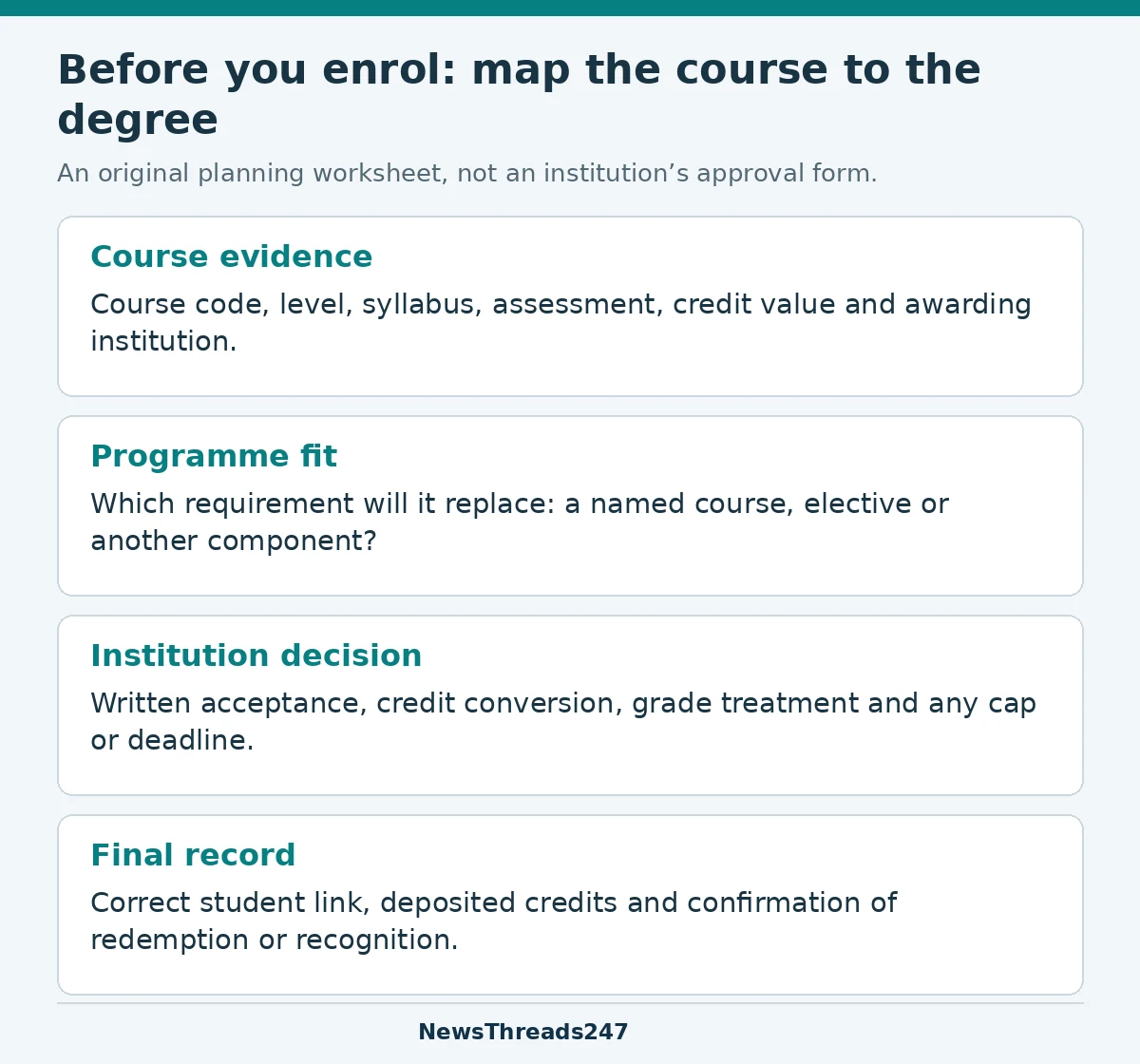
For each course, make one row in a planning sheet. Put the proposed course on the left and the requirement it would satisfy on the right. If you cannot name that requirement, you do not yet have a usable study plan.
- Record the awarding institution, course code, academic level, syllabus version, credit value and assessment method.
- Identify the receiving programme and admission cohort. Ask which named course, elective group or other requirement could be satisfied.
- Ask whether prior approval is required, which authority makes the decision, and what application deadline or document format applies.
- Request clarification of credit conversion, grade treatment, any limit on external credits, and requirements that must be completed at the degree institution.
- Keep the written decision with the syllabus and subsequent transcript. An informal assurance may leave the precise course mapping unclear.
These are planning questions, not a claim that every university uses the same form. Send them to the office named in the institution’s current policy—often an academic, examination or ABC coordination office—and ask it to identify the approving authority if necessary.
A worked example: six earned credits do not automatically replace six required credits
Suppose a fictional student, Arjun, wants to use two outside courses carrying three credits each toward a degree elective requirement. The addition is straightforward: he has earned six credits. The academic question is different: will both courses be accepted for that requirement, and at what recognised credit value?
For course A, the institution might confirm an appropriate elective match. For course B, it might ask for a fuller syllabus, find that the learning overlaps with a course already completed, or decide that it does not fit this programme. These are possible outcomes illustrating the decision, not reported decisions or universal university rules.
Arjun’s worksheet should therefore distinguish “earned at source,” “submitted for consideration,” and “accepted toward this qualification.” If only course A is accepted as three credits in this fictional example, he should plan around those three accepted credits, not the six he initially hoped to use. He should also ask whether any remaining compulsory component still has to be completed.
The useful document is the institution’s actual acceptance or rejection with reasons and course mapping. A screenshot of the account balance answers a narrower question: what is recorded there.
The seven-year limit needs careful reading
The UGC regulation’s shelf-life provision says credits have a defined validity not exceeding seven years, as specified by the awarding institution and subject to acceptance by the institution granting the qualification. That is a ceiling with conditions, not an unconditional promise that every credit will remain transferable for exactly seven years.
The same provision says credits used for an academic qualification are debited and cannot be reused for another formal qualification. Keep this separate from retaining a historical record of learning. A visible record does not mean the same credit remains available for repeated redemption.
If you are returning after a break, ask for the credit-earning date, the applicable validity rule and the receiving programme’s decision. Also ask how changes to the curriculum affect your proposed return. Do not calculate eligibility from the date you created the ID when the relevant rule concerns when the credit was earned.
Institutional policies show why a single national answer is incomplete
Dr. B.R. Ambedkar University Delhi’s published Credit Transfer Policy 2023 illustrates how an institution can specify level, time limits, conversion and approval requirements. That document, dated 20 September 2023, limits inward credits to 25% of the qualification’s requirements. It is an example from that institution’s published policy, not a national percentage or a confirmation of the rule for your current cohort.
B.R. Ambedkar Open University’s published ABC policy page provides another illustration: it describes consideration of credits from recognised learning platforms subject to its Equivalence Committee’s review. The important point is the institutional review, not an assumption that two universities with similar names share one policy. Obtain the latest applicable version before making a commitment.
If the credits are missing, identify which stage failed
Begin with the awarding institution: has it issued the result, deposited the credit record and linked it to the correct identifier? If the deposit is confirmed, retain the reference and ask the institution’s named support route to investigate the mismatch. Keep the report focused on the missing course and session rather than sending a general “ABC not working” message.
If the credits appear but the degree institution has not accepted them, the problem is no longer simply a missing digital record. Ask for the transfer application’s status, pending academic evidence and decision authority. Recreating the ID or repeatedly refreshing the account will not supply a missing equivalence decision.
A missing marksheet in DigiLocker is another related but separate issue. Our guide to finding the correct issued academic record explains why the issuing institution and document details matter. The presence of a marksheet should not be confused with approval to redeem its credits elsewhere.
Before enrolling, aim to have three things in writing: the institution’s current rule, the proposed course mapping and the decision or approval process that applies to you. That is a firmer basis for planning than an ID alone.