
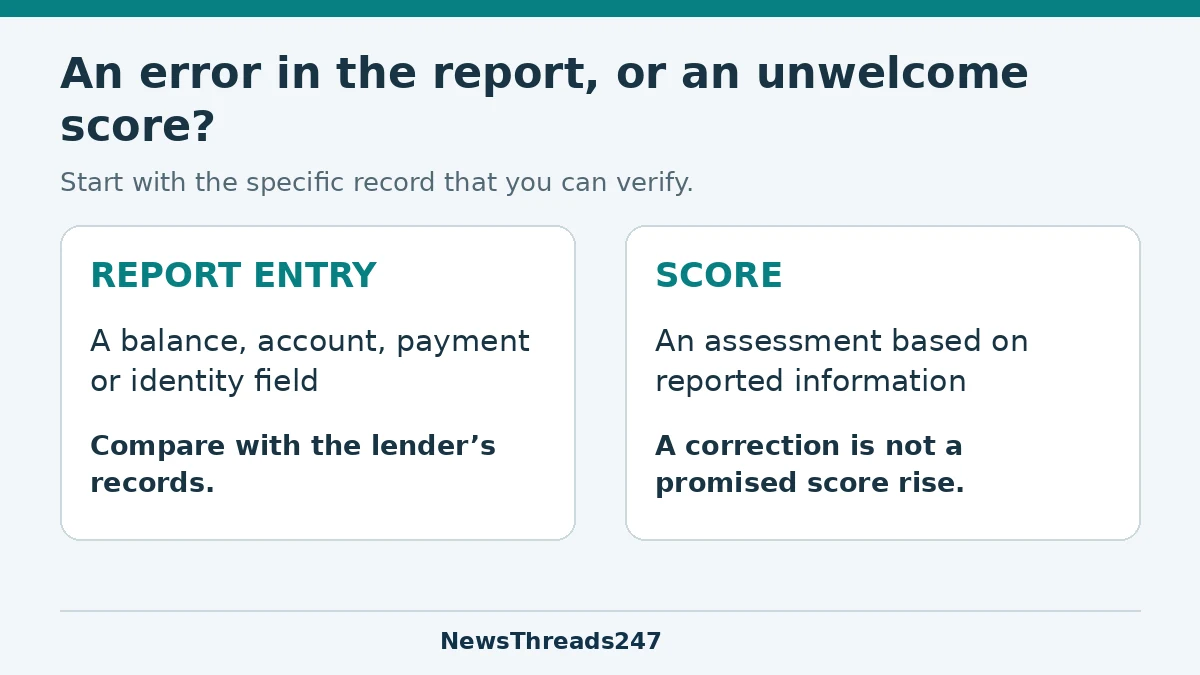
A closed loan still marked open, a repayment missing from the history or an account you do not recognise calls for a credit-report check. Start with the exact entry and the lender’s records. Asking for a higher score is much less useful than showing which information is wrong and what evidence supports a correction.
For readers in India, the practical route is to raise a documented complaint with the reporting lender and a dispute with the bureau whose report contains the error. Keep the first acknowledgement, track the response and inspect the corrected report. A correction does not guarantee a particular score, loan approval or interest rate. This guide checks the available official guidance as of 24 October 2026; US credit-report procedures are different.
Read the account before deciding it is wrong
CIBIL’s own dispute guide identifies inaccurate personal details, balances, account status, enquiries and duplicate entries as matters worth checking. It also explains two details that can initially look suspicious without being mistakes: a closed account can remain in your credit history, and a digital loan may appear under its financing bank or financial institution rather than the app’s brand.
Make two separate checks: do you recognise the borrowing relationship, and are the reported details accurate? An old account’s presence is different from an old account incorrectly showing a current balance. An unfamiliar lender name deserves verification, rather than an immediate assumption that the entry is either fraud or harmless.
Read the report’s date and the account’s last-reported information alongside your documents. A payment confirmation proves a transaction happened; it does not, by itself, explain how the lender allocated that payment or establish that every contractual amount was cleared. Ask for the account statement when the disagreement concerns the balance or payment treatment.
Build an evidence file around the disputed field
Experian’s consumer guide recommends a recent report, a specific description of the disputed account or section, supporting documents and a retained submission reference. It says a free report is available annually from each Indian bureau. Obtain the report through the bureau’s own service rather than treating a score tile in another app as the complete account record.
- For an account-status error, collect the closure confirmation and final statement, then identify the field that still says open.
- For a disputed repayment, pair the transaction reference with the lender’s statement for the relevant period. Identify the month or entry in question.
- For an identity mismatch, follow the bureau’s document requirements through its verified submission channel. Do not post PAN, Aadhaar or full account numbers in a public comment.
- For a suspected duplicate, compare lender, account identifiers, opening information and ownership. Similar balances alone do not prove duplication.
Keep one short chronology. A folder full of screenshots becomes useful when the reader can connect each document to a specific disputed fact. Retain the original files and use clear filenames; avoid editing the underlying evidence to make it look cleaner.
Send a precise request to the lender and the bureau
CIBIL’s contact and dispute FAQ directs consumers to its dispute centre and says multiple fields can be raised in a single dispute. It also says CIBIL cannot alter the credit institution’s reported records without that institution’s written confirmation. That is why contacting the lender’s official complaints channel alongside the bureau is useful.
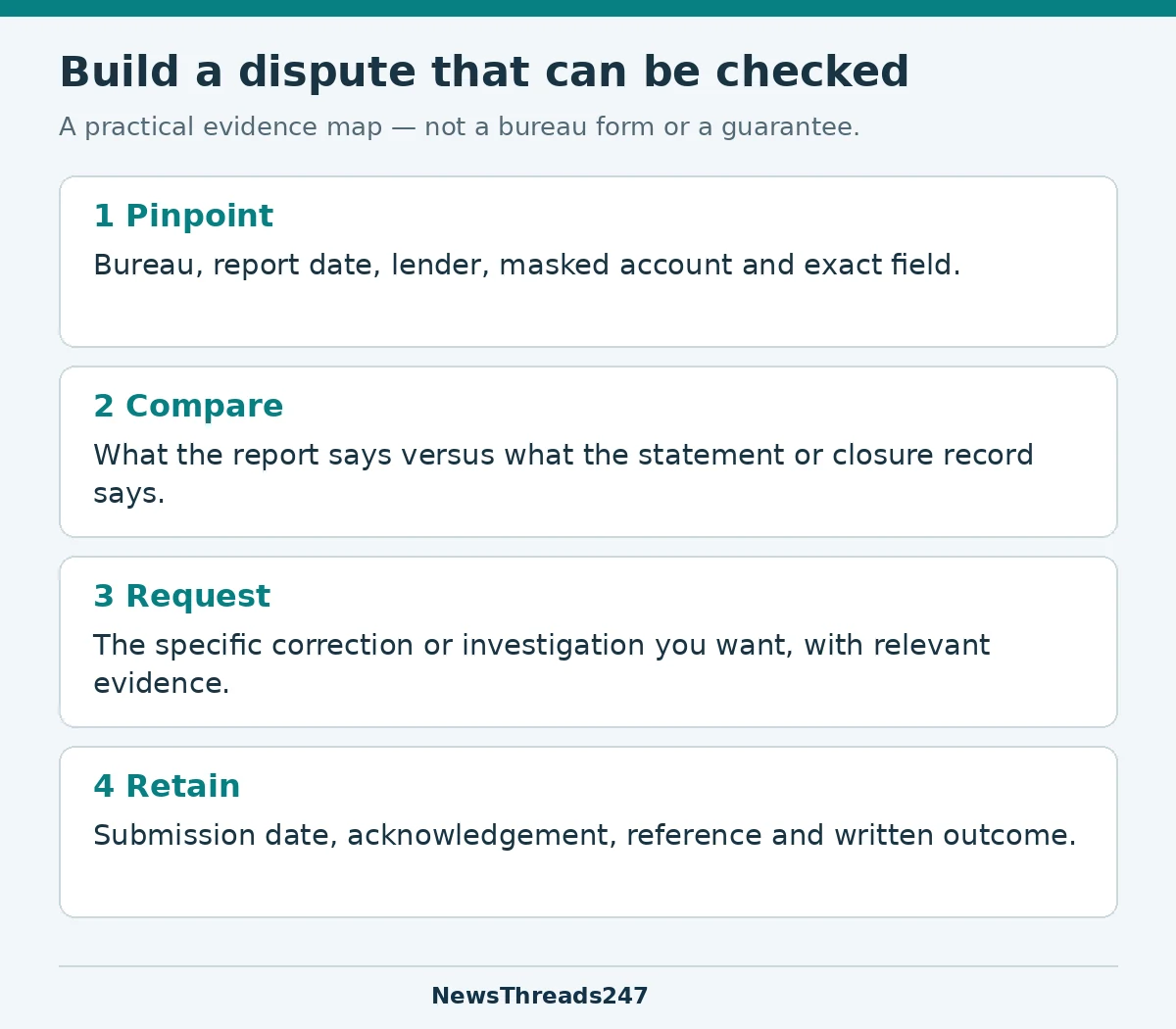
A useful request names the bureau and report date, identifies the lender and account through the secure form, describes what the field currently says, explains the discrepancy and states the requested investigation or correction. Include the earlier lender reference if one exists. Ask for a written response identifying the action taken, rather than relying on a telephone assurance.
Use the bureau named on the report. A CIBIL dispute is not a universal form for a report issued by another bureau. Experian’s official consumer-services page, for example, has its own dispute and grievance routes. Verify contact details there instead of using a number supplied by an unsolicited caller.
A worked example: a loan is closed, but the report says open
Consider a fictional borrower, Meera. Her lender’s closure letter identifies the loan and confirms closure, while a later credit report still labels that account open. Her first request should not be “delete my entire credit history” or “increase my score by 50 points.” It should ask the lender and bureau to investigate the account-status mismatch against the attached closure record.
She prepares a four-line comparison: the report date; the masked account identifier; the current status shown in the report; and the closure date stated by the lender. She adds the letter and final statement as separate attachments, saves both acknowledgement numbers and keeps the submission date in her chronology.
If the response says the account has been updated, she checks a newly issued report for that particular field. If the account remains in the historical list but is correctly closed, that is not the same as an unresolved open-status error. If a balance still appears, she asks specifically about that remaining discrepancy rather than sending the identical original complaint again.
The example is an editorial illustration of how to frame evidence, not a prediction of a bureau’s decision. The right correction depends on the actual records.
Routine reporting has its own timetable
The RBI’s 4 December 2025 amendment, effective 1 July 2026, requires reporting against reference dates of the 9th, 16th, 23rd and month-end. The month-end full file is due by the 5th of the following month. Incremental submissions for the three other dates are due within four calendar days; bureaus must ingest qualifying files and share rejection reports within three calendar days of receipt.
These are reporting and processing requirements, not a promise that a payment immediately changes every score displayed by every app. They are also separate from the complaint-resolution clock. When following up, ask which reporting reference date covered the change, whether the file was accepted and what the resulting report now shows. Avoid relying on an undated “wait 30–45 days” message as the entire explanation.
Understand the 30-day complaint framework
CIBIL’s current compensation page describes an overall 30-calendar-day period from the initial complaint to the lender or bureau, with ₹100 per calendar day of delay beyond that period where the framework applies. Its explanation divides responsibility into 21 days for the credit institution and the remaining nine for the bureau; these are parts of one overall period, not two consecutive 30-day allowances.
The page also distinguishes an unsatisfactory answer from a delayed answer: disagreement with a timely resolution alone does not establish delay compensation. Keep the acknowledgement and final response so the timeline can be assessed. Use only the verified complaint form for any payment details requested under the framework.
The RBI’s original compensation framework lists exclusions, including disputes about credit-score computation or the score model, certain matters covered by Section 18 of the credit-information law, commercial or internal-administration matters, and cases decided by or pending before other forums. A factual report correction and a challenge to the scoring model therefore need to be distinguished. Do not assume that every credit-related complaint qualifies.
Check the result, then decide what remains unresolved
Compare the response with the actual disputed field. Has the status changed? Is the relevant payment history corrected? Was the request rejected, and was a reason supplied? Save the new report alongside the original so a later follow-up can show what changed and what did not.
If you need to escalate, use the lender’s and bureau’s current published grievance process. Experian’s consumer-services page separates initial support from escalation contacts. Check the current eligibility and filing instructions for any further external complaint route rather than assuming every unresolved query belongs in the same forum.
Credit-report disputes are also separate from stopping future payment instructions. If that is your other problem, our UPI AutoPay guide explains how to review a mandate without confusing it with the underlying bill or borrowing agreement.
The aim is an accurate record and a traceable response. Nobody can responsibly promise a fixed score increase from deleting or changing one entry. This article provides general consumer information, not individual lending or legal advice.