
The striker is beyond the defensive line, the crowd shouts “offside”, and play continues. That can be correct: being in an offside position is not an offence by itself. The decision also depends on the relevant moment and whether the player becomes involved in active play.
For viewers in India and the United States, the most reliable way to follow the association-football rule is to ask two questions in order: where was the player when a team-mate played or touched the ball, and what did that player do next? The goalkeeper is often the last opponent, but the law refers to the second-last opponent, not a fixed number of outfield defenders.
Freeze the correct moment
Under IFAB’s current Law 11, an offside position concerns the head, body or feet being in the opponents’ half and nearer the opponents’ goal line than both the ball and the second-last opponent. Hands and arms do not count, including a goalkeeper’s. Being level with the second-last opponent or the last two opponents is not an offside position.
For an ordinary kicked pass, look at the first point of contact when the team-mate plays or touches the ball, not the moment the receiver collects it. The law specifies a different contact point for a goalkeeper throwing the ball: the last point of contact. That exception matters when reading a freeze-frame or a simplified social-media explanation.
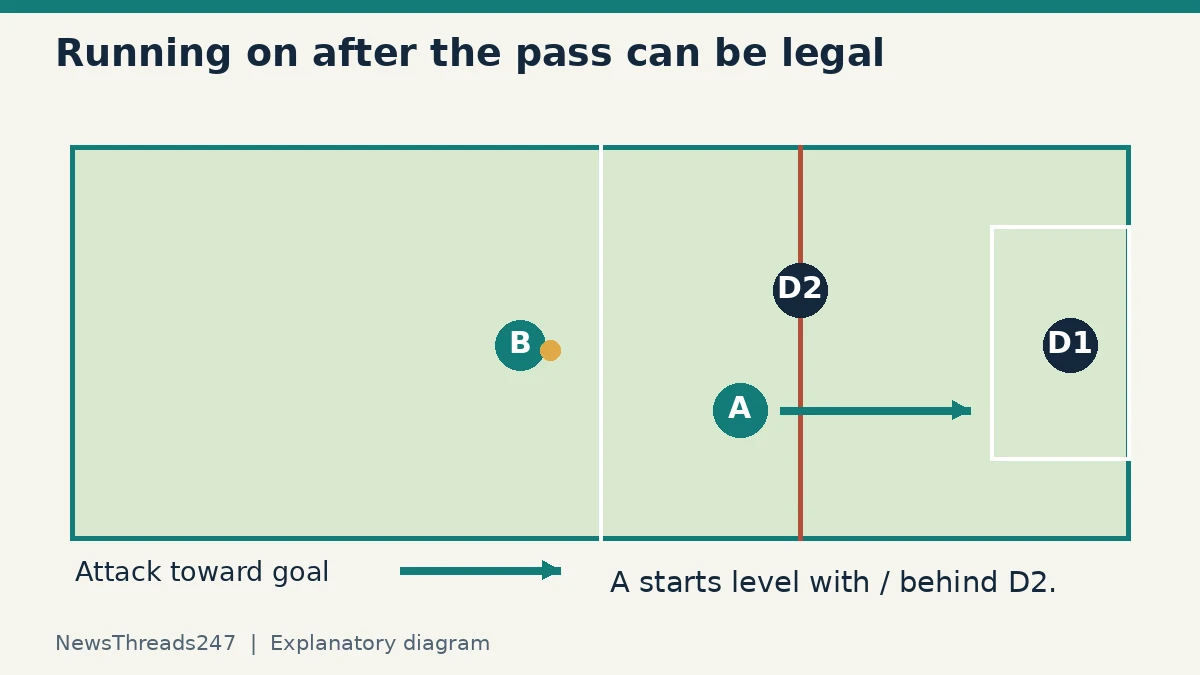
A forward can start onside, run beyond opponents and receive the pass nearer goal without having committed an offside offence merely because of that later position. Conversely, running back towards the ball does not automatically remove an earlier offside position at the relevant team-mate touch.
The ball is a reference too
A diagonal defensive line often attracts all the attention, but the ball also matters. An attacker must be nearer the goal line than both the ball and the second-last opponent to meet that part of the position test. A team-mate behind the ball at the relevant touch does not become offside simply because few defenders remain between them and goal.
In a fictional two-player attack, the ball carrier reaches a position nearer the goal line than the supporting attacker and passes across. If the supporting attacker is not nearer the goal line than the ball at the relevant moment, that position does not satisfy the offside-position test. Do not decide the case by counting defenders alone.
The pitch diagram below the title is a simplified position example, not footage, tracking data or a claim about a real match. It isolates the ball and second-last-opponent references so the sequence can be understood without camera perspective.
Position becomes an offence through involvement
The Football Association’s Law 11 explanation separates position from involvement. Playing or touching the ball is one route to an offence. Interfering with an opponent can also matter, so “they did not touch it” does not settle every decision.
An attacker who clearly obstructs a goalkeeper’s line of vision can interfere without making contact with the ball. Challenging an opponent, clearly attempting to play a nearby ball with an impact on an opponent, or an obvious action that clearly affects an opponent’s ability to play it can also be relevant under the law.
Apply that carefully rather than treating mere presence as interference. A player standing away from the play, with no relevant effect, is not automatically penalised just because the camera shows them beyond the line. To understand a decision, watch the goalkeeper and nearby defenders as well as the ball’s final path.
A defender’s touch is not an automatic reset
One of the most misleading shortcuts is “it touched a defender, so the attacker is onside”. The law distinguishes deliberate play from a rebound or deflection, and treats a deliberate save separately. The character of the opponent’s action matters, not simply the fact of contact.
IFAB’s 2022 clarification explains deliberate play in terms of control with the possibility of passing, gaining possession or clearing. An inaccurate attempt can still qualify. Its considerations include distance, speed, an unobstructed view, the expected direction and time to coordinate movement. That historical clarification supports the distinction; it is not a newly announced October 2026 change.
Imagine two illustrative sequences. In one, a defender has time to read a long ball and attempts a controlled clearance but misdirects it. In another, a fast ball strikes an outstretched leg during an instinctive block from close range. They should not be declared identical because both involve a defender touching the ball. The official must assess the action against the law’s criteria.
A save is a separate exception
Receiving a ball from an opponent’s deliberate play does not have the same effect when that action is a deliberate save. A save is an attempt to stop a ball going into, or very close to, the goal, as defined by the law. It is not limited to a goalkeeper’s hand.
A player who was in an offside position when a team-mate shot can commit an offence by playing the rebound from a save. The same broad issue arises with a rebound from a goalpost or crossbar. The attacker does not get a fresh clean position simply because the ball has changed direction after the shot.
For a replay, identify the team-mate’s shot, the attacker’s position at that moment and the nature of the subsequent contact. Avoid jumping directly to the frame in which the attacker taps the ball in. That final frame cannot explain the whole sequence.
The restart exceptions depend on “directly”
There is no offside offence when a player receives the ball directly from a goal kick, throw-in or corner kick. A free kick is not on that list. The word directly matters: a short corner followed by another team-mate’s pass creates a new moment to assess.
IFAB’s published examples explain that the corner taker can be offside when receiving a return pass, even though receiving the original corner directly would be exempt. For viewers, this is a useful way to avoid the claim that an entire attacking move following a corner is immune from offside.
The restart exception does not erase other possible offences. A foul, handling offence or another breach still needs its own assessment. This guide focuses on Law 11 rather than providing a universal answer to every incident surrounding a goal.
A better way to read a disputed replay
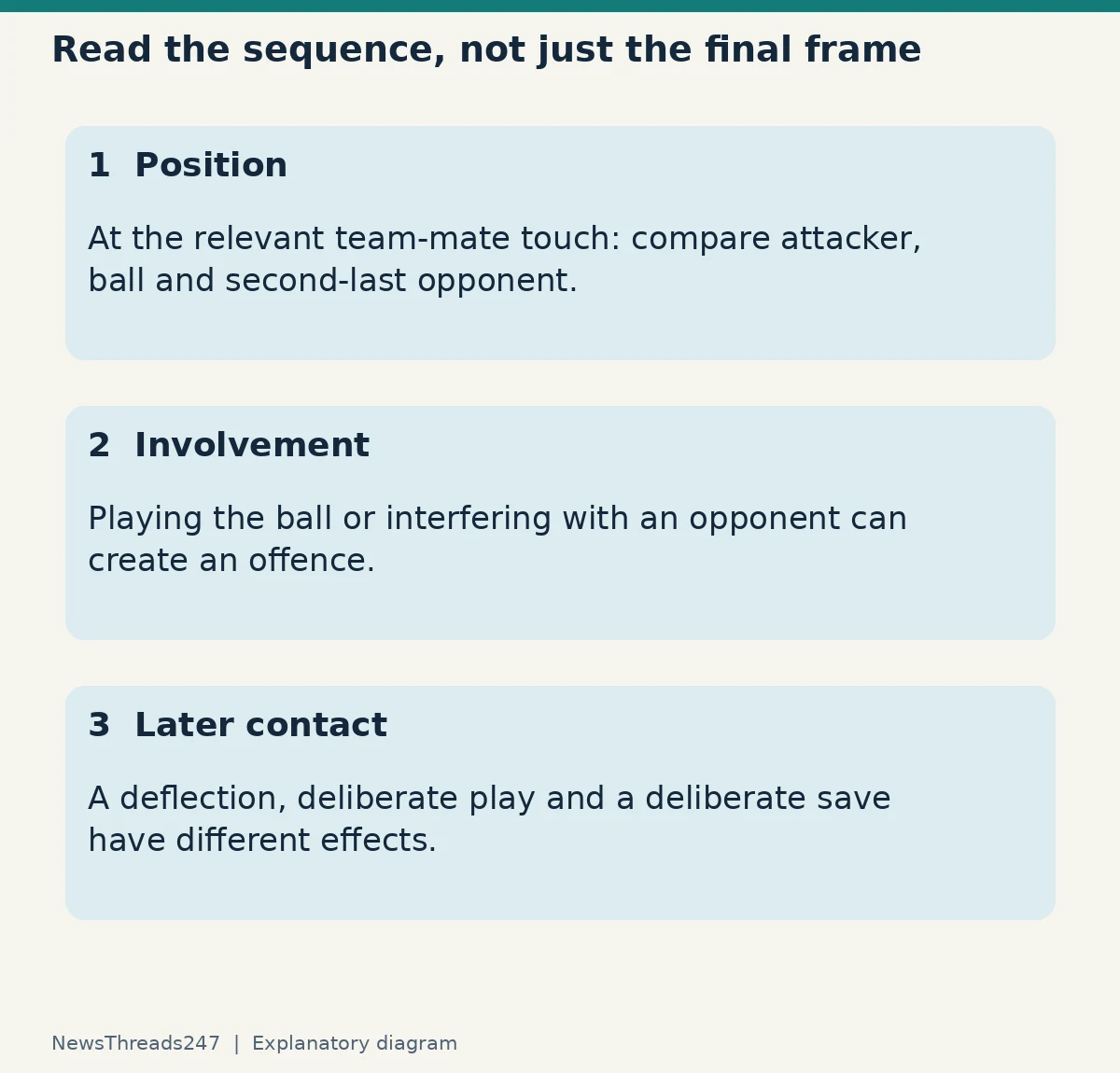
First establish the team-mate touch and correct contact point. Next identify the ball and second-last opponent, then the relevant parts of the attacker’s body. Finally watch the involvement and any rebound, deliberate play or save. If the broadcast does not show enough, keep that uncertainty rather than drawing a definitive conclusion from a cropped still.
Sources and scope
The explanation follows the current IFAB Law 11 and the FA version available on 25 October 2026. Trials and competition-specific technology procedures should not be assumed to replace the published rule everywhere. Our DRS Umpire’s Call guide covers a different sport, but likewise separates the actual rule from what a television graphic appears to suggest.