
The meal is over, but a deep pot of food stays on the counter because someone is waiting for it to cool completely. That habit can leave perishable food at unsafe temperatures longer than expected. Divide leftovers into smaller, shallow containers and refrigerate promptly; do not make a cold-to-the-touch pot the condition for putting food away.
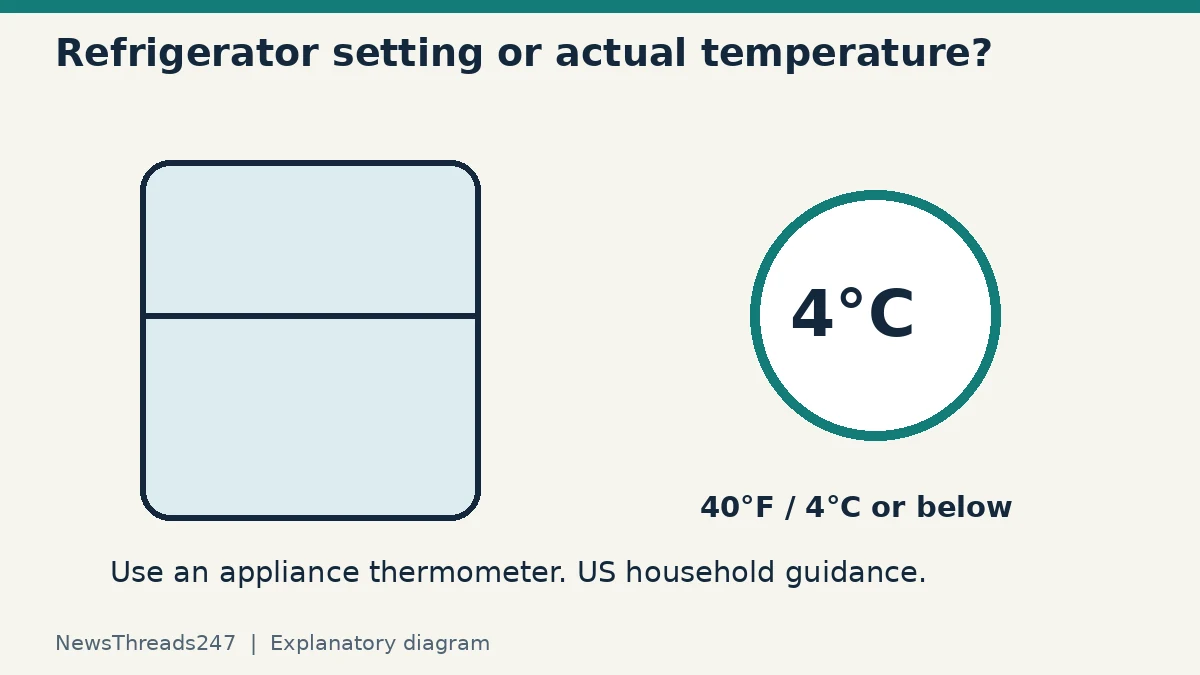
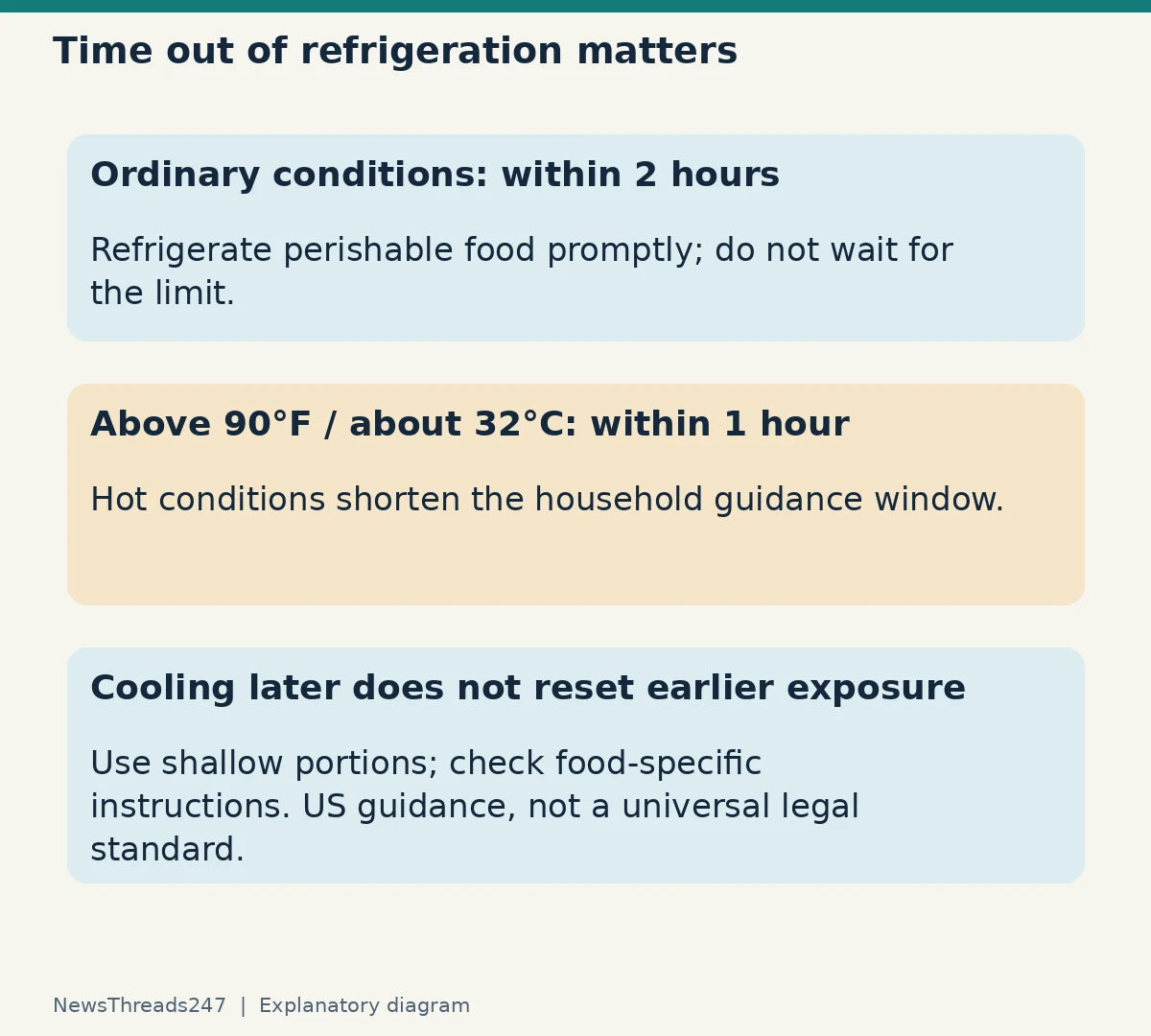
US FoodSafety.gov advises refrigerating perishable food within two hours, or within one hour when exposed to temperatures above 90°F, approximately 32°C. Its household guidance sets the refrigerator at 40°F, approximately 4°C, or below. Those are US guidance values used in this article, not a claim that every country has identical food-business regulations.
For households in India as well as the US, the practical problem is familiar: food can spend time cooking, on a table, in a vehicle and waiting to be packed. Keep track of the time it is not being held safely hot or cold. Refrigeration later does not erase an earlier long spell on the counter.
Start the clock with the meal, not the washing-up
FoodSafety.gov’s four-step guide says not to leave perishable food out for more than two hours, with the shorter limit in hotter conditions. If food is being kept for service, safe hot or cold holding requires the appropriate temperature; a pot that merely feels warm is not a measured holding method.
A useful household plan is to set aside the portion intended for another meal early, with clean utensils, rather than leave the entire batch on the table through a long gathering. Keep the serving portion manageable and return stored food to refrigeration promptly. Avoid adding a fresh batch to an older dish whose time history is unclear.
In an illustrative timeline, a dish leaves safe hot holding at 7 pm and is still on the table at 9:30 pm in ordinary room conditions. Putting it into a fridge at 9:30 does not make that earlier two-and-a-half-hour period disappear. Do not reinterpret the two-hour guidance as a target to use up or a guaranteed safe period for every food and circumstance.
Why the shape of the container matters
A large deep mass loses heat differently from smaller portions with more exposed surface. The US Food and Drug Administration recommends dividing large amounts of leftovers into shallow containers for quicker cooling. This gives you an immediate practical change that does not require guessing how long the centre of a large pot will remain warm.
Use clean, food-safe containers and allow space for cold air to circulate in the refrigerator. Do not cram a large amount of hot food into an already overloaded fridge and assume the control dial proves everything inside is cold. Follow the appliance’s guidance and use an appliance thermometer to check the actual temperature.
Container size, quantity, food and appliance performance all affect cooling. The timing limits in this guide are not predictions of how many minutes a particular batch will take to cool.
A dial setting is not a temperature reading
A fridge control labelled “3” or “medium” is not necessarily showing degrees Celsius. Use an appliance thermometer and check the manufacturer’s instructions for its placement and use. FoodSafety.gov recommends 40°F/4°C or below for the refrigerator and 0°F/−18°C or below for the freezer.
If the appliance is not keeping food cold, solve that problem before treating it as reliable storage. A container that was put away on time can still be affected by an extended loss of refrigeration. A power-cut assessment is a separate question; do not apply the simple counter-time example as a complete guide to every outage.
For a shared household, make the storage method visible and easy to follow. Put date labels where they can be read, keep older appropriate leftovers accessible and avoid a hidden stack that nobody remembers. A small system that everyone uses is more useful than a complicated log left blank.
What to write on a leftover container
Record the food, cooking or preparation date and intended use. If relevant, note that a portion was frozen. Avoid labels such as “Tuesday” without a date when the container might remain longer than a week. A label helps you interpret the history; it cannot certify food that was mishandled before storage.
US FoodSafety.gov’s leftovers advice recommends using or freezing properly handled leftovers within four days and reheating to an internal 165°F/74°C. Food-specific guidance or package instructions may call for a different or shorter storage plan. The four-day advice should not become a blanket permission to keep every prepared food for that long.
Authorities can give different conservative household storage windows. Health Canada, for example, advises eating refrigerated leftovers within two to three days or freezing them. Choose the applicable guidance for your food and location rather than mixing the longest limit from one source with the least restrictive instruction from another.
Reheat the portion you need thoroughly
Use a food thermometer to establish the internal temperature rather than relying only on steam at the edges. Follow the reheating method appropriate to the food. In a microwave, stir where appropriate, follow standing-time instructions and check for uneven heating; a hot bowl does not prove every part of its contents is hot enough.
FoodSafety.gov’s guidance is to reheat leftovers to 165°F/74°C. Reheating is part of safe handling, not a way to rescue food whose time or storage history makes it unsafe. If a dish was forgotten overnight at room temperature, do not use a quick boil or a stronger spice mixture as a reason to keep it.
Plan smaller portions for reheating. Apart from making the meal easier to manage, this reduces repeated handling of food you do not intend to serve. Return the stored portion to its appropriate conditions rather than leaving it out while the reheated portion is eaten.
Smell can warn you, but it cannot clear the food
A bad smell, visible mould or an unusual appearance is a reason to reject food. The absence of those signs is not proof of safety. Health Canada explicitly warns that you cannot determine contamination reliably by looking, smelling or tasting. Do not taste a doubtful dish to decide whether to serve it. If the room still smells musty after spoiled food has been discarded, investigate damp walls and household mould separately.
If you cannot establish when a perishable food was cooked or how long it spent unrefrigerated, be cautious and discard it rather than inventing a reassuring history. This is especially relevant to food brought home from gatherings, where the journey may be only one part of its time outside controlled storage.
A practical routine for the next meal
Before cooking a large batch, clear refrigerator space and find suitable containers. At serving time, decide what will be stored. Portion and refrigerate promptly, label the date, and plan when the food will be eaten or frozen. Before reheating, check its storage history and use an appropriate thermometer and method.
Sources and scope
This guide uses the US and Canadian household sources linked above, checked on 25 October 2026. It offers food-handling information, not a diagnosis or a substitute for food-specific instructions. Commercial kitchens and special situations require their applicable rules; the examples here describe ordinary household decisions.