
An old passbook turns up while a family sorts its records. The branch has moved, the account has not been used for years and nobody knows whether the money is still there. RBI’s UDGAM portal can help search for eligible unclaimed bank deposits across participating banks. It does not itself settle the claim or transfer the money to you.
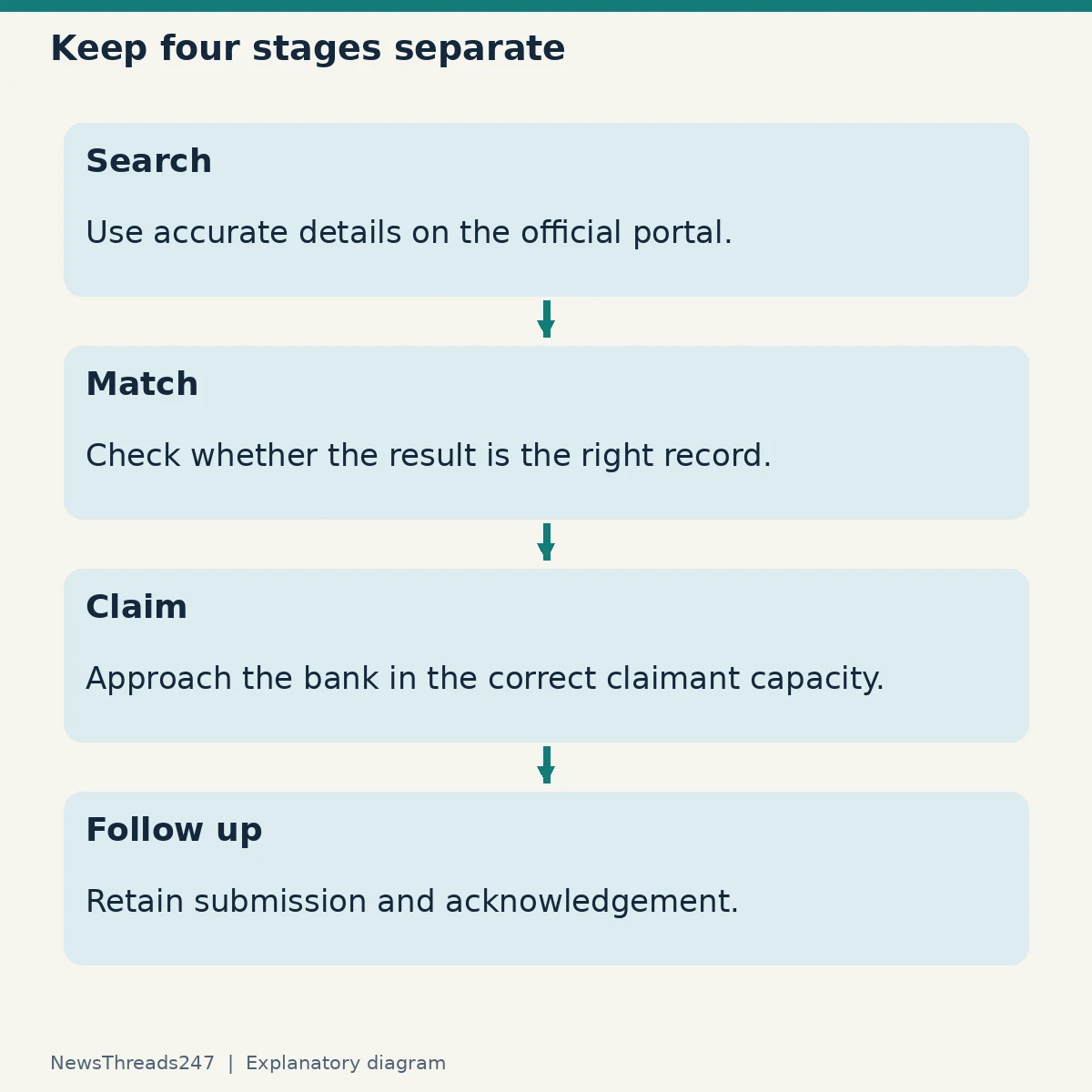
That distinction is the most useful starting point: search through UDGAM, preserve the result, then approach the relevant bank through its verified claim process. A matching name or a reference number helps locate a record; it does not prove the searcher owns the deposit or is entitled to receive it.
This guide concerns Indian bank deposits. It is not a US unclaimed-property search guide, and it does not cover every forgotten investment or insurance payment. Keep the type of asset clear before choosing a portal.
What UDGAM is designed to find
RBI launched UDGAM—Unclaimed Deposits: Gateway to Access inforMation—on 17 August 2023. Its launch announcement describes a central search facility intended to make it easier to identify unclaimed deposits across multiple banks. This is an existing service, not a newly announced October 2026 payout scheme.
RBI’s consumer explanation says balances in savings or current accounts not operated for ten years, and term deposits not claimed within ten years of maturity, are classified as unclaimed deposits and transferred to the Depositor Education and Awareness Fund. Depositors remain entitled to approach the bank to claim them, with applicable interest.
An account you stopped using recently may therefore need a direct bank enquiry rather than an unclaimed-deposit search. Do not use the absence of a UDGAM result as a general balance certificate. An inoperative account, an unclaimed deposit, a closed account and an investment held outside a bank are not interchangeable labels.
Prepare the record before starting a search
Collect what you already lawfully hold: the account holder’s name, likely bank, old branch or address details, passbook or deposit receipt and any relevant correspondence. Keep original documents safe. Do not upload a family member’s identity information to a search service whose purpose and official address you have not verified.
RBI’s UDGAM FAQ describes registration using a name and mobile number. For an individual search it describes the account holder’s name, bank selection and identifying information such as PAN or date of birth. It also provides an address route where specified identifiers are unavailable. Follow the current portal’s fields and instructions; do not invent missing identity details to get a result.
Start from the official UDGAM portal linked by RBI. Check its current participating-bank information. Historical announcements and the March 2024 FAQ describe the banks available at those dates; those counts should not be assumed to be an up-to-the-minute coverage list.
Treat a search result as a lead for the bank
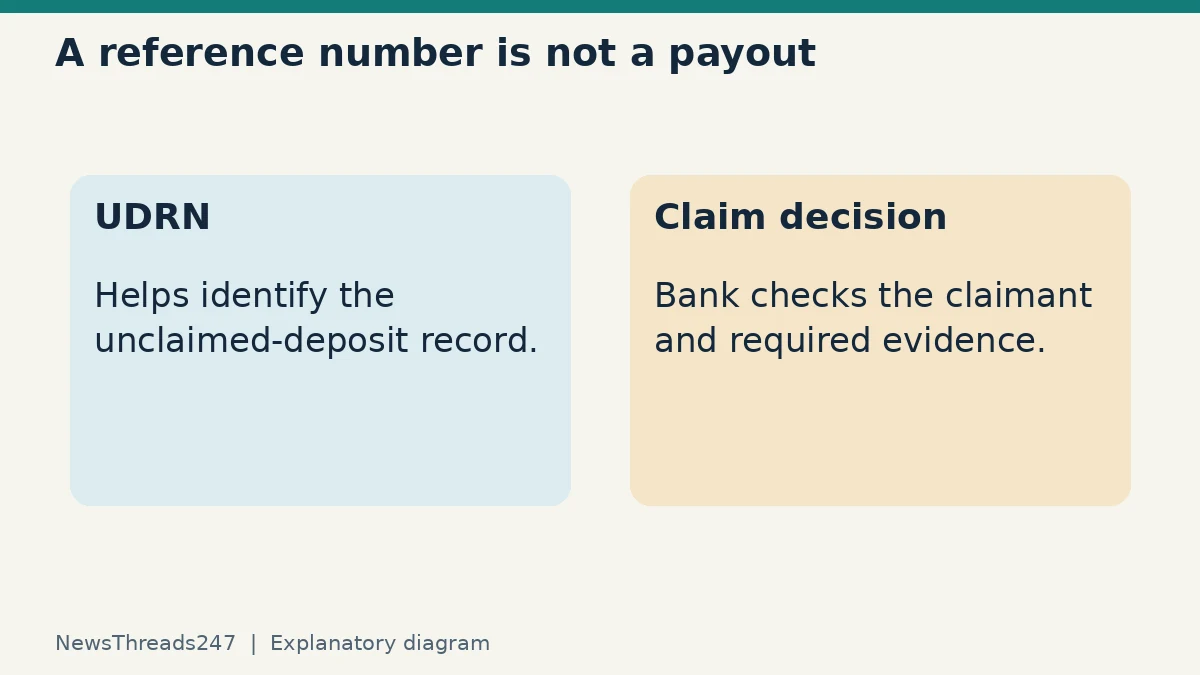
Preserve the bank name, the displayed reference and the claim-process information. RBI calls the reference an Unclaimed Deposit Reference Number, or UDRN. It is assigned to an unclaimed account or deposit transferred to the DEA Fund and helps the bank handle the corresponding claim. It is not a payment approval or a password for withdrawing funds.
The FAQ is explicit that unclaimed deposits can be claimed only from the respective bank. Use the bank’s official website, verified customer-service details or a branch to obtain its current forms and document requirements. Do not pay a stranger who claims the result must first be “released by RBI”. The portal’s role is search and process information, not an intermediary’s payout promise.
A sensible enquiry identifies the deposit record and asks: which claim form applies, which documents are needed for this claimant’s capacity, how can they be submitted securely, and how will receipt be acknowledged? Request the answer in writing where practical so you can prepare a complete submission.
The claimant’s capacity changes the next step
An account holder claiming their own deposit is not in the same position as a nominee, legal heir or representative of an organisation. Tell the bank which capacity applies. Ask for the relevant procedure rather than reusing a form found in another family’s case.
For a deceased account holder, a successful search does not settle questions about the claimant’s authority. The bank must assess the case through its applicable process. Our bank-nomination explainer discusses recorded nomination arrangements, but it is not proof that a particular old deposit has a nomination or that a particular person can claim it.
Keep identity and relationship documents out of public posts. If relatives are coordinating, share a basic record of the bank contacted, date and next required action without circulating complete identity files unnecessarily. Use the bank’s approved submission route for documents it actually requires.
A practical file for one forgotten deposit
Consider a fictional family that finds a matured fixed-deposit receipt. One person searches using the holder’s accurate details and finds a plausible record. Another person calls a number taken independently from the bank’s official website, confirms the claim route and notes the reference. They keep a copy of the submission and its acknowledgement.
That sequence separates four questions: does a record appear, is it the right deposit, who can claim it, and has the bank accepted and processed a complete claim? Skipping from the first question to “the money is recovered” creates false confidence. The amount eventually payable, supporting documents and processing issues depend on the actual bank record and claim.
A tracking note can contain the UDRN, bank, relevant old record, claimant capacity, contact date, documents requested, submission date and acknowledgement. Add a follow-up date based on the bank’s stated process. This is an organisational aid, not an assurance of a settlement deadline.
If nothing appears, broaden the enquiry carefully
Check spelling and the bank you selected, using reliable old documents rather than repeated guesses. Read the current portal’s search guidance. If the deposit is too recent for unclaimed-deposit treatment, the institution is not covered, or the record remains unclear, approach the bank directly with the evidence you have.
Also check whether the paper is actually a bank deposit. The government’s guide to unclaimed financial assets describes different routes for different assets, including MITRA for identifying certain inactive or unclaimed mutual-fund investments. UDGAM should not be presented as a single search engine for all financial property.
Keep future claims easier to trace
Maintain a private inventory of banks and the location of supporting records. Review contact details and nomination information through the institution, and decide what to do with accounts you no longer need. The goal is an accurate family record, not a public spreadsheet containing balances, account numbers and identity documents.
Sources and scope
The linked RBI and government guidance was checked on 25 October 2026. No account was searched for this article, and no recovery or eligibility is promised. The bank’s current requirements and the claimant’s actual circumstances determine the next steps.