Writing three family names on a bank-nomination form can create two very different instructions. You might want each person to receive a specified share from the bank, or you might want one person to receive the deposit with others named in a priority order. Before signing, make sure the form expresses the instruction you intend.
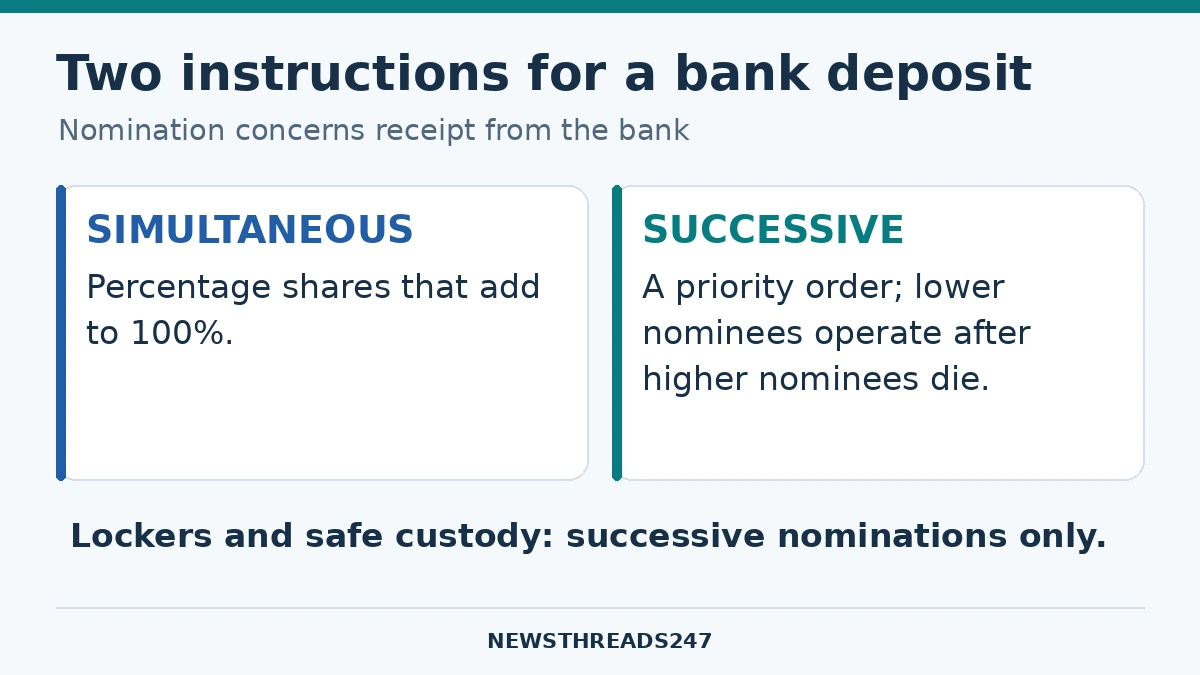
Quick answer: For bank deposits in India, simultaneous nomination specifies percentage shares totalling 100%; successive nomination specifies an order in which a lower nominee becomes operative only after the death of those above. Up to four individuals may be nominated. For lockers and articles in safe custody, the multiple-nominee option is successive nomination. Nomination does not, by itself, decide the legal heirs’ ownership rights.
The rule is already in force
The Finance Ministry’s announcement brought the relevant nomination provisions into effect from 1 November 2025. This is an explanation of the framework in force, checked on 23 October 2026; it is not a claim that a fresh four-nominee rule starts this week.
The useful choice is the instruction recorded for your particular deposit or facility. Do not infer it from a headline saying “four nominees allowed”, or assume every bank product follows the same rules. Ask the bank to identify the applicable nomination form and explain the option it is recording.
| Question | Simultaneous nomination | Successive nomination |
|---|---|---|
| What does it express? | Shares of a deposit in percentages. | A priority order of nominees. |
| How are multiple nominees treated? | The nomination operates in the declared proportions. | A lower nominee becomes operative only after the death of higher nominees. |
| What must the numbers show? | The full deposit is covered; shares total 100%. | The priority is clear; it is not a set of percentage shares. |
| Where is the option available? | Bank deposits. | Bank deposits, lockers and articles in safe custody. |
Choose the instruction before filling in the names
Start with a sentence in ordinary language. For example: “I want the bank to pay these nominees in these proportions,” or “I want this nominee first, with the others in this order if those above have died.” Read that sentence alongside the bank’s form. If the field labels do not let you express it clearly, ask for help before signing.
Having four spaces does not mean you must fill all four. Nor does the first row automatically mean a larger percentage. The revised nomination form published by SBI has separate fields for priority and proportion. Its notes say to complete only one of those columns for deposits.
Check which account or deposit the request covers. Do not assume that updating a savings-account nomination also changes every fixed deposit, locker or government savings scheme you hold. Ask the bank to show the scope of the recorded request and keep separate confirmation where necessary.
A percentage example—and a priority example
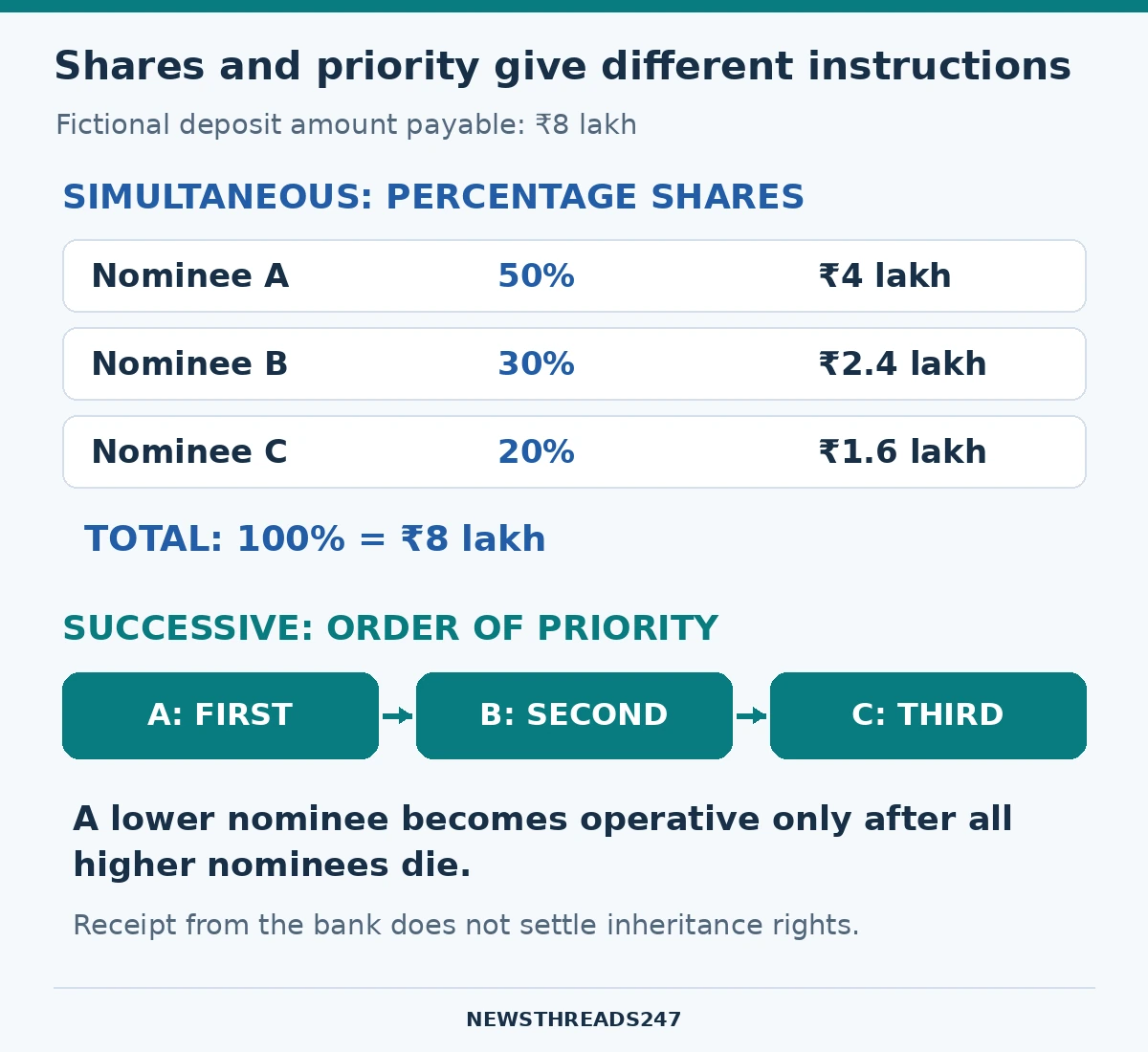
Suppose, purely for illustration, a deposit has ₹8 lakh payable when the bank settles it. A simultaneous nomination records 50% for one nominee, 30% for another and 20% for a third. The arithmetic is ₹4 lakh, ₹2.4 lakh and ₹1.6 lakh. The shares total 100%, and the illustrative amounts total ₹8 lakh. Actual settlement uses the amount payable and the applicable records; the example is not a prediction of an account balance.
Now imagine the same three people in a successive order: first, second and third. Those names are not receiving 50%, 30% and 20%. The order sets who becomes operative under the nomination. A lower nominee does not take over merely because someone higher is travelling, difficult to contact or less convenient to deal with.
This is why a family conversation and a form check should happen before submission. A phrase such as “keep my children as backup” can mean different things to different people. Ask the bank to explain how the particular entries will operate, then compare the answer with your intention.
If a nominee dies, do not redistribute the share yourself
For simultaneous nomination, the RBI’s consolidated directions for commercial banks say that a nomination becomes ineffective for a nominee who dies before receiving the deposit. The amount allocated to that nominee is handled under the rules for an account without a nominee. It does not automatically become an equal extra share for the surviving nominees.
For successive nomination, the order matters. If your circumstances change while you are alive, review and vary the nomination through the bank’s process rather than leaving an obsolete arrangement for others to interpret. Keep the cancellation or variation confirmation with the original account information.
Nomination helps the bank pay; inheritance is a separate question
The RBI’s consolidated directions for commercial banks state that payment to a nominee or survivor is received as trustee of the legal heirs and does not remove others’ rights or claims to that payment. A nomination entry should therefore not be described as a substitute for every question concerning a Will or succession.
If you are concerned about who ultimately inherits, obtain advice appropriate to your circumstances and applicable law. The useful preparation is to identify a mismatch between your bank records and your intentions while you can still clarify it. This article explains the banking mechanism; it does not determine anyone’s inheritance entitlement.
For commercial banks covered by those directions, RBI also states that, for a joint deposit account, the nominee’s right arises after the death of all depositors. An operating instruction such as a survivorship clause needs to be considered separately. Ask the bank how the joint-account mandate and nomination work together; do not treat a nominee as someone automatically authorised to operate the account during your lifetime.
Prepare the information the form actually asks for
The Banking Companies (Nomination) Rules, 2025 provide a nomination form and allow electronic nomination where the bank makes that facility available. The prescribed details include the relevant account/facility and nominee information. For a minor nominee, the rules provide for appointing an adult to receive the deposit on the minor’s behalf in the specified circumstances.
- Identify the deposit or facility, including the account or locker reference the bank needs.
- Check each nominee’s name, address, age and other details required by the current form.
- Decide whether you are recording proportions or priority, and check every entry accordingly.
- If a nominee is a minor, ask how to complete the relevant adult-recipient details.
- Read the completed form with all relevant depositors before signing or authenticating it.
Use the bank’s genuine branch, website or app. Do not send identity documents or banking credentials to a person who contacts you unexpectedly about “activating” a nomination. If an online screen does not offer the intended option, ask the bank for the supported route instead of improvising entries in an unrelated field.
Check the acknowledgement and the record after submission
For commercial banks covered by the RBI’s Responsible Business Conduct Directions—which exclude small finance banks, payments banks and local area banks—banks must acknowledge completed registration, cancellation or variation forms within three working days. If a request is rejected for non-compliance, the bank must communicate the reasons in writing within that period. The directions also require nomination-registration status and nominee names to appear on the relevant passbook, statement or term-deposit receipt.
After submitting, compare the confirmation with your copy: correct deposit, correct people, correct shares or priority. If something differs, request a correction and keep the response. A submitted form and a correctly recorded instruction are two checkpoints worth documenting separately.
Maintain a private household record showing where the account information and nomination confirmations are kept. It need not contain internet-banking passwords or payment PINs. Tell the relevant family member where to find the records, while retaining control of your credentials. A well-completed form is much easier to use when people know it exists.
Review after changes, not only when opening an account
Marriage, a death, a changed family arrangement or an outdated address can make a review useful. Compare your present intention with the current bank record, then use the variation process if needed. Avoid making changes from memory when you can first obtain the recorded details.
Keep other household payment arrangements understandable too. For recurring debits, our UPI AutoPay guide explains how to review payment mandates separately from the underlying service. A payment mandate and a nomination are different instructions; neither should be treated as a complete inventory of the family’s financial commitments.
What if I prefer one nominee—or none?
The framework allows up to four, not a compulsory four. RBI’s commercial-bank directions also say an otherwise eligible bank account applicant must not face denial or delay solely for refusing nomination; the directions set out how that choice is recorded. Ask the bank to explain the consequences and available process rather than accepting a claim that four names are mandatory.
Sources and editorial note
Primary sources checked on 23 October 2026: Finance Ministry commencement announcement; RBI’s Commercial Banks – Responsible Business Conduct Directions, 2025 (updated 1 October 2026); Banking Companies (Nomination) Rules, 2025; and SBI’s revised form. Examples and the preparation checklist are editorial explanations. This is general information for Indian bank customers, not personalised legal or financial advice. Confirm the process for your actual account, product and circumstances.