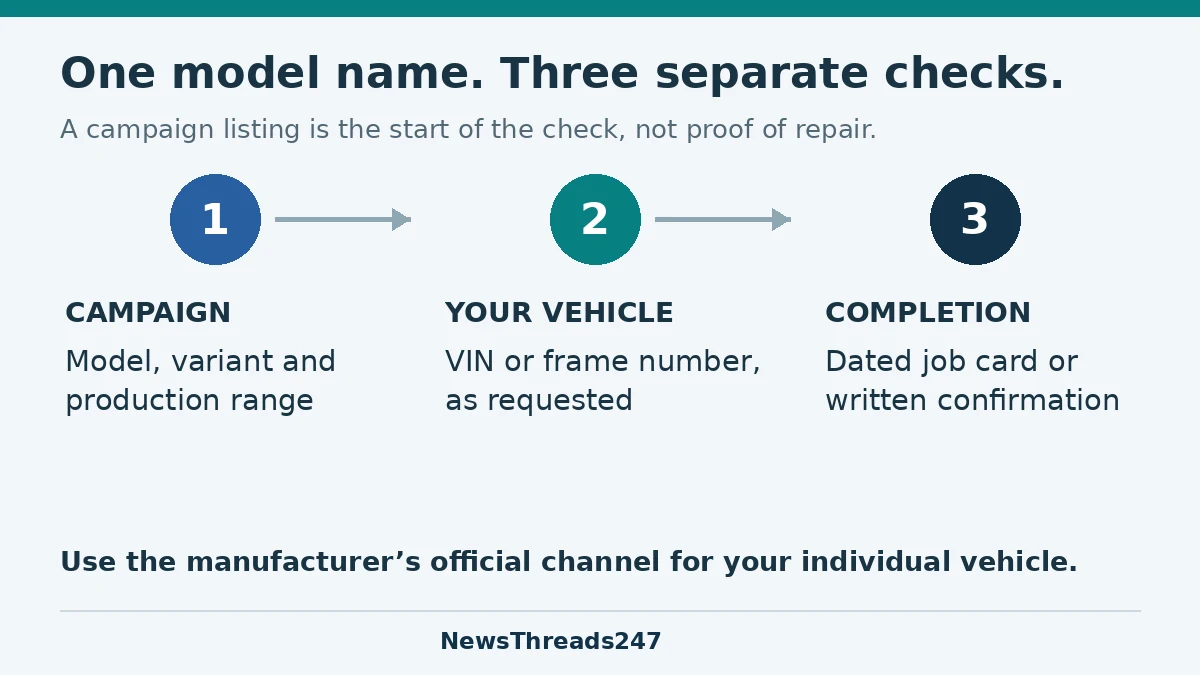
A recall notice names the car you drive. Before cancelling a journey—or deciding the headline does not concern you—find out which question the notice actually answers. It may describe a production batch, while you need to know whether your own vehicle is included and whether any required work has already been done.
To check a car recall in India, locate the campaign on the manufacturer’s official website or the SIAM recall portal, then use the manufacturer’s VIN or frame-number process for your vehicle. If the result is unclear, ask an authorised workshop for written confirmation. Keep the repair record after the work is completed.
Start with the campaign, then identify your vehicle
The Society of Indian Automobile Manufacturers’ voluntary-recall portal lists manufacturers, models, variants, recall dates, production periods and descriptions of potential defects. It is useful for locating the announcement behind a headline. Its campaign rows are not an individual vehicle’s service history.
Compare the variant and manufacturing period as well as the model name. Registration, delivery and manufacture are different events. A car sold from existing stock may have been built earlier; a model introduced in the same year may contain several batches. If the dates or variant names do not line up clearly, ask the manufacturer to resolve the difference.
This is a practical check before a long journey or a used-car purchase, and whenever you receive an official campaign notice. It is not a report that a new recall has been announced today. The official resources linked here were checked on 24 October 2026.
Find the identifier the manufacturer actually requests
Hyundai India’s customer-notification page asks for the Vehicle Identification Number and describes a VIN as a unique 17-character identifier. It lists the registration certificate, insurance document, certain vehicle markings, its app and an authorised workshop as ways to locate it. Positions on the vehicle vary; use the instructions for your model.
Toyota India’s recall page requests a VIN or frame number and supplies format examples. It points owners to the registration certificate, sales invoice and service invoice. That distinction matters: do not trim, pad or rearrange an identifier merely because another brand’s checker expects a different format.
Copy carefully from a reliable record and compare any unclear character with the vehicle marking or workshop record. A registration number is not automatically interchangeable with a VIN or frame number. Keep the full identifier out of public comment threads; provide it directly to the genuine manufacturer or service channel handling the check.
| Evidence | What it can help establish | What still needs checking |
|---|---|---|
| Campaign notice | The model, variant, period and stated issue covered by an announcement. | Whether this individual vehicle is included. |
| Vehicle lookup or written manufacturer reply | How the campaign relates to the VIN or frame number supplied. | Any operating instructions and whether work remains outstanding. |
| Dated campaign job card or completion confirmation | What work is recorded against the vehicle. | Whether another campaign or separate fault also needs attention. |
Use a genuine lookup and read the result completely
Reach the brand’s website independently, then look for its recall, customer-information or service-campaign section. Do not enter vehicle documents into a link simply because it arrived in a message with the right logo. If an online check is unavailable, use the contact details published by the manufacturer to reach its authorised network.
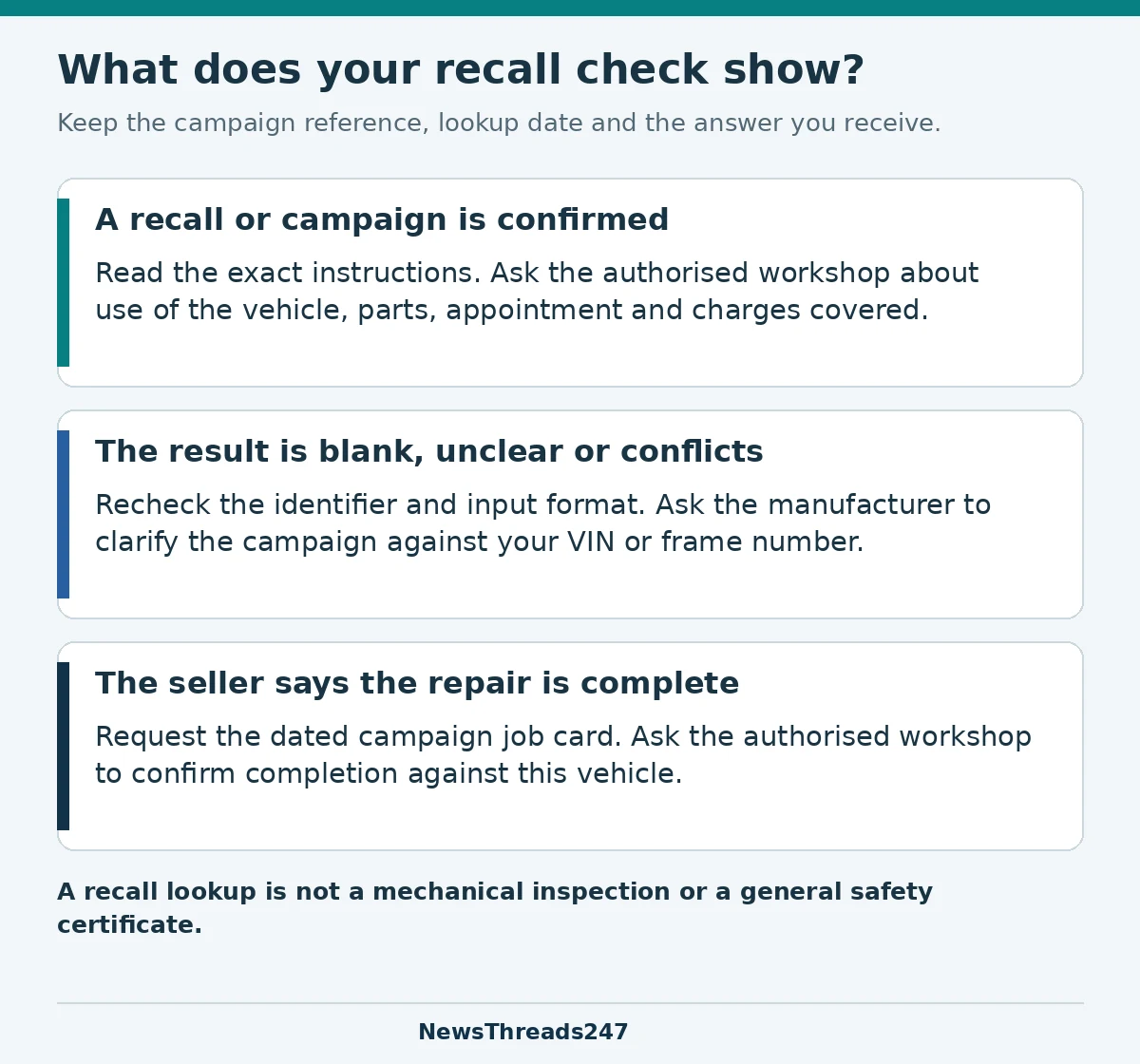
Save the campaign name or reference, the date you checked and the wording of the result. Read any instruction about continued use of the vehicle before making travel plans. A model match alone does not justify a universal ‘safe to drive’ answer, and a general article cannot replace a campaign-specific instruction.
If the response is blank, first check for an incomplete form, a rejected identifier or an unsubmitted verification step. A webpage may contain both positive and negative result messages before a search is completed. Only an actual completed result for the entered vehicle answers your question. Do not mistake generic page text for a successful lookup.
When the website and the headline disagree
A useful follow-up is precise: ‘Please confirm whether campaign [reference] applies to my vehicle, whether any work is outstanding, and what I should do until the appointment.’ Give the service channel the requested identifier privately. Include the notice you are asking about so the adviser is not answering a different campaign question.
An unclear or conflicting result is a reason to seek clarification, rather than proof that the car is affected or unaffected. Ask the manufacturer to confirm the correct market and vehicle record. This is especially important for an imported vehicle, a changed owner or a record with an obvious input mismatch.
Do not use a recall search to dismiss a new mechanical symptom. A warning lamp, abnormal braking or another concerning change still needs assessment through the appropriate service or roadside-assistance route, even if no campaign is found. A recall check asks about notified campaigns; a workshop inspection asks what is wrong with the car now.
If your vehicle is included, settle the appointment details
Renault India’s published recall process directs owners to check the VIN, arrange an appointment with a dealer and bring the vehicle for the campaign work. It states that affected parts are replaced free of charge under its recall process. Confirm the terms of your actual manufacturer’s campaign rather than assuming every item on a service estimate is part of it.
- Ask whether the instruction affects driving or parking before the appointment.
- Confirm which campaign and vehicle are being booked, and whether the required parts are available.
- Ask which inspection, parts and labour are covered, and request separate consent for unrelated paid maintenance.
- Keep the appointment details and any written instructions with the campaign notice.
- After the visit, obtain a dated job card or written confirmation identifying the campaign work and the vehicle.
If a charge seems inconsistent with the published recall notice, ask the workshop to explain it in writing and raise the discrepancy with the manufacturer’s published customer-care channel. Retain the estimate and campaign terms. Avoid approving a combined bill before you understand which work belongs to the campaign and which work you have separately requested.
Buying a used car: ask for evidence of completion
Consider a fictional example. A seller shows a recall notice for the correct model and says, ‘The previous owner sorted that out.’ The notice shows that a campaign existed. It does not show that this car attended, that the work was completed, or that the document belongs to this vehicle.
Ask for the dated campaign job card and compare its vehicle identifier with the car and sale documents. If that record is missing, ask the seller to obtain confirmation through the authorised workshop, subject to the workshop’s identity and record-access requirements. Decide on the handover after the outstanding question is answered; do not substitute a verbal assurance for the evidence you wanted.
Keep the recall check alongside an independent inspection and the normal ownership and document checks. It serves a different purpose from a crash-test rating. Our guide to reading a Bharat NCAP report explains how to match a safety rating to the assessed variant; neither exercise establishes the current mechanical condition of a particular used car.
For a US vehicle, use the US recall system
For readers checking a vehicle in the United States, NHTSA’s recall service provides VIN and other searches. Its published limitations include some recently announced recalls, older recalls and other exclusions. US results and rules should not be applied to an India-market car simply because the model badge is familiar. Use the manufacturer’s guidance for the vehicle’s actual market.
Sources and editorial note
Primary resources checked on 24 October 2026: SIAM voluntary-recall information; Hyundai India customer notifications; Toyota India VIN/frame-number lookup; Renault India recall guidance; and NHTSA recall searches and limitations. The evidence table, decision aid and fictional used-car example are NewsThreads247 editorial guidance. No individual vehicle was checked or mechanically inspected for this article.