
If mould keeps returning to a wall, start by finding and addressing the moisture. Cleaning or covering the visible patch without resolving the water problem can leave the conditions for growth in place. A humidity meter, dehumidifier and air purifier serve different purposes; none should be treated as proof that a leak has been repaired.
For a household, the useful first question is not which gadget to buy. It is what is getting wet, when that happens and who can identify the source safely. A short record of those observations can make a repair visit far more productive than a photograph accompanied by “please suggest waterproof paint.”
This guide uses US environmental-health guidance and general building-moisture principles, checked on 24 October 2026, for readers in India and the US. It is not an inspection, diagnosis, local building-code interpretation or advice about a particular tenancy dispute.
A wet wall and humid room air are not the same measurement
The US Environmental Protection Agency’s home guide identifies moisture control as central to mould control. It recommends keeping indoor relative humidity below 60% where possible, ideally 30–50%. Those are general prevention targets from that guidance, not a test certifying that a particular wall is dry or a home is safe.
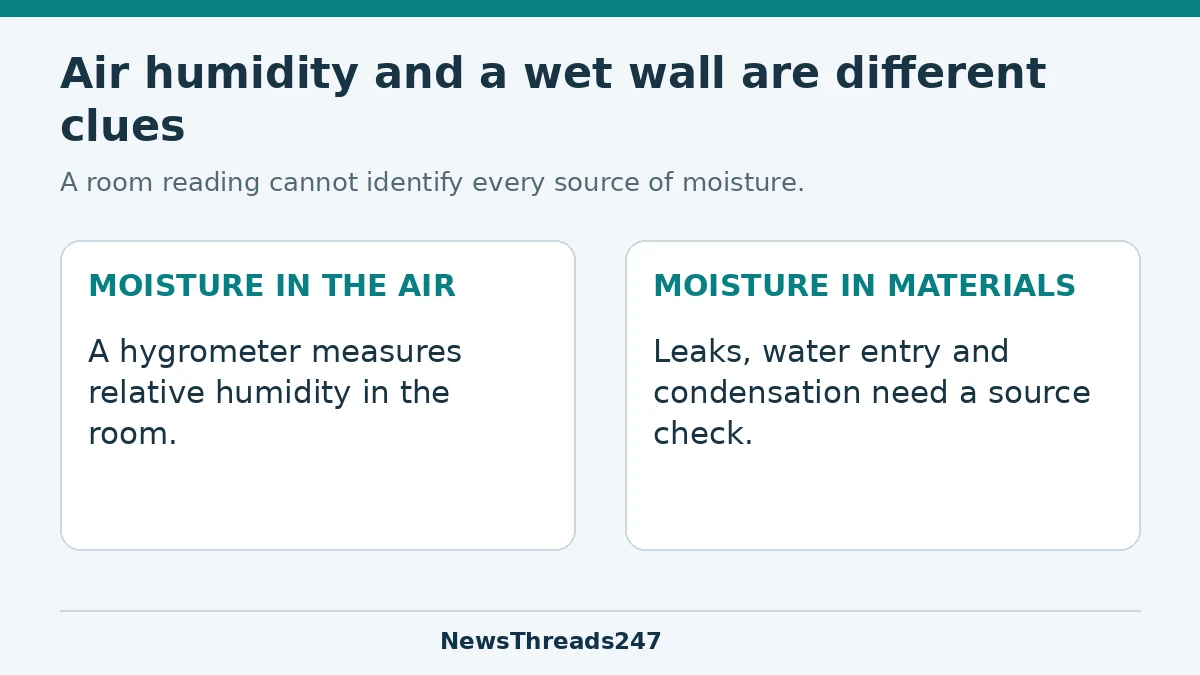
A hygrometer measures the relative humidity of the air around it. It does not identify a concealed plumbing leak, establish the moisture inside masonry or prove that a stain is mould. A reasonable room reading and a local water problem can coexist. Treat the reading as one observation to discuss, rather than a diagnosis.
For consistency, note where and when you take readings and follow the instrument’s instructions. A single value beside an open window or immediately after a shower answers a narrower question than a series of observations from the affected room. Do not invent precision beyond what your meter and method support.
Record the pattern without disturbing the damage
The Centre for Sustainable Energy’s condensation guide explains that moist air can condense when it reaches cool surfaces. It identifies everyday moisture sources such as cooking, showering and drying laundry. That helps explain why condensation belongs in the investigation, but it does not make every damp patch a condensation problem.
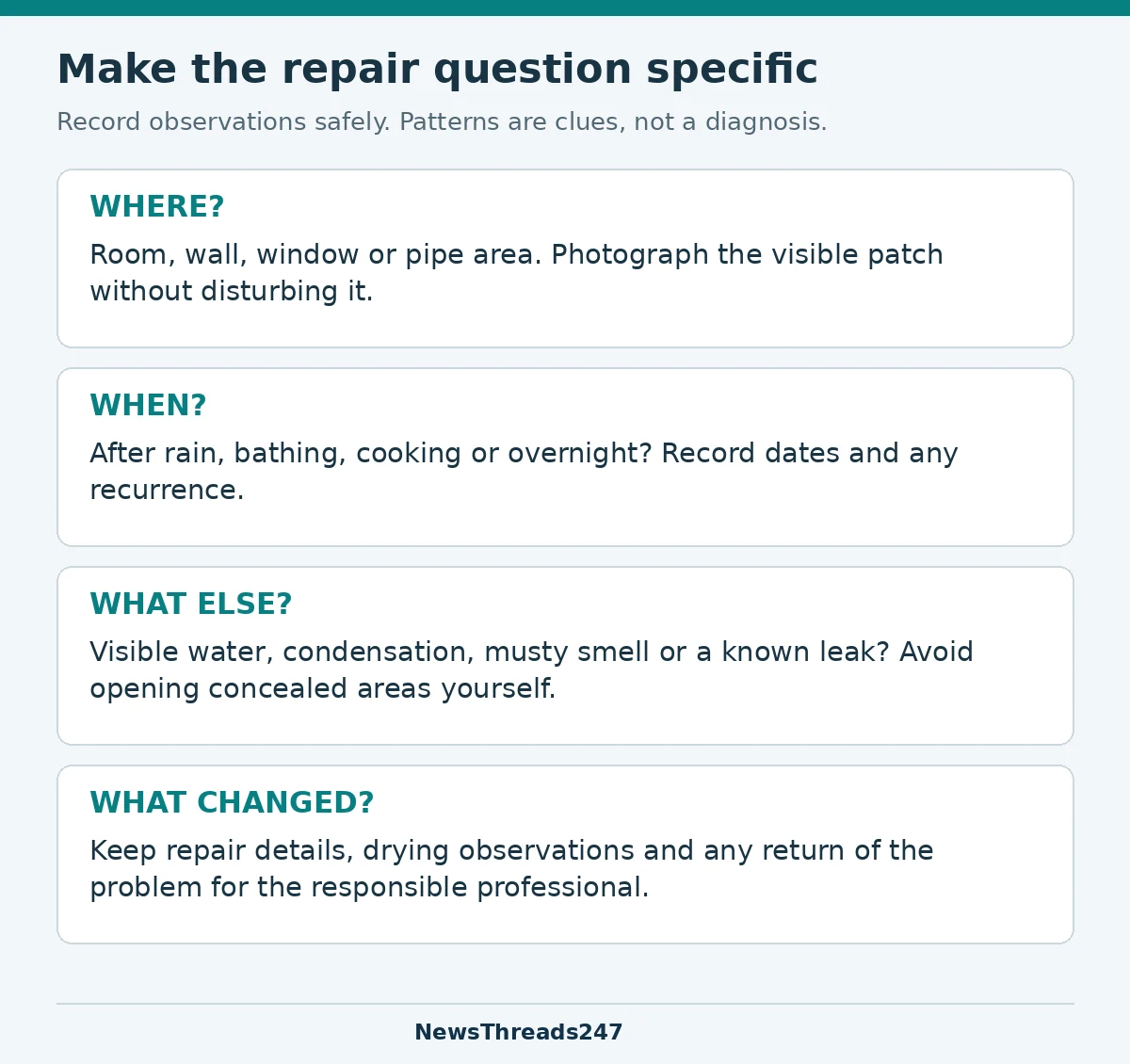
From a safe, accessible position, record the room, wall and visible area. Note whether the patch changes after rain, use of a nearby bathroom, cooking or overnight conditions. Include a known leak or recurring window condensation. These patterns can guide the questions a plumber or building professional asks; they do not establish the cause by themselves.
- Take dated photographs of the visible area without scraping, sanding or opening a concealed space.
- Keep a brief timing log: what changed, what activity or weather preceded it and whether it returned.
- Record previous repairs and what they were intended to fix. A freshly painted surface does not explain the original water source.
- Tell the responsible owner, manager or repair professional about the moisture promptly, with the location and observations.
- Avoid climbing onto roofs, touching wet electrical equipment or opening damaged building materials to investigate a patch.
Choose the repair question before the product
For a suspected plumbing problem, ask what evidence will identify the leaking component and how the repair will be checked. For suspected rain entry, ask which part of the building envelope needs inspection. For recurring condensation, ask about moisture generation, extraction, ventilation and cold surfaces together. The appropriate specialist and investigation depend on the property.
A useful quotation should make clear what source of moisture is being addressed, what material will be repaired or replaced, how drying will be assessed and what follow-up is planned. A promise to apply a coating is incomplete if it does not explain why that intervention fits the cause.
The National Institute of Environmental Health Sciences likewise recommends fixing water sources, controlling humidity and using experienced professionals for major mould cleanup. It does not present one coating, appliance or cleaning chemical as the answer to every damp building.
What the different devices can and cannot tell you
A hygrometer helps you observe room humidity. A dehumidifier is designed to remove moisture from the air. An air purifier is intended to address selected airborne pollutants through its particular filtration or other technology. These functions are related to indoor conditions, but they are not interchangeable.
If water is still entering a wall, lowering room humidity does not establish that the water-entry defect has been fixed. Likewise, an air cleaner’s reassuring light does not measure the moisture hidden in a building material. Start with the source and use equipment for a defined supporting purpose.
Our air-purifier buying guide explains room size, clean-air delivery and filter costs. Those are useful purchasing checks after you have identified the air-cleaning need; they do not replace a dampness investigation.
EPA’s shorter prevention guide recommends reducing moisture sources, venting moisture-generating activities outdoors and using ventilation, air conditioning or dehumidification where appropriate. What is practical depends on the climate, building and outdoor conditions. “Open every window all day” is not a complete plan for every Indian or US home.
A worked example: the patch returns after repainting
Consider a fictional rented flat where a corner has been repainted twice, but the visible damp patch returns. The household buys a humidity meter and obtains a moderate reading on one afternoon. That does not establish whether an intermittent pipe leak, rain entry, condensation or another problem is responsible.
A better handover to the property manager would include the dated photographs, the room and wall location, when the patch recurs, any nearby plumbing and the dates of the previous painting work. The question becomes “what moisture source was investigated, and how will it be verified after repair?”
If the next visit identifies and repairs a source, the household can retain that record and note whether the same area becomes damp again. The example illustrates a process for making the repair question specific. It does not diagnose the fictional patch from its position or colour.
Decide who should handle cleanup
Mould cleanup can carry health and injury risks. CDC says people with allergies, immune suppression, underlying lung disease or chronic respiratory conditions such as asthma or COPD should not take part in cleaning mould. Seek individual medical advice about exposure concerns rather than using an online photograph to explain symptoms.
The CDC cleanup guidance describes respiratory, eye and skin protection and warns never to mix bleach with ammonia or other cleaners. Follow product instructions and the relevant official cleanup guidance. This article does not provide a chemical recipe or recommend disturbing a concealed infestation.
EPA uses the size of the affected area as one planning factor: its home guide discusses about 10 square feet, roughly 0.9 square metres, alongside other considerations. It calls for specialist help with sewage or other contaminated-water damage, and advises caution if the heating, ventilation or air-conditioning system may be contaminated. A small visible patch is not a universal clearance for a do-it-yourself job.
Large, persistent, hidden or uncertain problems deserve an experienced professional’s assessment. Ask about relevant experience, the moisture source, containment where needed and how the result will be checked. If health concerns affect who can safely occupy or clean the space, consult a healthcare professional.
Do not wait for a mould-name test to address visible growth
CDC’s general mould page says that visible or musty-smelling mould needs attention and the moisture problem must be fixed. It does not recommend routine home mould testing. Knowing a colour or buying a test kit does not by itself establish an exposure level that is safe for a particular person.
If a leak or spill is recent, act promptly on safe drying and repair. EPA advises drying wet materials within 24–48 hours where possible to help prevent growth. That is an urgency for moisture control, not a guarantee that everything dried within that interval is undamaged.
The practical order is to make the situation safe, identify and stop the moisture source, arrange appropriate cleanup or material repair, and check for recurrence. A dry-looking coat of paint is the finish to a repair process, not evidence that the source has been found.