
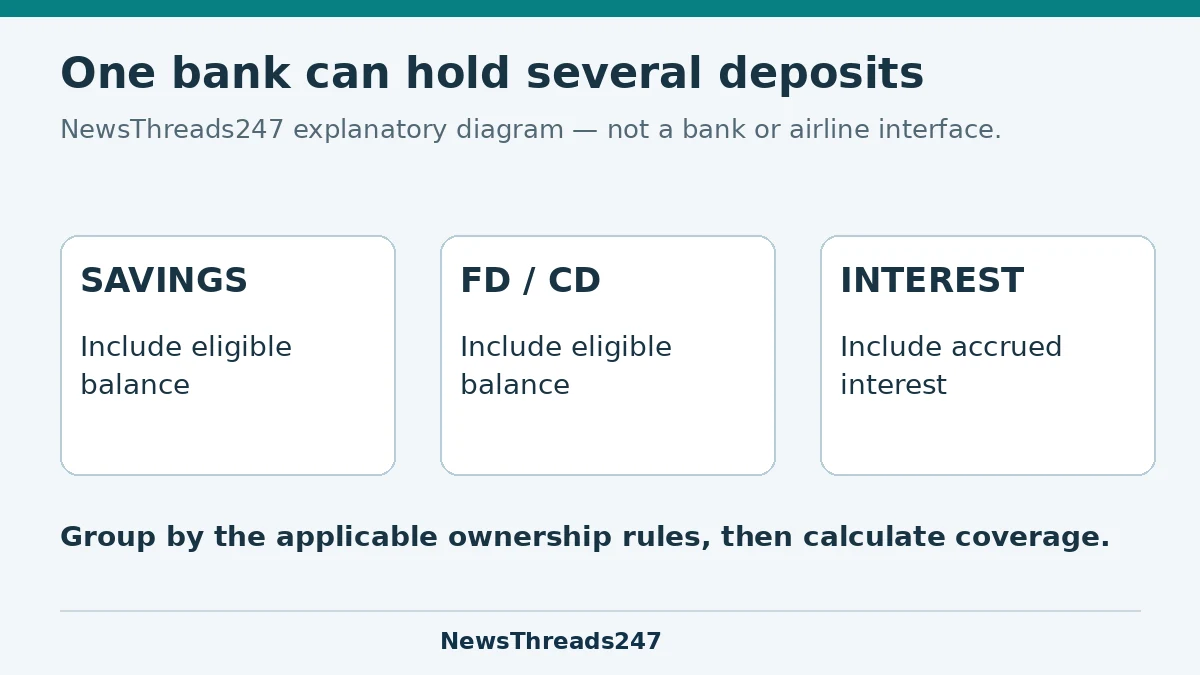
Opening another savings account or fixed deposit at the same bank does not automatically create another deposit-insurance allowance. First identify the insured bank, then group eligible deposits under the applicable ownership rules. Count accrued interest as well as principal.
For India, DICGC’s basic limit is ₹5 lakh per depositor per bank for deposits held in the same right and capacity. In the US, the FDIC’s standard limit is $250,000 per depositor, per insured bank, for each account ownership category. The currencies and legal categories are different; the figures are not interchangeable protections for a person’s worldwide money.
This guide, checked on 24 October 2026, explains how to prepare a coverage check. It does not rank banks, recommend a deposit allocation or provide personal financial, tax or legal advice. Complex ownership, trusts, business accounts, cross-border arrangements and claims require the relevant insurer’s guidance and, where appropriate, qualified advice.
Start with the institution that actually holds the deposit
An account nickname, a second branch or a different product label is not necessarily a different bank. Take the legal institution name from the actual account documents. If you access the account through an intermediary, establish who holds the funds and which terms apply before assuming that an insurance logo settles the position.
The FDIC’s EDIE FAQ directs US customers to BankFind to verify an insured institution. It also explains that separate branches of one insured bank do not receive separate allowances. Use the official lookup linked there; a similar trading name or an advertisement is not sufficient identification.
In India, DICGC’s deposit-insurance guide explains its covered institutions and directs depositors in doubt to ask the branch about insurance. Confirm the bank itself. Do not assume that every entity using the words “finance,” “credit” or “cooperative” has the same insured-bank status.
A useful first worksheet has just three columns: the account or deposit, the legal bank holding it, and the applicable insurance system. Do this before adding balances. Otherwise, neat arithmetic can conceal a mistaken assumption about which institution is responsible.
India: savings and fixed deposits can share the same ₹5 lakh cap
DICGC’s FAQ says balances held in the same ownership at the same bank are added together. Savings, current, fixed and recurring deposit labels do not by themselves create separate allowances for the same individual in the same right and capacity. Deposits across that bank’s branches are aggregated too.
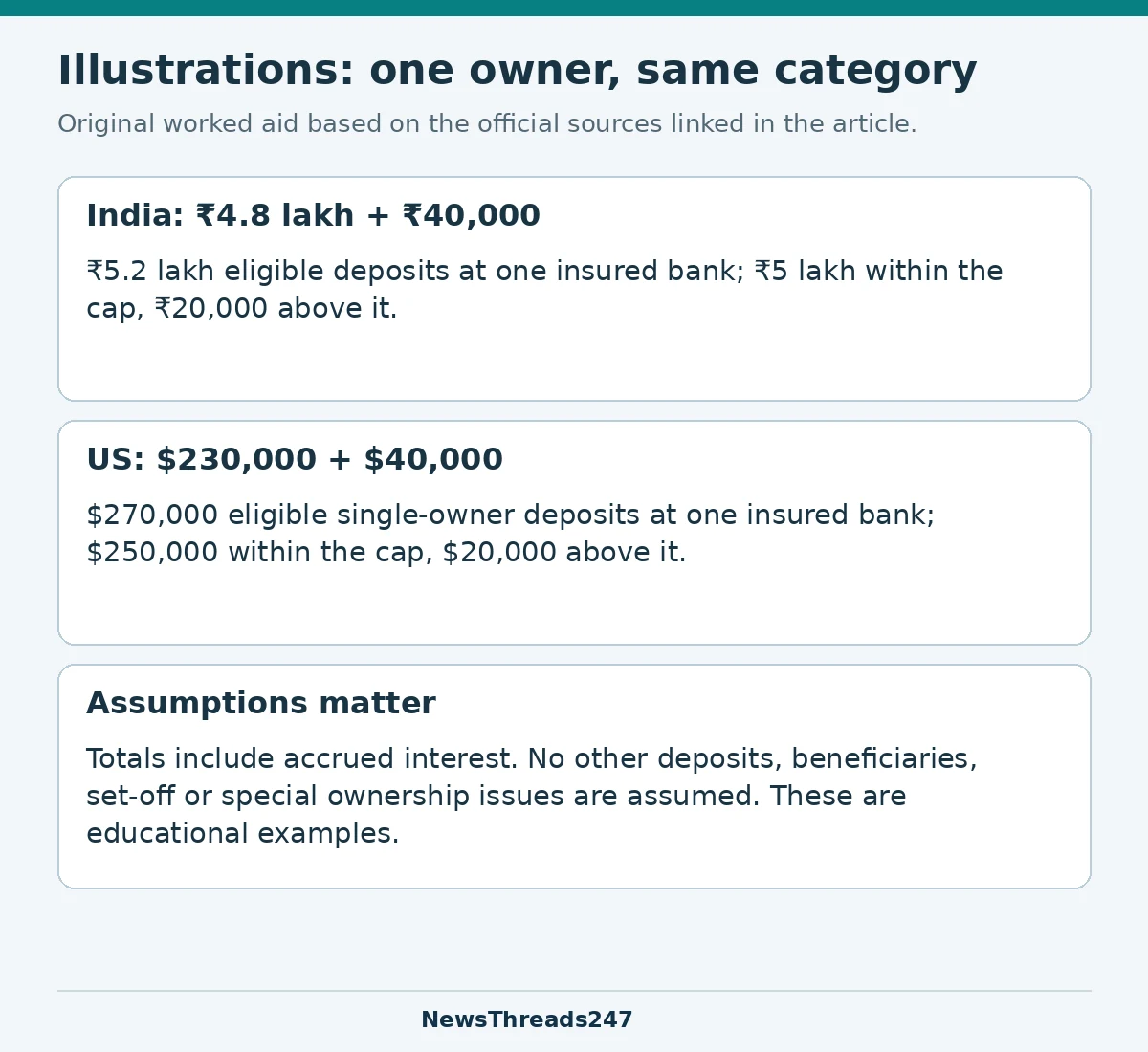
Consider a hypothetical individual with eligible balances of ₹4.8 lakh in a fixed deposit and ₹40,000 in savings at one insured bank, including the accrued interest already accounted for in those totals. The combined amount is ₹5.2 lakh. Under the stated simple assumptions, ₹5 lakh is within the cap and ₹20,000 is above it.
Moving the ₹40,000 to another branch of the same bank would not change that calculation. Nor would dividing the fixed deposit into smaller receipts while leaving ownership and bank unchanged. The number of account documents is different from the number of applicable insurance allowances.
This example assumes no other deposits in the same capacity, no relevant set-off and no special ownership issue. “Above the insurance cap” does not mean the excess is automatically lost; it means the excess is not covered by that capped protection. The actual treatment in a failure depends on the applicable process and recoveries.
Accrued interest uses part of the allowance
The Reserve Bank of India’s DICGC explanation confirms that the Indian ceiling includes principal and interest. A deposit with principal equal to the full cap does not acquire a separate allowance for interest simply because the interest has not yet been paid out.
For a second hypothetical case, ₹4,90,000 principal plus ₹15,000 accrued interest totals ₹5,05,000. Assuming the same simple ownership and eligibility conditions, ₹5,000 is above a ₹5 lakh cap. This is an illustration of addition, not a forecast of interest, a recommended deposit size or a claim about a particular bank’s rate.
Use statements or bank-confirmed accrued figures for a real check. A maturity value several years away and a balance at the relevant insurance event are not the same measurement. Clearly label which date your worksheet represents and update it when interest is credited or deposits are renewed.
US: the ownership category is part of the calculation
The US Office of the Comptroller of the Currency explains that FDIC coverage includes eligible checking, savings, money-market deposit accounts and certificates of deposit, subject to the limit. Principal and accrued interest are included through an insured bank’s closing date.
For a hypothetical US depositor with no beneficiaries on the accounts, suppose eligible single-owner deposits at one FDIC-insured bank total $230,000 in a CD and $40,000 in checking, with accrued interest included. The total is $270,000. Under those assumptions, $250,000 is within the single-account category cap and $20,000 is above it.
The FDIC’s EDIE explanation specifically groups single accounts owned by the same person at one bank. A checking account and a CD do not become separate ownership categories merely because their withdrawal terms differ. An additional branch does not change the bank either.
Do not extend that example to a joint account or an account with named beneficiaries without checking the applicable rules. The identity of the owner, the legal account title and the ownership category can change the analysis. The example is deliberately narrow so its arithmetic is not mistaken for a verdict on every household arrangement.
The Indian and US ownership rules must not be mixed
DICGC describes separate treatment for deposits in genuinely different rights and capacities and for deposits in separate banks. It also explains that a sole proprietor’s business deposits and individual deposits are aggregated for its stated example. A business-like account label alone is not enough to establish a new capacity.
FDIC categories operate under US rules. EDIE provides a structured way to enter the actual account relationships and estimate coverage. A beneficiary arrangement that affects a US category should not be assumed to work identically to a nominee on an Indian account. Nomination and insurance are different questions.
If your records include joint holders, trusts, a business or beneficiaries, list the exact account titles and ask the relevant bank or insurer how they are classified. Avoid changing ownership solely on the strength of a simple online example: ownership changes can have consequences beyond deposit insurance.
For the separate Indian nomination question, our guide to simultaneous and successive nominees explains the distinction between shares and priority order. It is not an insurance-coverage calculator.
Products sold by a bank are not all insured deposits
The OCC’s explanation distinguishes deposit accounts from investments such as stocks, bonds, mutual fund shares, life insurance policies and annuities. Buying one of those through a bank does not turn it into an FDIC-insured deposit. A money-market deposit account and a money-market mutual fund should not be treated as interchangeable names.
For India, check whether the product is an eligible deposit with an insured bank under DICGC’s rules. A corporate deposit, an investment scheme or another product shown in the same app should not simply be placed in the insured-bank-deposit column without verification. Ask for the issuer, product terms and explicit coverage basis.
This distinction also prevents a different misconception: deposit insurance is protection connected to an insured institution’s failure under the applicable system. It is not a general promise to reimburse any loss, failed investment or disputed transaction. The OCC expressly says FDIC insurance does not cover fraud and theft losses.
A practical coverage check to keep with your records
Gather current statements and deposit receipts, identify each legal bank, separate deposits from investments and record the actual account ownership. Add balances only within the grouping supported by that country’s rules. Include accrued interest and note the date of the calculation.
Then record what remains uncertain. Examples include an unclear intermediary arrangement, a changed bank name, a joint title, a beneficiary designation or a balance that may be subject to set-off. Ask a focused question with the account details through the bank’s secure channel rather than posting statements publicly.
Keep the response or estimator result with its date and assumptions. Recheck after a substantial deposit, renewal, ownership change or institutional change. The aim is a reliable map of what you hold, not the largest possible number of accounts.
Official references
DICGC FAQ; DICGC guide; RBI deposit-insurance explanation; FDIC EDIE FAQ and BankFind route; OCC explanation of FDIC coverage. Check current rules for your actual ownership and institution; this article does not determine a claim or promise immediate access to funds.