
A tyre’s date code tells you when it was made. It does not certify that the tyre is safe today. Low mileage, deep-looking tread and a recent purchase invoice cannot answer every question about age, damage or suitability for your vehicle.
The practical check is to record the manufacture code, inspect condition and consult the vehicle and tyre manufacturers’ guidance together. Include the spare. This explainer uses official US road-safety information and manufacturer guidance available in India and the US, checked on 24 October 2026. It does not announce a new universal tyre-expiry law.
For drivers preparing a longer journey, the value is in finding a problem while there is time to obtain a professional inspection—not in turning four digits into a pass-or-fail certificate. You can organise the evidence yourself; a website cannot remotely assess the structure of a particular tyre.
How to read the four-digit manufacture code
The US National Highway Traffic Safety Administration’s TireWise guide explains that the final four digits of the DOT Tire Identification Number indicate the manufacturing week and year. A code ending in 3524 means week 35 of 2024, not 35 months after purchase or an expiry date in 2035.
Look for the complete identification marking rather than treating any four-digit number on a sidewall as the date. The complete marking may not appear on both sides. If it cannot be read safely while the wheel is installed, ask the workshop to identify it; do not crawl under an unsupported vehicle to photograph an inner sidewall.
Michelin India’s tyre-life guide also explains the week-and-year marking. Use the tyre maker’s help if the marking is unclear or differs from the example. A size marking and a manufacture date serve different purposes, even though both contain numbers.
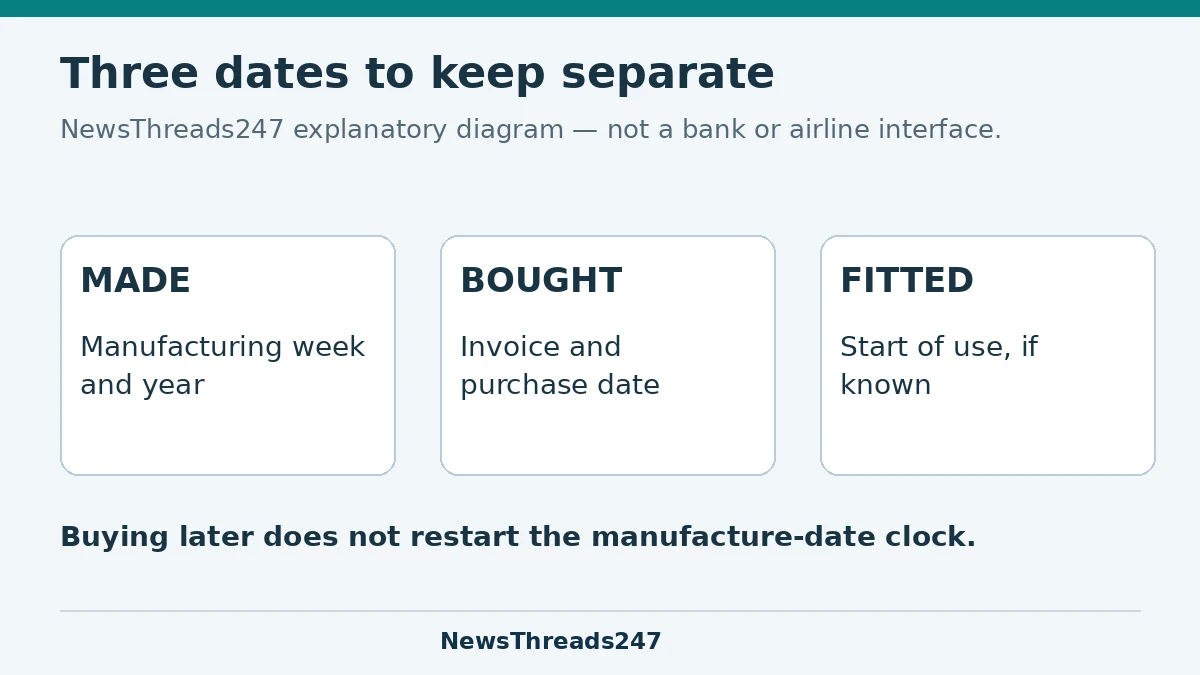
Manufacture, purchase and fitting are three separate dates
A tyre manufactured in 2023 and bought in 2025 does not become a 2025-manufactured tyre. The invoice establishes a transaction; a fitting record helps establish time in use. Keep both, but do not substitute either for the manufacturing code.
This matters when recommendations use different clocks. Michelin recommends professional checks at least annually after five years of use, while its precautionary replacement recommendation is ten years from manufacture. Those statements do not describe the same starting date.
For a hypothetical tyre made in week 35 of 2020 and fitted in September 2021, manufacture age and time in use differ by roughly a year in October 2026. The example illustrates recordkeeping, not a recommendation to continue using that tyre. Condition, vehicle guidance and its actual history still matter.
Write “fitting date unknown” where necessary. An honest gap is more useful to a technician than a guessed date that makes an old tyre appear newer. Ask a previous owner or workshop for records, without assuming that a car’s registration date establishes the age of every tyre currently installed.
There is no single calendar number that clears every tyre
NHTSA says some vehicle and tyre manufacturers recommend replacement between six and ten years regardless of treadwear. That is a description of differing manufacturer recommendations, not a universal US rule requiring every passenger-car tyre to be kept until ten years old.
Michelin’s US replacement guidance recommends replacement as a precaution ten years after manufacture, including spares, regardless of remaining tread or apparent condition. Follow the applicable vehicle-maker guidance too; an earlier replacement instruction should not be ignored in favour of a later generic figure.
Manufacturer Giti’s discussion of tyre age and storage explains why calendar age alone does not determine performance. Read that alongside, rather than instead of, the replacement guidance for the tyre and vehicle. “Age is not the only factor” does not mean “age never matters.”
The useful question for a workshop is specific: “Given this tyre’s marking, history and current condition, what does the applicable manufacturer guidance require?” A broad argument about whether all tyres expire after six years is less helpful than identifying the tyre actually on the car.
Condition can require action before an age threshold
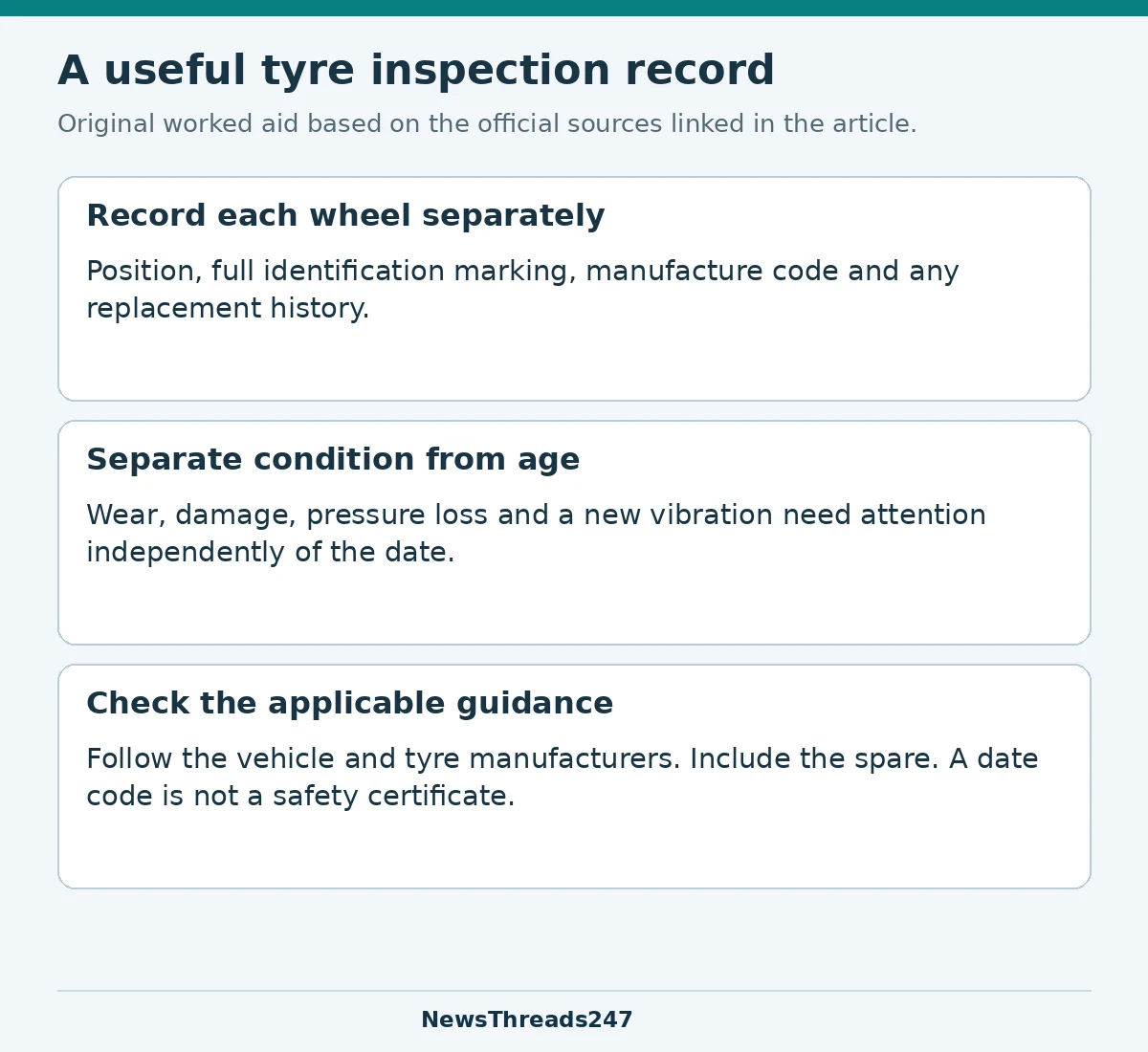
Michelin identifies sidewall bulges, deep cuts exposing cords and significant cracking among signs requiring replacement attention. Its guidance also warns that an impact can leave internal damage that is not settled by an external glance. A new vibration, pressure problem or handling change deserves professional assessment rather than waiting for a birthday.
After a pothole impact, report when it happened and what changed. Did the warning light appear immediately? Did the car begin pulling? Was the tyre driven while flat? These are observations for a technician, not a self-diagnosis of a broken belt or damaged suspension.
Check tread across the tyre, not only at the easiest visible edge. Michelin India describes abnormal centre, shoulder or one-sided wear as reasons to obtain a check. Correcting the underlying problem matters: fitting a fresh tyre without understanding uneven wear can leave the cause unresolved.
Do not treat this article as permission to drive on a visibly damaged tyre to reach a workshop. If you suspect an immediate safety problem, stop safely and seek appropriate roadside help. The safe next step depends on the actual vehicle and location.
Check pressure using the vehicle’s information
NHTSA’s tyre buyer’s FAQ points drivers to vehicle information for fitment and pressure. Use the vehicle placard and owner’s manual for the applicable tyre configuration rather than copying a pressure from another car or treating a sidewall maximum as the normal operating target.
Record pressure checks consistently and tell the workshop about repeated loss. Repeatedly topping up without investigating the cause is not the same as establishing why air is escaping. A tyre-pressure monitoring system is useful, but a dashboard reading cannot establish a manufacturing date or the absence of structural damage.
If tyres or wheels have been changed from the original configuration, ask a competent professional to confirm the correct specification and pressure guidance. This article intentionally gives no universal psi figure. A number suitable for one vehicle, load or spare may be unsuitable for another.
The spare needs its own entry
A spare often escapes attention precisely because it has done little work. NHTSA warns that spares age too. Michelin’s ten-year precaution includes them. An unused-looking tread is not a reason to omit the manufacture code and condition check.
Confirm what your car actually carries: a full-size spare, a temporary-use spare, or a different mobility arrangement. Read the owner’s manual for limitations. Do not assume that a compact spare has the same pressure, speed or distance instructions as a normal road tyre.
Before a journey, check that the relevant tools and any wheel-lock key are available. If the vehicle uses a repair kit, read its instructions and check its components rather than discovering the arrangement beside the road. This is preparation, not a claim that a repair kit can address every puncture or sidewall injury.
Make the next workshop visit more useful
Prepare one line for each wheel position and the spare: manufacturer and model, full identification marking, date-code ending, purchase and fitting dates where known, current concern and relevant repair history. A photograph can support the record, but it does not replace inspection.
For a fictional used-car buyer, four road tyres might have matching branding but different manufacture dates, with an older spare. The correct response is to investigate each item and the vehicle’s requirements, not assign all five the date of the newest tyre. This also helps avoid ordering replacements from an incomplete description.
Ask the workshop to explain its recommendation and record what was checked. Retain the invoice and fitment details for the next review. If a concern relates to a manufacturer campaign, our car-recall guide explains why campaign lookup and proof of completed work are separate checks.
The date code is an excellent starting point because it replaces a guess with a fact. Its value comes from using that fact alongside condition and the right guidance, rather than asking it to answer questions it cannot.
References
NHTSA TireWise; NHTSA tyre buyer’s FAQ; Michelin India tyre-life guidance; Michelin US replacement guidance; Giti on age and storage. Legal requirements and manufacturer instructions vary; the relevant guidance for your vehicle takes priority over a generic example.