
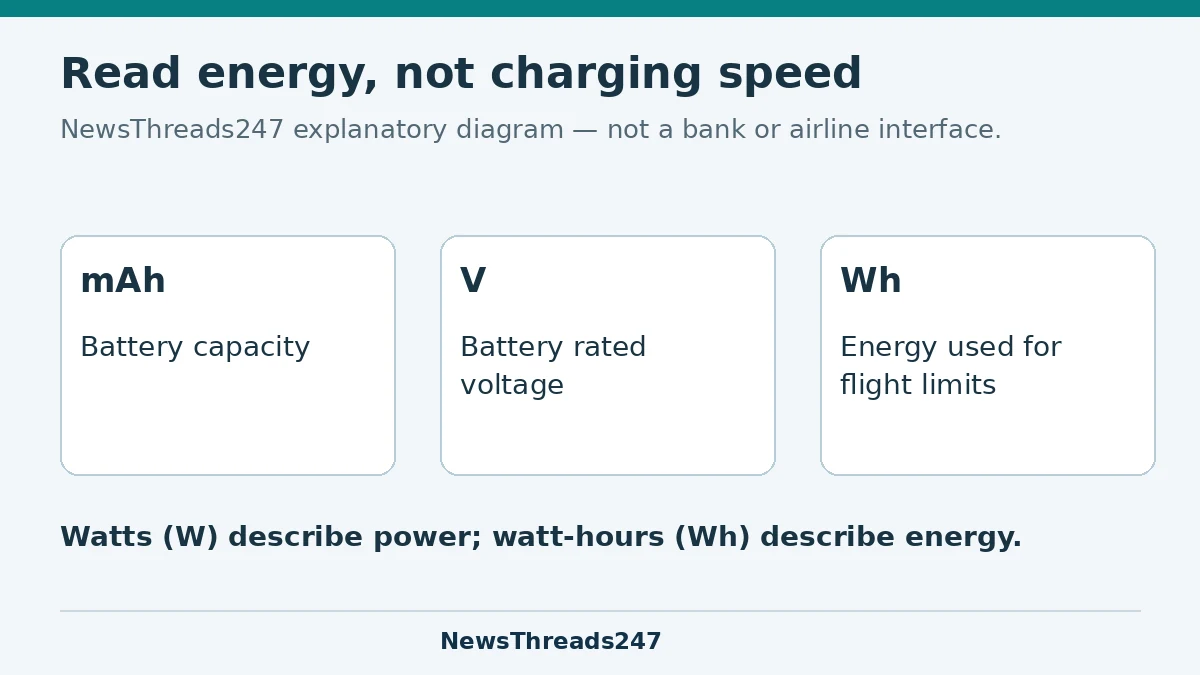
A power bank belonging in your cabin bag does not automatically make it acceptable for your flight. Check the exact model, its watt-hour rating, condition and the operating airline’s current rules. Carrying a charger and using it onboard are separate permissions.
That distinction matters now. Air India’s restricted-baggage page identifies the MOBIKINS MK-PB-04 as prohibited from cabin and checked baggage on flights to, from or within India, citing a DGCA restriction. An acceptable-looking capacity label does not override a model-specific prohibition. This guide was checked on 24 October 2026 and concerns ordinary personal-use power banks, not mobility-aid or medical-equipment battery procedures.
For an India–US itinerary, prepare for every operating carrier and connection. A generic packing article cannot grant permission on a particular airline. The useful outcome is a small, identifiable charger that meets the rules for the whole journey, with no uncertainty left until the boarding gate.
What changed in 2026, and why older advice can mislead
IATA’s guidance dated 31 March 2026 describes changes separating power banks from other spare batteries, limiting personal-use power banks to two per person and prohibiting recharging a power bank onboard. It distinguishes that prohibition from the recommendation against using a power bank to recharge another device. The document also explains that implementation depends on national legal frameworks. It is guidance for 2026, not a permanent worldwide permission slip.
India has its own relevant instruction. In a 9 March 2026 parliamentary answer, the Ministry of Civil Aviation said DGCA’s 11 November 2025 advisory advised airlines to prohibit power banks charging portable electronic devices during flight. These dates should not be confused: the parliamentary answer describes an earlier advisory; it does not announce a new rule issued on 9 March.
Older search results may group power banks with all spare batteries or discuss quantities that a carrier no longer permits. Read the current airline page rather than interpreting an old allowance as a right to board with several chargers. Also check whether an instruction concerns taking the device aboard, charging the bank itself, or using it to charge a phone.
Read Wh, mAh and W as different measurements
Watt-hours, abbreviated Wh, describe stored energy for the capacity check. Watts, W, describe power. A charger advertised as “65 W” has not thereby disclosed whether its battery meets a 100 Wh energy limit. Milliampere-hours, mAh, also need a voltage to give an energy figure.
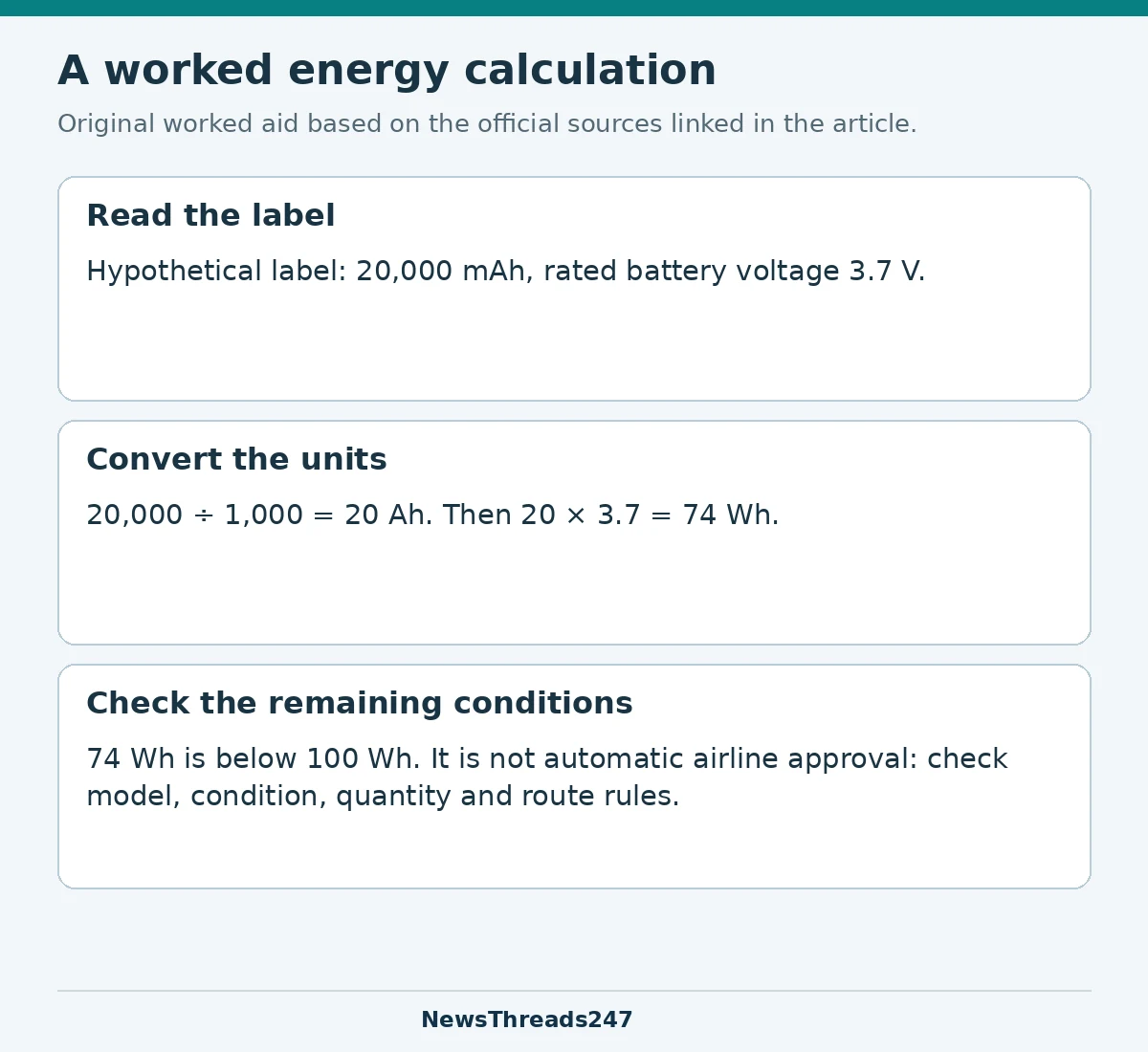
Australia’s Civil Aviation Safety Authority explains the calculation: multiply voltage by ampere-hours, or multiply voltage by mAh and divide by 1,000. Use the relevant rated battery voltage from the manufacturer’s specifications. Do not pick an output voltage from a USB fast-charging list simply because it is the largest number printed on the case.
For a hypothetical label stating 20,000 mAh at a rated battery voltage of 3.7 V, the calculation is 20 × 3.7 = 74 Wh. A different hypothetical battery rated 30,000 mAh at 3.7 V gives 30 × 3.7 = 111 Wh. These are arithmetic examples, not approvals of real products. A printed, legible Wh rating and the manufacturer’s matching documentation are more useful than trying to explain an uncertain calculation at security.
The US baseline is not the final airline allowance
The FAA’s current lithium-battery guidance requires spare lithium batteries, including power banks, in carry-on baggage. It describes the usual 100 Wh limit for lithium-ion batteries and an airline-approval route for up to two larger spare batteries in the above-100-to-160 Wh range. Crucially, it warns that airlines may impose tighter quantity and capacity limits.
Do not turn that approval route into “all airlines accept 160 Wh.” It means you must establish that your operating carrier permits the particular battery and obtain any required approval before travelling. The same FAA page’s general spare-battery quantity language should not be used to override a carrier’s separate power-bank rule.
A small bank can still fail another check. A damaged or recalled lithium battery that presents the specified heat or spark hazard is not ordinary acceptable baggage under the FAA’s passenger-battery guidance. Check the exact manufacturer and model, including any applicable recall instructions. A low Wh figure cannot repair physical damage or cancel a recall.
Read route-specific restrictions in their actual scope
Air India’s page includes a section explicitly headed “Additional Restrictions for Singapore Departures.” It limits those departures to two power banks, each no more than 100 Wh, and prohibits onboard use or charging. Do not remove the heading and present that paragraph as an unrestricted statement about every route worldwide.
The same airline page says power banks and spare batteries cannot be placed in overhead bins. Read the applicable packing and cabin instructions together, and follow crew directions. Rules may differ across the airlines on a connecting ticket; a codeshare brand on a booking is not sufficient to identify every operating carrier.
Make a simple itinerary note: flight sector, operating airline, checked policy link and any written approval. This is an editorial preparation aid, not an airline form. It prevents a familiar mistake: checking the longest international sector and overlooking the domestic or onward flight with a tighter rule.
Pack for the possibility of a gate-checked bag
Keep the power bank in a separate accessible protective pouch, with short-circuit protection appropriate to its design. IATA’s guidance describes individual protection, including insulating exposed terminals or separate protective packaging. Do not leave a loose battery where keys, coins or other metal can contact exposed terminals.
If staff take your cabin bag for carriage in the hold, tell them it contains a power bank and remove it before the bag is handed over. The carry-on rule follows the battery, not the bag’s original label. A device buried at the bottom of a packed case is harder to retrieve when the boarding line is moving.
Check the case for damage before packing, and do not improvise a repair to make a swollen or damaged bank travel-ready. For uncertainty about the label or condition, contact the manufacturer and airline before the journey. Do not rely on a seller’s “flight approved” phrase without matching it to the actual device and carrier policy.
Prepare your phone without depending on onboard charging
Charge the phone and any permitted bank before leaving, within the manufacturer’s safety instructions. Save essential travel information offline and retain a practical backup for documents you may need to show. Plan for the possibility that a seat outlet is unavailable or that use of the power bank is prohibited.
If an onboard device becomes unusually hot, swells or emits smoke, alert the cabin crew immediately. Do not hide it in luggage or try to solve the problem by putting it in an overhead bin. Follow crew instructions; this article is not an aircraft firefighting procedure.
Offline entertainment also needs preparation before connectivity disappears. Our Netflix download guide explains why a visible title is not proof of a completed, unexpired download. Battery planning and content preparation are different checks, but both are easier before departure.
The final check before departure
Can you identify the exact model and read its energy rating? Have you checked model restrictions and recalls? Does every operating carrier accept the quantity and capacity? Is any approval already obtained? Can you remove the bank promptly if the bag is checked? Do you understand the rules on storage and use onboard?
An unanswered question is a reason to clarify the policy before travelling, rather than assume that carrying it in the cabin settles everything. Recheck the airline’s current instructions close to departure, especially when the itinerary or equipment changes. These linked policies can change after 24 October 2026.
Sources
Primary references: Air India restricted baggage; IATA’s March 2026 power-bank guidance; Ministry of Civil Aviation parliamentary answer; FAA lithium batteries; FAA passenger batteries; CASA’s battery-size calculation.