
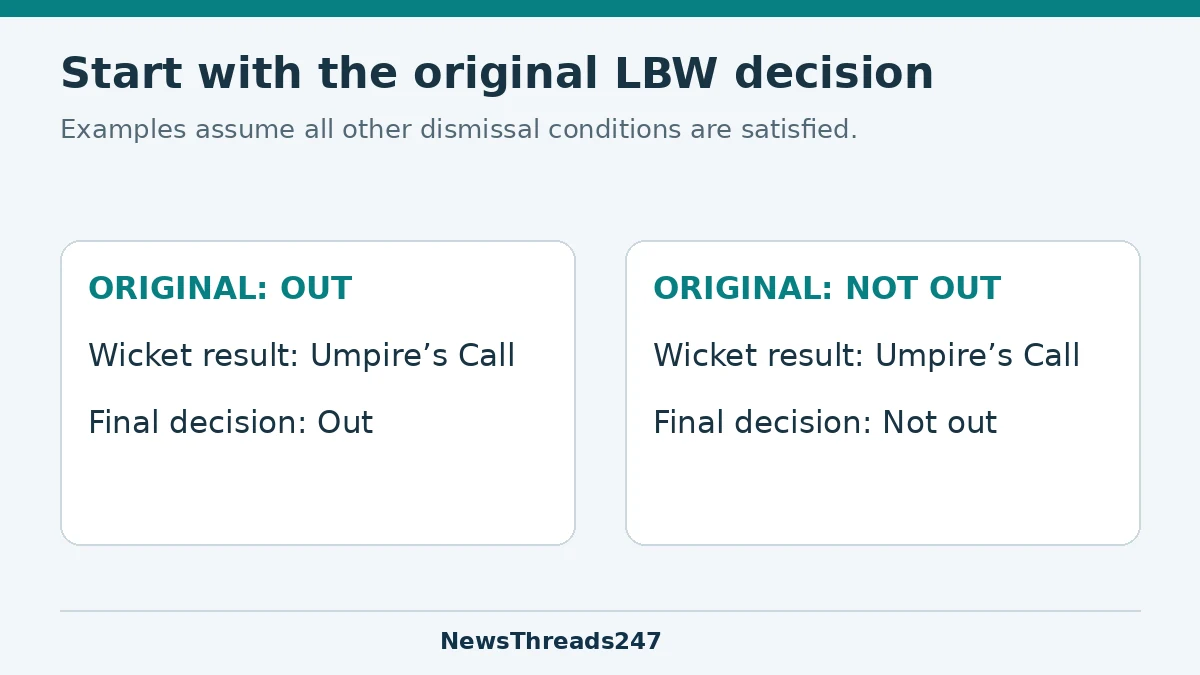
In an LBW review, Umpire’s Call can leave the batter Out or Not out because the original on-field decision is the starting point. If the decisive wicket result is marginal and classified as Umpire’s Call, it is not enough by itself to reverse that original decision. Other findings in the review still matter.
That is why a ball-tracking picture showing projected contact with the stumps does not always mean the batter must be given out. The question is not only whether the picture touches the wicket. It is whether the applicable review test permits the original decision to be changed.
This explainer uses the ICC Men’s Test Match Playing Conditions effective October 2026, checked on 24 October, for its current rule reference. The examples assume DRS is operating and all other relevant LBW conditions are satisfied. Do not apply them as a substitute for a different competition’s playing conditions.
First identify which kind of review you are watching
The ICC’s DRS overview distinguishes a Player Review, requested by a player to reconsider an on-field decision, from an Umpire Review initiated by the officials. It directs readers to each competition’s playing conditions for the complete protocol. A television referral does not automatically mean a team has used one of its Player Reviews.
For the situation discussed here, start with the on-field LBW decision. Was it Out, challenged by the batter, or Not out, challenged by the fielding side? Without that fact, a still image of the predicted ball path can leave out the information needed to understand the outcome.
A useful habit for a new viewer is to say the original decision aloud before looking at the tracking labels. “The batter was given Not out” is a much better starting point than “the ball looks as if it clips leg stump.”
Why DRS preserves the original decision at the margin
In a 1 April 2021 statement, the ICC explained the underlying approach: DRS should address clear errors while retaining the on-field umpire’s role, recognising the predictive element of the technology. That is historical context for the system’s design, not an announcement of a new rule in October 2026.
A review therefore does not simply erase the first decision and ask for a fresh opinion from scratch. The protocol defines what evidence is sufficient to reverse it. For the marginal category, the original call remains important.
You can disagree with that policy and still understand how it works. An argument that every projected touch should mean Out is an argument for a different decision rule. It is not a description of the Umpire’s Call rule currently being applied in the examples.
A wicket result and the whole LBW decision are different things
The October 2026 Test conditions, Appendix D, paragraph 3.4, identify landing, impact and wicket information in the tracking process. Umpire’s Call concerns a marginal impact or wicket result. The wicket categories distinguish Hitting, Umpire’s Call and Missing; the detailed zone definitions determine those labels.
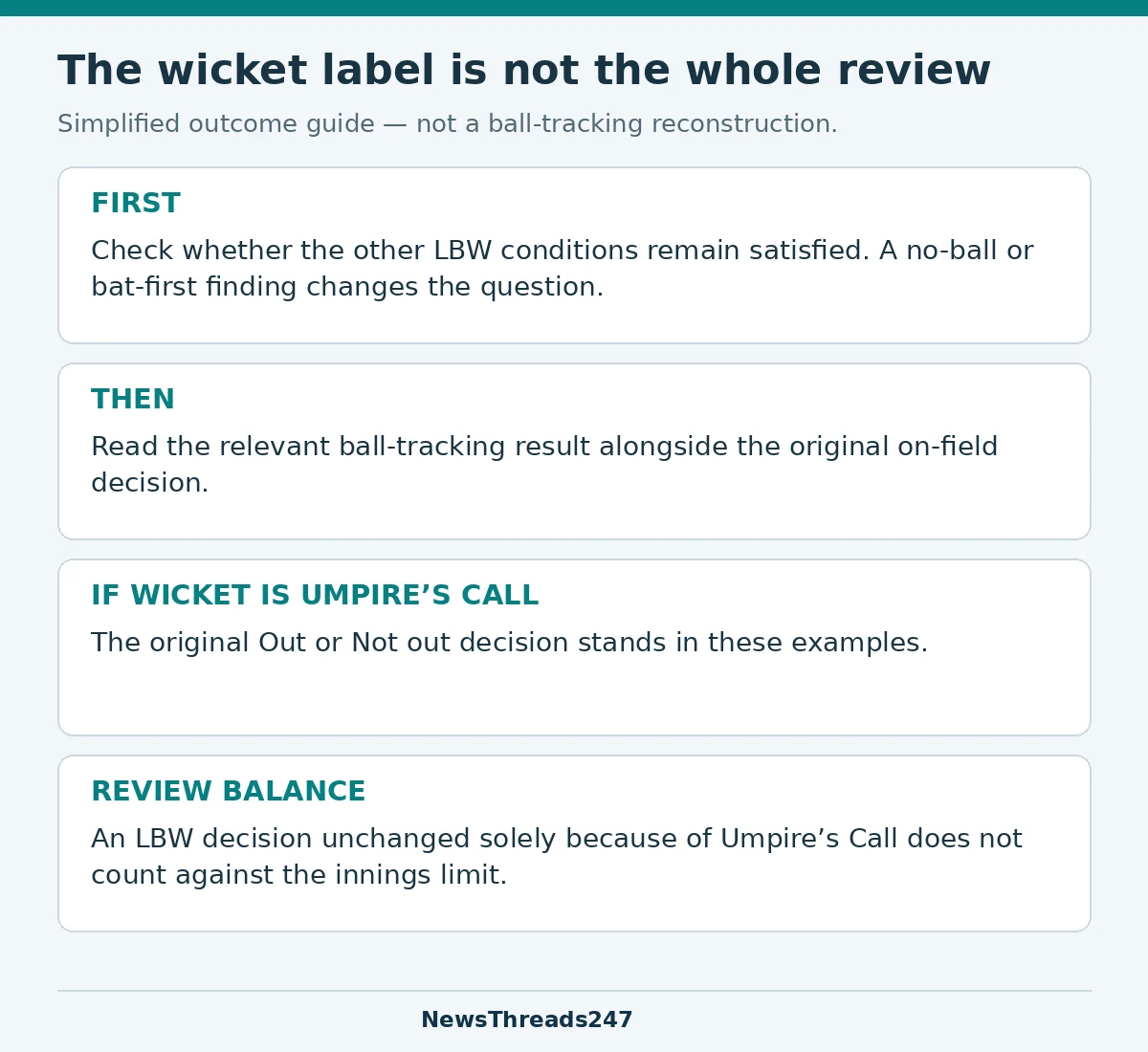
Do not read the wicket panel in isolation. A no-ball, bat contact before interception or another unmet LBW requirement can decide the matter before a marginal wicket projection becomes decisive. The examples below deliberately set those other issues aside so that the effect of the original decision can be seen clearly.
Also avoid turning “Umpire’s Call” into a numerical confidence claim. The label does not tell the viewer that the ball has a stated percentage chance of hitting. It is a category in the applicable review protocol, and a television graphic should be interpreted through that protocol.
Two hypothetical reviews with the same marginal wicket result
Imagine a fair delivery with no bat-first contact, the other required LBW elements satisfied and a wicket result classified as Umpire’s Call. In example A, the on-field umpire gave the batter Out. The batter reviews. The marginal wicket result is insufficient to overturn Out, so Out remains the decision.
In example B, use the same assumptions about the delivery, but start with Not out. The fielding side reviews. The marginal wicket result does not supply the stronger wicket finding required to turn that decision into Out, so Not out remains.
These are original teaching examples, not descriptions of two actual deliveries. Their purpose is to change one input—the original decision—while holding the relevant assumptions constant. The different outcomes follow from the decision rule, not from an invented difference in the tracking image.
Does the team lose the review?
The October 2026 Test protocol, paragraph 3.6.4, says an LBW review unchanged solely because of Umpire’s Call does not count against the innings limit. In the two examples, the team does not obtain a reversal, but it also does not lose a review on that basis.
The word “solely” matters. “The decision stayed the same” is a broader statement than “the decision stayed the same solely because of Umpire’s Call.” Do not assume every unchanged decision receives identical treatment.
The ICC’s older published ODI protocol page is useful background on that distinction, including separate categories for successful, unsuccessful and Umpire’s Call outcomes. For a current match, use the current document for that competition rather than importing an old allowance or an unrelated format’s rules.
What the short version leaves out
Impact has its own conditions, including whether the batter made a genuine attempt to play the ball. The current Test protocol also contains additional restrictions involving some interceptions far from the stumps. That is why “three favourable-looking labels always mean Out” is not a complete explanation.
A genuinely inconclusive replay is also a different description from a defined Umpire’s Call tracking result. Both can leave an original decision unchanged, but they should not be treated as interchangeable diagnoses of what happened. Listen to the third umpire’s explanation and read the final decision alongside the evidence.
Nor should an unsuccessful review automatically be called a technology failure. A functioning system can produce evidence that does not justify reversal. If a technical failure actually occurs, the applicable protocol governs the response; a commentator’s frustration is not evidence that the equipment failed.
A viewing checklist for the next close LBW
- Identify the competition, format and whether DRS is in use.
- Remember the original Out or Not out decision and which side requested the review.
- Follow the whole review, including any earlier finding that resolves the dismissal question.
- Read the impact and wicket labels rather than judging only the animated ball’s edge.
- Distinguish the final dismissal decision from whether the review was retained.
The ICC’s 1 October 2026 announcement says its updated conditions apply to international series starting on or after that date, with ongoing series remaining under the previous regulations. A current calendar date alone does not tell you which version governs every match.
Boundary catches raise a separate rules question. Our guide to the October 2026 boundary-catch change explains that issue; a catch referral should not be analysed as if it were a marginal LBW tracking decision.
For Umpire’s Call, keep two facts together: the relevant marginal result and the original decision. That pair explains the apparent contradiction far better than a cropped screenshot of the stumps.