
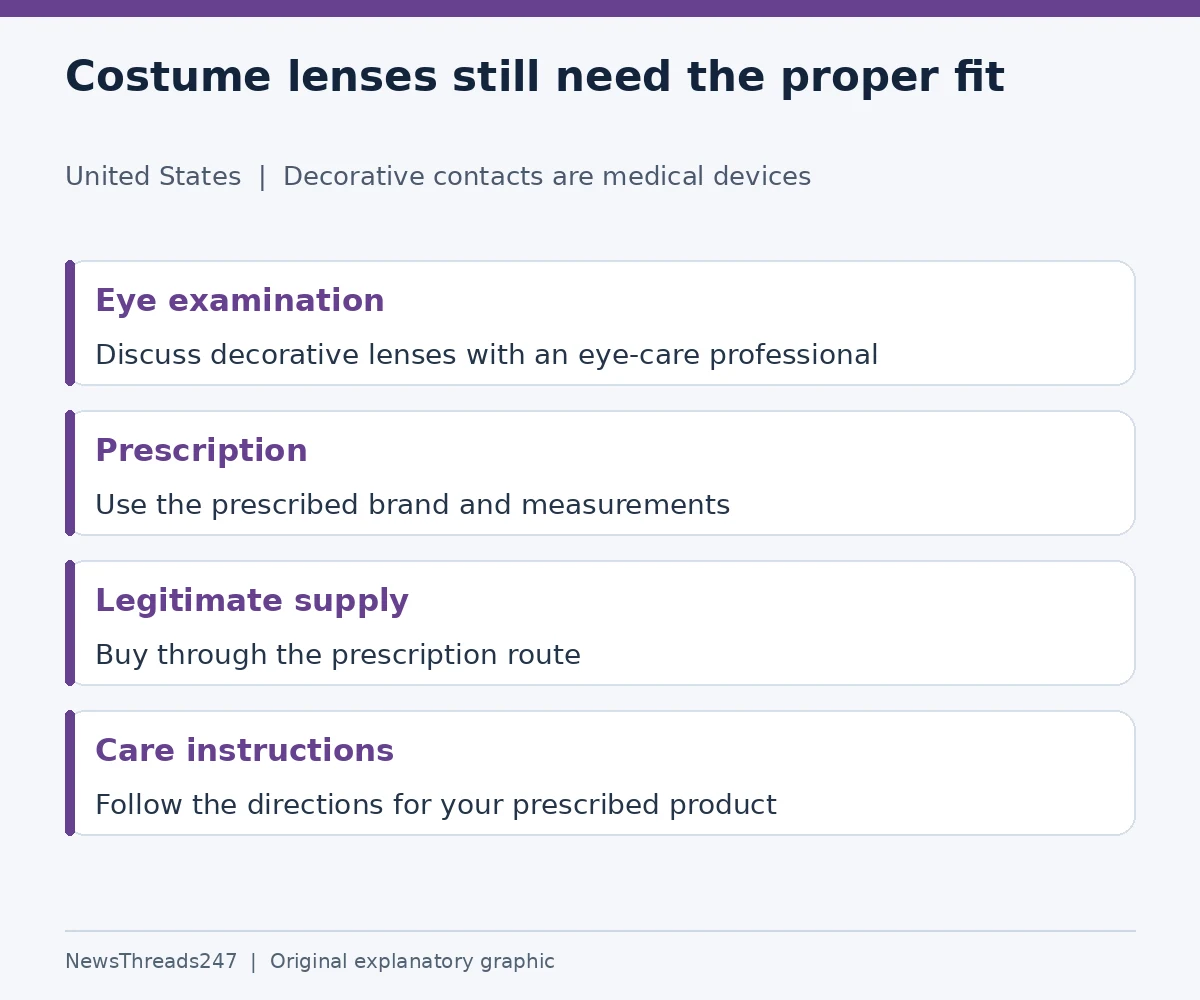
Decorative contact lenses need a prescription in the United States even when they do nothing to correct your vision. If Halloween is approaching and the proper examination, fitting and purchase cannot be arranged, choose a costume without contact lenses. A last-minute look is not a reason to bypass the prescription route.
The timing matters: Halloween is 31 October, and Prevent Blindness’s 24 September 2026 campaign release promotes October as Contact Lens Safety Month. That campaign is a current reminder. It does not mean the FDA introduced a new decorative-lens rule this October.
“Cosmetic” describes the effect, not an exemption
The FDA’s decorative-lens guidance treats these products as medical devices and says all contact lenses must be prescribed. Names such as costume, theatrical, fashion or Halloween lenses do not remove that requirement. The device still sits on your eye.
A product photo can show an effect you like; it cannot establish that a lens fits you. Likewise, “no vision correction” answers a question about purpose, not whether you need professional fitting. Keep those two questions separate when browsing a seller’s page.
Before ordering, tell the eye-care professional that you want decorative lenses rather than assuming an existing glasses prescription is the information a contact-lens seller needs. Let the clinician determine the appropriate examination and fitting. This article cannot assess whether a particular lens or wearing plan is suitable for your eyes.
Arrange the prescription before committing to the look
The FDA’s consumer update explains that the prescription identifies the lens brand, measurements and expiration. A seller’s promise that one design suits everyone is not a substitute for the details prescribed for you.
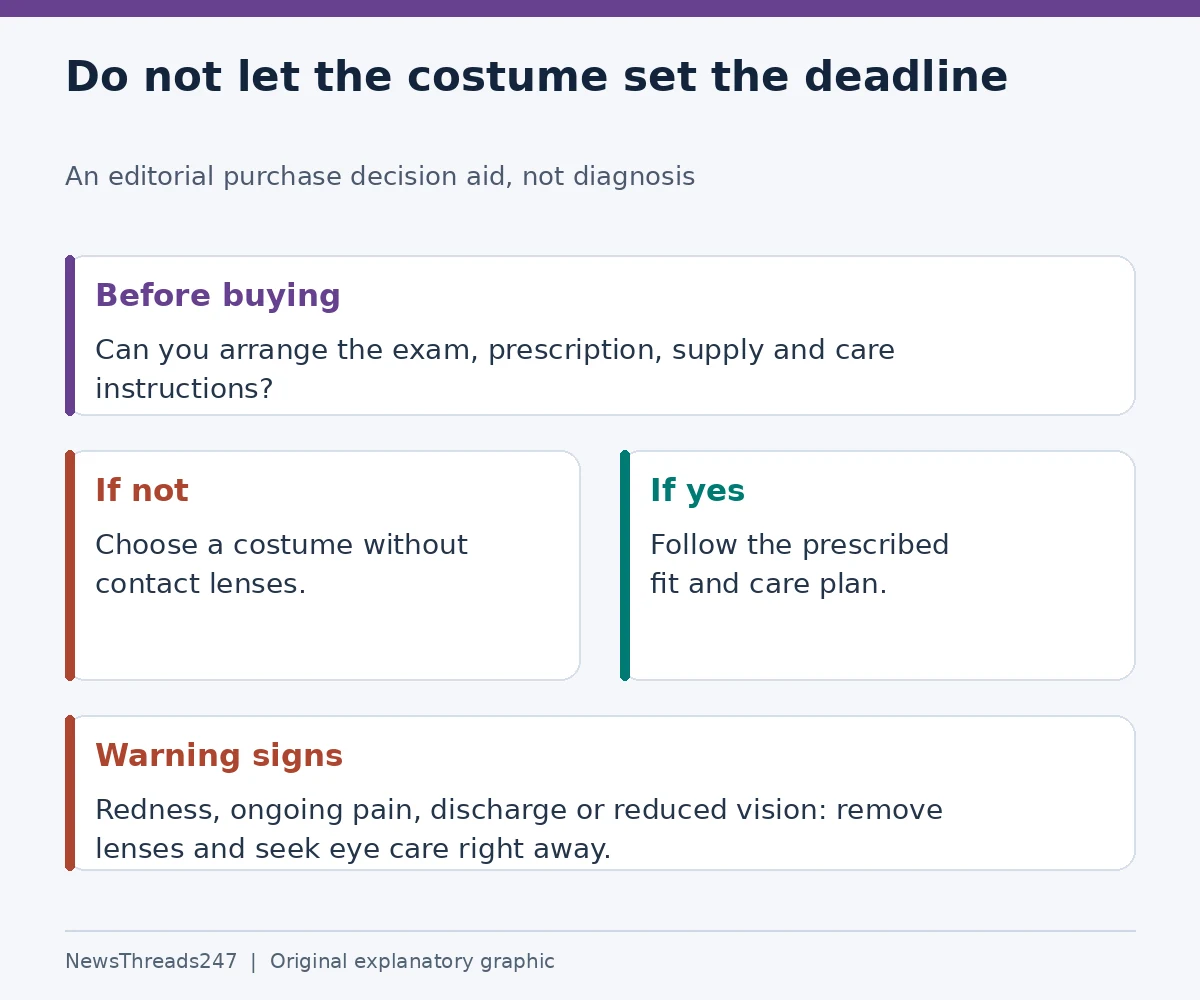
Make your costume plan in two versions: one that uses lenses only if the appropriate route is completed, and one that works without them. This small planning choice removes the pressure to treat delayed delivery or an unavailable appointment as something to work around.
For a fictional example, Alex finds a dramatic eye effect three days before an event but has not arranged an examination or fitting. Buying first and seeking reassurance later reverses the sequence. Alex can choose a mask, clothing or another costume feature without making contact-lens use a condition of attending.
Someone who already wears prescribed lenses also has a separate decision to make. A decorative product is not automatically interchangeable with the lens they know. Confirm the prescribed product and instructions instead of choosing by colour alone or assuming another person’s experience establishes suitability.
Check the seller and the care plan together
CDC’s decorative-contact guidance recommends licensed sources and a valid prescription. An attractive marketplace listing, a high review count or a claim of professional quality does not establish that the seller is following the prescription route.
Use the same attention for care instructions as for the purchase. Before the event, know which product you have been prescribed, how it is meant to be used and whom to contact with questions. If instructions are missing or unclear, ask the eye-care professional; do not improvise from a costume tutorial.
| Before you buy | Question to resolve | If unresolved |
|---|---|---|
| Examination and fit | Has a professional assessed the lens for me? | Choose the costume without lenses |
| Prescription | Does the purchase follow my prescribed product and details? | Clarify before ordering |
| Seller | Is this a legitimate prescription supply route? | Use an appropriate source |
| Care | Do I understand the product-specific instructions? | Ask before wearing |
This table is an editorial planning aid, not a clinical clearance checklist. Completing it does not establish zero risk. It helps identify the questions that should be answered by the professional and the legitimate supplier rather than by an event deadline.
Occasional wear still needs careful handling
CDC advises against sharing contact lenses, storing them in water or using water or saliva to clean them. It also warns against mixing fresh solution with old solution. Follow the prescribed product’s instructions and your eye-care professional’s advice; products and replacement schedules are not interchangeable.
“Only for one evening” can make a device feel like an ordinary costume accessory. Plan its care before leaving home instead. If you cannot follow the instructions in the setting you will be in, discuss that with the clinician or leave lenses out of the costume.
Keep the prescribed instructions available rather than relying on memory or a friend’s routine. Do not lend a pair to someone else who wants the same effect in a photograph. The fact that a lens is decorative does not make another person’s fit relevant to yours.
Warning signs need prompt eye care
FDA guidance says to remove the lenses and seek eye care right away for redness, ongoing pain or discharge; decreased vision is also a warning sign requiring prompt attention. Do not wait for the event to end to see whether the look is worth keeping.
These symptoms do not allow this article to diagnose what is happening. They do mean a costume guide or an online comment section is the wrong place to seek reassurance. Tell the eye-care professional which lenses you used, when symptoms began and what you have already done.
If you are uncomfortable about interrupting plans, decide in advance that eye symptoms take priority. Someone else can take the photograph later; professional care should not depend on finishing the party. There is no need to invent a home treatment or experiment with a different lens to test whether the problem goes away.
Keep the decision proportionate
Decorative lenses can change a costume, but the costume does not require them. Compare the time needed for the examination, prescribed supply and care instructions with the time actually available. If those steps cannot be completed, changing the look is a practical decision, not a failed celebration.
For parents or anyone helping another person choose a costume, share the prescription requirement early. Do not assume that a product placed beside makeup or party supplies follows the same rules as those accessories. The useful conversation is about the proper route before purchase, rather than a warning after the parcel arrives.
Sources and visual credits
FDA and CDC guidance was checked on 27 October 2026; the campaign date is attributed separately to Prevent Blindness. This US-focused article provides general information, not diagnosis, personal medical advice or a claim that prescribed lenses are risk-free. Alex is fictional. The featured image is AI-generated conceptual artwork; the two explanatory graphics are original NewsThreads247 illustrations, not clinical images.