
The Houston Rockets beat the Oklahoma City Thunder 119–98 on Saturday, 31 October 2026, with Jabari Smith Jr. scoring 30 points and grabbing nine rebounds. Marcus Smart added 24 points, while Houston hit 18 three-pointers to Oklahoma City’s 10. The final margin was 21 points.
The score is the headline; the interesting question is how Houston built and maintained its advantage. The NBA official game summary and Rockets’ game box score show a team shooting advantage, a strong first half and contributions beyond Smith. This is a scorecard-based analysis, not a fabricated arena interview.
Result and key player numbers
| Category | Houston Rockets | Oklahoma City Thunder |
|---|---|---|
| Final points | 119 | 98 |
| Half-time score | 62 | 51 |
| Three-pointers made | 18 | 10 |
| Top listed scorer | Jabari Smith Jr. — 30 | Shai Gilgeous-Alexander — 26 |
| Game venue | Toyota Center, Houston | Away team |
Smith shot 10-for-18 overall and 6-for-12 from three-point range according to the NBA account. He also had five assists. Smart made seven of his ten three-point attempts, a major addition to Houston’s outside scoring. Yet the result was not solely about one player becoming hot: the team held the Thunder below 100 and had multiple effective scoring stretches.
A quarter-by-quarter view
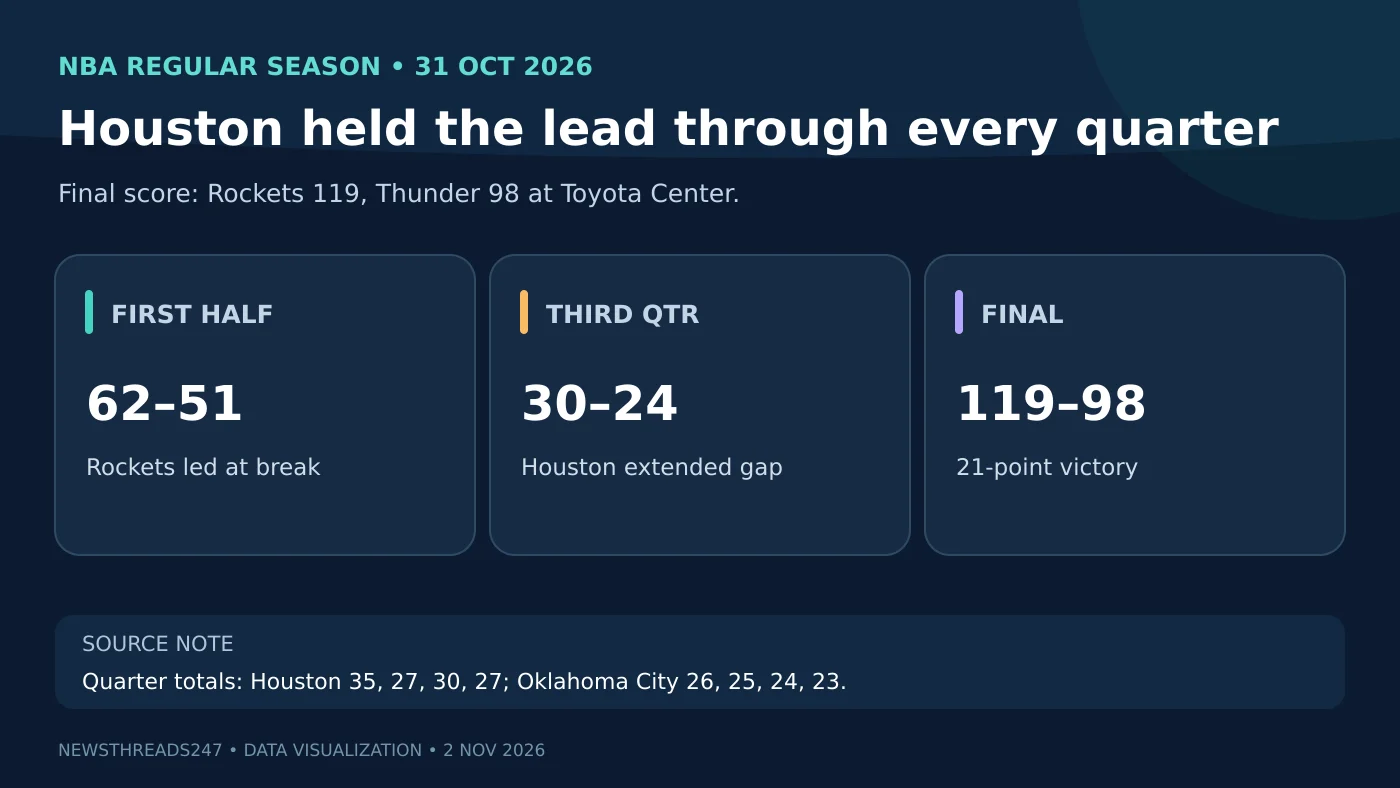
Houston won the opening quarter 35–26, the second 27–25, the third 30–24 and the fourth 27–23. The lead was 62–51 at half-time. The NBA recap describes an 18–4 Houston run in the second quarter that pushed a 37–30 advantage to 55–34 before Oklahoma City reduced the difference ahead of the break. These swings show how a final score develops rather than pretending the margin was constant from tipoff.
Houston then opened the third period with an 8–0 run and established another 19-point margin. The NBA reported that its lead did not fall below 12 afterward. It was a performance built on sustained pressure in more than one phase, not just a closing burst when the game was already decided. The quarter totals support the same general interpretation, while the official play-by-play provides the finer sequence.
The three-point scoring difference
Houston made 18 of 41 three-point attempts. Oklahoma City made 10 of 32. At three points per made shot, those totals translate to 54 points for the Rockets and 30 for the Thunder from beyond the arc—a 24-point difference. That is larger than the eventual 21-point victory margin, but it does not by itself explain every possession. Two-point scoring, free throws, turnovers and rebounding also contributed.
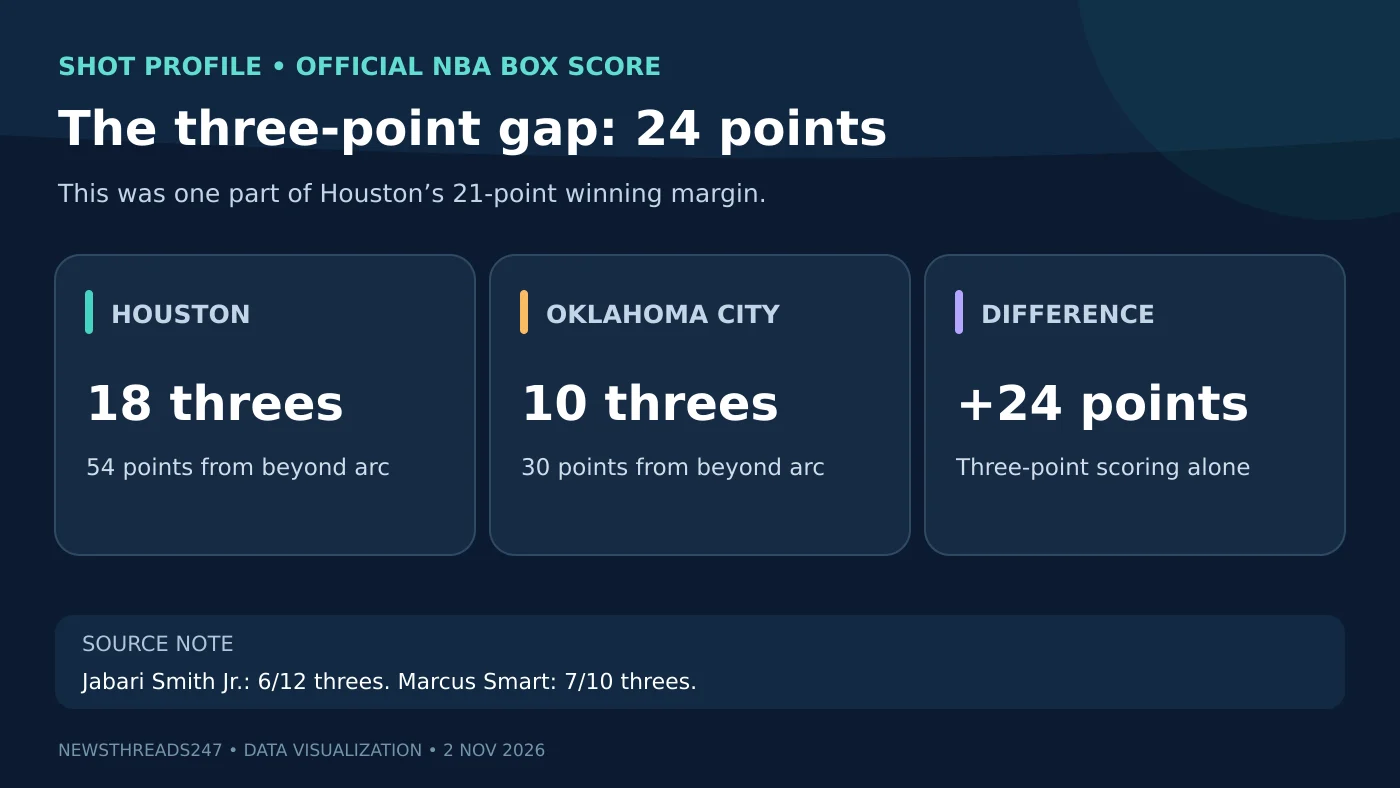
Smith’s six made threes and Smart’s seven together accounted for 13 of Houston’s 18 successful three-pointers. That concentration is noteworthy because the top two long-range contributors supplied much of the advantage. It would still be simplistic to say the Thunder lost only because of perimeter defence: the box score records the outcome, while a detailed film study would be needed for firmer causal claims about coverage choices.
The shooting percentages make the same comparison from a different angle. Houston’s 18 makes from 41 attempts work out to roughly 43.9% from three, while Oklahoma City’s ten makes from 32 attempts work out to 31.3%. Those are game percentages, not season trends. They matter because the teams attempted different numbers of shots; comparing only the eight-make gap without attempts conceals the efficiency difference.
Other contributors: Sengun, Durant and Gilgeous-Alexander
Alperen Sengun returned after missing two games with back soreness and recorded 16 points, nine rebounds and ten assists. Kevin Durant scored 14 for Houston. For Oklahoma City, Shai Gilgeous-Alexander led the scoring with 26 points, while other contributors had smaller totals. Smith was the leading scorer, but Sengun’s playmaking and Smart’s shooting help explain why the offence was not limited to isolations for one forward.
When comparing star performances, keep statistics in their correct unit. Ten assists are not a triple-double when a player has nine rebounds, even if that player was close; 30 points in one game is not a season average. NewsThreads247’s earlier Stephen Curry 44-point performance report covers another NBA result and should not be mixed into this contest’s numerical record.
What the game says about early-season form
The NBA recap said the Rockets moved to 6–1 and the Thunder to 4–2 after this result. Those are early 2026–27 regular-season records, not a final playoff standing or a guarantee of future performance. Houston’s ability to take a substantial lead and defend it is a positive single-game indicator; whether it persists requires more games, opponents and player-availability context.
Oklahoma City had begun the season with four wins before two consecutive losses, according to the recap. It also noted that Chet Holmgren was expected to miss at least two months with a right knee injury. That information belongs to the dated league report; no independent medical prognosis should be invented. If an official team statement subsequently changes the timeline, the article must be updated.
The final 21-point difference can be reconstructed quarter by quarter, which is a useful guard against a mistaken “late collapse” description: Houston gained nine in the first quarter, two in the second, six in the third and four in the fourth. The sum is 21. Oklahoma City narrowed a larger second-quarter deficit before the break, but Houston still won each complete period. Both statements can be true because point runs inside a quarter are not the same as the quarter’s net margin.
The next fixtures and what to recheck
The NBA recap listed Oklahoma City’s next game at Cleveland and Houston’s next game at home against Boston on the following Monday. Local dates and tipoff times can change in readers’ time zones, so the NBA official schedule remains the correct place to verify current details and broadcast access. Avoid claiming that a 21-point win proves Houston will beat Boston or that the Thunder cannot recover.
- Check the dated box score if you see a conflicting player total.
- Use official team or NBA injury updates for player availability rather than viral account speculation.
- Separate one-game percentages from season-long percentages.
- Keep the early-season records contextual rather than calling a standings race decided in November.
Common questions
What was the Rockets–Thunder result on 31 October 2026?
Houston won 119–98 at Toyota Center. It was a 21-point margin.
How many points did Jabari Smith Jr. score?
Smith scored 30 points with nine rebounds and five assists; he made six three-pointers on 12 attempts.
How many three-pointers did Houston make?
The Rockets made 18 threes compared with Oklahoma City’s 10, giving Houston a 24-point edge in points from three-point shots.
Did Alperen Sengun have a triple-double?
No. His reported line was 16 points, nine rebounds and ten assists, leaving him one rebound short of that statistical mark.
Bottom line
Houston’s 119–98 win was driven by multiple contributors, an early advantage and high-value outside shooting, with Smith’s 30 points at the centre of the individual story. The official NBA summary and box score support the numbers and should be used for any later correction.
Editorial check: 2 November 2026, IST. This report analyses an official completed-game box score. It does not claim live attendance, player interviews or future outcomes.
Visual disclosure: The feature image is an AI-created conceptual basketball scene without identifiable real players; the two companion images are original, accessible-data visualisations from published game statistics.