
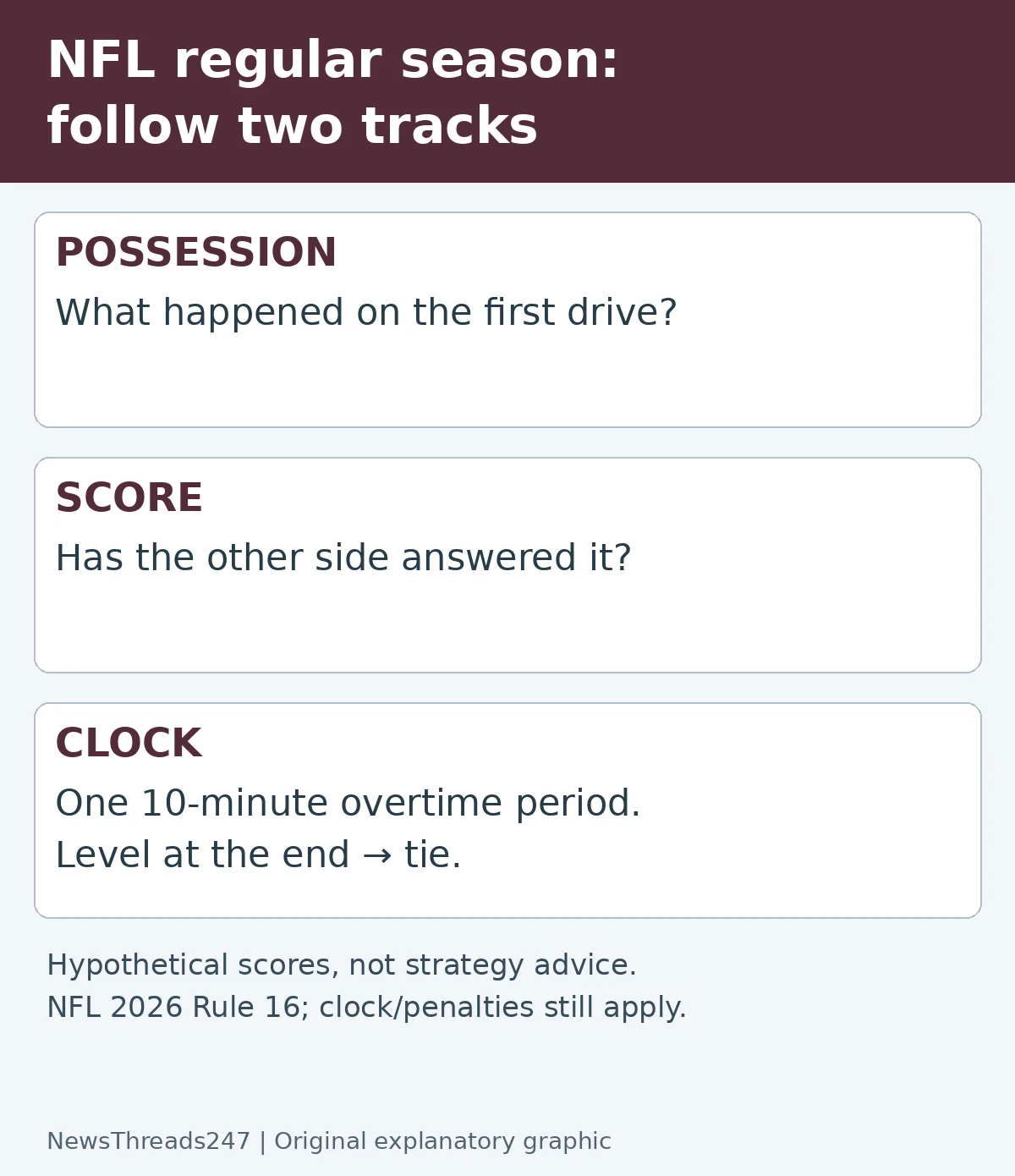
An NFL team scores a touchdown on the opening overtime drive, but the broadcast does not end. The opponent’s opportunity to answer is now central to regular-season overtime. So is a limit that short explanations sometimes omit: there is only one ten-minute overtime period.
For US viewers and new fans elsewhere, the clearest way to follow the finish is to track two things together: possession opportunities and time remaining. This explainer uses Rule 16 of the official 2026 NFL rulebook. It concerns the NFL, not college football or another professional league.
The regular-season rule in one short sequence
Rule 16 provides a maximum ten-minute extra period. Both sides have an opportunity to possess, subject to the clock and the opening-possession safety exception. Once those opportunities are resolved, the higher score wins; if the opening side does not score, or the sides remain level after their opportunities, the next score wins. A level score at the end of the regular-season period is a tie, even if the second opportunity is unfinished.
That final qualification matters. “Both teams get the ball” is a helpful shorthand for the change in approach, but it should not be interpreted as a guarantee of extra time after the period expires.
Example: an opening touchdown is a lead to answer
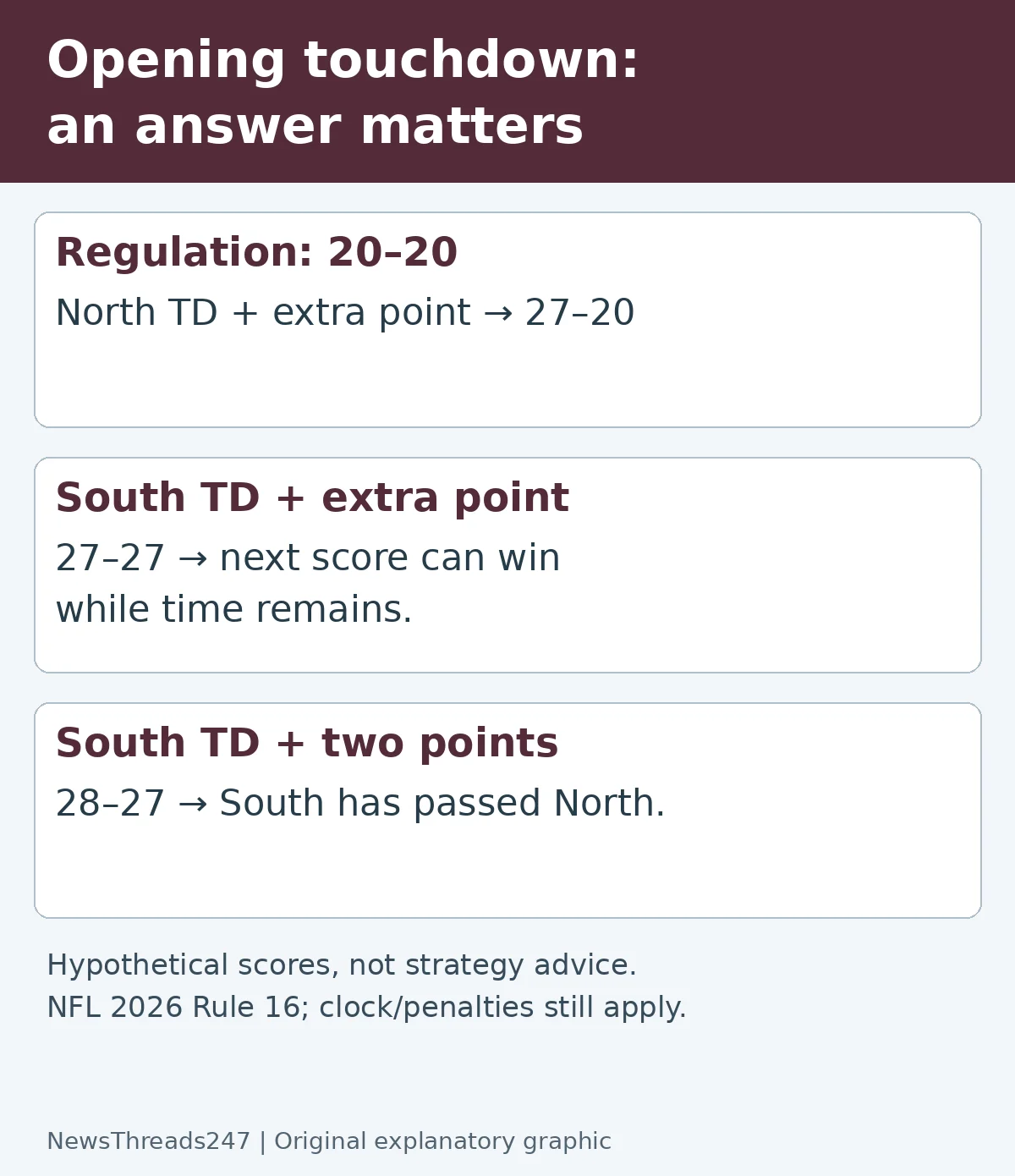
Use fictional teams North and South. Regulation ends 20–20. North receives and scores a touchdown, then makes the extra point: 27–20. South’s answer now needs to be understood against that seven-point lead, with the remaining overtime clock still running.
If South scores a touchdown and makes its extra point while time remains, the score becomes 27–27. Neither side has won merely by matching. The next score decides the game unless the period expires level. If South instead adds a successful two-point conversion, the arithmetic produces a different result: 28–27.
These examples explain scoring sequences, not recommended strategy. The choice to kick or attempt two points depends on circumstances this article is not modelling. Do not turn an illustration into a claim that one choice is universally best.
Example: a field goal leaves a different answer
Suppose North instead kicks a field goal on its opening possession: 23–20. If South answers with a touchdown, South has passed North’s score. If South answers with a field goal, the scoreboard is level again and the next score can decide it while time remains.
If South fails to score and its opportunity legally ends, it has not matched North’s lead. A turnover play can involve further action, points or penalties, so wait for the play and ruling to finish rather than declaring the outcome at the first sight of a loose ball.
For explaining a highlight, write the score before the drive and the score after it. “They scored next” is incomplete until you know whether the opponent’s initial scoring possession still entitled the other side to respond.
A scoreless opening drive changes the sequence
Now imagine North receives, does not score, and punts. South can win with a score; it does not have to produce a touchdown simply because this is overtime. The opening side’s failure to score is an important branch in the rule, not a reason to wait mechanically for two complete offensive drives before recognizing a winner.
This is why a useful notes sheet contains more than “first team” and “second team.” Record the result of the first opportunity as touchdown, field goal, or no score. Then follow the actual possession change and clock.
The ten-minute limit can decide what is possible
Consider a hypothetical first drive that leaves only a short amount of time. The team answering has to operate inside that remaining period. It cannot treat its opportunity as a fresh ten-minute allotment. If the clock ends with one side ahead, the scoreboard and applicable rulings matter; if it ends level, the regular-season game is tied.
A tie is therefore a permitted result, not an administrative error requiring an automatic second period. Do not promise another drive simply because a viewer thinks each team should get the same number of plays. The rule describes possession opportunities and a time limit, not equal play counts.
The distinction also prevents confusion between game time and broadcast duration. Ten minutes of game clock is not a promise that the television segment lasts ten real-world minutes. Stoppages and normal administration still exist.
Playoffs do not use that tie-ending limit
Postseason overtime uses fifteen-minute periods and continues as necessary to determine a winner. Rule 16 also preserves the second team’s unfinished initial opportunity across a period ending. Do not apply the regular-season “one period, possible tie” conclusion to a playoff game.
Before sharing an explanation, establish the season and game type. Older explainers may describe an opening-touchdown finish under a previous regular-season rule. A search result’s recent crawl date does not make its original rule description current.
A compact way to follow the next overtime
Write down the opening recipient, first opportunity’s result, current score and time left. Update the row when the other team’s opportunity ends. Add any officials’ ruling before describing the winner. That simple record is usually more useful than trying to memorize an old slogan about sudden death.
Keep exotic penalty situations tied to the actual ruling and the detailed rulebook. This guide does not claim to replace officials or cover every possible double change of possession. Its purpose is to prevent the common mistake of separating the possession rule from the clock.
Source and visual credits
Primary reference: NFL 2026 rulebook page and the linked PDF, Rule 16, printed pages 64–65. All teams, scores and sequences in this guide are hypothetical, not reports of real games or betting advice. Featured artwork is AI-generated conceptual illustration, not event photography; both diagrams are original explanations.