
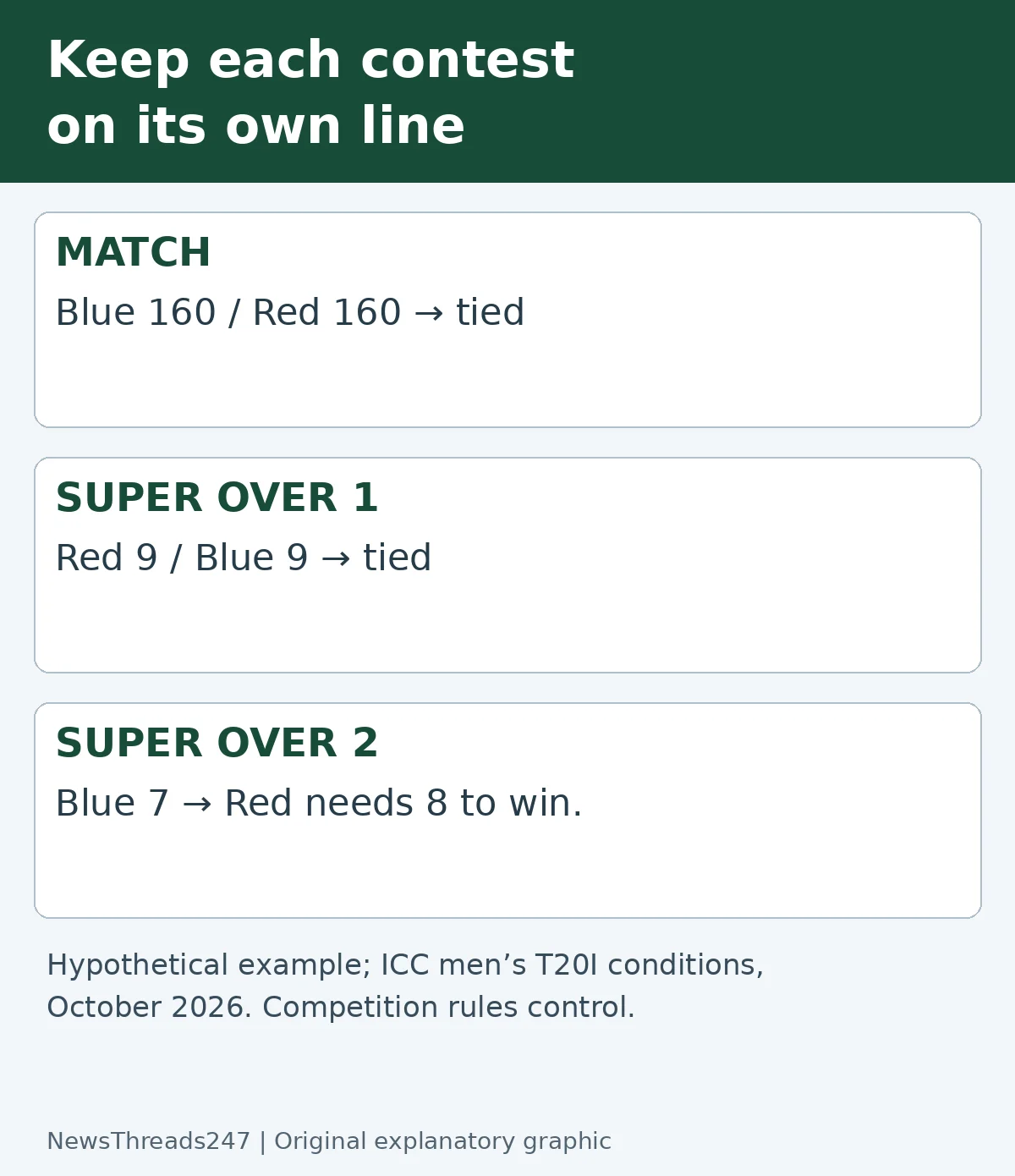
The match finishes level. Then the Super Over finishes level too. That does not mean adding the two mini-innings to the original scoreboard and looking for a new net run total. The next Super Over is another contest, with its own chase and restrictions on who can take part.
This guide uses the ICC men’s T20I playing conditions effective October 2026, especially clause 16.3 and Appendix F. It is written for viewers in India and elsewhere following men’s international T20 cricket. Do not apply it automatically to the IPL, a women’s tournament or a local match; read that competition’s conditions.
Identify which scoreboard you are watching
Keep a separate line for the completed match and each Super Over. The match tie triggers the procedure; the Super Over scores decide that short contest. If that contest also ties, the relevant subsequent procedure applies rather than an improvised calculation using the original innings.
A useful viewer note has four fields: contest number, side batting first, first-innings score, and runs required in the chase. Write “SO1” and “SO2” explicitly. It prevents a broadcaster’s switch between graphics from making an old target look current.
The core procedure in brief
Under Appendix F, each team faces an over of six balls, unless its innings ends earlier; losing two wickets ends that innings. Greater runs decide the winner, irrespective of wickets lost. The side that batted second in the match bats first in the initial Super Over. A further tie normally leads to further Super Overs, subject to the conditions’ exceptional time and interruption provisions.
For a hypothetical example, Blue and Red each finish the match with 160. Red batted second, so Red bats first in SO1. If Red makes 9, Blue needs 10 to win that contest. Nine would only draw it level. These are fictional scores chosen to show the arithmetic, not a report of a match.
Now suppose Blue reaches 8 and loses a second wicket. The chase is over even if balls remain; eight has not passed nine. You do not grant the side another batter because it still has deliveries left. Conversely, the side scoring more runs is not penalized merely because it lost more wickets.
When the next Super Over needs different players
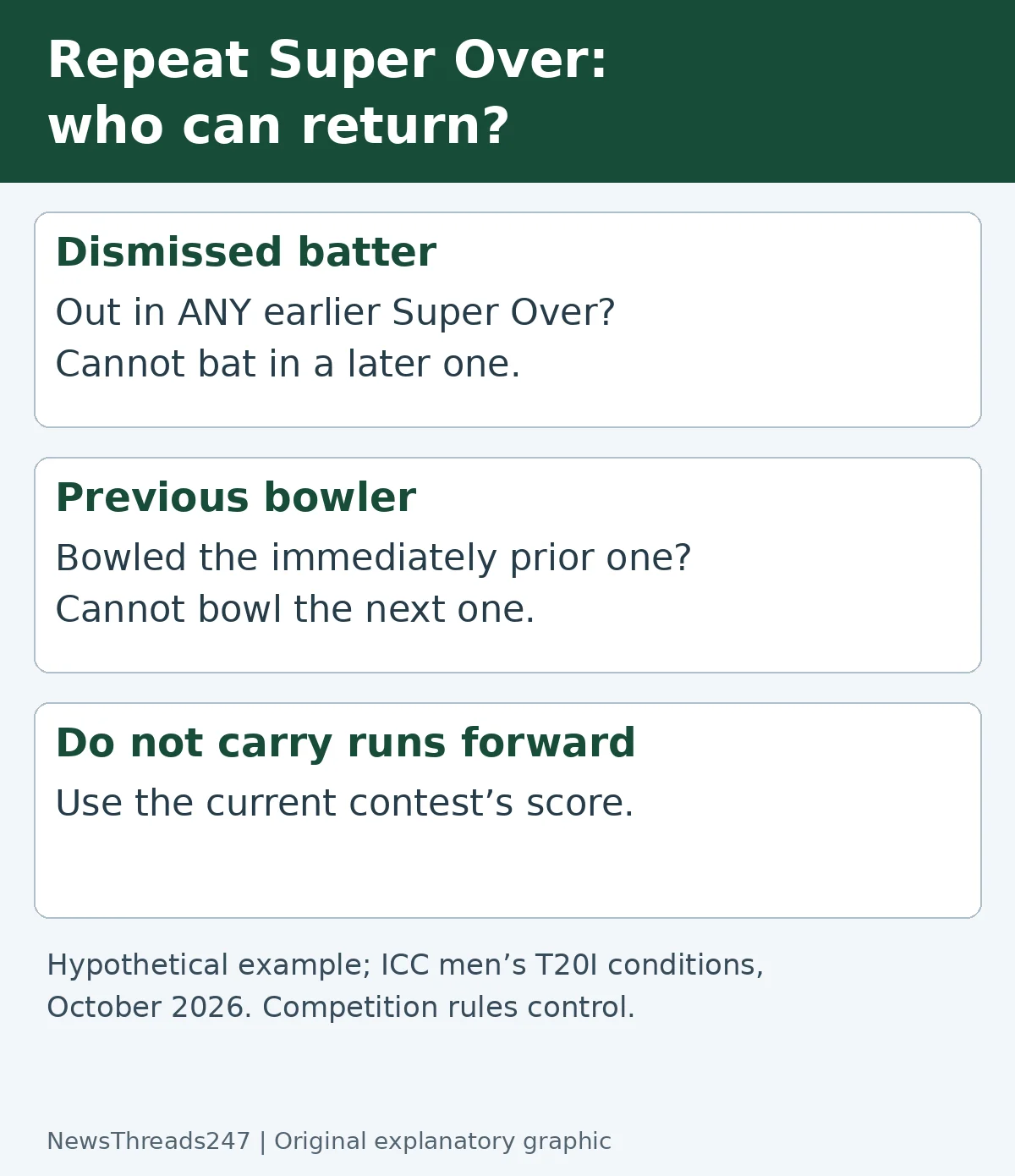
The October 2026 conditions say a batter dismissed in any earlier Super Over is ineligible to bat in a later one. The bowler from the immediately preceding Super Over cannot bowl the next. The team batting second in the previous Super Over bats first in the next; the bowling end changes, and each side reuses its selected ball.
Those restrictions have different memories. “Any earlier” for a dismissed batter and “immediately preceding” for the bowler are not the same test. Keep names against each contest rather than trying to remember only who appeared most recently.
In a fictional eligibility record, batter R1 is dismissed in SO1 and R2 finishes unbeaten. Do not put R1 back into the next batting selection merely because the team wants its strongest hitter. If bowler B1 bowls SO1, the next over needs a different bowler. This explains the checks, not who a particular team should select.
A tied example without carrying runs forward
Return to Red’s 9 in SO1. If Blue also finishes with 9, start a fresh SO2 record. Blue batted second in SO1, so it bats first now. Suppose Blue makes 7 in SO2. Red needs 8 in that chase. It does not need to beat 16, the sum of Blue’s two short innings.
Why does that matter? A running total can accidentally turn two separate chances into one invented match. The score that matters to Red’s SO2 chase is the completed first innings of SO2. Keep the earlier line to explain why SO2 happened, not to set its target.
The same clarity helps when discussing tactics. Saying “Blue already scored nine” describes SO1 history. Saying “Blue has set seven” describes the current contest. A precise explanation names the contest before comparing the numbers.
Why a tie may still remain a tie
The conditions allow a tie if the necessary Super Overs cannot be played or completed, and permit the referee to limit their number for unavoidable time constraints with notice to captains before the first. “Keep repeating” should therefore not be read as a promise that play can continue indefinitely regardless of weather or venue constraints.
For a live match, look for the officials’ announced arrangement. Check the announced cutoff and reserve-day arrangement for this match. A screenshot of an old competition document is not enough to establish the current match’s time allowance.
An abandoned procedure is also not permission to revive a different historic tiebreak method. Older official webpages can remain online with superseded wording. The current competition document should settle which procedure is in use.
What to check before explaining a live finish
Start with format and competition, then the document version. Establish whether the match is tied, whether a Super Over has been completed, and which short innings the graphic shows. Check player eligibility only after you have a record of previous dismissals and bowlers.
A rain-adjusted match creates another potential mix-up: par and target are different numbers. Our DLS par-score guide explains that distinction. Do not use a Super Over explanation as a substitute for establishing the original match result correctly.
Source and visual credits
Reference: ICC current playing-conditions index and the linked October 2026 men’s T20I PDF, clause 16.3 and Appendix F, printed pages 100–101. This is an original viewer explainer; all score and player examples are hypothetical. The featured image is an AI-generated cricket illustration, not event photography. Both diagrams are original explanatory graphics.