
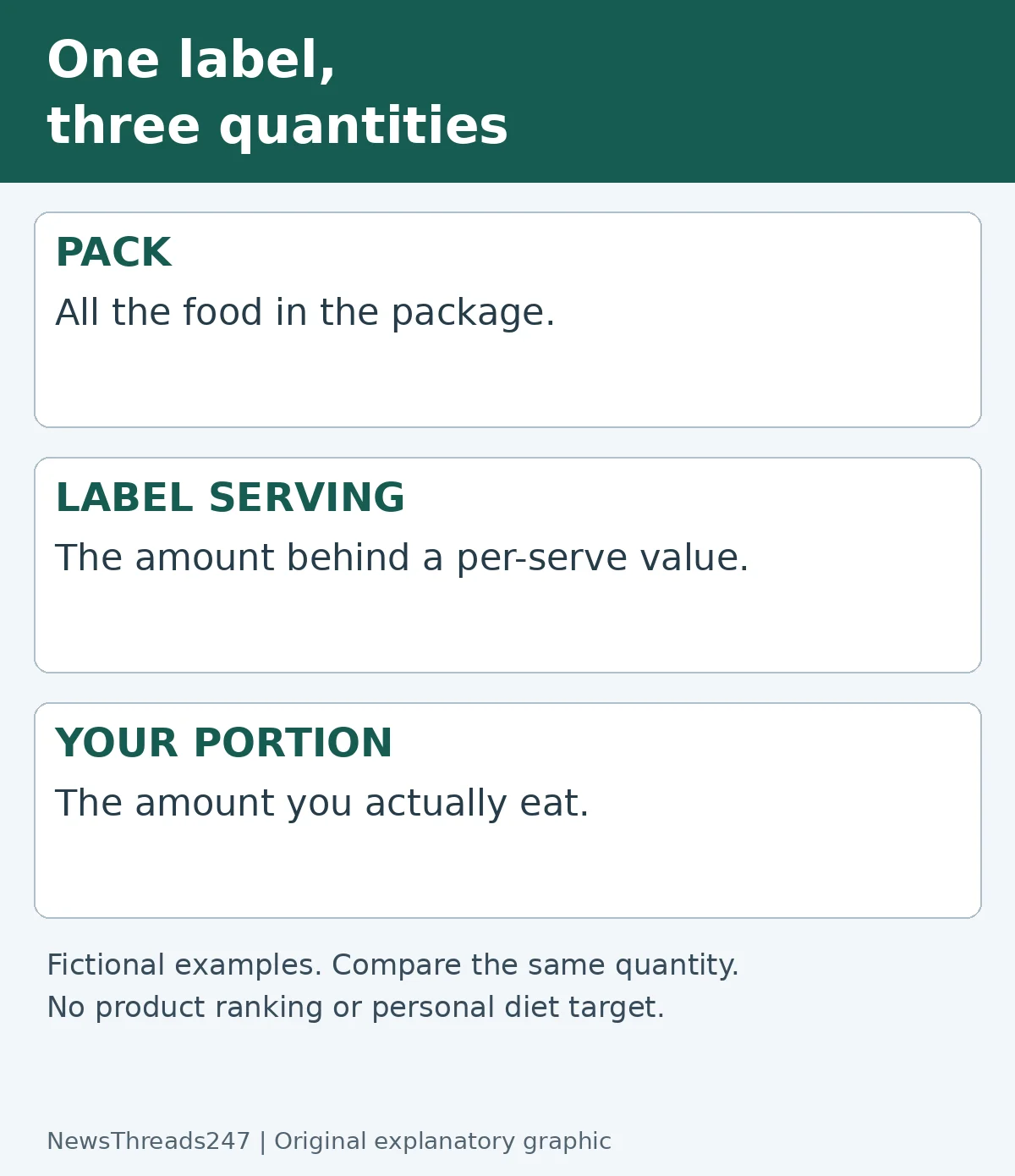
One snack lists 120 kcal per serving; another lists 450 kcal per 100 g. The first number looks smaller, but the two labels have not yet answered the same question. You need the serving weight before you can compare them.
For shoppers in India, a practical label check has two stages: compare similar products on an equal quantity, then work out the amount in your own portion. A 100 g reference is a comparison tool, not an instruction to eat 100 g of everything.
Find the quantity beside the nutrition number
FSSAI’s Eat Right India label guide asks consumers to check serving size, net weight and the basis of the nutrition information. A packet can contain more than one labelled serving. Keep the number and its unit together: “120 kcal” is incomplete for comparison unless you also know what quantity it describes.
Look for grams (g) for a solid or millilitres (ml) for a liquid, and check whether the panel describes the product as sold or after preparation. Do not compare a dry powder with a made-up drink without accounting for what is added. Read the actual package rather than treating an online thumbnail as the final label.
Separate net pack quantity from serving quantity. A 200 g pouch may display nutrition for 25 g. Neither number is inherently wrong; they serve different purposes. The mistake is reading a 25 g value as though it describes all 200 g.
A smaller headline number can reverse the comparison
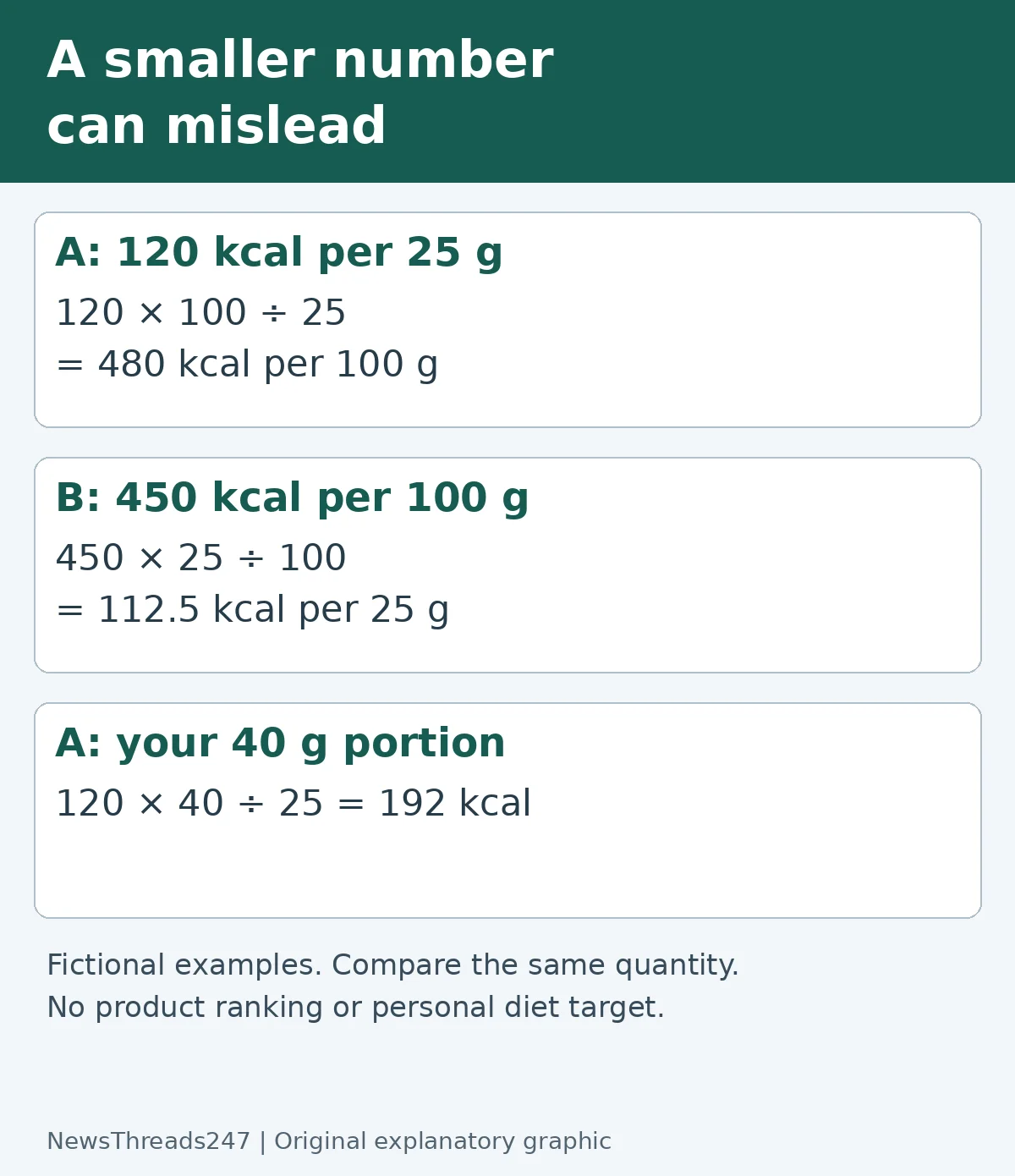
Here is an entirely hypothetical example, not a comparison of brands. Product A supplies 120 kcal per 25 g. Product B supplies 450 kcal per 100 g. Convert A to the same 100 g basis: 120 × 100 ÷ 25 = 480 kcal per 100 g.
On that equal-weight comparison, A has 480 kcal and B has 450 kcal. The apparently smaller 120 did not establish that A had less energy for the same quantity. At 25 g, B would provide 450 × 25 ÷ 100 = 112.5 kcal. Both calculations answer the same question from opposite directions.
The arithmetic does not establish that B is a universally better food. Ingredients, other nutrients, allergies, price and the purpose of the food remain separate considerations. This worked example isolates the denominator so a serving-size difference cannot silently decide the comparison.
Now calculate your actual portion
Use this formula for a value stated per 100 g: amount in your portion = label value × portion weight ÷ 100. For a value stated per serving: amount consumed = label value × number of those servings consumed. Use the same unit throughout.
If A’s portion is 40 g, its energy in that portion is 120 × 40 ÷ 25 = 192 kcal. If you eat the full 200 g pouch, there are eight 25 g servings, so the illustrative total is 120 × 8 = 960 kcal. Do not use the 120 figure for both a small bowl and the whole pouch.
A kitchen scale can help you understand an unfamiliar portion once. You can then use a familiar bowl or measure consistently if that suits your routine. Precision beyond the label’s own rounding is not the goal; noticing that your bowl is substantially larger than the stated serving is useful in itself.
The method works for nutrients as well as energy
Suppose a fictional label lists 6 g of total sugars per 30 g serving. For a 45 g portion, the amount is 6 × 45 ÷ 30 = 9 g. If a different product gives sugars per 100 g, convert to an equal basis before comparing.
Compare the same row: total sugars with total sugars, added sugars with added sugars, sodium with sodium. Do not treat sodium and salt as interchangeable labels or silently substitute one for the other. Where the units or definitions differ, stop and resolve that difference before doing arithmetic.
A daily-percentage figure answers another question again: how the labelled amount relates to the reference used on that label. Read its basis. It is not a personalized allowance for every child or adult. This guide does not prescribe an individual calorie target or a medical diet.
Check preparation instructions before judging the result
Consider a breakfast powder sold dry but prepared with milk. A per-100 g dry value describes the powder quantity shown. If your drink includes milk or sugar, those additions change what is in the cup. Conversely, water changes the finished weight without adding the same nutrients as milk.
A fair comparison needs a clear boundary: powder alone, or both drinks prepared the same way. Write that boundary beside your numbers. If the two manufacturers’ “prepared” examples use different ingredients, compare their as-sold panels or calculate a common preparation from verified ingredient information instead.
The same caution applies to cooking and draining instructions. Do not assume millilitres and grams, or dry and cooked weights, are interchangeable. Use the product’s declared basis and a suitable verified measurement; otherwise keep the comparison limited.
A simple shopping note that prevents repeat confusion
Use four columns: product and comparable category; label basis; value converted to a common quantity; amount in your intended portion. Add price per comparable quantity separately if you need a cost comparison. A nutrition calculation does not automatically establish the better-value purchase.
For example, your note might read “A: 120 kcal/25 g → 480 kcal/100 g → 192 kcal/40 g portion.” That line preserves the original data, the comparison and the personal portion calculation. If you later notice the serving was 30 g rather than 25 g, you can correct the calculation instead of relying on a remembered headline.
Storage and handling are separate checks. For cooked food, our leftovers refrigeration guide covers prompt cooling and storage decisions. A careful nutrient calculation cannot make a damaged or improperly stored product safe.
Sources, examples and visual credits
Primary guidance: FSSAI Eat Right India: How to Read Labels. All product figures here are fictional teaching examples, independently checked with the stated formulas; they are not laboratory results, product reviews or dietary recommendations. This article explains arithmetic and consumer reading, not the legal compliance of a particular label. Featured illustration is AI-generated; both diagrams are original explanatory graphics, not package photographs.