
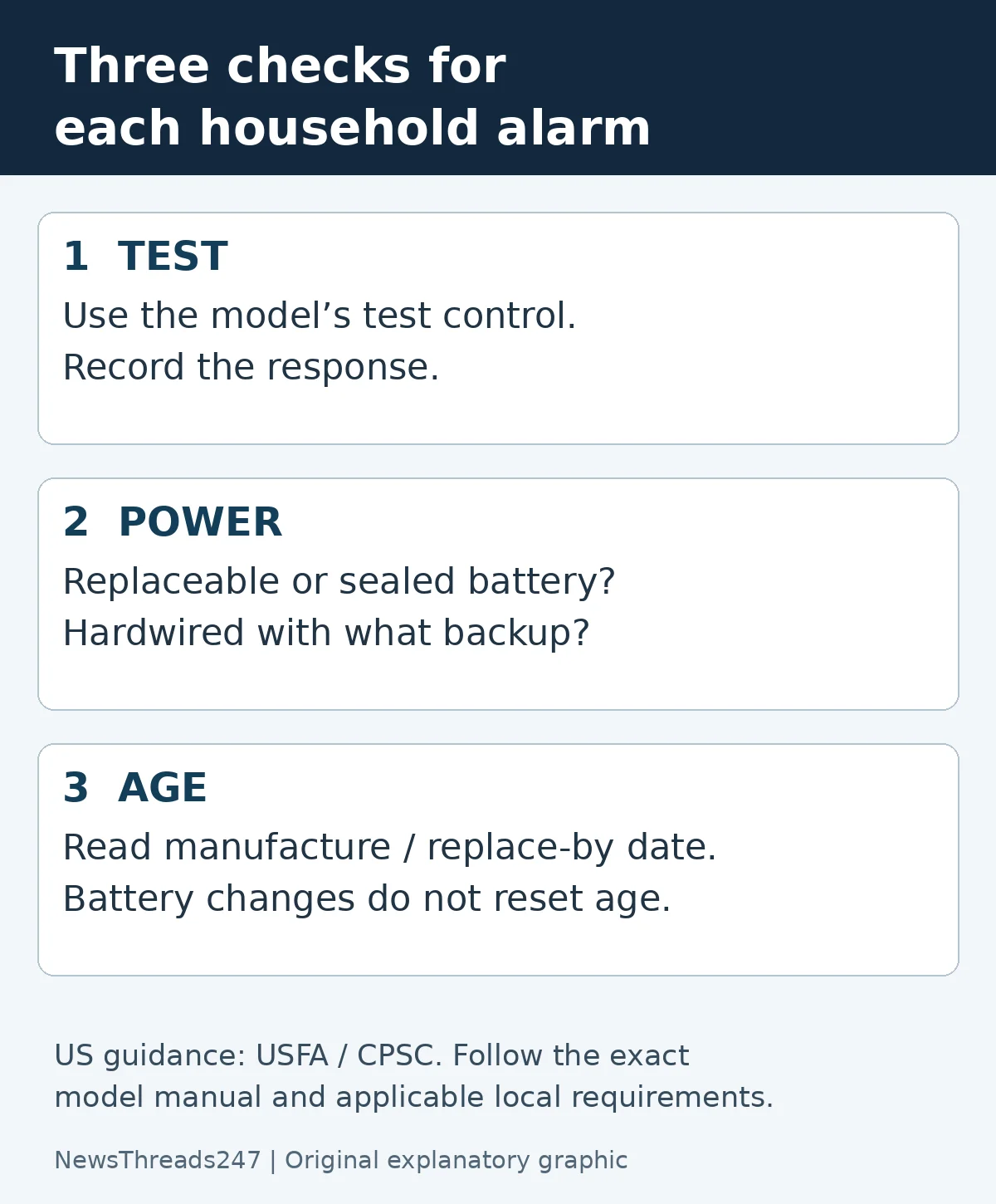
A new battery cannot make an expired smoke alarm young again. And a sealed-battery alarm may have no battery compartment you are supposed to open. Before buying a multipack of batteries for the November clock change, identify what is actually fitted in your home.
For US households, the useful check has three parts: test the alarm, check its power arrangement, and read its replacement date. Smoke and carbon monoxide (CO) alarms serve different purposes; a unit protects against both only if it is a combination model. This guide covers household alarms, not the maintenance of a building’s professionally managed fire-alarm system.
NIST confirms that daylight saving time ends on November 1, 2026, at 2 AM local time, when clocks return to 1 AM in participating areas. Hawaii and most of Arizona do not make that change. You can use the date as a maintenance reminder wherever you live, but it is not the alarm’s service interval.
Start with an alarm-by-alarm record
Walk through the home and record each alarm separately. A hallway unit and a bedroom unit may look similar while having different manufacture dates or power supplies. A receipt for one replacement does not establish the age of the others.
Make a simple note with these fields: room, smoke/CO/combination, manufacturer and model, manufacture or replace-by date, battery type, last test, and action needed. Photograph the label only if you can reach it safely and the manufacturer’s instructions explain how to access it. Arrange help rather than balancing on furniture or disturbing wiring.
Keep the record somewhere another household member can find. The immediate benefit is practical: the next person hearing a chirp can locate the correct manual instead of guessing what the sound means. A move-in date is not a reliable substitute for a manufacture date.
Match the maintenance to the power supply
The US Fire Administration distinguishes replaceable-battery, long-life-battery and hardwired smoke alarms. It recommends monthly testing. For conventional 9-volt battery alarms, its general guidance is battery replacement at least annually; hardwired alarms commonly need backup-battery maintenance too. Always use the battery specified for the actual model.
A sealed long-life unit is a different decision. Do not pry it open to force in a fresh battery. Follow its replacement instructions when it gives a low-power or end-of-life indication. “Ten-year battery” describes the intended product arrangement; it does not mean you can ignore testing or a warning before ten years.
Hardwired does not mean maintenance-free. Identify whether the backup is replaceable or sealed and follow that model’s instructions. If replacement involves mains wiring, the USFA says hardwired smoke-alarm installation should be done by a qualified electrician. An internet guide cannot establish connector compatibility for your existing circuit.
Check the whole alarm’s age
USFA’s household smoke-alarm guidance calls for replacement ten years from the manufacture date. Changing the battery does not restart that clock. If a label says the unit was manufactured in October 2016, October 2026 is ten years later—even if you installed a fresh battery last month. This is a worked date example, not an inspection of any reader’s equipment.
Do not apply one universal lifespan to every CO or combination alarm. Kidde’s replacement guidance, for example, gives seven to ten years for its CO and combination alarms depending on model and directs owners to the manual. That is a manufacturer-specific example, not a guarantee for other brands.
Where the age cannot be established, ask the manufacturer about the model and replacement. Record uncertainty as uncertainty. Do not convert “we bought the house five years ago” into “this alarm has five years left.”
A test, a chirp and an emergency are different situations
For a routine test, use the test control according to the instructions and check the expected response. The CPSC recommends monthly smoke and CO alarm testing. A failed test requires prompt action; a calendar reminder should not leave a nonworking unit in service until next weekend.
For a chirp or a fault message, find the signal description in the exact model’s manual. Do not assume every brief sound means the same thing across brands. Replacing a battery repeatedly is not a sensible plan if the model is reporting end of life.
An emergency smoke or CO warning is not the moment to search for battery discounts or dismantle the unit. Follow the emergency instructions, leave the building, and call 911 from outside. Do not stay indoors trying to locate an invisible CO source or re-enter until responders say it is safe. The CPSC’s carbon monoxide fact sheet explains the response to a CO alarm.
Turn the check into specific actions
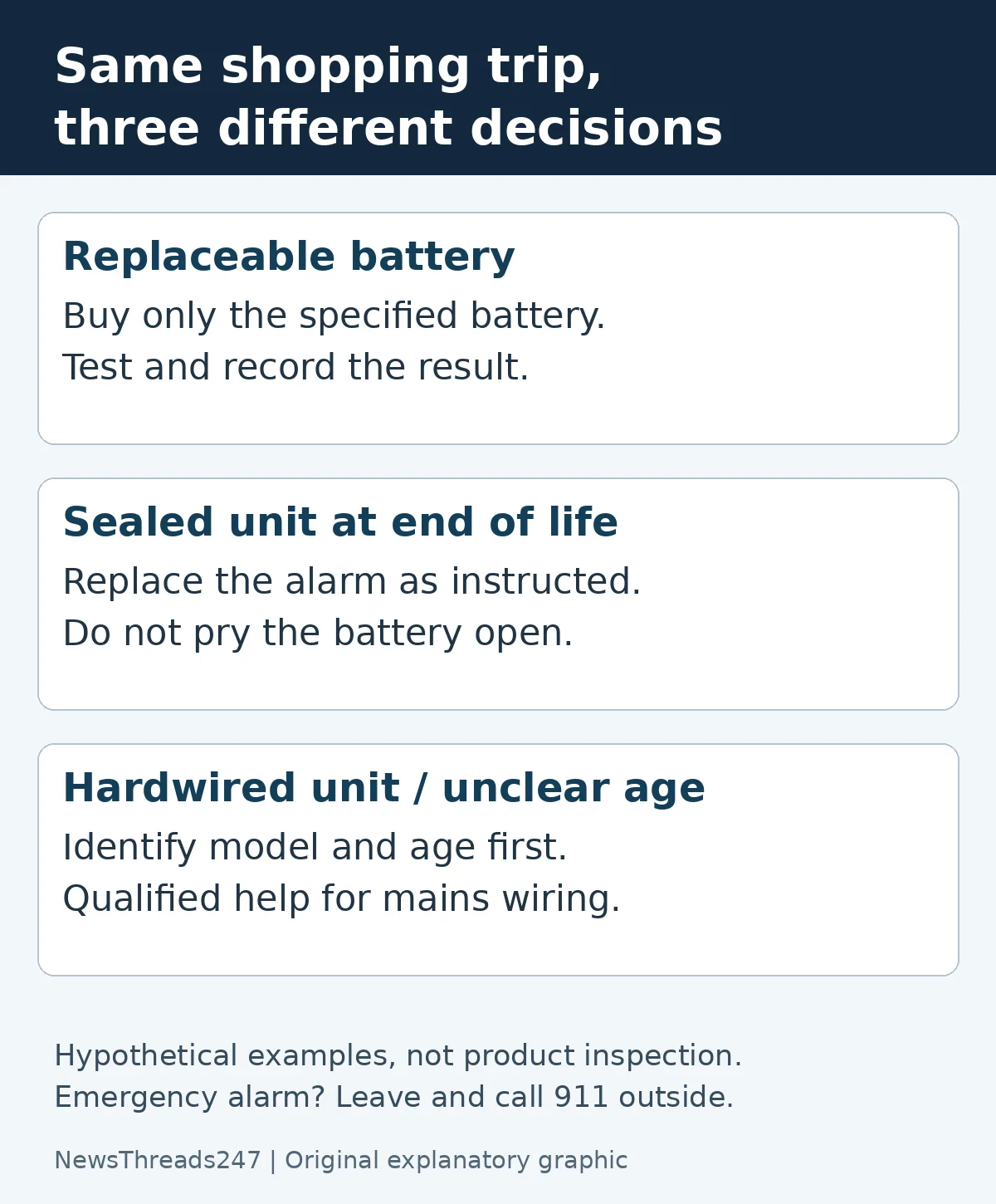
Consider a hypothetical household with three different units. A replaceable-battery bedroom smoke alarm needs its specified battery and a recorded test. A sealed hallway alarm reporting end of life needs unit replacement following its instructions. A hardwired combination alarm with an unreadable age label needs model identification and qualified help where wiring is involved. Buying the same battery for all three solves none of those distinctions.
If you rent, send the landlord or property manager a clear written report: location, model if readable, date of failed test or warning, and the action requested. Do not invent your local legal deadline from national advice. Building requirements and responsibility vary; the local fire authority can clarify applicable requirements. Keep a copy of the report and the response.
Check whether everyone can hear and respond to the warning. The USFA notes that alarms with flashing lights or vibration are available for people with hearing loss. Discuss suitable equipment with the fire department or an appropriate installer rather than assuming a phone notification provides equivalent protection.
What to finish before putting the ladder away
End with an action list, not simply “alarms checked.” Record which units passed, which batteries or units were replaced, which issues need professional help, and the next test reminder. Keep installation and replacement details with the model manual. If a unit has failed, resolve that loss of protection promptly rather than treating a note as the repair.
Smoke and CO alarms also do a different job from a household air purifier. Our air-purifier buying guide explains filtration decisions; it should not be used as a substitute for alarm selection or emergency protection.
Sources and visual credits
Sources: NIST daylight saving rules; USFA smoke-alarm guidance; CPSC CO alarms; Kidde model-dependent replacement guidance. This is general US household safety information, not a remote inspection or a statement of local code compliance.
Visual credits: featured image is an AI-generated conceptual illustration, not a photograph or a depiction of a named alarm model. Both diagrams are original editorial graphics; they do not replace installation instructions.