
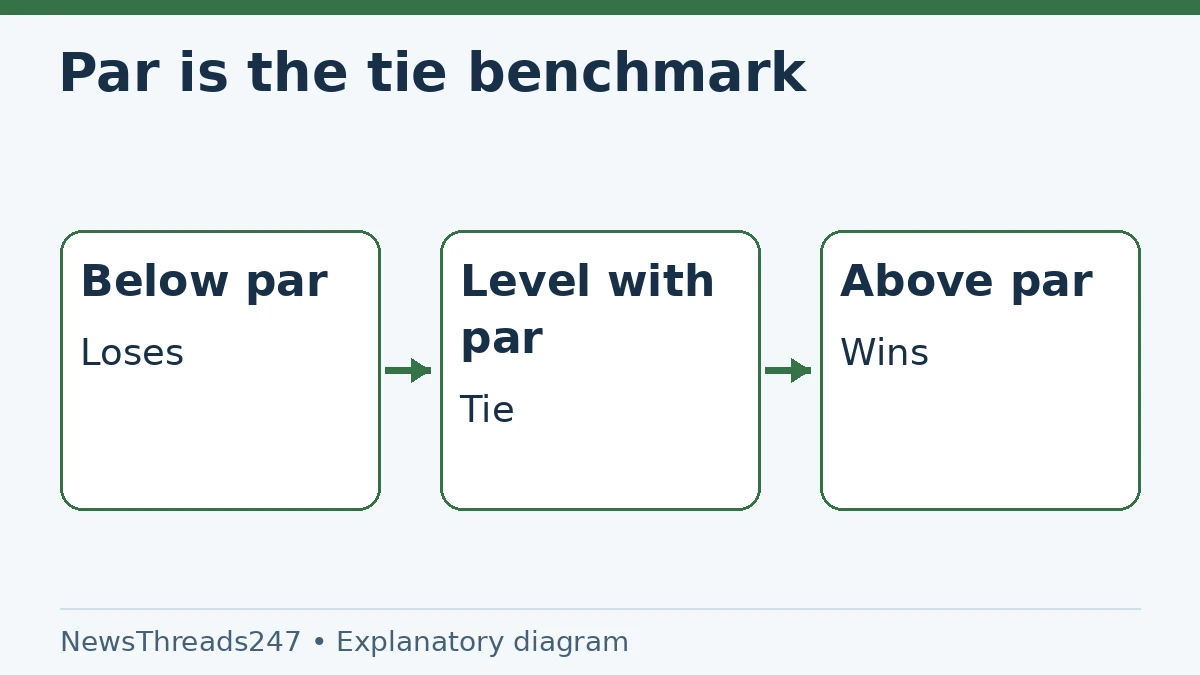
The rain arrives with the chasing team on the number labelled ‘par’. Have they won? Being level with the applicable par score means a tie at that point if the rules permit an abandonment result. The winning target is one run above the relevant tie benchmark. Those labels are close enough to confuse viewers and different enough to change the result.
First ask whether play will resume or the chase has ended permanently. Then read the official target or par score for the exact match state. This guide uses the ICC men’s standard ODI and T20I playing conditions effective October 2026, checked on October 26. Tournament, women’s and domestic playing conditions must be checked separately.
Target and par answer different questions
The current ICC men’s ODI conditions, clause 16.4.1, describe a revised whole-number target for an interrupted chase; one run less constitutes a tie. That is the score the second team aims to reach to win within its available innings.
Clause 16.4.2 addresses a chase that is suspended and cannot resume. Subject to the applicable result requirements, its score is compared with the DLS par score at the instant of suspension. Above par wins, level is a tie and below par loses. The winning or losing margin is the difference in runs, not the number of wickets still available.
An on-screen projection does not itself declare the match finished. While officials are considering a restart, a par display can explain the position if play stops permanently; the live chase may still have a revised target and more balls to face. Listen for the official status as well as the score.
Read these two fictional cases separately
Suppose officials set a revised winning target of 164 after a reduction. The chasing team needs 164 to win. If its completed innings ends on 163, it is level with the tie score under that target. Calling 163 ‘enough to win’ loses the one-run distinction.
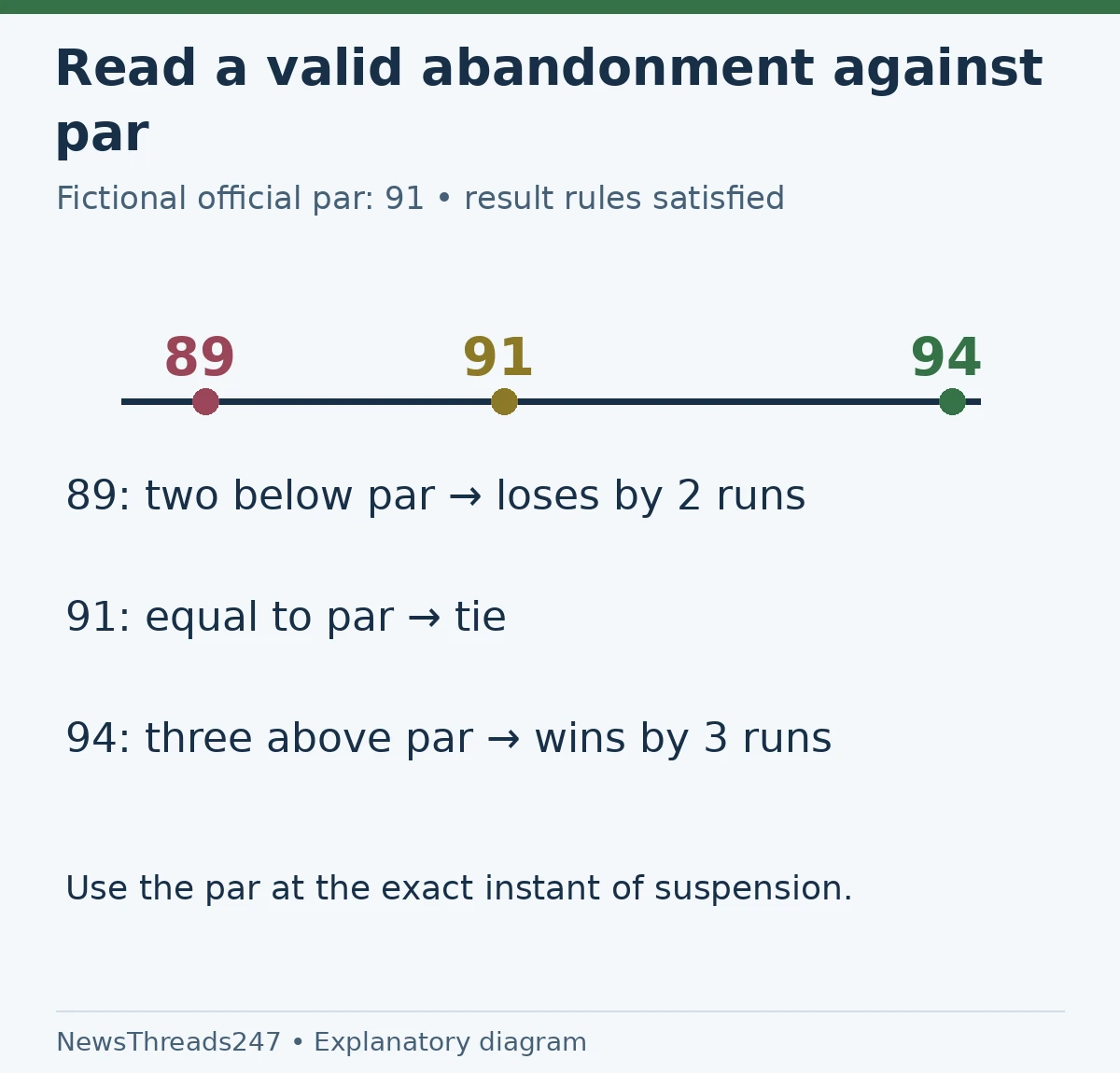
Now consider a different fictional match abandoned at a valid stoppage. The official par score at that instant is 91, and the chasing side has 94. Once the applicable result conditions are satisfied and the abandonment result is confirmed, the side is three runs above par. It does not win ‘by six wickets’ merely because it is four wickets down.
These numbers illustrate reading an official output; they are not DLS calculations for invented overs and resource percentages. You cannot reproduce a sanctioned target simply by selecting a plausible par number. The appointed method and match data have to produce it.
The same par number produces three outcomes
| Official par at a valid abandonment: 91 | Position against par | Result comparison |
|---|---|---|
| Chasing side has 94 | Three above | Wins by three runs under the comparison |
| Chasing side has 91 | Level | Tie, subject to applicable tie procedures |
| Chasing side has 89 | Two below | Loses by two runs under the comparison |
The assumptions are essential: this is the official par for the exact stoppage, the match cannot resume, and the competition permits a result. The table is not a licence to announce a winner whenever a shower starts. A tie can also lead to the competition’s separate tie-break procedure where conditions permit.
Why overs alone do not explain DLS
The ICC’s DLS methodology FAQ explains the role of resources: overs and wickets together. Ten overs with many wickets available are not the same scoring opportunity as ten overs with the innings close to ending. Dividing the first total by its overs and multiplying by the new allocation leaves out that distinction.
A wicket can therefore alter the par position even if no run was scored on that delivery. A viewer who notes only the team’s run rate can miss why the comparison moved. The relevant record includes the score, wickets and exact balls or overs at the interruption, not just the headline total.
The methodology is a target-setting framework, not a forecast that a particular side would certainly have won an uninterrupted match. The ICC FAQ makes that distinction. A team above par can still lose if play resumes; a team below can recover. The remaining cricket, if played, still matters.
Use the exact stoppage, not the end of the over
The ECB’s scoring guidance warns that a displayed end-of-over par must be changed to the actual ball position when an interruption occurs mid-over. If play stops after 12.3 overs, a figure labelled for the completed thirteenth over is not automatically the correct stoppage benchmark.
In ordinary six-ball-over notation, 12.3 means twelve overs and three balls, not 12.3 decimal overs. This matters when describing the state for a scorer or comparing a screenshot with a ball-by-ball record. Use the notation as published and do not feed a decimal interpretation into an unofficial calculation.
If the broadcast and an app disagree, check whether they refer to the same delivery and wickets lost. One may have updated after a wicket or to the next over while the other has not. Record the timestamps and official match information before assuming the method itself has changed.
A result still needs the competition’s minimum opportunity
Under the October 2026 standard men’s T20I conditions, the general result requirement is an opportunity for both teams to bat at least five overs, with stated exceptions such as being all out or reaching the winning score sooner. The corresponding standard ODI requirement is twenty overs. Read the full clauses for the match situation.
A competition can set different requirements, including tournament-specific knockout conditions. Do not apply a standard five-over statement to every T20 event or assume a reserve day exists. The ICC’s current document index distinguishes standard conditions from event documents.
If the required opportunity has not been met, a graphic showing a theoretical par does not create a valid result by itself. Officials first determine the status under the applicable conditions. Only then does the permitted comparison decide the outcome.
A resumed chase requires a fresh reading
When play resumes with fewer overs, note the confirmed revised target and remaining allocation. Do not carry an old target or a previous stoppage’s par into the new phase. Multiple interruptions require accurate records of each change and the resources affected.
A generic online calculator can be useful for learning, but it may use a different edition or simplified resource table. The ICC FAQ says the cricket authority appoints the edition and describes software requirements. An unofficial estimate should not be represented as the official target or used to overrule the scorer.
For viewers, a short note is enough: competition, resumed or abandoned, official target or exact-stoppage par, current score and minimum-opportunity status. Those fields let you follow the decision without pretending to calculate unpublished model parameters.
Keep the rain decision separate from a review decision
A boundary decision or DRS review may change the recorded score or wickets and therefore the data used at a stoppage. It is still a different rules question. Our Umpire’s Call guide explains why a review can retain an original decision; it does not supply a rain-adjusted target.
When reading the final result, look for the official method designation and margin. Par, target and the match’s legal status each have a job. Keeping the three visible is more useful than treating every rain graphic as a prediction of who ‘deserves’ to win.
Sources and visual credits
Sources: ICC men’s ODI and T20I conditions effective October 2026, particularly clauses 16.1, 16.3 and 16.4; ICC DLS FAQ; and ECB scoring guidance, linked above. Checked October 26, 2026. All numerical match examples here are fictional and assume an official output; no DLS software calculation or live-match reporting is claimed. Featured image: AI-generated conceptual illustration. Score and decision diagrams: NewsThreads247.