
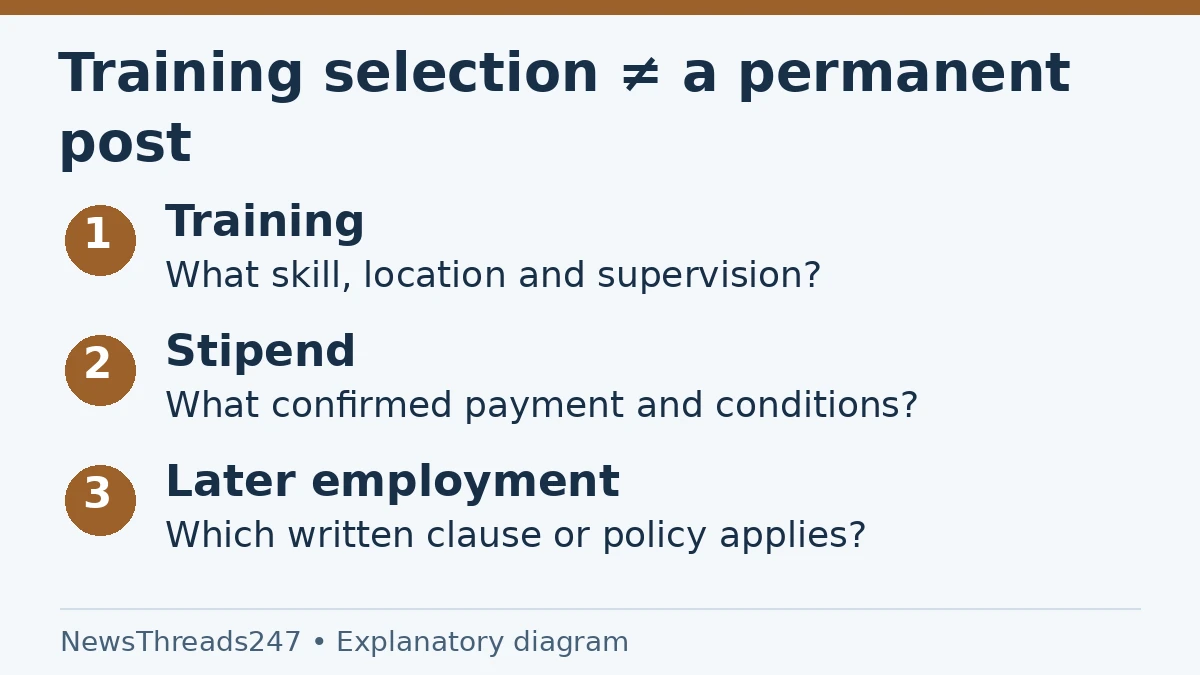
The message says ‘selected’, names a well-known company and mentions a monthly stipend. A graduate may read it as the first step into a permanent job. Before accepting, read what was actually offered: an apprenticeship is a training arrangement, and the terms after training need their own check.
In India, completing an apprenticeship does not automatically guarantee permanent employment. That does not make training worthless, or mean every contract has identical employment terms. Compare the official notice, apprenticeship contract and any recruitment policy before relying on a promise. This guide uses government and programme sources checked October 26, 2026; it does not announce a vacancy or determine an individual contract dispute.
Separate training selection from regular recruitment
The National Apprenticeship Training Scheme’s explanation describes supervised practical learning and a transition from education into a workplace. It also explicitly says employment after training is not guaranteed. The Maharashtra government’s NAPS guidance similarly distinguishes completing training from a later regular job offer.
A familiar company name is not enough to identify which arrangement you are entering. Find the exact notice, establishment, location, trade or discipline, duration and selection conditions. A permanent post, an apprenticeship and an internship may all use recruitment language, but the underlying documents are not interchangeable.
Ask what the word ‘selected’ refers to. It might mean shortlisted for verification, selected subject to eligibility, or offered a contract after checks. Preserve the complete notice rather than a cropped image of a headline. You need the conditions as well as the congratulatory line.
Find the actual contract and the employer’s policy
A government explanation of the 2014 amendment states that employers formulate their own recruitment policy for apprentices who complete training. That policy question is different from assuming a universal rule that a fixed share of trainees must receive jobs.
If your contract contains a post-training service or employment clause, ask for an authoritative explanation of its operation before signing. Read the exact period, remuneration and obligations stated, and seek appropriate programme or legal advice if the terms are unclear. A general FAQ should not be used to erase a specific contractual condition.
Request the employer’s applicable absorption or recruitment policy in writing where one is relevant. ‘Preference may be given’ and ‘employment will be offered on these conditions’ are different statements. Do not rewrite a conditional possibility into a guaranteed salary in your own household budget.
Verify the route as well as the logo
Government apprenticeship opportunities and processes use the relevant official programme portals. The Maharashtra NAPS page directs establishments to Apprenticeship India; NATS has its own official portal and regional boards. Check which route the notice specifies instead of assuming the two are the same application system.
Match the establishment’s details and notice with its own verified careers or apprenticeship page. Contact it through a route independently obtained from the organisation, not only the number supplied in a forwarded message. A screenshot of registration is not a substitute for finding the relevant record through the official process.
If an intermediary is involved, establish its role and authority. The Maharashtra guidance notes that third-party aggregators can assist with apprenticeship processes; their existence does not authenticate every agent. Ask who issues the contract, who supervises training and where a grievance can be raised. Keep each answer tied to a named organisation.
Check the training you will actually receive
Ask for the discipline or trade, location, training schedule, supervision, practical work and assessment process. A useful offer should let you understand what you will learn and how completion will be recorded. ‘Industry exposure’ alone is too vague to compare with another opportunity.
Use the programme’s current instructions for eligibility and prior-training restrictions. A degree title that sounds relevant is not proof that every notice accepts it. Check qualification, passing-year and other conditions against the particular opportunity; do not borrow a criterion from an older recruitment round.
For a fictional comparison, two placements offer similar stipends. One clearly identifies the training supervisor and work modules; the other promises only ‘office duty’ and a possible job. The difference to investigate is training substance and written terms, not which message uses a more impressive company logo.
Calculate the money that remains after practical costs
Verify the monthly stipend, payer, payment schedule and any attendance or other conditions in the official contract. Minimum rates and programme support can depend on apprentice category and current rules. Do not use a reimbursement percentage paid under a scheme as if it were an extra amount automatically payable to the apprentice.
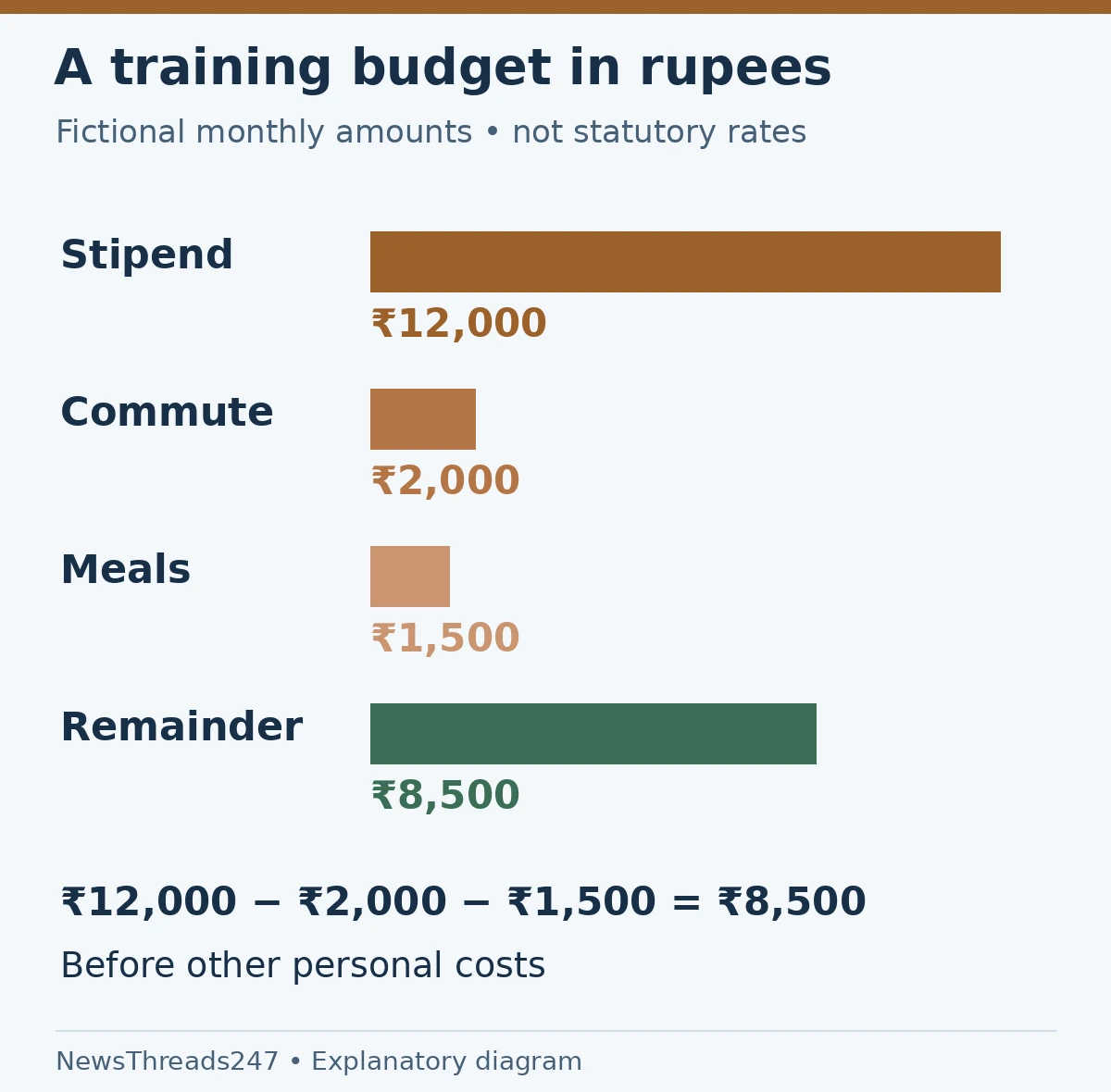
Make a simple comparison using only confirmed terms. In an illustrative budget—not a statutory stipend rate—an offer of ₹12,000 a month with ₹2,000 of commuting and ₹1,500 of additional meal costs leaves ₹8,500 before other personal expenses. Accommodation, relocation or required purchases could change that figure substantially.
Ask which costs are actually covered. Written confirmation of transport or lodging is different from ‘usually arranged’. Do not count a possible permanent salary in the same budget as the training stipend. A training opportunity may still be worthwhile, but the decision should use money and conditions that are established.
A comparison sheet for the offer
| Field | Evidence to obtain | Question to resolve |
|---|---|---|
| Training | Trade, duration, location and supervision | What skill and assessed work will be completed? |
| Payment | Stipend and current contract terms | Who pays, when, and subject to what conditions? |
| Completion | Programme-specific assessment and certificate route | What record will be issued and by whom? |
| Later employment | Exact contract clause and recruitment policy | Is it guaranteed, conditional, or only a possibility? |
Complete the sheet with source names and dates, not just yes/no ticks. An empty employment row exposes an unresolved promise; it does not prove the entire placement is fraudulent. Ask for clarification and keep the answer before deciding whether to rely on it.
Protect the evidence and ask about exit terms
Read notice periods, termination provisions, attendance, conduct and any service conditions before signing. If you need to leave for another opportunity, ask the relevant programme and employer how that affects the contract and completion record. Do not assume abandoning training is consequence-free or that an agent can cancel it informally.
Keep the signed contract, joining acknowledgement, stipend records and training communications. Ask how assessments and completion documents will be delivered. NATS describes a completion and proficiency process; that should not be stretched into a promise that every employer or another recruitment scheme will treat every certificate identically.
If a payment or training problem arises, describe the contract, dates and unresolved issue through the organisation’s and programme’s official grievance routes. Avoid posting identity documents, bank information or private contract pages publicly. Evidence should help resolve the matter without creating a second problem.
Be cautious about an employment guarantee sold separately
An unofficial agent’s promise of permanent absorption needs independent verification. Do not pay merely to turn a conditional training offer into a supposed guaranteed appointment. Our Indian job-offer verification guide explains checking the employer and recruitment route.
The useful final question is specific: ‘Which signed document supports the employment outcome I am relying on?’ If the answer is only a verbal assurance, record the job outcome as unconfirmed. You can then compare the training on its actual learning, payment and completion terms rather than an unsupported future salary.
Sources and visual credits
Sources: NATS programme guidance, Maharashtra’s NAPS guidance, the PIB explanation of the Apprentices Act amendment, and the official programme portals linked above; checked October 26, 2026. Individual contracts, current rules and official programme decisions govern specific cases. Featured image: AI-generated conceptual illustration. Offer-comparison and budget diagrams: NewsThreads247.