
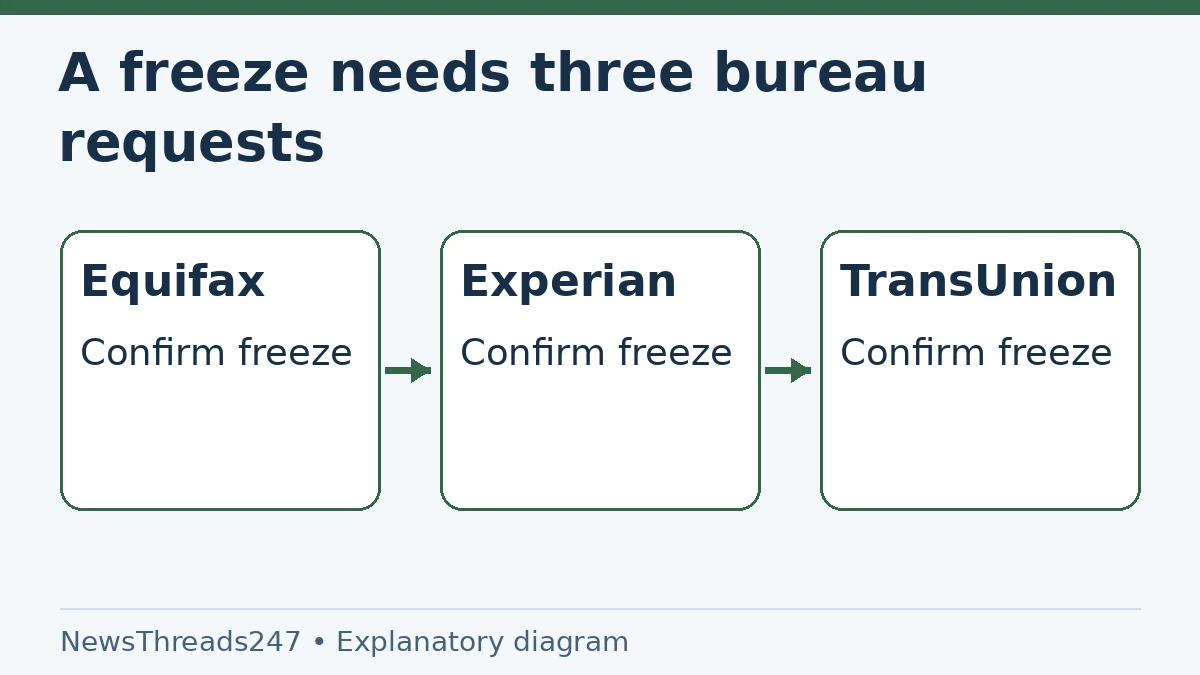
You place a credit freeze online and receive a confirmation. It is tempting to tick ‘identity protection’ off the list. First check which bureau sent that confirmation. Freezing a report at Experian, Equifax or TransUnion does not automatically freeze the other two. A fraud alert works differently: contacting one bureau starts the notification process to the others.
For US consumers, that distinction changes the practical work after a breach notice or suspected identity theft. Both tools are free under the processes described by the FTC and CFPB, but they do different jobs. This guide, checked October 26, 2026, explains those US procedures; it does not apply them to Indian credit-bureau records.
Choose the protection by the problem
A security freeze restricts access to the credit report for relevant new-credit checks. A fraud alert tells businesses to verify the applicant’s identity before granting new credit, while leaving the report available. The FTC’s comparison also says a freeze does not affect the credit score. The tools can be used together.
Do not confuse either with closing a bank account, cancelling a card or recovering a stolen password. The report is one part of a lender’s decision. A freeze is not a switch that locks every financial transaction you already make, and it does not erase an account an identity thief has already opened.
Start by writing down what is known. A genuine breach notice without evidence of misuse is different from an unfamiliar loan on a report or a charge on an existing card. You may need several responses, but each should answer a specific problem. Avoid buying a product merely because its name includes ‘protection’.
One freeze confirmation is one bureau’s confirmation
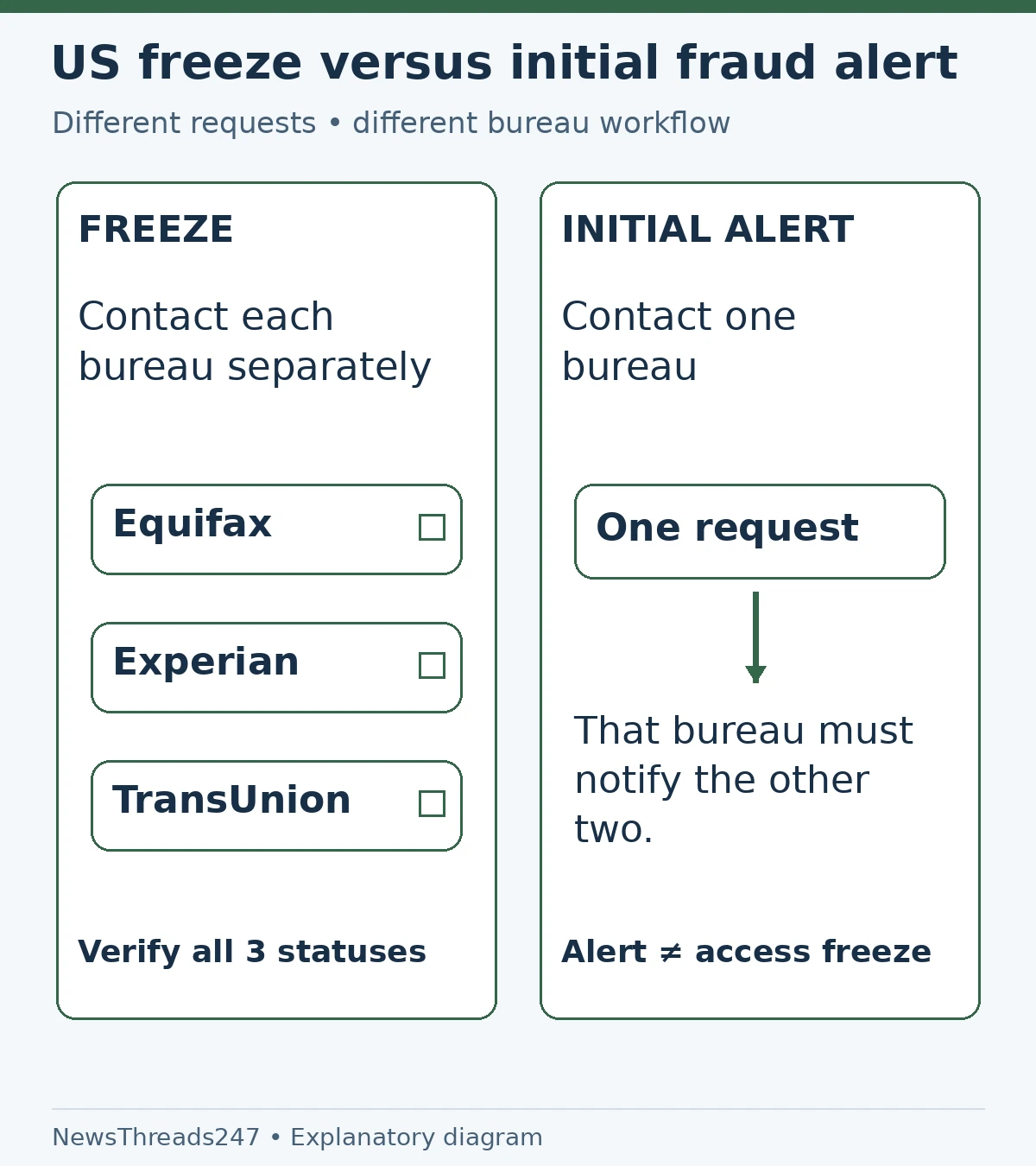
The Consumer Financial Protection Bureau says to contact each nationwide credit-reporting company separately for a freeze. Use the official bureau routes linked there. Keep the three status checks separate so a successful request at one is not mistaken for completion everywhere.
Create a small private record with a row for each bureau, the request date, current freeze status and confirmation location. Store account-recovery information securely rather than putting passwords or Social Security numbers in the same checklist. The checklist needs to tell you whether a task is complete, not expose the information it is supposed to protect.
If an identity-verification step fails, record that bureau as unresolved. Do not mark it frozen because you reached the application page or received a marketing email. Follow the bureau’s official support instructions for that specific problem. A paid-service offer is not the confirmation you were trying to obtain.
A fraud alert has a different workflow
The FTC distinguishes an initial alert, normally lasting one year and renewable, from an extended alert for eligible identity-theft victims, which lasts seven years. For an alert, the bureau contacted must notify the other two. Check the current requirements for the type requested rather than assuming every alert has the same duration or evidence requirement.
A fraud alert still allows businesses to see the report. That is why it is not another name for a freeze. If a form offers both, read the description of the action being confirmed. Keep contact information current so an identity-verification request has a reliable way to reach you.
For a documented identity-theft case, the CFPB’s recovery guidance describes additional steps and distinguishes bureau notifications. Use that broader process when misuse has happened. Placing a protective control and correcting fraudulent records are separate tasks.
A compact comparison
| Question | Security freeze | Fraud alert |
|---|---|---|
| Main function | Restricts access for relevant new-credit checks | Calls for identity verification before new credit |
| Starting route | Contact all three major bureaus separately | Contact one bureau; it must notify the other two |
| Cost through these processes | Free to place and lift | Free |
| Planning issue | Manage access for a genuine application | Check alert type, contact details and renewal needs |
Consider a fictional consumer with a freeze confirmation from one bureau and no record of requests to the others. The missing step is not purchasing monitoring or refreshing a credit score. It is completing and confirming the other bureau requests. A checklist exposes that gap immediately.
Plan a temporary lift before a genuine application
When applying for credit, ask the lender which bureau or bureaus it expects to use. The CFPB’s freeze guidance explains temporary access and the applicable response times. Plan around the official process rather than assuming a last-minute click will resolve every identity or account-access problem while a seller is waiting.
Experian’s current freeze guide distinguishes a permanent removal from a temporary thaw that can be scheduled. Read the confirmation: which report is accessible, when the window starts and when protection returns. A request to lift one report is not necessarily a request to lift them all.
In a fictional loan application, the lender says it will check two bureaus on a specified date. Record those two names and the agreed access window. Afterward, confirm the intended status at each. This is administrative planning, not a recommendation to take the loan or a promise that the application will be approved.
A lock or monitoring subscription is a separate product
Bureau websites may also offer locks, scores or monitoring packages. Compare the actual service and terms with the free statutory freeze route. Do not infer that a freeze requires a subscription just because a paid offer appears nearby. Likewise, an alert telling you about a new inquiry does not necessarily mean access was blocked.
Use a verified route to the bureau rather than a sponsored search result or a link in an unexpected text. If a message says your freeze failed and demands urgent payment, open the official account independently and inspect its status. A message’s confidence and a familiar logo are not proof of its origin.
Keep confirmation emails and receipts for any product you intentionally choose separate from freeze-status evidence. This reduces confusion later when a paid package expires but you still need to know what happened to the credit-file control. Read the specific terms instead of guessing that all services share one switch.
Existing accounts still need attention
A credit freeze does not replace reviewing bank and card statements, securing email access or contacting a financial institution about an unauthorised transaction. Use the institution’s official fraud process promptly for the particular account. Do not wait for a credit report to explain a debit that already appears in a bank account.
If identity theft has occurred, use IdentityTheft.gov and the CFPB’s linked recovery guidance to organise the response. Preserve report entries, complaint references and institution replies. Record what was disputed and what remains unresolved rather than interpreting one protective confirmation as proof that all damage has been repaired.
Check your own credit reports through the official route described by the FTC. An unfamiliar entry needs investigation; a familiar account with a recording error needs an appropriate dispute. Neither a freeze nor an alert automatically corrects the content of the file. Keep the correction request separate from the access-control request.
Use the country-specific process
These instructions concern US credit files at the named bureaus. Indian readers should not assume the same freeze mechanism, alert duration or statutory process applies to their Indian records. Our Indian credit-report dispute guide addresses correcting those records through their relevant channels.
For this US task, the completion test is concrete: each intended freeze has a confirmed bureau status, any alert has the right type and contact details, a genuine application has an access plan, and actual misuse is being handled through the appropriate recovery process. None of those checks guarantees that every form of fraud has been prevented.
Sources and visual credits
Sources: FTC credit-freeze and fraud-alert guidance; CFPB freeze and identity-theft recovery pages; Experian’s freeze guide and IdentityTheft.gov, linked above and checked October 26, 2026. General consumer information, not individual financial or legal advice. Featured image: AI-generated conceptual illustration. Comparison and bureau-check diagrams: NewsThreads247.