
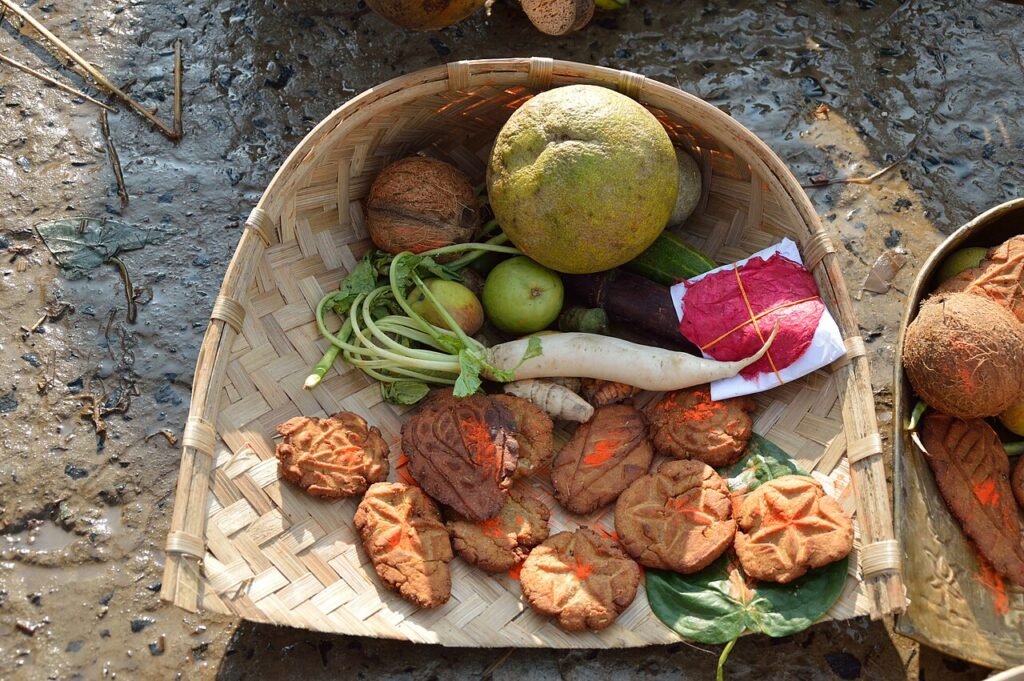
Chhath Puja 2026 runs from Friday, 13 November to Monday, 16 November. The four-day observance moves from Nahay Khay and Kharna to Sandhya Arghya on Sunday, 15 November, and Usha Arghya on Monday, 16 November. The clock time is local: for Patna, the Panchang reference lists sunset at 5:01 pm on 15 November and sunrise at 6:07 am on 16 November. Do not use one city’s timing as a national muhurat; check the Panchang and ghat notice for the place you will actually visit.
This guide brings the dates, a city-specific timing example, a practical preparation checklist and public-safety checks into one place. Ritual details and household samagri differ, so use the customs followed by your family and local community rather than treating a general article as a ritual authority.
In this article — dates, local timings and a ghat checklist
Chhath Puja 2026 dates at a glance
The 2026 Patna Chhath calendar lists the observance across four consecutive days, from 13 to 16 November. The main evening offering to the setting sun falls on Sunday, 15 November; the morning offering to the rising sun follows on Monday, 16 November. Bihar Tourism describes Chhath as a four-day observance centred on both the setting and rising sun.
| Date | Observance | What families commonly plan for |
|---|---|---|
| Friday, 13 November | Nahay Khay | First-day preparation and household cleaning, according to family custom. |
| Saturday, 14 November | Lohanda and Kharna | Second-day observance and preparation for the evening prasad. |
| Sunday, 15 November | Chhath Puja / Sandhya Arghya | Offering to the setting sun at the designated ghat or permitted water-side place. |
| Monday, 16 November | Usha Arghya and Parana | Offering to the rising sun, followed by the conclusion of the observance according to family practice. |
The dates above are the Patna 2026 calendar dates shown by Drik Panchang. The same calendar gives the Shashthi tithi as beginning at 11:23 pm on 14 November and ending at 2:00 am on 16 November. That overnight tithi is one reason a single date label can look confusing when websites describe the main evening observance. For planning, keep the four-day sequence together and confirm the local Panchang rather than relying on a social-media graphic without a location.
The four-day Chhath calendar: what each day means for planning
1. Nahay Khay — Friday, 13 November
This is the opening day of the observance. Bihar Tourism describes it as a day associated with bathing, cleaning the home and preparing for the days that follow. If your family observes Nahay Khay, confirm its own meal and preparation customs in advance; there is no need to copy a menu from an unrelated online list.
2. Lohanda and Kharna — Saturday, 14 November
The second day is commonly called Kharna, with Lohanda also used in festival calendars. Bihar Tourism notes the evening breaking of the day’s fast and the sharing of prasad. Exact food preparation, sequence and household responsibilities vary, so confirm them with the people observing the vrat in your family.
3. Sandhya Arghya — Sunday, 15 November
This is the evening offering to the setting sun and the main public gathering for many families. Plan the route, parking or drop-off point and walking distance before leaving. Arrive with enough time to follow the authorised entry route; do not assume that a familiar ghat from a previous year will remain open or have the same access arrangements in 2026.
4. Usha Arghya and Parana — Monday, 16 November
The final morning offering is made to the rising sun. The Patna calendar lists sunrise at 6:07 am on 16 November. Treat this as a city-centre Panchang reference, not a promise that the sun will be visible from every riverbank at precisely that minute. Buildings, the local horizon, weather and the exact ghat can affect what people see. Follow the local observance instructions and allow time for the return journey after the gathering.
How to check local Arghya times without using the wrong city
Arghya is connected to the setting and rising sun, so a time printed for Patna should not be copied into a Delhi, Kolkata, Mumbai, Gorakhpur or overseas family group as if it were universal. Use a Panchang page set to your city, note the date attached to the sunrise or sunset, and then compare it with the local administration’s current ghat notice.
For a concrete reference, Drik Panchang’s Patna page lists sunset at 5:01 pm on Sunday, 15 November, and sunrise at 6:07 am on Monday, 16 November. Its New Delhi page lists sunset at 5:28 pm on 15 November. These are location-specific calculations; the page itself notes that its times are local to the selected city. If you are travelling, check the destination city—not only the city where you live.
There is also a difference between an astronomical sunrise/sunset time and the moment the sun becomes visible from a particular ghat. A high riverbank, buildings, haze or cloud can affect the visible horizon. Use the published time as a planning reference, not as a reason to enter water early, cross a barrier or ignore an official announcement.
Choose the right ghat before you travel
Do not select a ghat only because it is close, familiar or shown in an old video. Check the current list issued by the relevant municipal corporation or district administration. Patna Municipal Corporation has published a 2026 Kartik Chhath ghat/talab information page that can be searched by circle, ward or ghat. Use that live list to identify the authorised place and its current access information, then recheck for any later closure or route notice.
Before setting out, answer four practical questions: Is this ghat listed for the 2026 observance? Where is the official entry point? Where can a vehicle stop without blocking emergency access? What is the agreed meeting point if family members become separated? If the local administration changes the arrangement, the latest notice takes priority over an earlier plan.
A practical preparation checklist
Use this as a planning aid, not as a universal ritual samagri list. The exact offerings and sequence should come from your family’s tradition and local guidance.
- Confirm the family list: check the required baskets, offerings, clothing and household tasks with the people observing the vrat. Avoid buying items simply because a generic online list includes them.
- Confirm the ghat: save the official ghat name, entry point, route and any parking or shuttle instructions. Check again on the day because access can change.
- Prepare travel essentials: carry a charged phone, a small power bank, a torch for the early-morning return, essential medicines, drinking water for people who are not fasting, and a dry change of clothes if your family needs one.
- Make a family meeting plan: choose a meeting point away from the water and main walking route. Give children and older family members a simple contact card and explain whom to approach if separated.
- Keep the route clear: travel light, wear footwear that is safe on wet steps, and do not leave bags or baskets on stairs, bridges or narrow lanes.
- Plan the return: agree who is driving, where the vehicle will wait and how the group will leave if the ghat becomes crowded or is closed.
If you want a more detailed household document and contact plan, see our related family emergency kit and go-bag guide. Its general document and communication checklist can help with family coordination, but it does not replace local festival instructions.
Ghat safety in crowds and near water
A religious gathering does not make an unsafe stretch of water safe. Follow the designated ghat, barricades, queue system, lifeguards and rescue staff. The Maharashtra Government’s official Simhastha safety guidance is written for a different pilgrimage, not as a Chhath order, but its public-gathering principles are relevant: use marked entry and exit routes, keep children close, stay away from deep or fast-flowing water, and leave when officials issue a warning or close a ghat. Your own district’s Chhath directions take priority.
A safer ghat visit in four steps
Confirm the official ghat, route, timings and latest warning.
Use marked entry, exit, queue lanes and barricades.
Keep children with an adult and stay out of deep or fast water.
Move away when the ghat closes or officials issue a warning.
Follow local authorities and rescue staff. Never cross a barrier to reach the water.
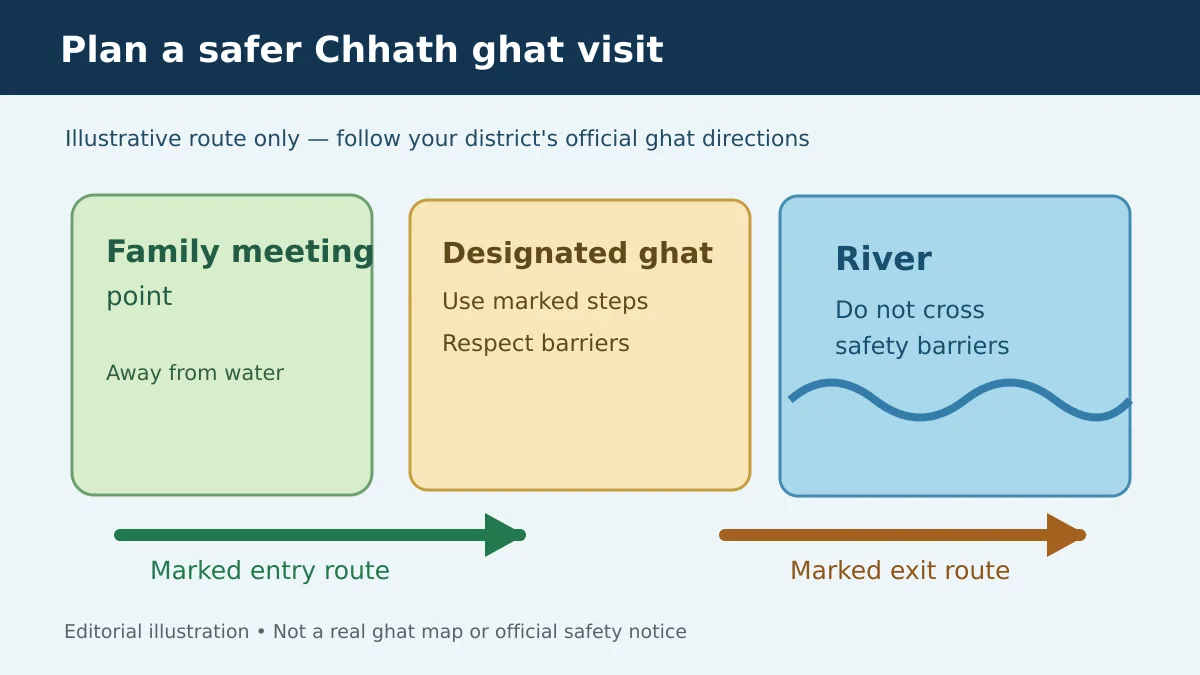
Do not enter deep, fast-flowing or closed water. Hold children’s hands near the river, keep older relatives away from the densest crowd, and do not stop on steps or narrow access lanes. If a siren, announcement or rescue-team instruction tells people to move, leave the water’s edge immediately. A planned ritual time never overrides a safety closure.
Check weather and official alerts before travelling. India’s NDMA SACHET portal publishes authorised disaster warnings and location-based alerts. It is not a substitute for the local police or municipal announcement at the ghat, but it is a useful additional source when weather, flooding or other hazards may affect travel.
Cleanliness and respectful disposal
Carry offerings in reusable baskets where practical and use the waste and collection points designated by the organisers. Do not leave plastic wrappers, disposable plates, bottles or food waste on the riverbank, steps or road. Do not put soap, detergent or other cleaning products into the water. If the local authority has specified a collection point for flowers or other offerings, use it instead of assuming that every item should be released into the river.
Leave enough room for emergency workers, sanitation teams and other visitors. A clean, unobstructed ghat is part of a safer gathering, not merely a matter of appearance.
Frequently asked questions
When does Chhath Puja start in 2026?
The Patna 2026 calendar lists Nahay Khay on Friday, 13 November. The four-day sequence continues with Kharna on 14 November, Sandhya Arghya on 15 November and Usha Arghya/Parana on 16 November.
When is Sandhya Arghya in 2026?
Sandhya Arghya is on Sunday, 15 November 2026. The sunset reference differs by city; Drik Panchang lists 5:01 pm for Patna and 5:28 pm for New Delhi. Check the location-specific page and the local ghat notice before leaving.
What time is Usha Arghya in Patna?
Drik Panchang’s Patna Chhath calendar lists sunrise at 6:07 am on Monday, 16 November 2026. Treat it as a city-centre reference and confirm local instructions for the exact ghat.
Is there one Chhath muhurat for all of India?
No single clock time should be applied to every city. The observance is tied to the setting and rising sun, so local sunrise and sunset references differ. Use a Panchang set to your city and follow the designated ghat’s current instructions.
Can we visit any riverbank for Arghya?
No. Use a place designated or permitted by the local administration. A familiar, convenient or privately accessible riverbank may be unsafe or closed for the event. Do not enter water behind a barricade or after an official closure.
Sources and editorial method
Calendar and timings: Drik Panchang’s 2026 Patna Chhath calendar and city-specific Chhath timing pages were checked on 9 November 2026. The four-day sequence and Patna sunrise/sunset references are taken from the Patna calendar; the New Delhi sunset reference is taken from its New Delhi page. These are Panchang/astronomical references, not a universal muhurat or a guarantee of the sun’s visibility from a particular ghat.
Primary and official references
- Drik Panchang — 2026 Chhath calendar for Patna
- Drik Panchang — Chhath timing for Patna
- Drik Panchang — Chhath timing for New Delhi
- Bihar Tourism — Chhath Puja traditions and four-day observance
- Patna Municipal Corporation — Kartik Chhath ghat/talab information 2026
- Maharashtra Government — general pilgrimage crowd and ghat safety guidance
- NDMA SACHET — official disaster alert platform
Editorial note: The Maharashtra safety guidance is cited only for general crowd and water-safety principles; it is not presented as a Chhath-specific order. Local district and ghat instructions take precedence. Ritual customs vary by family and region.