
Two offer letters can promise the same annual cost to company while leaving different amounts available for your regular monthly budget. The difference may be sitting in the salary annexure: one package puts more into fixed cash, another into a target bonus or employer-funded benefits.
For an Indian job offer, compare the fixed gross cash first, then its payroll deductions, and keep conditional and one-time amounts separate. Dividing the headline CTC by twelve does not establish take-home pay. Ask the employer to explain each component and provide a dated monthly-pay illustration before you decide.
Read the salary annexure as a set of different payments
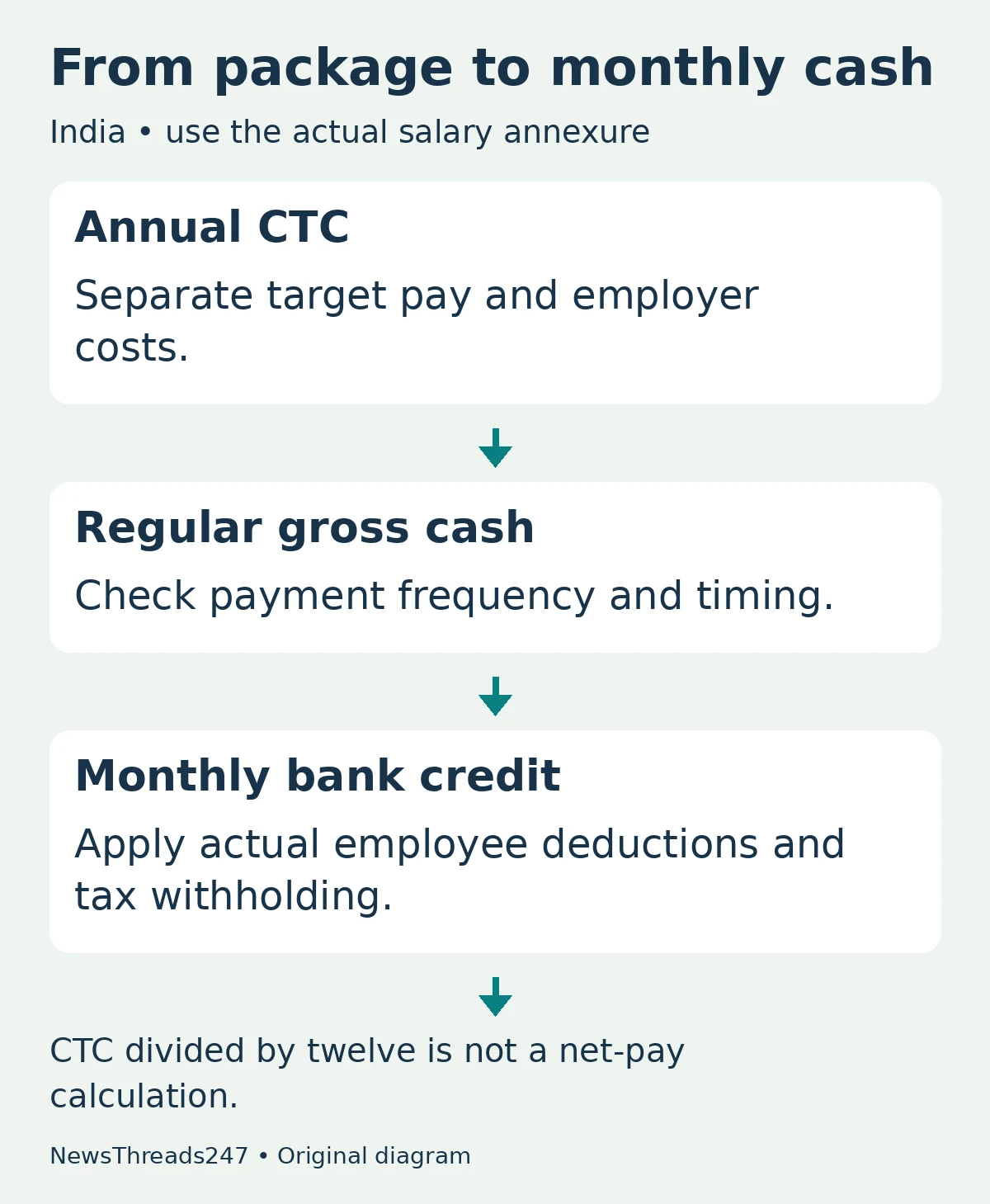
CTC describes an employer’s cost rather than a single monthly bank credit. Union Bank of India’s January–March 2021 HR publication, pages 28–29, distinguishes gross salary before deductions, net salary after deductions and the wider costs included in CTC. That older publication is useful for the distinction; it is not a source for a current tax calculation or universal contribution rate.
Start by marking regular gross cash payable through payroll. Next identify variable cash linked to performance or another condition. Then mark employer costs or benefits that are included in the package but do not arrive as salary every month. Keep joining and retention payments on another line because their timing and conditions may differ from recurring pay.
Do not assume that an employer’s use of the word fixed means fixed cash. Ask whether the quoted fixed component contains employer contributions or benefit costs. You need the amount payable as regular gross salary, not merely another subtotal with a reassuring label.
An equal-CTC comparison with different monthly cash
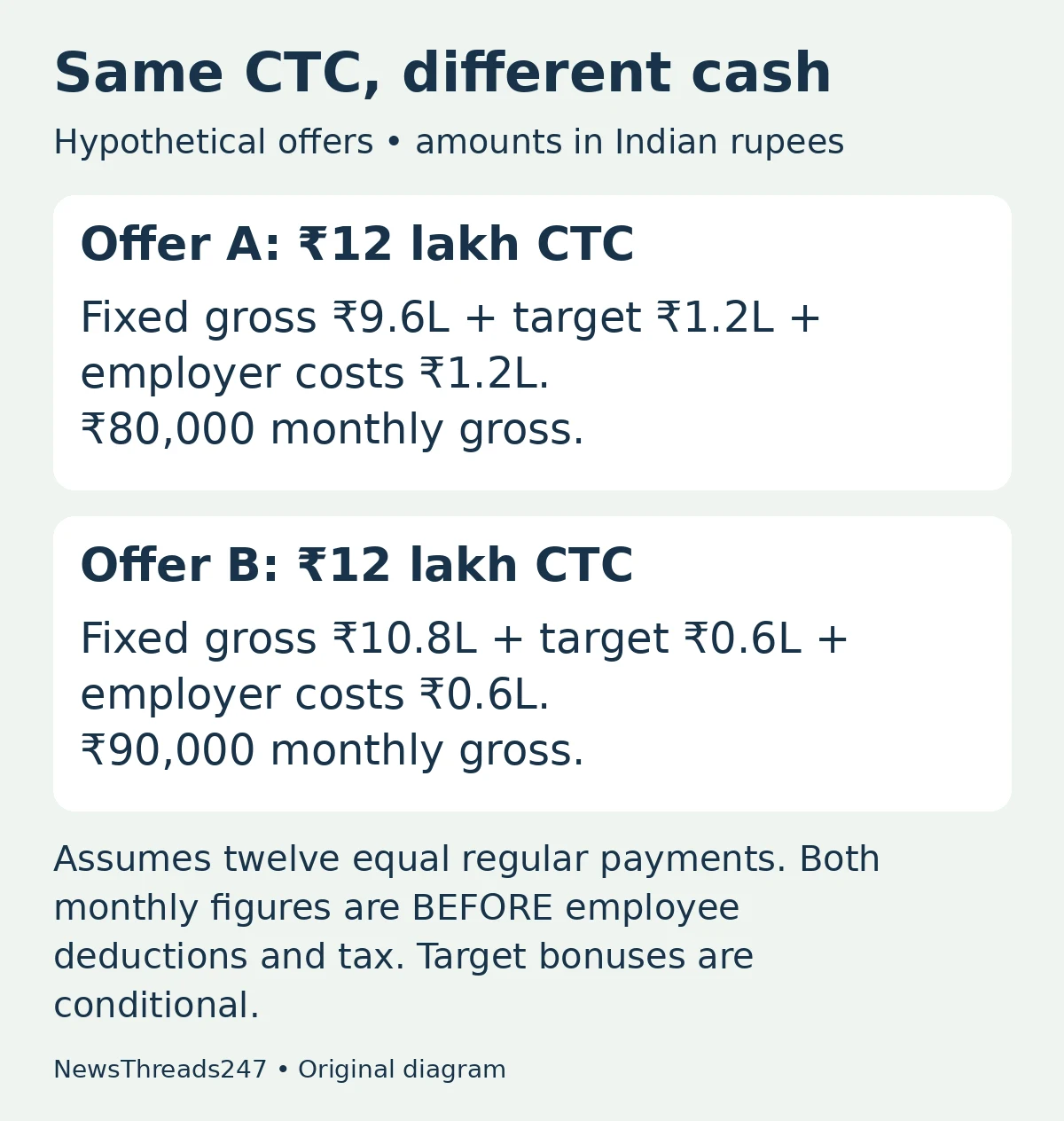
Here is a hypothetical comparison in Indian rupees, not a market salary estimate. Both packages show ₹12,00,000 annual CTC. Offer A comprises ₹9,60,000 regular annual gross cash, ₹1,20,000 target variable pay and ₹1,20,000 employer costs or benefits. Offer B comprises ₹10,80,000 regular annual gross cash, ₹60,000 target variable pay and ₹60,000 employer costs or benefits.
Assuming twelve equal regular payments, Offer A gives ₹9,60,000 ÷ 12 = ₹80,000 monthly gross cash. Offer B gives ₹10,80,000 ÷ 12 = ₹90,000. The ₹10,000 difference is before employee deductions and tax withholding. Neither figure is a calculated take-home salary.
The annual sums reconcile: ₹9,60,000 + ₹1,20,000 + ₹1,20,000 = ₹12,00,000, and ₹10,80,000 + ₹60,000 + ₹60,000 = ₹12,00,000. The example deliberately leaves tax, provident-fund calculations and individual benefit values unestimated. Those require the actual offer, applicable rules and payroll assumptions.
If every target bonus were earned, annual cash would be ₹10,80,000 under A and ₹11,40,000 under B before deductions. But a target is not proof of an earned payment. For a regular monthly budget, compare the fixed cash without treating the entire bonus as already received.
Ask how variable pay is earned and when it arrives
For each variable component, request the written basis: individual or company performance, assessment period, payout date and any eligibility condition. Ask how joining part-way through a cycle is handled and whether the first payment is prorated. Do not replace missing terms with an average payout mentioned informally during recruitment.
Keep three scenarios on your comparison sheet: fixed cash alone, fixed cash plus the stated target, and any genuinely guaranteed first-year payment supported by the offer. Label them clearly. This is a way to expose uncertainty, not a prediction that a bonus will be zero or fully earned.
A joining payment also needs its own reading. If repayment is required when leaving within a stated period, obtain the actual clause and ask how repayment is calculated. Do not assume the amount can fund a permanent increase in monthly spending. Questions about enforceability or a personal dispute need advice on the particular contract.
Move from gross pay to a documented net estimate
The Income Tax Department’s current TDS transition guidance, questions 19–20, says salary payments from April 2026 use the new Act framework and the employer’s computation considers projected income, deductions and tax regime for Tax Year 2026–27. An old online example is not enough to establish your current withholding.
Ask payroll to list the deductions used in its net estimate and identify the tax year and personal assumptions. Where provident-fund deductions apply, distinguish the employee deduction from an employer contribution included in CTC. Ask which wage base and applicable rate the illustration uses rather than applying one percentage to the entire package.
Also ask whether the illustration assumes a full month. Joining after payroll cut-off, unpaid days or an advance recovery can make a first payslip differ from a normal later month. Reconcile each difference instead of concluding immediately that either the offer or payslip must be wrong.
Compare benefit conditions alongside cash
A non-cash benefit may have value even though it cannot pay rent. Read what is actually provided: who is covered by an insurance benefit, when it starts, what happens on exit and whether you need to contribute. A gratuity provision shown in CTC is not evidence that the same sum will be paid to you every year; obtain the applicable entitlement and payment rules.
For shares or options, keep the grant separate from spendable salary. Request the written vesting and exercise terms and the basis of any quoted value. Do not treat a paper valuation as a cash receipt or assume you can sell immediately.
When changing EPF-covered employment, keep this salary comparison separate from account continuity. Our existing UAN guide explains the records to check with the new payroll team. It does not calculate the net pay in your new offer.
The clarification worth sending before you accept
Ask for a single written reconciliation: total annual CTC; annual regular gross cash; regular monthly gross cash; each employee deduction; estimated monthly net; target or guaranteed bonuses and their dates; one-time payments; and employer benefits or costs. Ask the employer to explain any difference between that reconciliation and the offer annexure.
Then compare both offers using the same period and assumptions. Role, location, working pattern and prospects still matter, but the pay decision becomes clearer once recurring cash is separated from conditional rewards. Retain the agreed annexure and the assumptions behind any net estimate.
References and visual credits
Sources: Union Bank HR publication, January–March 2021, for compensation terminology; Income Tax Department TDS guidance, checked 26 October 2026. The two-offer arithmetic is original and hypothetical. Featured image: AI-generated illustration of reviewing employment paperwork; diagrams are original explanatory graphics.