
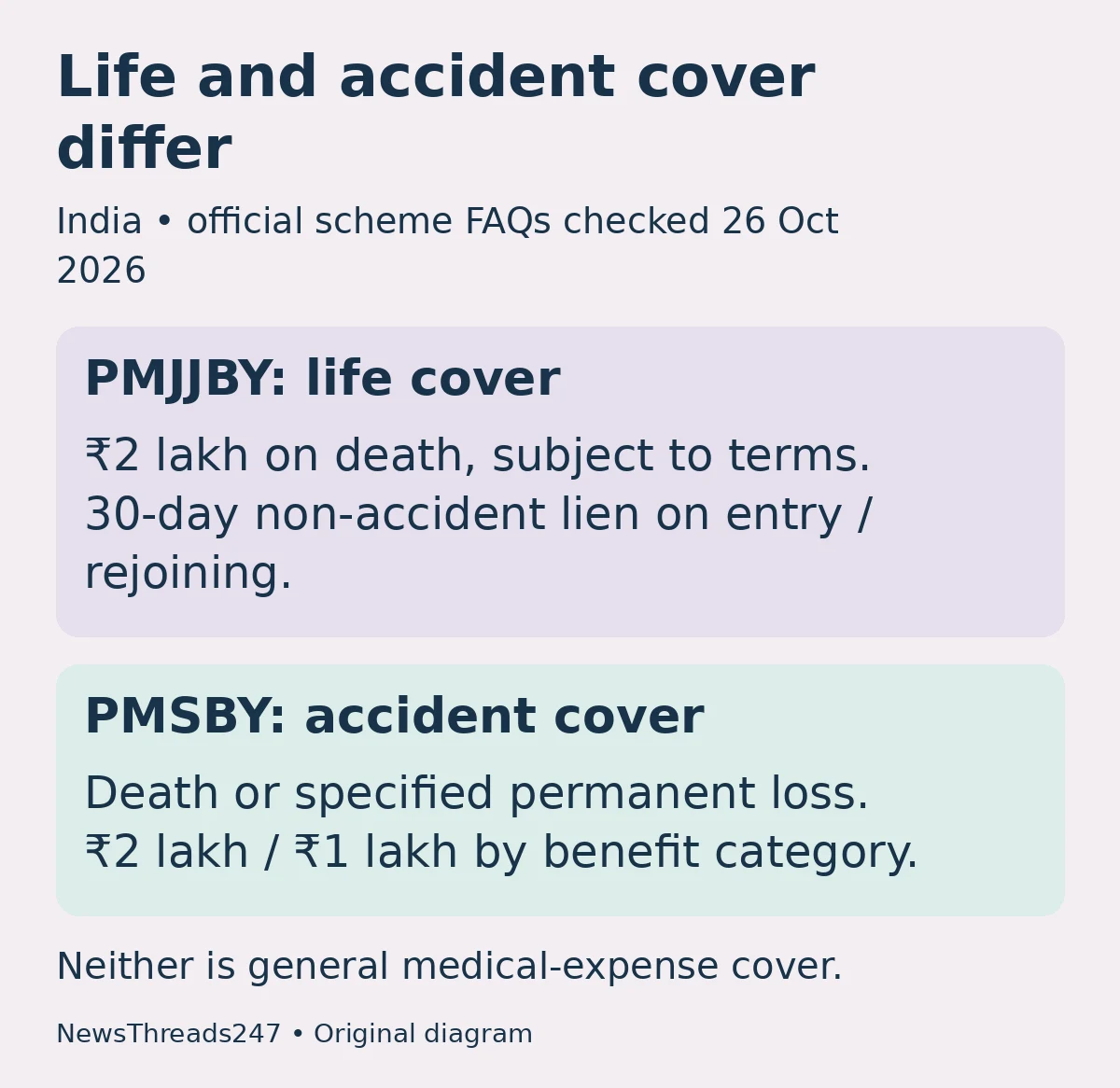
A small annual debit with an unfamiliar insurance abbreviation is easy to overlook in a bank statement. Before assuming your family has life cover—or that an accident hospital bill will be paid—check the full scheme name. PMJJBY and PMSBY have different triggers for a claim.
Pradhan Mantri Jeevan Jyoti Bima Yojana (PMJJBY) provides life cover. Pradhan Mantri Suraksha Bima Yojana (PMSBY) provides specified accident cover. Both operate in India through participating institutions, but neither is a general health-insurance policy. The distinction matters more than the difference between their premiums.
The essential comparison
The Department of Financial Services PMJJBY FAQ lists ₹2 lakh for death due to any cause, subject to its terms, with an annual premium of ₹436. Entry is from age 18 to 50; eligible renewal can continue up to 55. For first-time enrolment and rejoining, non-accidental death in the first 30 days is excluded. Accidental death is outside that lien.
The official PMSBY FAQ lists an annual ₹20 premium and entry from 18 to 70, with cover terminating at 70 under its age convention. Accidental death and the specified total disability attract ₹2 lakh; specified partial disability attracts ₹1 lakh. Hospitalisation expenses are not reimbursed.
The age at which someone can enter a scheme and the age at which existing cover can end are separate checks. Do not read PMJJBY’s renewal limit as permission for a new 54-year-old applicant to enter. Equally, a person’s eligibility for PMSBY does not establish eligibility for PMJJBY.
Why the same ₹2 lakh headline can mislead
Start with the event you want covered. A death arising from illness and an accidental injury are different claim situations. The life scheme’s terms and lien need checking for the first; the accident scheme’s definition and benefit schedule need checking for the second.
An accident does not turn every injury into a payable disability benefit. Under PMSBY’s official schedule, total and irrecoverable loss of both eyes, both hands or feet, or one eye together with a hand or foot falls within the ₹2 lakh disability category. Total and irrecoverable loss of one eye or one hand or foot falls within the ₹1 lakh category. A temporary inability to work is not the same thing.
For example, someone treated for a fracture may face a real hospital bill and lost wages. That does not establish that the injury matches a listed permanent-loss benefit. The useful question is which clause describes the actual loss, rather than whether the person broadly describes the event as an accident.
Similarly, a family should not treat a debit as an unconditional promise of payment. Enrolment, active cover, the event, exclusions and the required evidence all need to be established under the relevant scheme. This is a comparison of rules, not an assessment of any individual claim.
Joining in October: distinguish entry cost from annual renewal
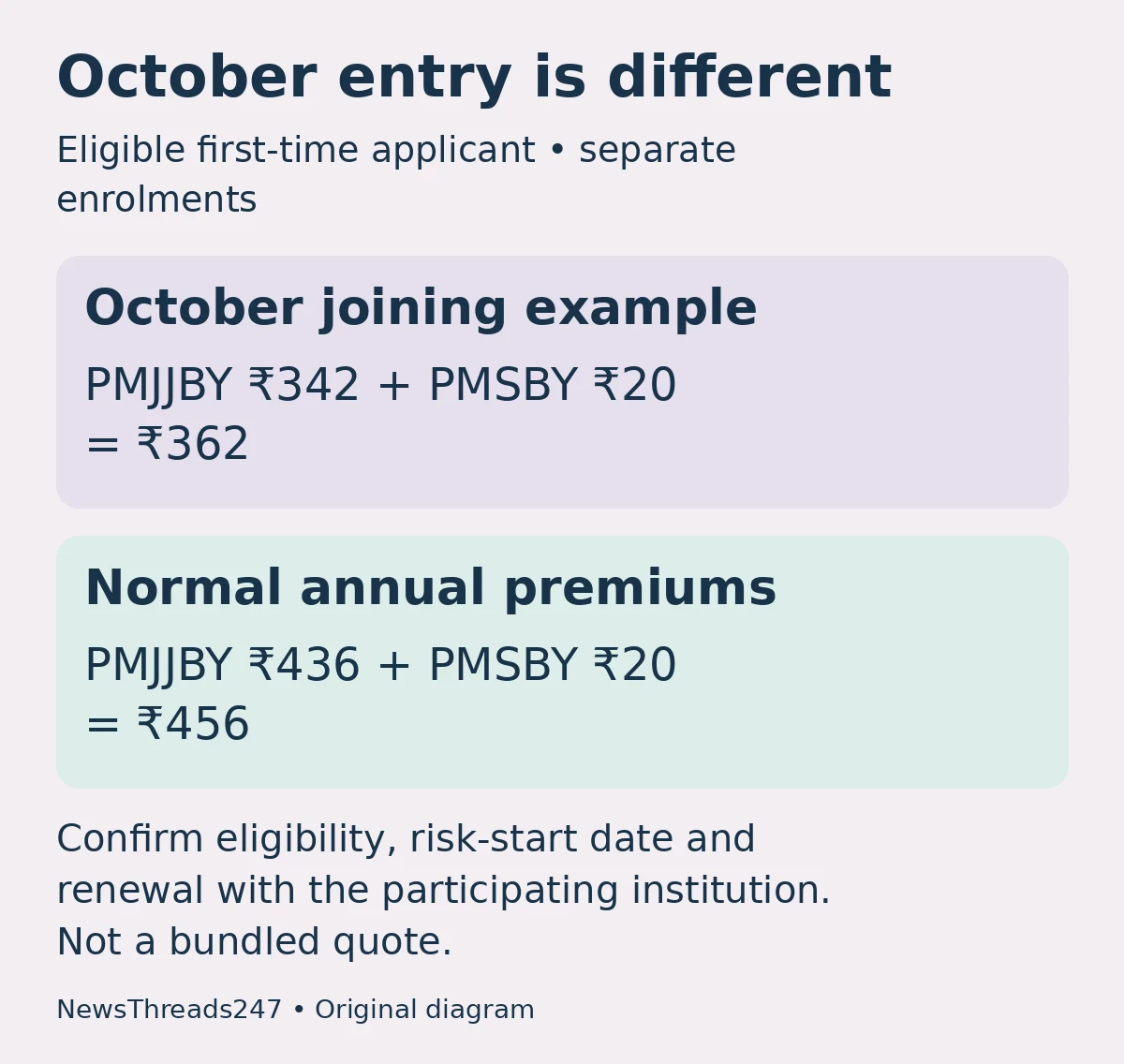
The Finance Ministry’s May 2026 scheme summary, corroborated by the PMJJBY FAQ, provides a pro-rata premium of ₹342 for first-time enrolment during September, October or November. Its full annual renewal premium remains ₹436. PMSBY’s annual premium is ₹20. The normal cover year runs from 1 June to 31 May; joining later does not automatically create a fresh twelve-month cover year.
For an eligible first-time applicant joining both schemes during October, the two listed premiums add to ₹342 + ₹20 = ₹362. The normal full annual amounts add to ₹436 + ₹20 = ₹456. These are arithmetic examples based on the official schedules checked on 26 October 2026, not a bundled product quote or a promise that either enrolment will be accepted.
Ask the participating bank or post office to confirm the applicable joining amount, actual risk-start date and next renewal. PMJJBY risk starts from the premium auto-debit under its FAQ, and the first-time or rejoining lien still needs attention. A calendar reminder alone cannot establish that cover has begun.
Check the bank record, not just the acronym
Before enrolling, obtain the current consent form and scheme terms from your participating institution. Check the full scheme name, subscriber details, designated account, premium authorisation and nominee record. If an online channel offers enrolment, use the institution’s verified channel rather than a forwarded link asking for banking credentials.
After enrolment, retain the acknowledgement and check the actual debit and cover confirmation. If the debit is absent or a renewal has failed, ask the institution to confirm the status and the permitted next step; do not assume a previous year’s participation keeps the current year active.
Both official FAQs restrict duplicate participation through multiple accounts. Paying through a second account is not a way to multiply the insured amount. If you discover two debits, ask the participating institutions to identify and correct the records under the scheme rules rather than treating them as two valid layers of cover.
Put the documents where the claimant can find them
A useful family record identifies the scheme, participating institution, insurer, designated account and nominee. Store the enrolment acknowledgement and subsequent renewal evidence with those details. Share the location of the record with the person likely to handle a claim; do not share passwords or one-time passcodes.
For a claim, contact the participating institution and insurer for the current checklist for the actual event. Death and disability claims require different evidence. Do not buy an agent’s promise of guaranteed approval, assume one generic document list fits every claim, or delay checking the operative procedure because an online comparison said the payment was automatic.
Finally, compare the benefit with the need it is meant to address. A modest fixed benefit may be useful without being sufficient for years of household expenses, debt or treatment. Neither scheme should be mistaken for a complete financial plan. Choosing additional cover requires a separate assessment; this article does not recommend a personalised sum insured.
Keep the insurance nominee record separate from the nomination on the underlying deposit account. Our bank-deposit nomination guide deals with deposit records; those rules should not be assumed to determine the insurance claim.
Official references and visual credits
Department of Financial Services: PMJJBY FAQ; Department of Financial Services: PMSBY FAQ. Scheme terms and premiums can change; check the current documents at enrolment and renewal. Featured image: AI-generated conceptual illustration. Comparison and premium diagrams: original editorial graphics based on these official schedules, not policy certificates or evidence of a paid claim.