
A ₹2 lakh loan does not necessarily put ₹2 lakh in your account. If a lender deducts a fee before disbursal, you start with less usable money while the repayment commitment remains. That is why a comparison based only on the advertised interest rate can miss a material part of the cost.
For an Indian retail term loan, ask for the Key Facts Statement, or KFS, before agreeing. Read the annual percentage rate (APR) alongside the interest rate, the amount actually disbursed, the instalment schedule and the charges. APR is a useful common measure, but the underlying cash flows still need to match your borrowing need.
What the RBI requires—and the scope of the rule
The RBI’s 15 April 2024 KFS circular applies to new retail and MSME term loans sanctioned from 1 October 2024 by regulated lenders, including banks and NBFCs. Credit-card receivables are exempt. It requires a pre-contract KFS in language the borrower understands, an APR computation and an amortisation schedule. APR includes interest and other associated charges, including relevant third-party charges recovered through the lender.
For loans lasting at least seven days, the offer must remain valid for at least three working days; shorter loans have at least one working day. A charge absent from the KFS cannot be imposed during the loan without the borrower’s explicit consent. That consent qualification matters: an omitted charge is not automatically permission to ignore a later request.
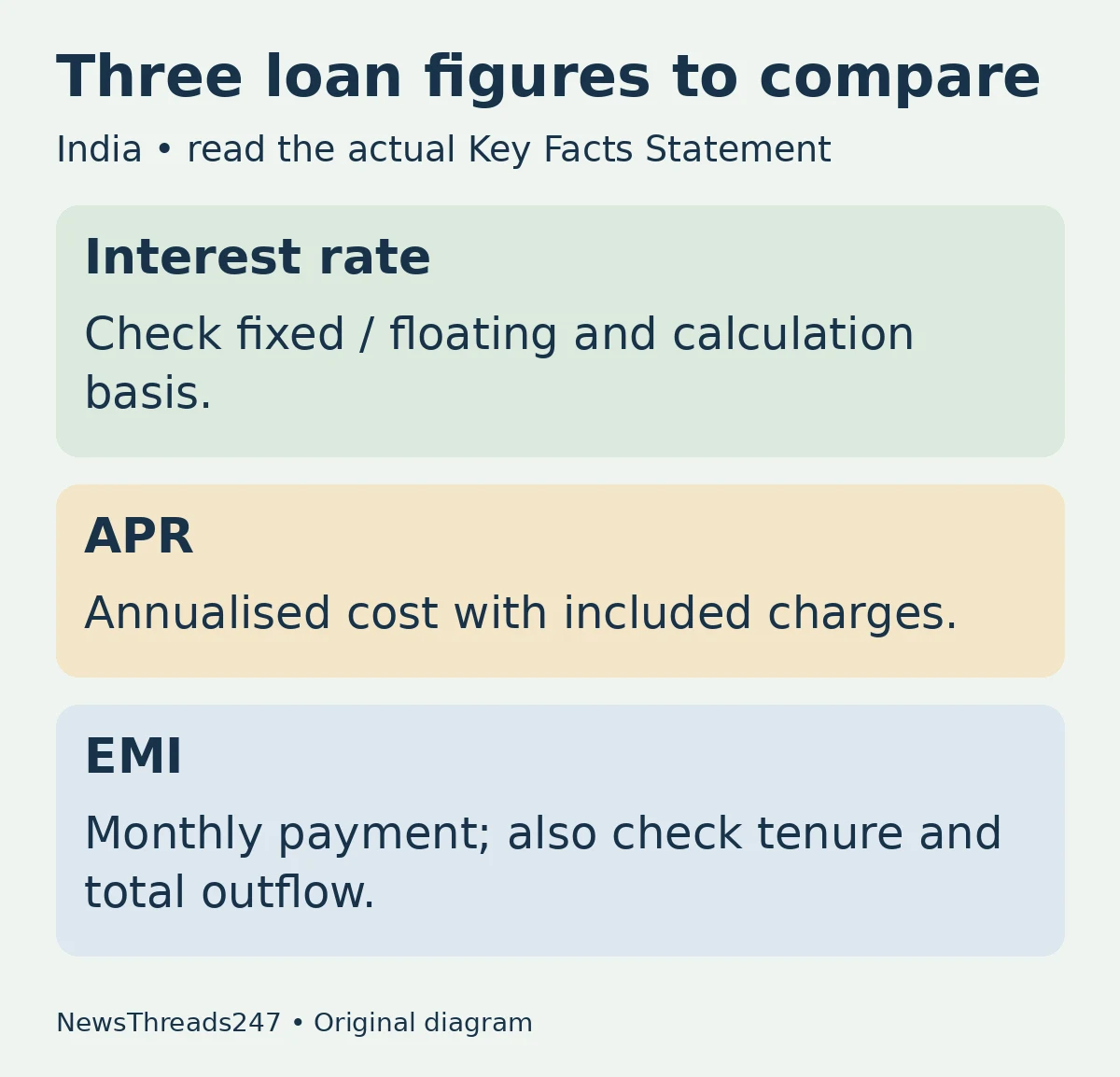
Interest rate, APR and EMI answer different questions
The interest rate describes the interest calculation on the loan. Before comparing two rates, establish whether each is fixed or floating and whether interest is calculated on a reducing balance or a flat basis. The same printed percentage is not a meaningful like-for-like comparison if the calculation bases differ.
APR expresses annualised borrowing cost after the included charges and their timing are considered. EMI tells you the regular monthly payment. A smaller EMI can come from spreading the debt over more months; it does not by itself establish a cheaper loan. Total repayment gives another useful view, but it cannot replace an annualised measure when tenures differ.
Put these figures on one comparison sheet rather than choosing whichever looks most favourable in a sales message. Where an offer uses unfamiliar terms, ask the lender to reconcile the KFS with the repayment schedule in rupees.
A worked cash-flow check: ₹2 lakh sanctioned, ₹1.98 lakh received
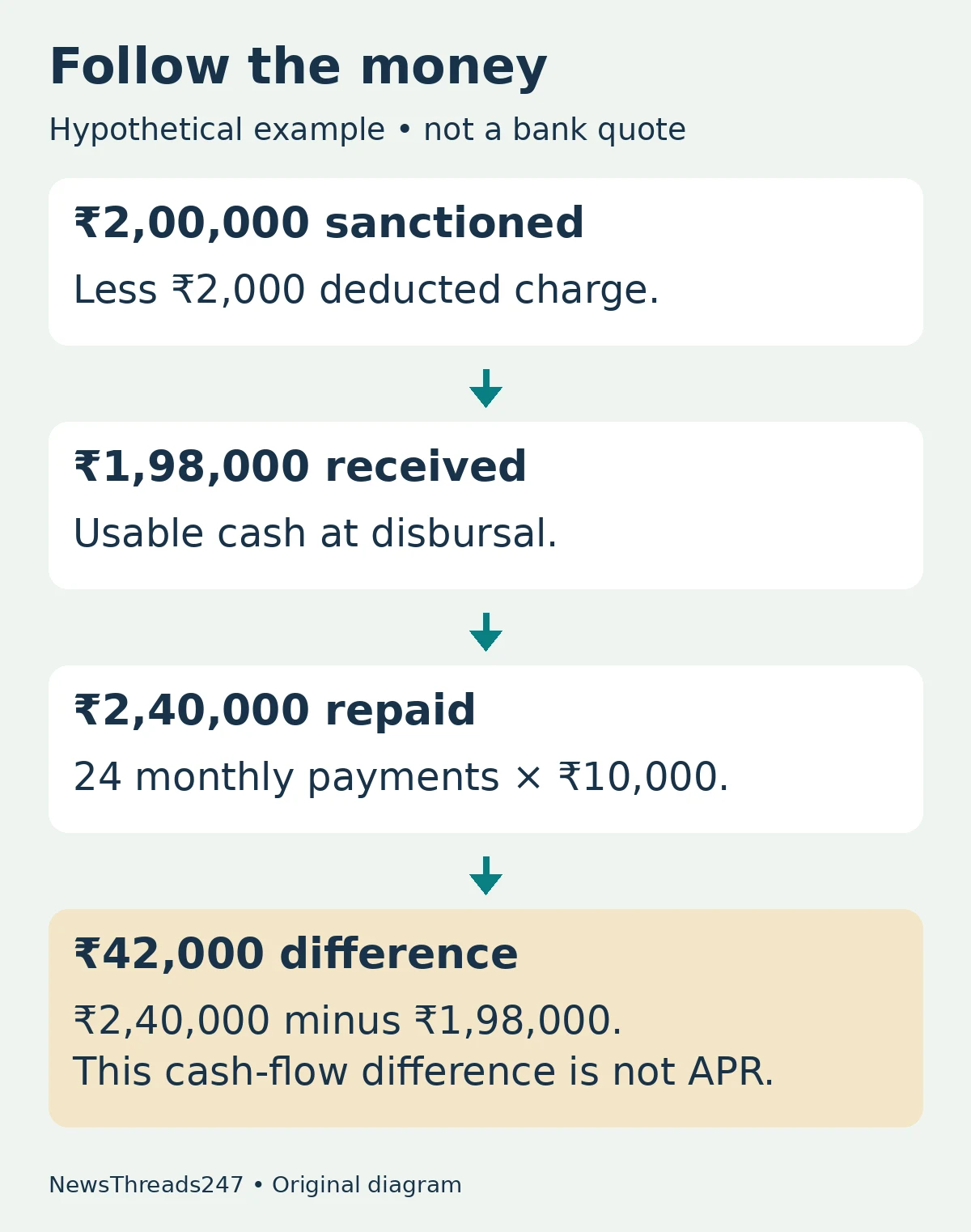
Consider a hypothetical cash-flow example. Assume ₹2,00,000 is sanctioned, a ₹2,000 charge is deducted at disbursal, and the agreed schedule contains 24 monthly payments of ₹10,000. No further charge, rebate or additional payment is assumed.
The usable amount received is ₹2,00,000 minus ₹2,000, or ₹1,98,000. Scheduled repayments total 24 × ₹10,000 = ₹2,40,000. The difference between cash received and cash repaid is therefore ₹42,000. Comparing repayment only with the sanctioned amount would show ₹40,000 and miss the ₹2,000 deducted before the borrower received the money.
₹42,000 is a cash-flow difference in this example, not an APR. Dividing it by the loan amount and number of years does not reproduce an APR: repayments happen over time while the outstanding balance changes. Use the lender’s disclosed calculation and dates to check the annualised figure. These assumptions are illustrative, not a current loan offer.
Make two offers comparable before choosing
Start with the amount you need to receive. If both offers sanction the same amount but deduct different charges, they may not solve the same cash requirement. Ask for the net disbursal and a breakdown of deductions. Then compare the same tenure and repayment frequency, noting any payment collected in advance.
Next place the two KFS documents side by side: rate and rate basis; APR; EMI and number of instalments; total scheduled payments; upfront and recurring charges; and any separate third-party payment. Ask what is included in the APR and what remains conditional. An identical EMI does not establish identical cost if one offer begins with a smaller disbursal.
For a floating-rate offer, record the benchmark, spread and reset arrangements from the actual contract. Compare what can change, not just today’s EMI. For a fixed-rate offer, confirm how long that rate remains fixed. Do not project a floating rate unchanged over the entire tenure and describe the result as guaranteed.
Keep conditional charges separate from the standard repayment case
A comparison of routine repayments is incomplete if your likely decision involves early closure, a part-payment or a missed instalment. Ask for the applicable written conditions rather than assuming every possible event is included in the headline APR. Get an explanation of any cancellation or optional-service charge before giving consent.
If insurance or another service appears in the deduction list, ask who supplies it, whether it is required for that offer, the amount charged and which document governs cancellation or refunds. Do not infer that an amount labelled insurance is refundable, optional or compulsory without the relevant terms. Obtain the receipt and retain it with the KFS.
If the amount disbursed or charged differs from the agreed paperwork, first set out the discrepancy in a written request to the lender: the quoted line, actual debit, date and supporting document. A clear rupee reconciliation is more useful than a complaint that the rate merely seems high.
For early repayment, also check the RBI’s Pre-payment Charges on Loans Directions, 2025, applicable to loans sanctioned or renewed from 1 January 2026. For floating-rate loans to individuals for non-business purposes, covered lenders cannot levy pre-payment charges, with or without a co-obligant. Business-purpose cases have lender and amount distinctions; a written fee line does not override an applicable prohibition. Check the loan’s purpose, sanction or renewal date and rate status before comparing an exit cost.
A practical decision record
Before accepting, save the dated KFS, sanction terms and full repayment schedule. Write a short note stating the cash you will receive, payment dates, total scheduled outflow and the conditions most relevant to your plans. If a sales explanation contradicts the documents, resolve it in writing before signing.
Also separate borrowing affordability from approval. A lender’s willingness to offer credit does not establish that the payment fits your household budget. This guide explains comparison mechanics; it does not recommend a lender or a personalised borrowing amount.
If your next step is an application and a report contains an error, our credit-report dispute guide explains how to assemble the underlying evidence. Correcting a record and comparing the terms of a new loan are separate tasks; neither guarantees approval.
Source and visual credits
Regulatory source: RBI, Key Facts Statement for Loans & Advances, 15 April 2024. The cash-flow example and diagrams are original illustrations. Featured image: AI-generated editorial illustration, not a lender interface or an offer. Read each actual lender’s current KFS and contract before deciding.