
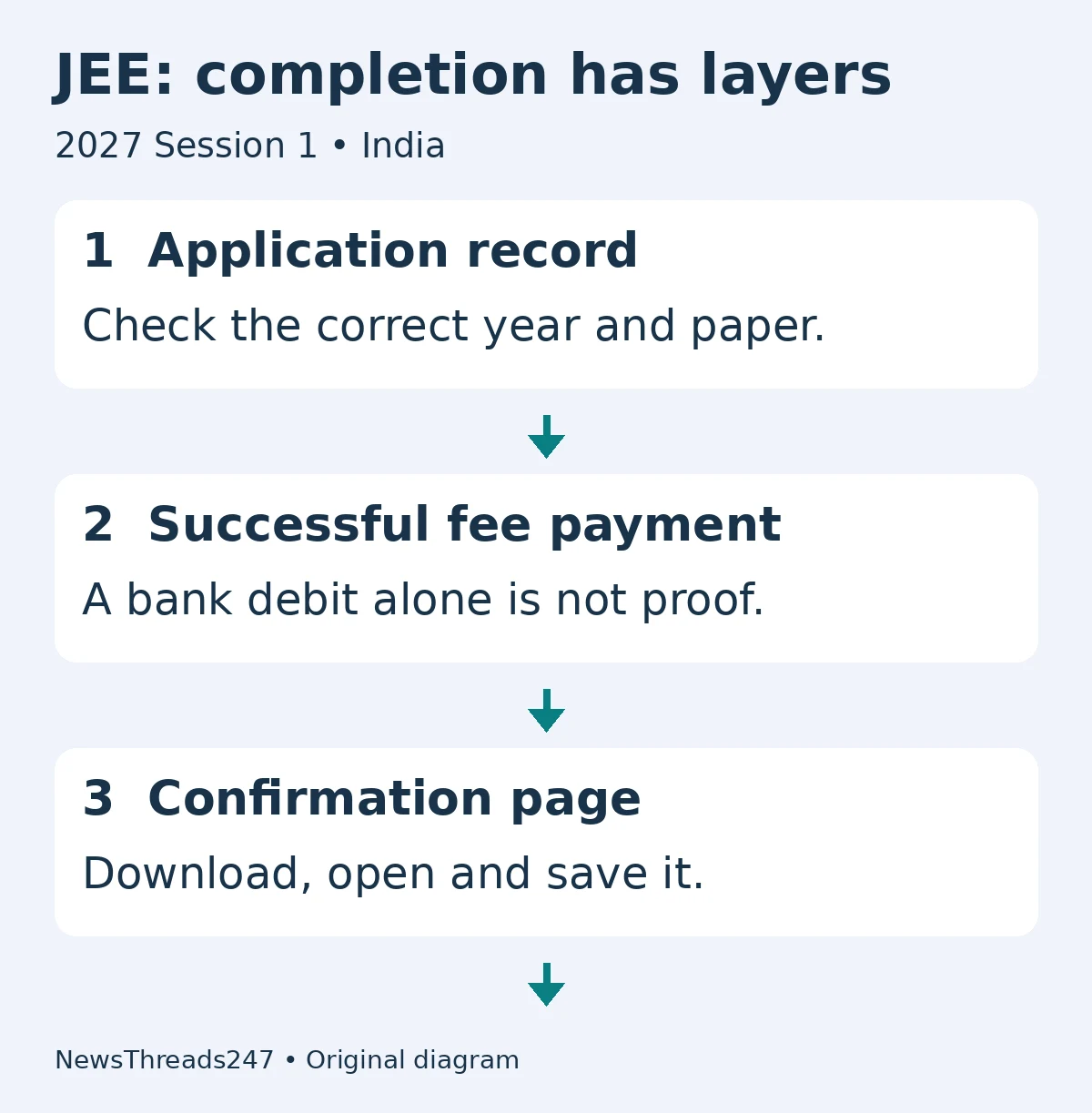
A bank debit is not the document you need at the end of a JEE Main application. The important final check is whether the official system records the successful fee payment and lets you download the confirmation page. Save that page before treating the application task as finished.
NTA’s current JEE Main website links the 2027 Session 1 form and the notice dated 24 October 2026. The normal application and payment deadline is 22 November 2026, 11:50 PM IST. This guide, checked on 26 October, focuses on completing and documenting the application; it does not replace the full eligibility and admission rules.
Use the 2027 notice and the correct paper
The 24 October public notice identifies Paper 1 for B.E./B.Tech, Paper 2A for B.Arch and Paper 2B for B.Planning. Choose according to the intended course, not merely because one option appears first. The published Session 1 examination dates are 20, 21, 22, 23, 24 and 28 January 2027; your own allotted date and shift must be checked when issued.
Keep the application website, notice and information bulletin together in a single folder. Check the year on every document you open. The same official site also hosts earlier cycles, so an official-looking PDF is not necessarily the current instruction. If a later NTA notice changes a detail, use that later instruction and keep its date with your record.
Check eligibility before paying
The 2027 information bulletin, Chapter 3, identifies Class XII/equivalent pass years 2025 and 2026, or appearing in 2027, for examination eligibility and states there is no age limit for appearing. Admission to a particular institution remains subject to that institution’s rules. Do not turn permission to sit the test into a promise of admission.
Make a short pre-payment check with your actual records: qualifying examination, first passing year, intended paper and the category or disability particulars you are claiming. Where your circumstances need an exception or equivalence decision, consult the relevant bulletin provision and official support. A coaching-site summary cannot decide an unusual individual case.
Use contact details you can access throughout the cycle. Prepare your own required photograph, signature and certificates according to the current instructions. A readable document with the wrong person’s details is still the wrong document; check content as well as file format.
Treat the fee as a selected-case amount
The bulletin’s fee table separates candidate category, gender, paper combination and examination-centre location. There is no single fee that accurately describes every applicant. Match all those fields before accepting the amount shown, and distinguish the examination fee from any payment-gateway charges.
Record the amount displayed for your selection and retain the payment reference. If the amount is unexpected, check the selected paper or combination and candidate particulars before authorising payment.
A debit without confirmation needs a payment-status check
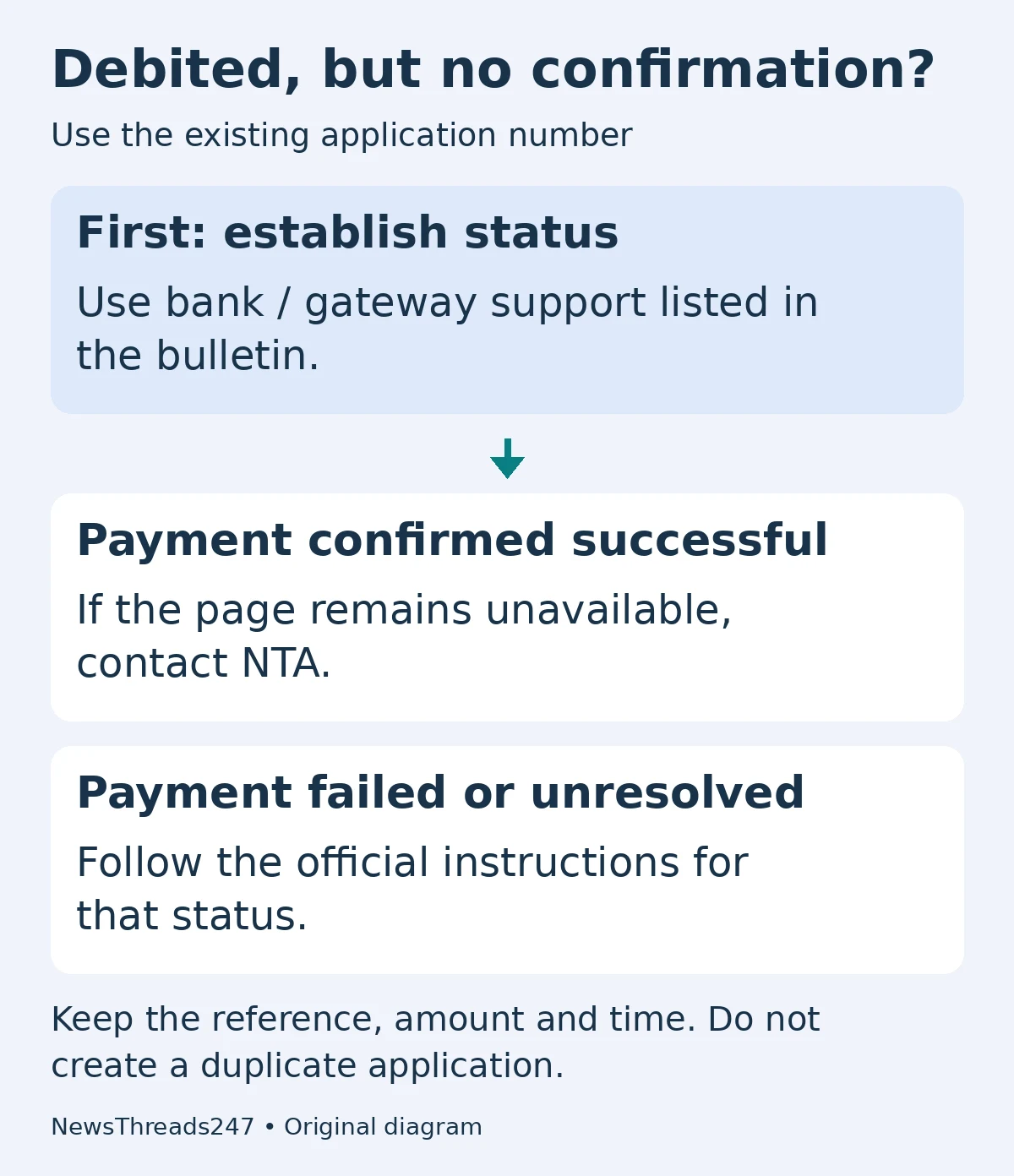
The bulletin’s application instructions say the confirmation page follows successful fee payment. If it is missing, use the bank or payment-gateway support identified in the bulletin to establish the transaction’s status; if successful payment is confirmed but the page remains unavailable, contact NTA. Keep the existing application number while resolving the issue.
In a hypothetical example, a student sees a debit on a banking app but no confirmation page after returning to the application portal. The next useful evidence is the gateway status and the portal record, not a second application created in panic. Write down the transaction reference, amount and time so support can trace one specific attempt.
Do not promise yourself an automatic refund or a guaranteed repair time. Follow the official payment instructions for the actual status returned. Keep any later payment or refund reference separate from the first attempt so the transaction history stays understandable.
Keep the deadlines separate
The public notice lists a late-submission period from 23 to 26 November, with an additional ₹500 late fee over the applicable examination fee. It lists corrections from 27 to 29 November, ending at 11:50 PM IST. These are separate stages, not a reason to postpone a normal application.
Do not assume a future correction window will reopen every field. Finish the form carefully now. Before any correction, check the live NTA instructions for the permitted fields and save the revised record. A planned correction date does not excuse an unresolved payment or incomplete submission today.
Build a record you can use later
Save the confirmation page, application number, current notice and payment evidence together. Open the saved page to confirm it is readable and belongs to the correct applicant and session. Keep a backup somewhere you can retrieve without relying on a temporary browser tab.
A confirmation page is not an admit card. When later travel information appears, our city-slip versus admit-card guide explains why those documents serve different purposes. For understanding results later, the NTA percentile guide separates a score scale from a percentage of marks. Neither substitutes for completing the application now.
Sources and visual credits
Primary references: NTA JEE Main website, the linked 24 October 2026 notice, and the 2027 bulletin. Check later notices before acting. Featured image is an AI-generated study concept, not an NTA interface. Diagrams are original NewsThreads247 decision aids.