

Early Decision (ED) and Early Action (EA) are not interchangeable college-application plans. At participating US institutions, Early Decision normally involves a binding agreement to enrol if admitted, while ordinary Early Action gives an earlier decision without a comparable commitment. Restrictive Early Action can limit applications to other colleges even though it is generally not a binding enrolment promise. The correct choice is about fit, affordability, restrictions and deadlines—not simply whether “early” might sound more competitive.
In November 2026, many applicants are working around early-round deadlines, but there is no universal date for every institution. We checked the National Association for College Admission Counseling (NACAC) definitions and Common App Early Decision agreement instructions. This guide helps families interpret plans and prepare documents; it is not an admissions prediction or a list of “guaranteed acceptance” tricks.
On this page: ED, EA and REA · What binding means · November dates · Aid and affordability · Common App agreement · How to choose · Common errors · Questions
Early Decision, Early Action and restrictive plans
The usual vocabulary has four main entries. Regular Decision (RD) is the school’s standard admissions cycle. Early Action (EA) provides an earlier response and is generally nonbinding. Early Decision (ED) asks an applicant to make a first-choice commitment: if the college admits the student under the ED agreement, the student is expected to attend and withdraw other college applications, subject to the agreement and any applicable aid considerations. Restrictive or Single-Choice Early Action (REA/SCEA) is not the same as an ordinary EA plan: it can prohibit or limit other early applications.
| Plan | Usually binding? | Can applicants keep multiple options? | What to read |
|---|---|---|---|
| ED / ED I / ED II | Yes, per institution agreement | Very limited once admitted | Binding terms and aid provisions |
| Ordinary EA | No | Often yes | Institution’s application rules |
| Restrictive EA / SCEA | Usually no enrolment commitment | May restrict other early applications | Exact restriction and exceptions |
| Regular Decision | No advance binding commitment | Typically yes | Regular deadline and reply date |
The broad labels do not replace a particular college’s current policy. Some schools offer ED I and ED II with different windows. Others offer only EA or a restrictive version. Some operate priority scholarship deadlines that are separate from application-plan names. NACAC explicitly advises consulting individual college rules before treating a general chart as universally applicable.
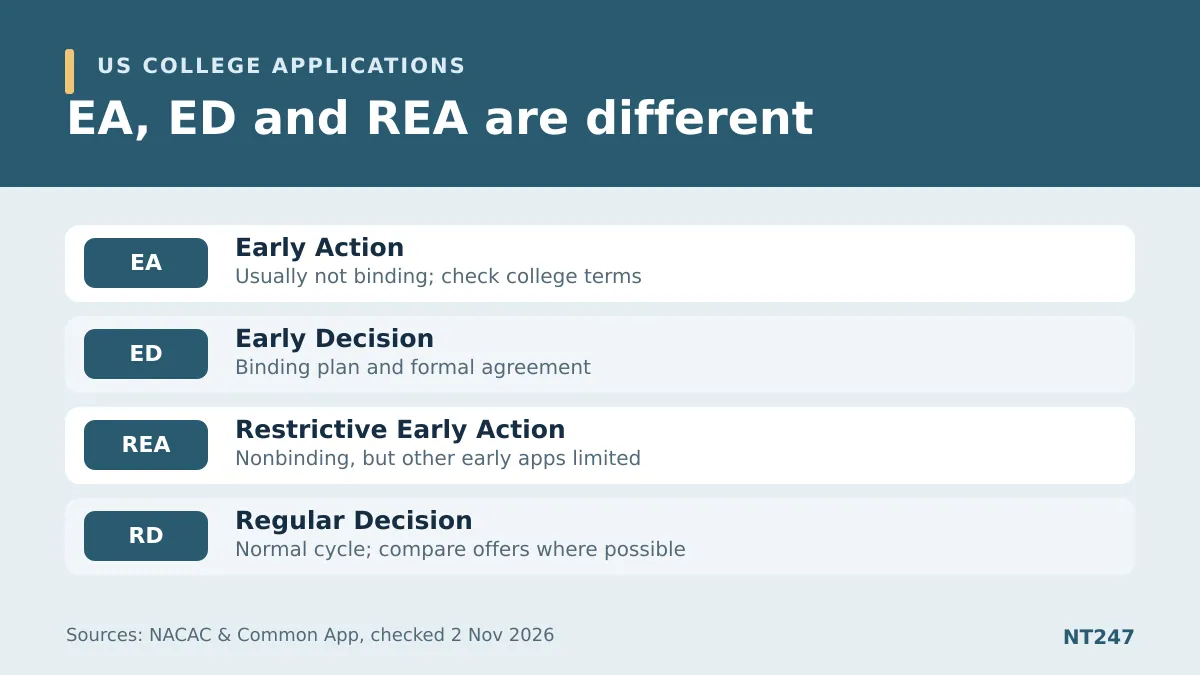
What does a binding Early Decision agreement involve?
A binding commitment means the applicant is not treating the admission as one of several offers to compare freely. Common App instructions say the student, a parent or guardian and a school counselor participate in an Early Decision agreement when that process applies. The student selects the ED option for one institution, reads the terms and submits the required acknowledgement. The counselor and parent or guardian may need to complete their own portions. The exact route and timing can vary by institution and how recommendations are submitted.
Families should read the complete agreement before submitting. This includes any circumstances in which a student who cannot afford the offered package can consult the institution about release from the commitment. It would be misleading to promise either that an ED offer can always be withdrawn without consequence or that families must accept unaffordable aid without asking questions. The college’s written policy and financial-aid office should control that discussion.
Are all early deadlines on November 1?
No. November 1 is common at some US colleges, but it is not a national filing date, and some institutions use mid-November, December or other calendars. By 2 November, applicants may already have missed certain ED I or EA deadlines but still have options elsewhere. Do not claim an “extension” from a generic admissions article. Check each school’s current first-year admission page for the specific entry year and plan.
An application may also require supporting items beyond the student form: transcripts, school report, counselor recommendation, teacher letters, testing if applicable, portfolios or other programme material. Some schools distinguish the submission deadline from the supporting-material deadline. An applicant who submitted the main form but has missing required materials should verify the portal status and contact admissions rather than assume the file is complete.
- Confirm the institution, entry term and exact ED/EA/REA/RD plan.
- Write down the date and time zone; do not assume the website follows your local time zone abroad.
- Check whether the main application and recommendation materials have different due dates.
- Read the institution’s restrictions on applying early to other colleges.
- Retain the submission receipt and watch the applicant portal for missing items.
Why the financial-aid comparison matters
Students who need substantial aid should discuss affordability before choosing a binding plan. An ED commitment can reduce the normal opportunity to compare multiple complete aid packages side by side. That does not mean every college’s ED aid is worse or better; there is no reliable universal rule. Families can use a college’s published net-price calculator, the financial-aid office and official award policies to form a realistic range, while treating estimates as estimates.
US federal financial aid and college admission use different applications. The FAFSA may be relevant to eligible students, but colleges can also have institutional aid forms, documents and earlier priority dates. Students outside the United States should not assume they are eligible for US federal student aid merely because they apply through Common App. International applicants should read each college’s actual international-aid policy.
How the Common App ED agreement works
Common App’s published recommender instructions explain that an applicant who selects an ED option must read and sign the agreement and arrange required parent/guardian and counselor participation. A parent may receive a link using the email supplied in the applicant’s account; a counselor handles their part through recommender tools or approved offline procedures. A missing acknowledgement should be resolved through the documented workflow, not by submitting a false signature.
If a student’s family situation makes an agreement step difficult, contact the counselor or college rather than entering another person’s details without consent. Keep your login credentials private. An admissions helper should never demand that you hand over your entire account password or produce an unofficial “binding agreement certificate.”
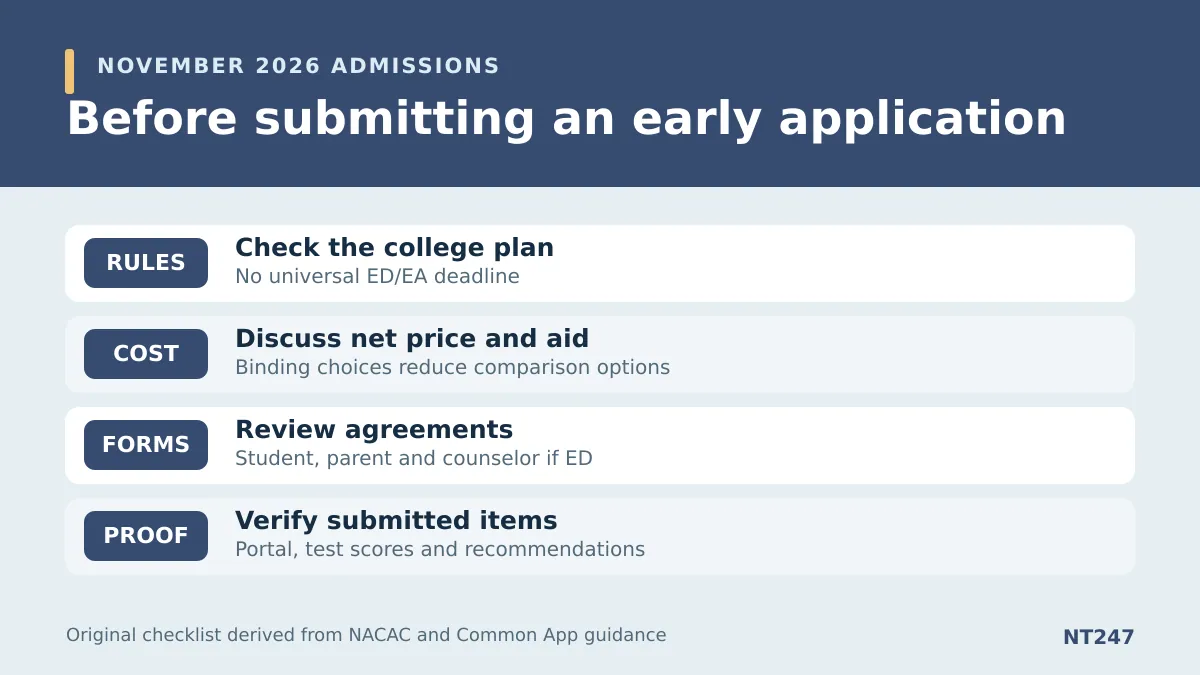
A simple decision method for students and families
Ask three questions in order. First, would the student genuinely choose this school over alternatives after comparing programme content, location, costs and support? Second, can the family evaluate the likely net cost well enough to consider a commitment? Third, are all early-plan restrictions, recommendation requirements and dates understood? If any answer is uncertain, ordinary EA or Regular Decision may preserve valuable flexibility. That is a decision framework, not a guarantee about admissions chances.
For a strong but still undecided applicant, applying EA to appropriate colleges may offer an earlier answer without the same enrolment obligation. For an applicant with a clear first choice, carefully researched affordability and a strong understanding of the agreement, ED may be appropriate. A student with changing academic interests or significant financial uncertainty may prefer to wait. No application plan compensates for an inaccurate academic record or a rushed personal statement.
Mistakes worth preventing before clicking submit
- Treating ED as nonbinding because it is filed through the same platform as EA.
- Applying to other early programmes despite an REA policy that restricts them.
- Assuming every college uses November 1 or the same time zone.
- Ignoring the parent/counselor agreement steps for an ED application.
- Comparing sticker tuition instead of realistic net cost and financial-aid terms.
- Believing an early application automatically improves admission chances for every student.
Frequently asked questions
Is Early Decision binding?
Generally yes. The applicant agrees to attend if admitted under the terms of the school’s ED agreement. Read the actual institution terms.
Can I apply to multiple schools through Early Action?
Ordinary EA often permits that, but restrictive EA and certain college-specific rules can limit other early applications.
Is every ED or EA deadline November 1?
No. Deadlines vary by institution, entry term, admission plan and sometimes material type.
Does applying early guarantee acceptance or scholarship aid?
No. Colleges make their own admissions and aid decisions; a plan choice alone guarantees neither.
Primary sources and review
Checked 2 November 2026 IST: NACAC admission terminology, NACAC explanation of early rounds and Common App ED agreement workflow. The article does not assert specific colleges’ current deadlines without their own announcements.
Visual disclosure: The lead photo is AI-created conceptual imagery; the two charts are original explanatory materials. No real applicant interview or admissions-office affiliation is claimed.