
November 2026 is Native American Heritage Month in the United States. The month is an opportunity to learn about the histories, languages, cultures and ongoing contributions of Native nations—rather than treating Indigenous peoples solely as figures from the past. The official federal cultural-institutions portal offers exhibitions, primary-source collections, events and teaching materials. The useful starting point is asking whose perspective a source represents and how the community describes itself.
A surge in US Google Trends searches for the month on 2 November gives this subject immediate relevance, but a trend is not evidence that any particular historical claim is true. We checked the official Native American Heritage Month portal, its history page and its teacher resources. This guide is an educational overview and research roadmap—not an attempt to speak on behalf of Native peoples.
On this page: Meaning and dates · How it developed · Living communities · Classroom learning · Reliable resources · 2026 events · Common mistakes · Questions
What is Native American Heritage Month?
It is a month-long US observance in November that recognizes American Indian, Alaska Native and other Indigenous histories and contributions. Some federal resources use the name “National American Indian Heritage Month”; others use “Native American Heritage Month” or a longer form. Those variations reflect the history of the observance. They do not mean every community uses the same preferred identity terms. When referring to a specific nation, using its self-identified name and language is more precise than relying on a single broad label.
It is also important to distinguish a commemorative month from a federal legal holiday. The month does not make every day in November a public holiday or change school calendars by itself. Institutions may host programmes, exhibitions and lessons, but each activity has its own dates and access conditions. Consult the relevant organizer before planning a visit or claiming an event is free.
How the November observance developed
The Library of Congress-hosted history explains that New York recognized an American Indian Day in 1916, following decades of advocacy for wider recognition. In 1990, President George H. W. Bush approved a joint resolution designating November of that year as National American Indian Heritage Month. Similar annual proclamations have continued under differing titles since 1994. The record is more nuanced than the shorthand claim that one person simply “invented” the month in 1990.
The official historical overview links to legislative and proclamation records held by the Law Library of Congress. Students writing a history assignment should use those dated documents for the legal timeline and distinguish them from community-led cultural celebrations, which did not suddenly begin with federal recognition. The public observance is recent; Native nations and their histories are not.
Why the present matters as much as the past
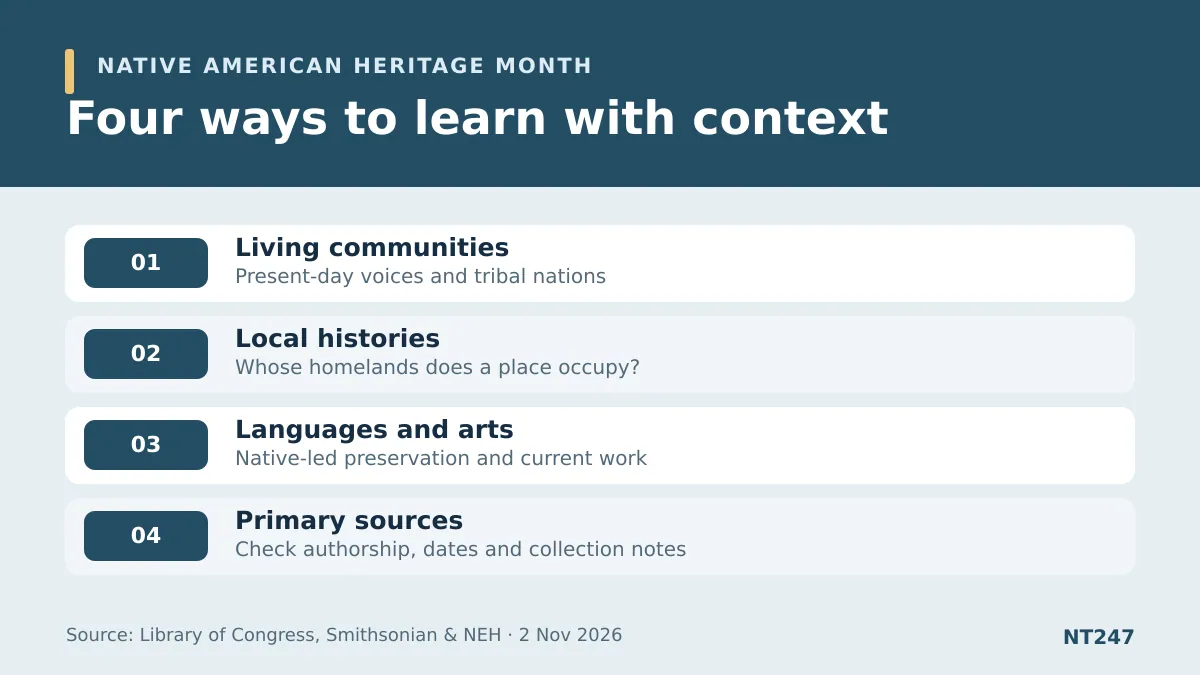
A respectful explanation begins with the fact that Native communities are contemporary, diverse societies. Tribal nations differ in governments, languages, geography, law, traditions, art, economic life and educational priorities. A single artwork or classroom costume cannot represent them all. For an accurate local lesson, identify the specific nation or nations relevant to that place and look first for their own contemporary public resources.
A useful classroom question is: who created this account, and when? A nineteenth-century government record, a tourist poster, a present-day tribal government page and an interview with a Native author may tell very different parts of the story. None should be treated as interchangeable. Historians also examine how land policies, forced displacement and education systems affected communities; however, those difficult topics should be approached with sourced evidence and age-appropriate context, not sensational anecdotes.
A practical classroom lesson without stereotypes
A 45-minute lesson can be meaningful without buying decorations. Begin with a five-minute introduction to the observance and a local map. Spend fifteen minutes comparing two trustworthy descriptions of the same place, one from an official archive and, where accessible, one from a relevant tribal institution. Ask students to record the author, date, nation, subject and unanswered questions. Use the next fifteen minutes to explore contemporary Native writing, language work, science, art or community institutions. Finish with a ten-minute evidence check: what did students learn that challenged an oversimplified textbook image?
- Use the exact name of the specific nation when the source identifies it; do not mix nations into a generic “tribal culture” display.
- Choose materials by Native educators, artists and institutions whenever possible, and credit their authors.
- Avoid dressing children in imitation ceremonial clothing, making sacred objects as crafts or staging invented rituals.
- Teach historical facts alongside current voices; a lesson focused only on conflict or tragedy is incomplete.
- Check image rights, especially for archival photographs and culturally sensitive objects, before reuse.
Where to find reliable free educational material
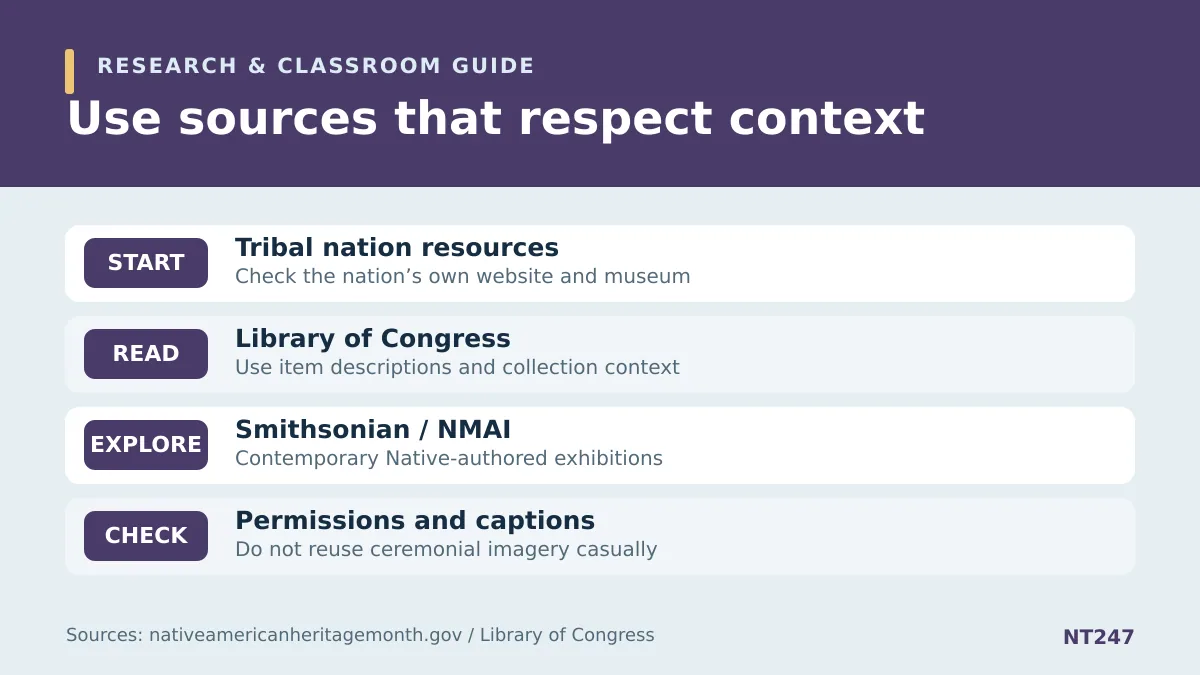
The federal teaching portal points to resources from the National Endowment for the Humanities, the Smithsonian, the Library of Congress and other institutions. Its links cover Native American diversity, languages, historical interpretation and specific communities. The exhibitions and collections index leads to archives with descriptions, provenance and subject notes. Teachers should preview each resource rather than assuming every linked item suits every age group.
| Source type | Best use | Important check |
|---|---|---|
| Tribal nation or Native-led museum | Current identity, cultural guidance and local context | Who speaks for the institution? |
| Library of Congress collections | Primary sources, maps and archival material | Date, creator, collection notes and rights |
| Smithsonian / National Museum of the American Indian | Curated exhibitions and teaching resources | Read the full contextual explanation |
| NEH lesson material | Structured classroom enquiry | Appropriateness for the year group |
An archival photograph might be historically valuable but still require a warning about outdated captions or colonial terminology. A teacher can explain that older language appears because the document is evidence from a particular time; it is not automatically appropriate language to repeat as the school’s own voice. Rights to reproduce an image and cultural permission to use it respectfully are also different considerations.
What can visitors explore in November 2026?
The 2026 official events page lists institutional programmes and links to Smithsonian and Library of Congress programming. Check the host’s actual event page for date, time zone, location, admission and accessibility information. A museum exhibition may be open all month, while a lecture, webinar or performance may have one precise date. A title shown on a portal is not proof that a programme is taking place in every state.
For families outside the United States, including Indian readers, digital exhibits and educational collections can be worthwhile without claiming a direct local holiday. The best cross-cultural learning is specific: compare how two countries preserve languages or present archival history, while acknowledging that their legal and historical situations are different. Do not imply that Native American nations and Indian Scheduled Tribes are the same category or share identical experiences.
Five common mistakes to avoid
- Writing as if Native American history ends in the nineteenth century.
- Treating hundreds of distinct nations and peoples as one undifferentiated group.
- Presenting a classroom activity as “authentic” without a Native source or permission.
- Using an AI-generated headdress or invented tribal symbol as an apparently documentary image.
- Copying a museum image without its creator, context, licence and cultural considerations.
This article’s lead image deliberately uses a neutral library setting because an invented depiction of a specific tribe would risk misleading readers. Our charts are original teaching aids, not Indigenous-designed artwork. For school projects, sourcing real contemporary voices is more educational than attractive but unsourced visuals.
Frequently asked questions
When is Native American Heritage Month 2026?
It is observed throughout November 2026 in the United States. Individual museums and institutions publish their own event dates.
Why is November associated with the observance?
The federal November designation dates to the 1990 joint resolution, with later annual proclamations and an earlier history of advocacy and state observances.
Is it a federal holiday?
It is a national commemorative month, not a general month-long federal legal holiday.
Where should a teacher begin?
Start with the Library of Congress-hosted teaching resources, then consult relevant tribal nations and verify each resource’s creator and context.
Source notes and editorial disclosure
Research checked 2 November 2026 (IST). Primary references: official heritage portal, historical overview, educator guide, 2026 events and collections index. No firsthand interview, attendance or Native authorship is claimed.
Visual disclosure: Feature image is AI-created conceptual library photography; the two figures are original explanatory graphics. Do not treat these images as documentation of any specific community, exhibit or collection.