
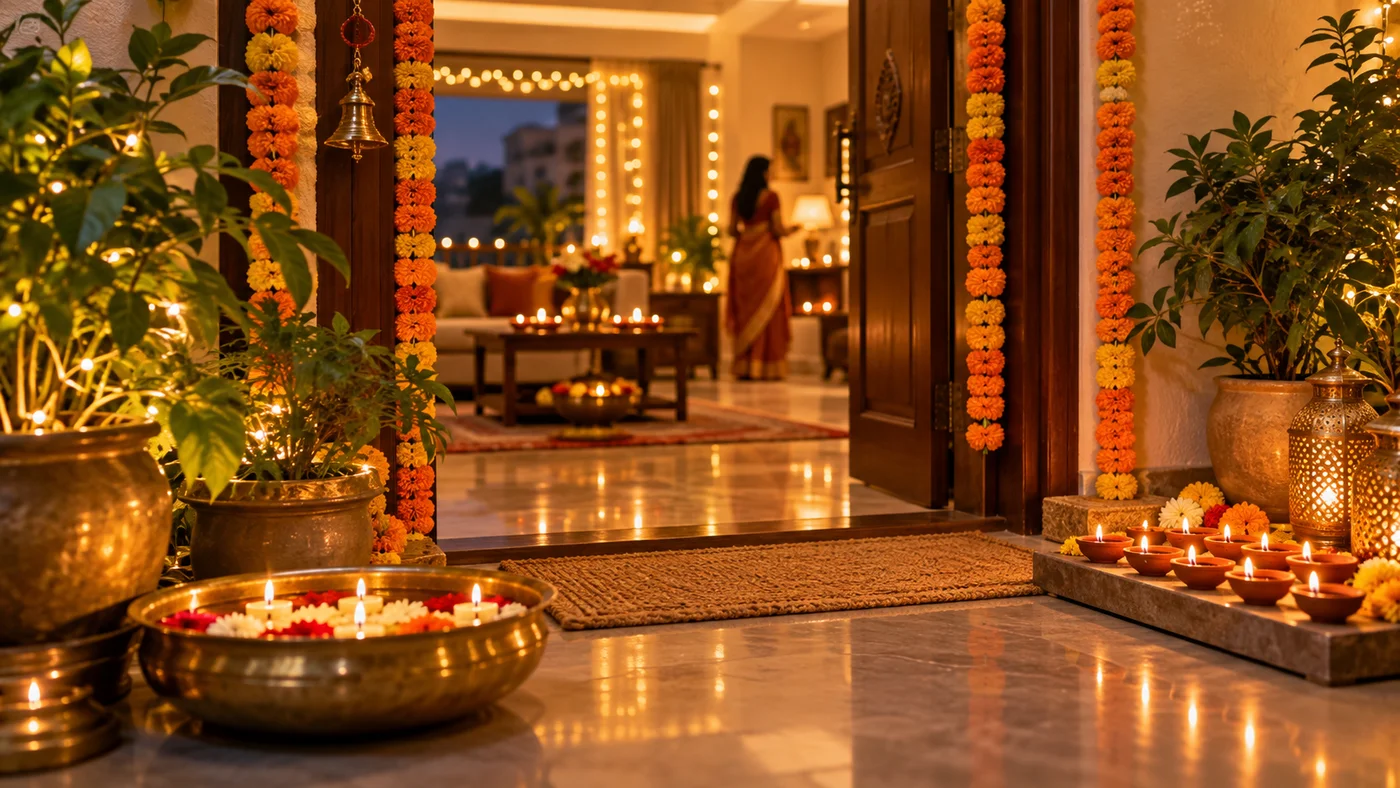
Diwali (Deepavali) is listed for Sunday, 8 November 2026, in the Government of India’s central holiday calendar. That gives families starting preparations on Monday, 2 November one calendar week to check decorations, shopping, travel and household safety without a last-minute rush. The central list itself warns that some states observe the holiday on Naraka Chaturdashi instead, so local practice and government leave calendars must be checked separately.
This guide focuses on tasks readers can act on before the festival, not unsupported city-wide claims about a universal puja muhurat. The official 2026 central holiday list states the 8 November date and the regional exception; the Government of India tourism page describes the wider celebration. Safety points are drawn from Indian fire-service advice and the current official Green Diwali campaign.
Diwali 2026 date: what is confirmed and what varies
| Question | Verified context | What the reader should do |
|---|---|---|
| When is the central Diwali holiday? | Sunday, 8 November 2026 | Check your school, employer and local holiday notice |
| Is every regional observance identical? | No; some states emphasize Naraka Chaturdashi | Use local official and community calendars |
| Is one puja time valid nationwide? | No such universal time is established here | Verify locality-specific tithi and tradition |
| Does a holiday listing set fireworks rules? | No; restrictions are local and time-specific | Check current district/state orders |
Diwali can refer to a sequence of culturally varied observances rather than a single identical ritual in every household. Dhanteras, Naraka Chaturdashi, Lakshmi Puja, Govardhan Puja and Bhai Dooj may be discussed together, but the date, naming and custom can vary by community and region. Avoid copying a viral image that claims one absolute muhurat for all of India. The appropriate source for ritual timing is a credible local Panchang or religious institution used by the household, with place and time zone stated.
A realistic November 2–8 preparation timeline
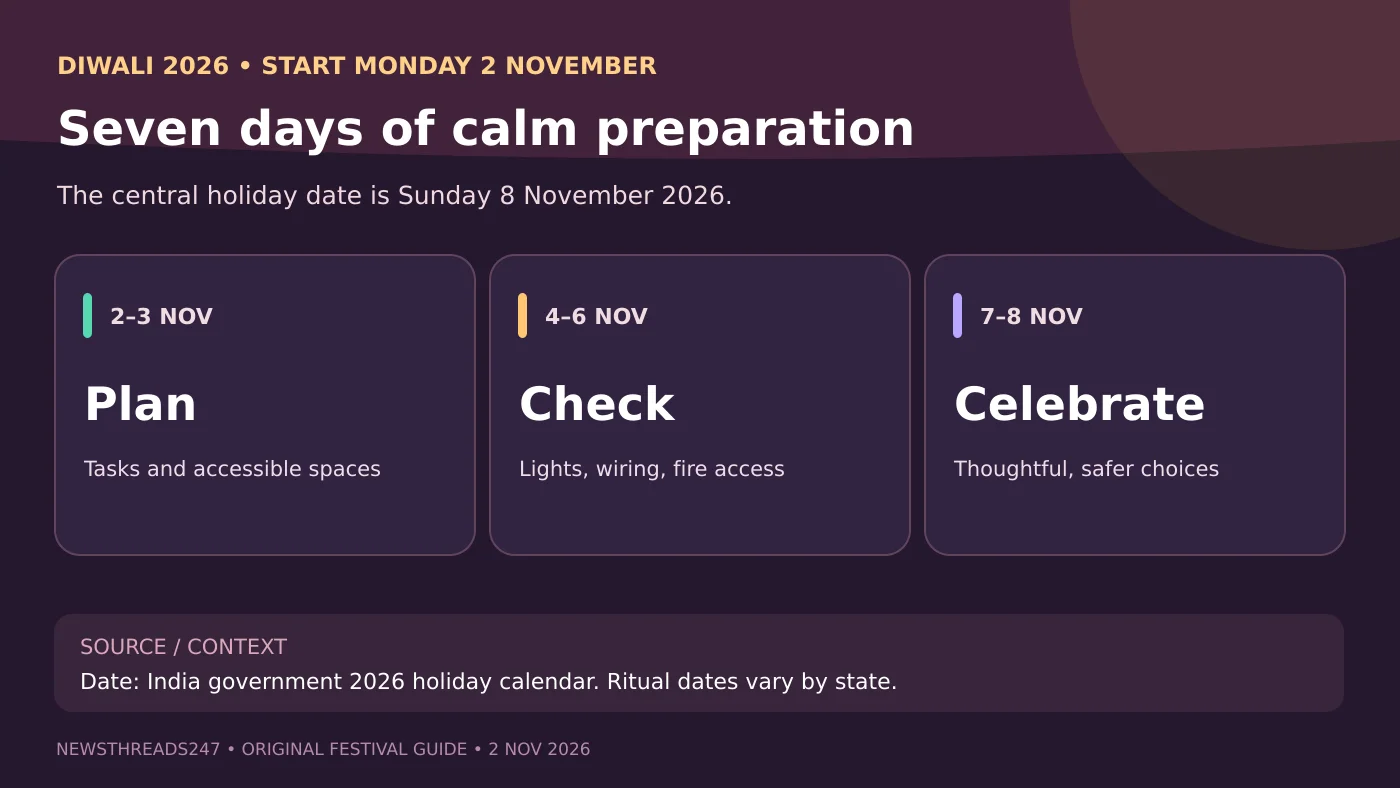
2–3 November: Walk through your home and note tasks that genuinely need doing. Clear passageways and balconies, check where guests or older relatives may need stable walking space, decide which decorations are reusable and check whether a nearby market delivery or pickup is practical. This can reduce unnecessary buying and long journeys during peak festival crowds.
4–6 November: Test decorative lights and power connections during daylight. Check the condition of cords and plugs, use lights intended for their installed location, and inspect where diyas could safely stand. If shopping for packaged food, compare expiry or best-before details and storage instructions rather than judging quality by a festive label alone. Repair, return or replace unsafe equipment before the main celebration.
7–8 November: Prepare a tidy place for gatherings, finish time-sensitive food shopping from reputable sellers and keep emergency access clear. Make travel arrangements with extra time if a local holiday affects transport or shop hours. Households that observe specific rituals should follow their own verified tradition and local time, not a generic national checklist. A calm plan should leave room for rest and visiting, not just purchases.
Decorative lights: inspect before you plug in
Festival lighting often adds several temporary electrical connections to a home. Inspect cables for exposed conductors, cracking, heat damage or unreliable plugs. Do not use damaged strings; do not route cords where people trip, doors crush them or rain can reach an item not rated for outdoor use. Avoid loading several appliances into one unsuitable extension arrangement, and unplug decorations when unattended as appropriate for the device.
The Government of India’s Central Electricity Authority maintains electrical-safety resources, while public fire guidance from the Goa Directorate of Fire & Emergency Services covers festive hazards and keeping fire-risk areas clear. This article does not certify any product or offer electrical installation instructions. If an outlet sparks, overheats or has a burnt smell, stop use and seek qualified help rather than improvising a repair.
Diyas and candles: choose the right location
Clay lamps are part of many Diwali traditions, but an open flame beside curtains, loose paper, furniture edges or traffic paths creates avoidable risk. Put diyas on steady, nonflammable surfaces with space around them. Keep matches and lighters away from young children, supervise any live flames, and have an adult extinguish lamps when appropriate. Never leave a flame unattended near decorations or sleeping spaces.
The Maharashtra Fire & Emergency Services precautions specifically warn against placing lighted oil lamps, incense or candles on the floor or near fireworks. Its advice also emphasizes adult supervision and preparation around fire hazards. The practical point is not to remove cultural decoration but to create a stable, thoughtful setting for it.
Fireworks, air quality and local restrictions
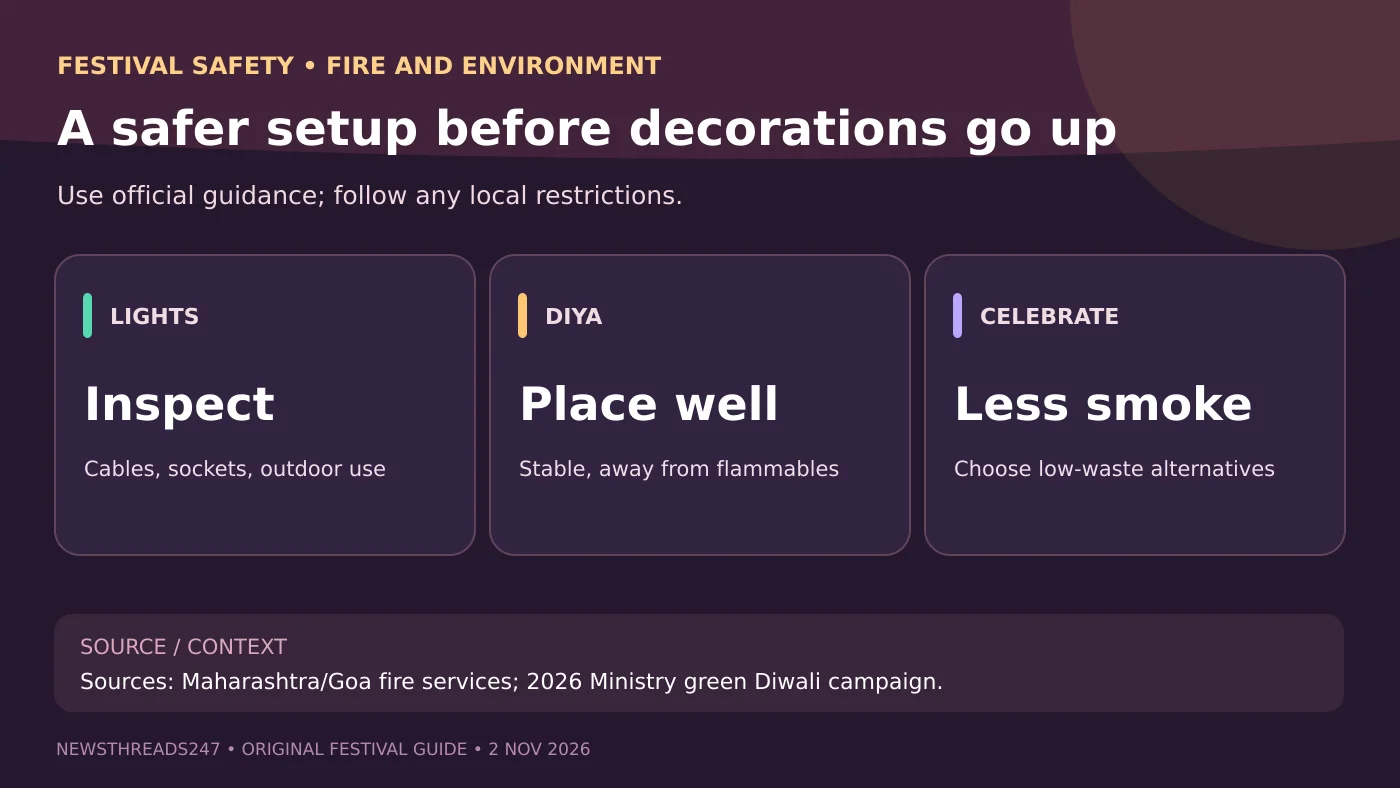
On 20 October 2026, the Press Information Bureau described a nationwide Green Diwali campaign organized by WWF-India’s environment-information partner with support from the environment ministry. The official release encourages a cracker-free celebration, energy-efficient lighting, reusable choices, waste segregation and local products. This is a public awareness campaign, not a statement that the same fireworks ban applies nationwide.
Rules about fireworks can differ by state, district and court order, and can change near the festival. Check official local government and police notices rather than relying on a last-year screenshot. Where any permitted fireworks are used, the Maharashtra fire service advises safe outdoor locations, adult supervision, avoiding failed-firework relighting, keeping water and sand available and never using fireworks indoors. A safer, lower-smoke celebration is particularly considerate of children, older adults and people sensitive to noise or polluted air.
For an actual burn, eye injury or breathing difficulty, seek appropriate emergency medical care promptly and follow qualified responders’ guidance. The central health ministry has released fireworks-injury prevention and first-response guidance. Do not apply improvised home remedies or delay care while searching social media.
Festival shopping: read the label, not the hype
A practical list starts with what will be eaten or used: ingredients for planned meals, reasonable gifts, reusable decorations and any genuinely necessary household items. Compare unit prices and return policies, not just “festival special” banners. For sweets and other packaged food, inspect the applicable label, packaging integrity, storage requirements and date information. Our FSSAI food-label reading guide explains how to identify ingredients and date statements rather than accepting a package slogan as evidence.
Avoid claims that buying a particular metal, device or appliance guarantees future wealth or happiness. Cultural significance and financial outcomes are different questions. If merchants advertise discounts, confirm the final checkout cost, delivery timing and applicable return terms. For large purchases, take time to check the product specification and need rather than letting a countdown timer make the decision.
Guests, pets, neighbors and cleaner celebrations
Consider predictable noise and light sensitivity, the needs of pets, access for delivery workers and the comfort of neighbors. Let guests know where footwear, wet floor areas or open flames will be, and keep shared building corridors clear. Dispose of packaging and spent decoration materials according to local rules, with separation where facilities exist. These small choices make a celebration more accessible and less stressful.
The government-backed Green Diwali campaign advocates avoiding single-use plastic, using energy-efficient lights and choosing local products. A lower-waste approach can include reusing clean decorations, choosing durable gifts and planning food portions to reduce spoilage. None requires giving up meaningful family rituals.
Frequently asked questions
What is the Diwali date in 2026?
The central government holiday calendar lists Sunday, 8 November 2026. Certain state or community observances can differ, so check local calendars.
Is 8 November the only festival-related day?
No. Related observances can span more days, with local traditions and tithi-based timings. This article intentionally avoids an unsourced universal timetable.
Can ordinary indoor string lights be used outside?
Only if the product is suitable for outdoor exposure and is installed safely. Damaged wiring or an overheating plug should not be used.
Are fireworks banned everywhere in India?
No uniform nationwide ban is asserted here. Rules and restrictions should be checked with the relevant current state, district or local authority. The 2026 Green Diwali campaign encourages cracker-free celebrations.
Bottom line and editorial verification
With the central Diwali date set for 8 November, the useful work on 2 November is to check local observance details, plan a safe and welcoming space, inspect lights, buy thoughtfully and respect neighborhood and environmental needs. Primary references: 2026 holiday list, fire-service guidance and the current Green Diwali campaign.
Verified 2 November 2026 IST. This is a seasonal practical guide, not a personalized electrical, fire-safety or religious-time determination. The lead illustration is AI-created and the two companion graphics are original summaries. Regional dates, government notices and restrictions require local rechecking.