
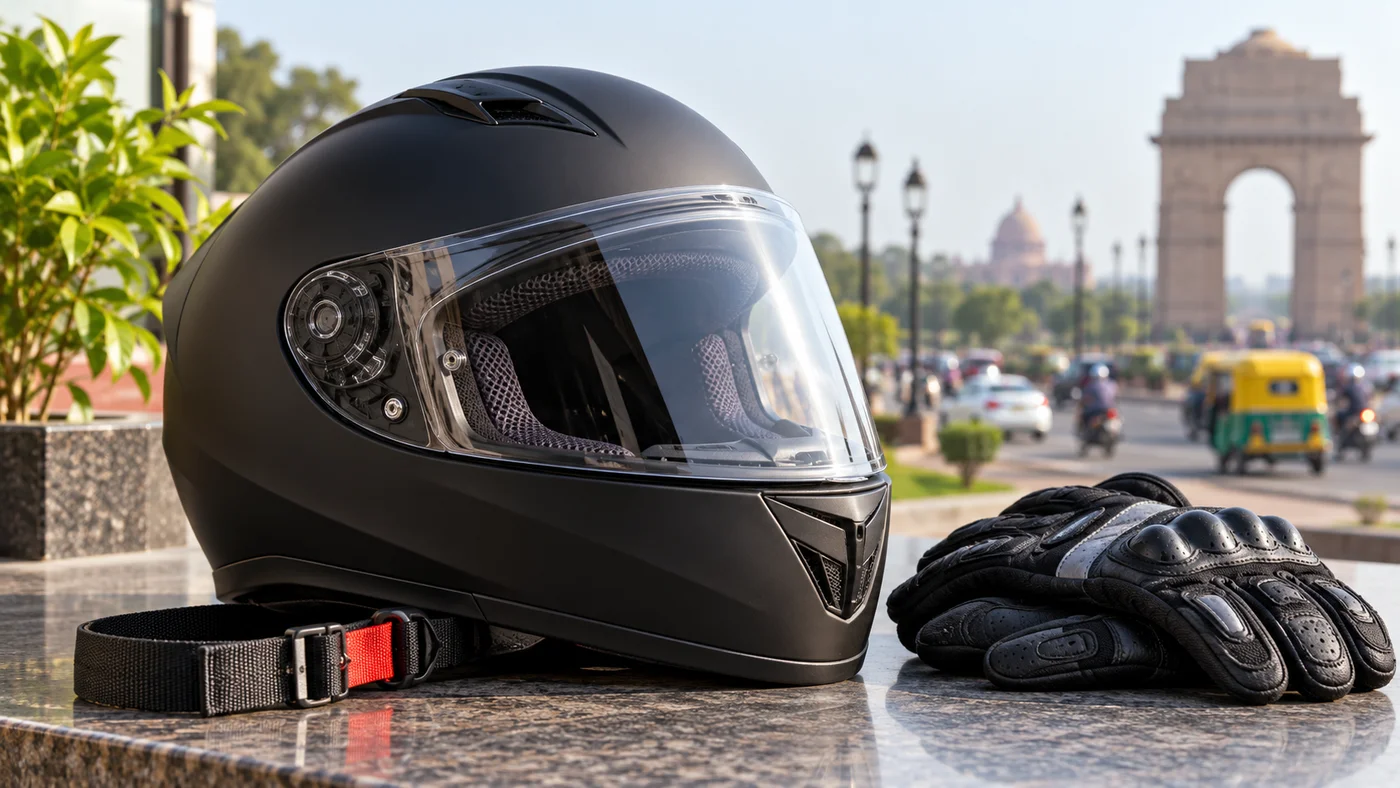
A motorcycle helmet bought in India should meet the applicable Bureau of Indian Standards requirement, but a sticker that merely resembles the ISI mark is not enough to prove a product is authentic or that it fits the rider. The BIS lists protective helmets for two-wheeler riders under IS 4151:2015 in its compulsory certification scheme. Buyers should check the actual product marking and licence information through official BIS tools, then assess fit and condition before riding.
The BIS compulsory-certification list and IS 4151 standard page are the primary references. The helmet requirement is distinct from voluntary claims such as “racing design” or “international styling”; neither styling nor a high price is evidence of a valid Indian standard mark. This is a practical guide, not a laboratory certification or specific brand recommendation.
What does BIS IS 4151 cover?
| Question | What the official BIS material establishes | What the shopper checks |
|---|---|---|
| Applicable standard | IS 4151:2015 protective helmets for two-wheeler riders | Correct helmet product category |
| Certification route | Listed in compulsory Scheme I/ISI mark scheme | Authentic mark and relevant licence |
| Licence information | BIS links marks with manufacturer licences | Details on helmet and BIS lookup |
| Practical protection | Helmet construction/performance is governed by standard | Actual fit, retention and condition still matter |
The government quality-control order names IS 4151:2015 for two-wheeler riders’ protective helmets, subject to applicable amendments and implementation. This article does not pretend that a graphic logo alone certifies a unit, nor does it reproduce standard test procedures as if a consumer could perform them at home.
How to check a helmet’s ISI/BIS claim
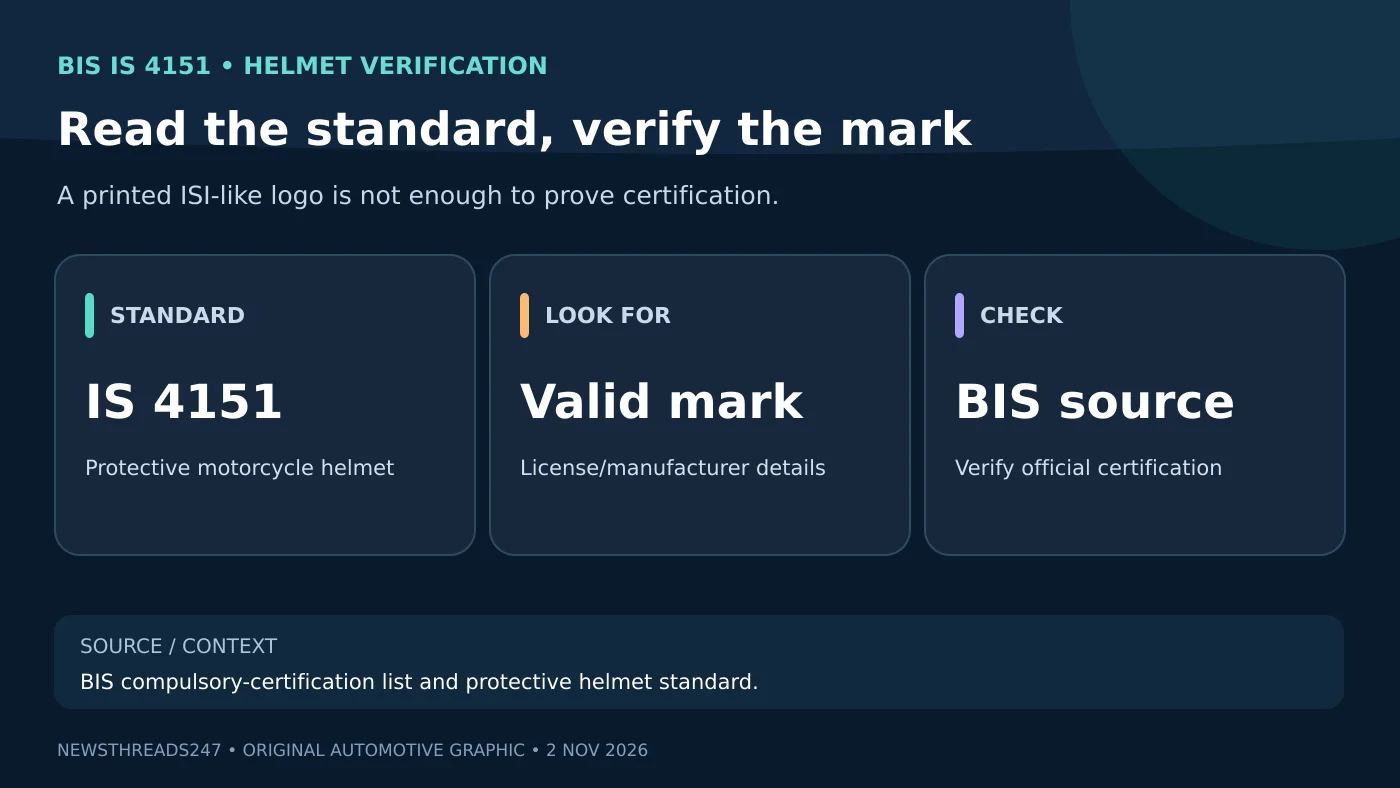
BIS explains that a Standard Mark licence number is normally shown with a certified product, often using a CM/L-style identification. When evaluating a helmet, inspect the product label, packaging and maker information for the applicable standard and licence claim. Then use the official BIS Care app guidance for “Verify Licence Details” rather than entering the number on a seller-controlled imitation website.
- Check that the helmet belongs to the relevant protective motorcycle-helmet category, not a bicycle or decorative novelty helmet.
- Find the standard marking and manufacturer/licence information as supplied on the actual product.
- Cross-check the licence details through BIS Care or the BIS site; note whether the manufacturer and product class match.
- Buy from a traceable seller and keep the invoice and model information for a later complaint or replacement.
- If the marking is suspicious, seek official verification instead of relying on social-media claims or a forged-looking hologram.
The BIS standard-mark explanation describes licence-number identification, while the agency’s app page lists complaint facilities for misuse of standard marks. This is much more reliable than a slogan such as “100% ISI-like” or a marketplace product photo that may not correspond to the delivered item.
Fit and retention: certification is only one check
A genuine helmet that rolls, lifts or shifts excessively on your head may not provide the intended practical fit. Try the correct size in person when possible. The helmet should feel secure without painful localized pressure; the chin strap and retention hardware must fasten as designed. Check visibility, visor movement, compatibility with any corrective eyewear and the ability to turn your head comfortably.
Do not pick a larger size merely for hairstyle convenience or replace the original strap with an improvised cord. Follow the exact model’s manufacturer fitting instructions. The WHO motorcycle safety guidance emphasizes a helmet’s correct fit and a secured chin strap. No published protection percentage or “safest brand” ranking is invented here.
Inspect physical condition before the first ride
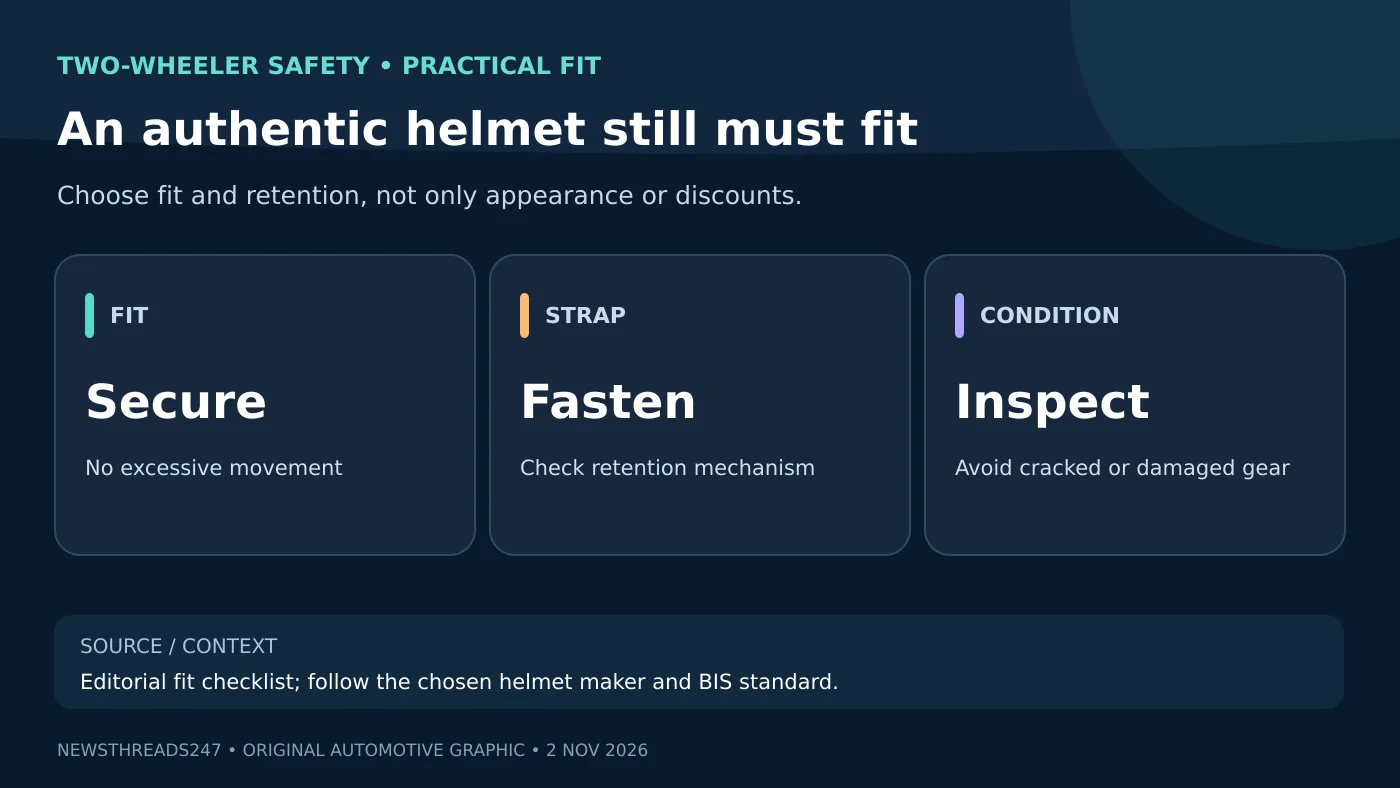
Look for a damaged outer shell, cracked visor, missing padding, fraying straps or faulty fasteners. A helmet that has suffered a significant impact may need replacement even if damage is not obvious externally, according to manufacturer guidance. A second-hand helmet with unknown crash or storage history is difficult to assess reliably; a cheap price is not evidence of safety.
Check the product age and replacement guidance from its manufacturer. Do not use a generic “all helmets expire exactly after three years” rule without the model’s documentation, material history and use context. Conditions such as heat, sunlight, chemical exposure and repeated drops can affect a helmet, but exact service life and handling instructions belong to the maker’s product guidance.
Full-face, open-face and price comparisons
Different helmet designs cover different parts of the head and face. A full-face model may provide greater facial coverage than an open-face style, while fit, ventilation, comfort and correctly attached fasteners remain essential. The right decision for a shopper includes genuine certification, coverage, size, weight comfort and use case; a higher advertised MRP does not by itself prove a safer result.
Do not confuse a visor with a guaranteed eye-injury prevention device or assume the darkest visor is suitable at night. Check the helmet maker’s visor guidance and local visibility requirements. If the rider uses spectacles, test that they can remove and refit the helmet correctly without damaging the frames or disrupting the strap.
Why online-only photos can be misleading
Marketplace images often show a different size, batch or color from the unit delivered. The product listing may claim a standard without displaying a valid licence. Check the seller identity and refund conditions, photograph an actual product marking for your own records if needed and verify through BIS independently. A counterfeit mark may be more dangerous than an obviously unbranded product because it creates false reassurance.
If a listing claims a “double certification,” inspect exactly which testing and legal regime each claim belongs to. An imported approval or a glossy brochure is not automatically a substitute for a compulsory Indian requirement. Avoid buying a purely decorative novelty helmet for public-road motorcycle use.
Five checks before leaving the shop
- Authentic applicable BIS marking and licence information verified by an official tool.
- Correct model and physical condition, with no visible damage or missing parts.
- Secure fit, working chin strap and comfortable field of view.
- Traceable seller, invoice and clear returns/replacement procedure.
- Manufacturer guidance for care, impact replacement, cleaning and visor use.
For riders who also travel by car, our tyre age and condition explainer illustrates the same general safety principle: a label or date does not replace inspection and correct use. The analogy is about verification habits, not an assertion that helmet materials and tyres age identically.
Frequently asked questions
Which BIS standard applies to motorcycle helmets in India?
BIS identifies IS 4151:2015 for protective helmets for two-wheeler riders under its compulsory certification scheme, with applicable amendments and orders.
How do I check whether an ISI helmet claim is genuine?
Inspect the product marking/licence details and use the official BIS Care “Verify Licence Details” function or corresponding BIS resources. Do not trust a printed lookalike mark alone.
Does an expensive helmet automatically protect better?
No universal conclusion follows from price alone. Genuine standards compliance, appropriate design, secure fit and sound condition all matter.
Can I use a helmet after a serious impact if it looks fine?
Follow the manufacturer’s impact and replacement guidance; internal damage may not always be evident from an outside look.
Bottom line and verified sources
Buy the genuine certified product you can verify, then ensure it fits and fastens correctly. Official checkpoints are BIS compulsory certification, BIS Care app and the helmet standard page. Reviewed 2 November 2026 IST; check later amendments when purchasing.
Editorial/visual disclosure: This article is independent safety education, not an endorsement or certification of a named helmet. The lead helmet picture is AI-created and deliberately lacks a fake BIS mark; the two supporting figures are original checklists.