

Reading a packaged-food label in India takes more than spotting a large ‘high protein’ or ‘no added sugar’ claim. The useful information is usually spread across the ingredient list, nutrition table, quantity declaration, allergen statement, storage instructions, date marking and manufacturer details. These fields answer different questions, and the most eye-catching statement on the front may not tell you what the entire product contains.
India’s Food Safety and Standards Authority (FSSAI) maintains the Food Safety and Standards (Labelling and Display) Regulations, 2020 and amendments, including a March 2026 amendment. This is a practical shopping guide, not personalised diet or medical advice. Labels and exemptions can vary by product category and pack size.
The quickest useful reading order
- Identify the food: read the actual product name or nature of food, not just the brand or flavour.
- Scan the ingredients: ask what the product is made from and look for ingredients you avoid or cannot consume.
- Check allergens: read the allergen declaration and relevant manufacturing warnings rather than inferring safety from a claim.
- Compare nutrition on the same basis: per 100 g or 100 ml is often more comparable than different ‘one serving’ sizes.
- Read date and storage requirements: look for expiry/use-by and any best-before wording, plus refrigeration after opening.
- Check pack quantity and contact details: useful for true price comparison or raising a complaint.
Ingredients list: why its order matters
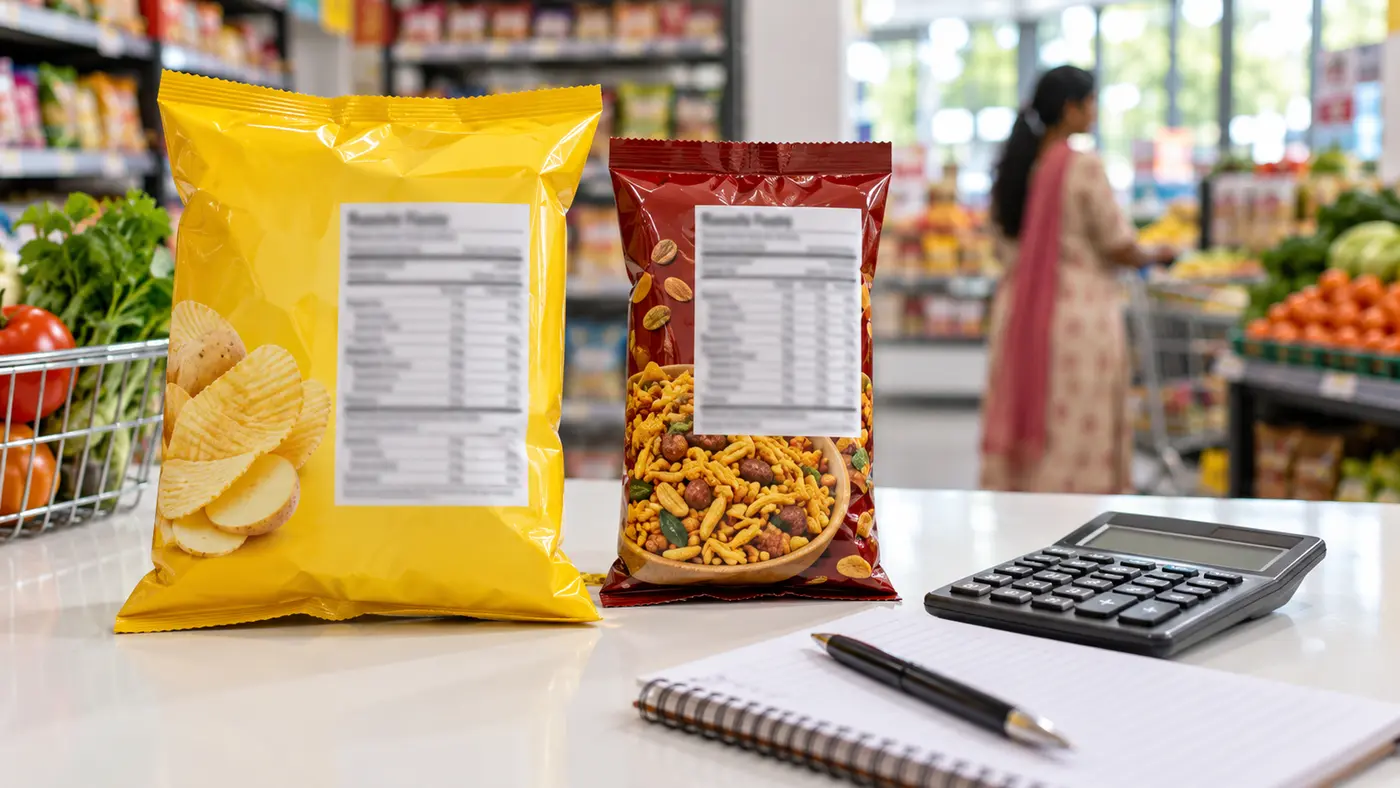
Ingredients generally appear in descending order by weight or volume at the time of manufacturing, subject to the applicable labelling rules. That gives a useful first impression of a composite food. If sugar or an ingredient derived from it appears near the top, that is worth noting even if the front of the pack suggests a wholesome snack. A long list does not automatically prove a product is unsafe, and a short one is not automatically nutritious.
Look for alternate names, compound ingredients and additives, paying attention to statements required for a particular food. For allergies, never substitute guesswork for an explicit ingredient or allergen check. A brand’s website description may be outdated; inspect the actual pack you are buying.
Nutrition panel: per 100 g versus ‘per serving’
For the detailed arithmetic behind per-100-g comparisons, see our guide to comparing food labels on an equal serving basis. This article takes the next step by assessing ingredients, dates, storage and claims together.
Imagine two snacks: one reports nutrients for a 25 g serving and the other for a 40 g serving. Comparing their ‘per serving’ sugar totals directly may mislead you because they represent different quantities. Convert them to the same basis, preferably the printed per-100-g or per-100-ml values, and then account for the portion you actually plan to eat.
| Label value | What it means | Comparison mistake |
|---|---|---|
| Energy | Energy declared for the stated reference quantity | Treating one pack’s 25 g serving as equal to another’s 40 g serving |
| Total sugar / added sugar | Different declarations with different meanings where applicable | Assuming ‘no added sugar’ implies the absence of naturally occurring sugars |
| Sodium | A nutrient quantity useful for comparing products | Confusing sodium with weight of total salt without conversion |
| Protein | Amount in the reference quantity | Assuming ‘high protein’ automatically makes the whole product suitable |
| Fat and saturated fat | Separate quantities for context | Ignoring portion size or other ingredients |
A worked reading example: Pack A lists 8 g sugar per 40 g serving; Pack B lists 6 g per 30 g serving. Normalising both gives 20 g sugar per 100 g. The per-serving number appeared different, but the reference-based concentration is identical. This arithmetic is a label-reading example, not a judgment on a real product.
What ‘best before’, ‘expiry’ and storage tell you
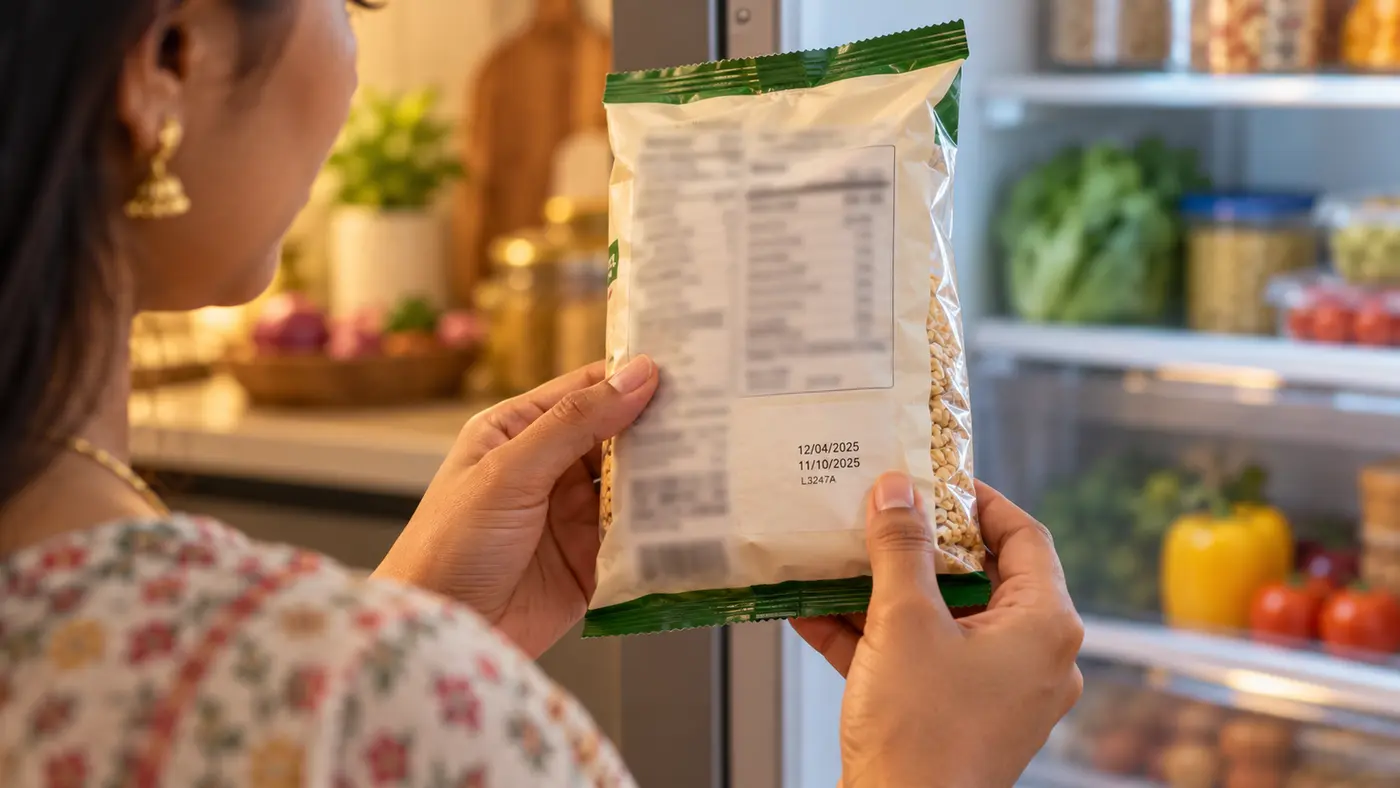
Date marks communicate food quality or time-related consumption instructions under the applicable rules; they should be read exactly as written. The FSSAI’s Eat Right India guidance recommends checking manufacture, expiry/use-by or best-before dates and following use and storage instructions. Never assume a best-before label authorises consumption beyond an expiry/use-by declaration.
Also look for phrases such as ‘refrigerate after opening’, ‘consume within X days after opening’, or preparation instructions. The printed date assumes handling and storage conditions; a pack stored improperly can be compromised before its marked end date. If a seal is broken, packaging is swollen or the food appears damaged, do not treat a distant printed date as proof of suitability.
Claims on the front: ask what is actually being claimed
| Front-of-pack statement | Better follow-up question |
|---|---|
| ‘No added sugar’ | What total sugars are declared, and what other sweeteners or ingredients are present? |
| ‘Natural’ | What precise attribute does the term describe under the applicable food regulations? |
| ‘High protein’ | How much protein per 100 g and per realistic portion? |
| ‘Made with whole grains’ | Where are the grains placed in the ingredient list, and how much is the product serving? |
| ‘Low fat’ | What are the total energy, sugar and other nutritional values? |
A claim may have a defined regulatory meaning, but it is still only one attribute of a food. FSSAI’s rules on labelling and claims, plus category-specific regulations, determine when declarations can be used. This article is not a legal test of a particular label. If the front message and ingredients appear inconsistent, record the batch and product details and check the regulator’s official material.
How to compare prices without a misleading pack-size effect
Unit price makes shopping comparisons more meaningful. If a 200 g pack costs ₹90 and a 300 g pack costs ₹120, the nominal price is not the whole story: the first is ₹45 per 100 g, the second ₹40 per 100 g. Consider how much you will actually use before it expires, because a cheaper unit price is not a saving if the larger pack is wasted.
The seven-field photo check for online orders
- Actual product name and size, not just an attractive listing title.
- Ingredients and allergen information wherever required and available.
- Nutrition information for an appropriate common reference quantity.
- Expiry/use-by or other applicable date declaration on the delivered pack.
- Storage and preparation instructions, especially after opening.
- Manufacturer, packer or importer and customer-care information.
- Batch or lot details if you need to report a quality concern.
An online listing may show a stock photo or old packaging. On delivery, compare the actual product label, size and date with what was advertised. Take clear photographs before discarding packaging if there is a discrepancy. Consumers can use seller support and appropriate food-safety complaint mechanisms where relevant, but an apparent inconsistency should be described factually rather than turning into an unverified accusation.
Common questions
Is a food with a short ingredient list always healthier?
No. Length alone does not determine nutrition, safety or suitability. Consider the actual ingredients, quantities, allergens and your individual dietary needs.
Can I compare two products using ‘per serving’ numbers?
Only after confirming both use a comparable serving size. Per-100-g or per-100-ml declarations give a more consistent basis for many packaged-food comparisons.
Does ‘no added sugar’ mean sugar-free?
Not necessarily. Review the total sugar declaration and ingredients. Different claims have distinct meanings; do not infer an absence of all sugars from the phrase alone.
What if there is no nutrition table on a very small pack?
Regulatory exemptions and special display rules may apply to certain pack sizes and foods. Check the relevant outer, multipack or other accessible required declarations rather than assuming the absence is automatically unlawful.
Is a printed expiry date enough to judge storage safety?
No. Packaging integrity and the specified storage instructions also matter. A damaged or improperly stored food should not be considered suitable simply because its date has not passed.
Bottom line
For packaged food, the meaningful comparison is actual ingredients, a common nutrition basis, declared dates, storage conditions and unit price. Do not let one front-of-pack phrase replace the full label. Primary references: FSSAI’s updated Labelling and Display rules and its consumer food guidance.
Editorial check: 1 November 2026. Product-specific exemptions and updates may apply. For an actual allergy or medical dietary restriction, seek qualified health guidance and use the product’s current authoritative label.
Visual disclosure: All three images associated with this article are AI-created editorial illustrations. They do not depict an identified real applicant, organisation, official interface or recorded event.