
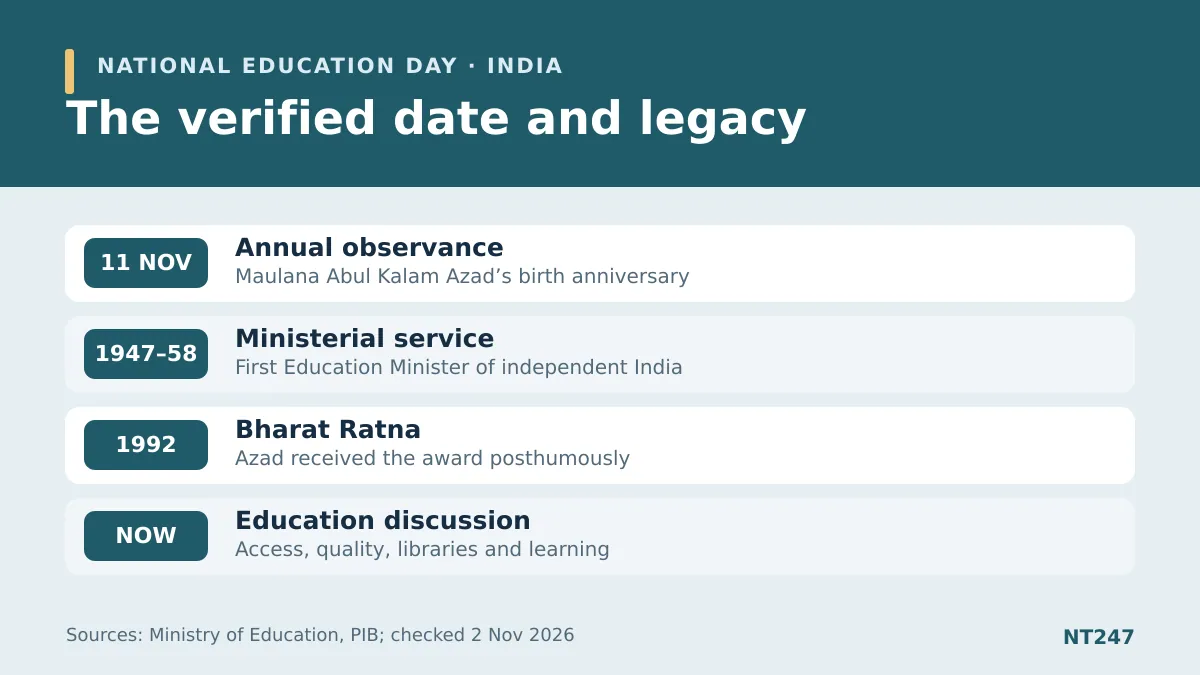
National Education Day in India falls on Wednesday, 11 November 2026. The annual observance commemorates the birth anniversary of Maulana Abul Kalam Azad, the first Education Minister of independent India. Schools and colleges can use the occasion to examine what education gives people—and what still prevents many learners from accessing good teaching, libraries, technology and opportunities.
The date and reason are confirmed by the Government of India Press Information Bureau release and the Ministry of Education’s historical note on Azad. This article suggests practical student activities without pretending that an official 2026 theme, compulsory event schedule or school holiday has been announced. It is a guide for teachers, parents and students, not an official circular.
On this page: Date and purpose · Maulana Azad’s contribution · Why the day matters · School activities · Short speech outline · Ideas for families · Avoiding misinformation · FAQs
When is National Education Day 2026?
It is observed every year on 11 November in remembrance of Maulana Abul Kalam Azad’s birth anniversary. In 2026 the date falls on a Wednesday. The observance should not be confused with Teachers’ Day in India, which is held on 5 September, or International Literacy Day on 8 September. Those occasions have different histories and purposes.
A commemorative observance does not by itself establish a nationwide school holiday. If parents need to know whether classes will run, the relevant state education department, school notice or college calendar is the authority. Likewise, a school activity described online should not be called an “official 2026 programme” unless the institution has actually announced it.
Who was Maulana Abul Kalam Azad?
Azad was an independence-era leader and educationist who served as the first Education Minister of independent India. Ministry of Education historical material records his period in office from August 1947 into 1958 and describes his commitment to education, national unity and India’s composite culture. He was awarded the Bharat Ratna posthumously in 1992. These dates are useful anchors for a school talk because they can be traced to government documents rather than copied from unsourced social-media graphics.
It would be too simple to claim that every modern university, school programme or education policy exists because of one individual. Education systems grow through institutions, teachers, communities, governments and generations of students. Azad’s public role is an entry point for examining how India approached nation-building through education after independence—not a reason to erase others’ contributions or make sweeping historical claims.
What is the most useful message for students today?
A celebration becomes meaningful when it asks who can learn well, not only who can deliver a speech. Schools can examine library access, attendance barriers, access to accessible materials, support for students with disabilities, safe transport, language diversity and the gap between memorising facts and understanding them. These issues differ by location; a rural government school and a well-resourced urban college may face very different priorities.
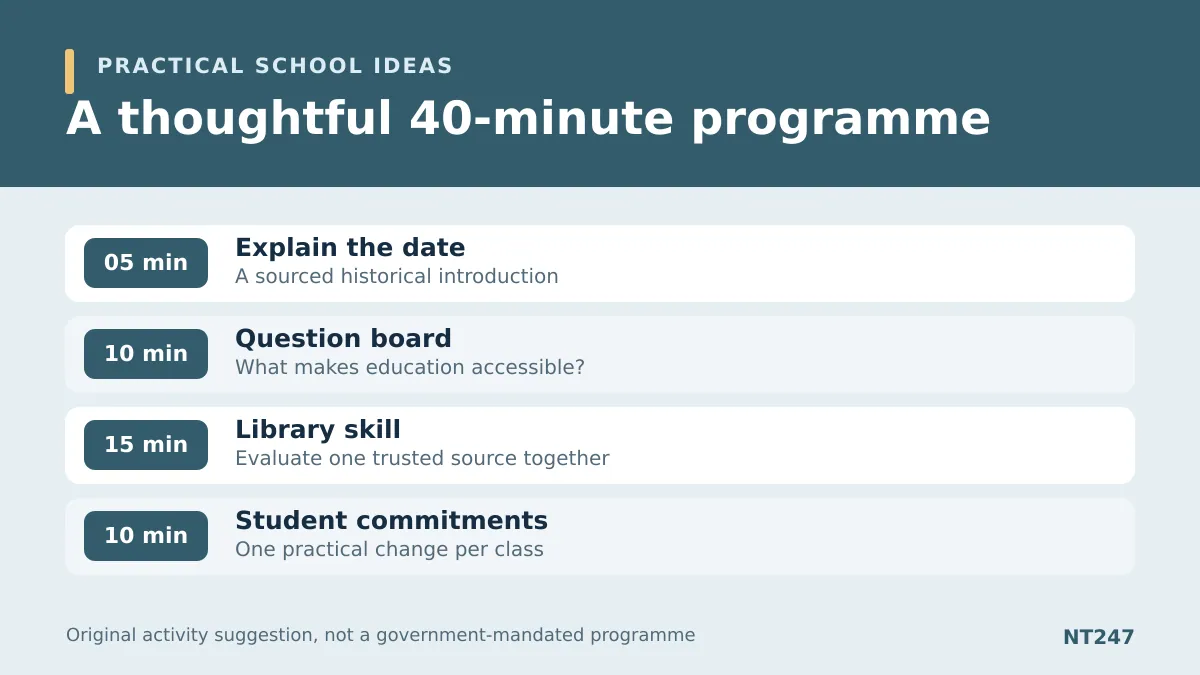
The strongest question for a student council is not “Which slogan sounds best?” but “What one improvement could our school actually make before the next term?” Possible answers include a weekly library hour, peer-tutoring timetable, accessible reading material, a clear anti-bullying contact or a shared system for repairing broken classroom resources. Announcing a change should be followed by an owner, a date and a way to check whether it helped.
Six substantial school activities—not just decorations
- Primary-source mini exhibition: Students use one Ministry document and explain who issued it and why its date matters.
- Library access audit: Survey how many useful books are available for different age groups and languages.
- Peer learning session: Older students teach one concept to younger learners and receive feedback.
- Problem-solving wall: Students identify a real classroom barrier and suggest an achievable remedy.
- Learning skills workshop: Compare a trustworthy government source, a newspaper account and an unsourced viral claim.
- Accessibility walk-through: With school consent and appropriate sensitivity, examine readable signage, seating and access to learning resources.
A school need not host all six. One well-led activity with a documented takeaway is better than a long programme of slogans and speeches that leaves no evidence of learning. Activities should be age appropriate and avoid putting individual students’ economic circumstances, grades, disability or family situation on public display without consent.
A short, factual speech outline
A confident two-minute student speech can use four moves. First, state that 11 November marks National Education Day in India. Second, explain in one or two sentences why Maulana Azad is remembered and cite the Ministry of Education. Third, connect the idea of education to a real local example: a library book that opened a new subject, a teacher who made a difficult concept clear or a digital-access barrier students want to solve. Fourth, close with one concrete commitment, such as sharing reading materials or helping a classmate practise a skill.
Avoid exaggerated quotations attributed to Azad unless you can find a primary source. Generic lines about “education being the most powerful weapon” are often circulated with uncertain attribution to different leaders. A speech can sound sincere without a single supposedly famous quotation. If using numbers about literacy or enrolment, state the government dataset and year; an old figure should not be presented as a current 2026 national rate.
What can families do at home?
A family can mark the day without spending money. Ask a child to explain one topic learned this week in their own words, then ask a question that requires reasoning rather than recall. Set aside fifteen minutes to read together, compare two interpretations of a story or visit an accessible library. Let older children explore a practical skill—budgeting pocket money, evaluating a website or understanding a map—while younger children may benefit from shared reading and simple hands-on science.
Parents should also listen when a child describes something that makes learning harder. It may be poor sleep, a timetable that leaves no revision time, unclear instructions or a subject in which the basics were never secure. A realistic educational improvement often begins with one small, repeated change rather than another high-pressure promise about examination scores.
What should schools and publishers avoid?
| Weak approach | Better alternative |
|---|---|
| Inventing a “National Education Day 2026 official theme” | Use the theme only if a verified authority publishes it |
| Calling 11 November a compulsory holiday | Check state or institution notices |
| Making unsupported historical claims | Link the Ministry of Education’s dated documents |
| Using a generic 50-quote list | Publish a sourced speech and achievable activity |
| Posting photos of children without care | Follow consent and school privacy practice |
This restraint makes the content more trustworthy. A page can be timely and engaging without promising national prizes, discounts, official themes or competition deadlines that cannot be verified. Teachers can adapt the activity plan to available time, language and resources.
Frequently asked questions
What date is National Education Day 2026?
Wednesday, 11 November 2026, in India.
Whose birthday does the day commemorate?
Maulana Abul Kalam Azad, the first Education Minister of independent India.
Is 11 November automatically a school holiday?
The observance alone does not establish a holiday. Follow the relevant school, college or state notice.
What is one meaningful school activity?
Choose a real learning problem, such as poor library access, and design a small measurable improvement with student participation.
Government references and disclosure
Research checked 2 November 2026 IST: Ministry-hosted PIB National Education Day material and official biographical note. The proposed activity outline is original editorial advice and not an official government event circular.
Visual disclosure: The classroom lead image is AI-created conceptual art; the two supporting diagrams are original source-labelled graphics. No specific school visit, teaching experience or interview is claimed.