
Quick answer: An electric-car battery warranty in India is not a promise that the battery will always perform like new. Some manufacturers advertise a “lifetime” high-voltage-battery warranty for the first registered private owner; others specify a number of years and kilometres. The decisive questions are which exact car and battery variant qualify, what happens when the car changes hands, what defects or capacity-loss thresholds are covered, and how a claim is assessed. Obtain the current written warranty schedule before paying.
Checked on 1 November 2026. This buyer’s guide compares publicly available manufacturer information for selected models, not a ranking of the best EVs or a replacement for the warranty booklet issued with an individual vehicle. Manufacturer offers and eligibility may change.
Why the word “lifetime” needs a second look
Imagine two buyers looking at the same electric SUV. One plans to keep it for ten years. The other expects to sell it after three. An advertisement says “lifetime battery warranty”, but the resale buyer may receive a different, finite limit. That difference can matter more to the second owner than the size of the headline.
Electric vehicles contain a large high-voltage traction battery that powers the motor and a separate low-voltage battery used by other systems. When a manufacturer advertises an extended or lifetime battery warranty, it usually refers to a defined high-voltage component under model-specific conditions; it does not automatically extend the whole vehicle’s bumper-to-bumper warranty.
The words “first owner”, “private registration”, “from the initial date of delivery” and “whichever occurs earlier” have precise consequences. They also mean a used-car seller’s brochure cannot settle what the next buyer will receive.
What major manufacturers currently say
The table below is a starting-point comparison, not a contractual quote. It reflects statements on manufacturers’ official India pages. It does not imply that every model, pack, year, commercial registration or financing arrangement receives identical terms.
| Model or programme | Manufacturer’s stated headline | Important qualification to verify |
|---|---|---|
| Hyundai CRETA Electric | 8 years / 1,60,000 km for the high-voltage battery | The published BaaS comparison lists the same headline warranty for conventional ownership and BaaS. Check the signed contract and pack variant. |
| Mahindra electric SUVs | Lifetime for first registered private owner | Mahindra says later owners receive 10 years / 2,00,000 km, whichever occurs first, counted from the first delivery date. |
| Tata Nexon.ev 45 kWh and Curvv.ev | Lifetime high-voltage battery offer announced for specified models | Read the model’s dedicated high-voltage warranty terms and first-owner conditions; do not infer the offer covers every Tata EV or pack. |
| MG Windsor / Windsor PRO | Lifetime battery warranty advertised for the first owner | Check eligibility, private-vehicle conditions, ownership transfer and the exact scheme documents before relying on a sales summary. |
Official references: Hyundai’s CRETA Electric BaaS comparison, Mahindra EV FAQ and Mahindra warranty footnote, Tata’s Nexon.ev announcement, and MG Windsor’s launch statement.
A transfer example: a three-year-old Mahindra
Suppose a privately registered Mahindra EV is sold after three years. Under the manufacturer’s published first-owner/later-owner distinction, the new owner should not assume the original lifetime description still applies. The stated later-owner ceiling is 10 years or 2,00,000 km from the first delivery, whichever comes first—not a fresh ten-year period from resale. If that car has already travelled 80,000 km, the new owner should ask the dealer to confirm the remaining time and distance in writing.
A transfer is not just an insurance or registration issue. Before a purchase, supply the VIN, first delivery date, odometer reading and proposed ownership type to an authorised service centre; request a model-specific warranty eligibility statement. This is especially important for older brochures, demonstrator vehicles and vehicles previously registered to a business.
Capacity loss is not the same as a failed battery
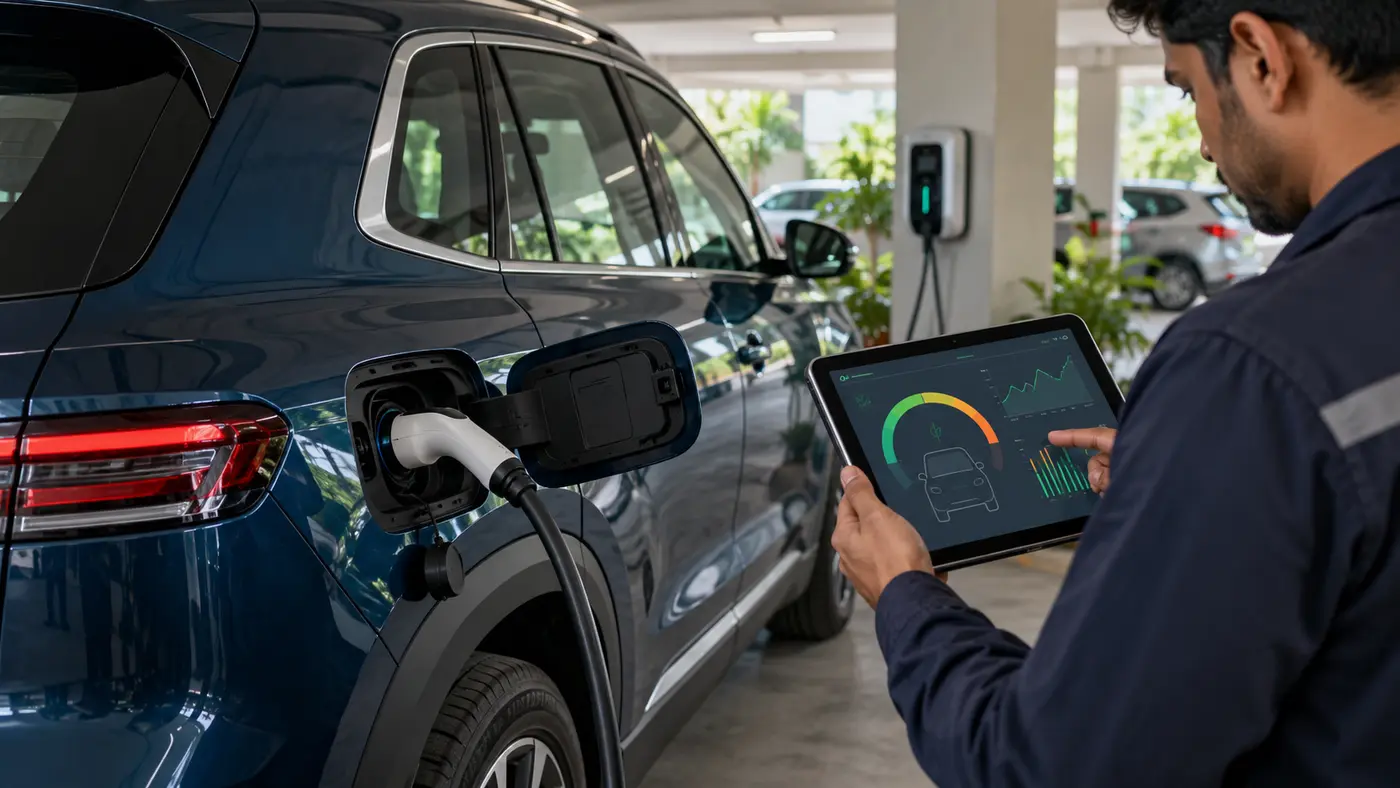
An EV’s displayed range can move up and down even when there is no battery defect. Temperature, air-conditioning, driving speed, gradient, tyre pressure, payload and recent driving behaviour change energy use. A dashboard range estimate is therefore not itself a formal battery-health certificate.
Rechargeable batteries also lose some usable capacity with age and use. Tata’s Nexon EV owner’s manual explains that some decline in capacity and driving range is expected. The question for a warranty claim is whether an authorised test finds a covered defect or a capacity value below the threshold actually written in that vehicle’s warranty conditions.
Avoid copying a capacity percentage from another manufacturer, another country or an older model. Even where an article online mentions a familiar threshold, the only safe basis for that purchase is the current signed booklet for the specific VIN and pack.
What to ask for in a battery-health check
- The test method: Is this an authorised battery management system or diagnostic test, or merely the dashboard’s estimated range?
- The report: Will the service centre give a dated written state-of-health result, observations, diagnostic codes and any recommended next steps?
- The reference: Which official battery-warranty clause and capacity threshold will be used to assess a claim?
- The exclusions: What happens if the pack has accident damage, water intrusion, unauthorised modification or charging-system damage?
- The record: Are repairs, software updates and earlier battery interventions traceable to the VIN?
A buyer should not ask a workshop to open a high-voltage pack merely to inspect it. The system can carry dangerous voltage even with the vehicle switched off; manufacturer-qualified personnel should perform the testing and any service.
Battery warranty, whole-car warranty and insurance are different
| Question | Battery warranty | Other protection |
|---|---|---|
| Manufacturing defect in the high-voltage pack? | May be covered if the model’s conditions are met. | The general vehicle warranty can have a different duration. |
| Gradual loss of displayed driving range? | Not automatically a claim; a formal pack test and contractual threshold matter. | No routine insurance claim follows from ordinary ageing. |
| Battery damaged in a collision or flood? | Accident and external damage are commonly treated separately; inspect the policy and exclusions. | Motor insurance scope, deductibles and claim conditions need their own review. |
| Charging port, on-board charger or 12V battery fails? | Do not assume the traction-battery offer covers these components. | Check the vehicle/component warranty and service diagnosis. |
A high-voltage warranty can be valuable, but it should not become an excuse to skip the vehicle warranty, motor policy, battery replacement cost, labour terms or roadside-assistance documents. Ask whether the manufacturer may repair individual modules, replace a complete pack, use serviceable replacement components, or offer another remedy; do not assume a brand-new battery is owed in every covered case.
BaaS and lifetime warranty are two separate decisions
A Battery-as-a-Service or battery-financing offer reduces some upfront vehicle cost but introduces another financial obligation. It is not inherently the same thing as the warranty. Hyundai’s own CRETA Electric illustration shows an 8-year/1,60,000-km battery warranty in both its conventional and BaaS columns, while its published BaaS fee begins at ₹3.90 per kilometre. Mahindra describes certain BaaS offers as dual-loan financing and warns that illustrated effective per-kilometre figures depend on assumptions about distance, down payment and monthly EMI.
Here is a transparent calculation, not a quotation for your vehicle: at an illustrative ₹3.90 per kilometre, 1,000 km in a month implies ₹3,900 before electricity and any additional contractual fees. At 1,500 km, the same multiplication gives ₹5,850. The calculation does not establish what a particular customer will actually be billed; minimum usage, financing terms, GST, agreement duration, mileage bands and early settlement can change the result.
Compare the total cost of ownership over the period you expect to hold the car: down payment, regular vehicle finance, battery financing or subscription, electricity, insurance, maintenance, charger installation and probable resale restrictions. A lower advertised entry price alone does not show which arrangement costs less.
Seven checks before buying a new EV
- Identify the exact variant and pack. Ask the dealership to write the model, battery capacity, manufacture year, VIN and registration type on the order.
- Get the complete battery terms. Request the warranty card, booklet or digitally signed PDF that applies to that VIN, not only an advertising banner.
- Read the transfer clause aloud. Find what happens when ownership changes, whether the deadline runs from first delivery and whether a second owner must register the transfer.
- Find the capacity rule. Ask whether degradation is covered, which testing method applies and whether the service centre will give the result in writing.
- Inspect use and service conditions. Check prescribed maintenance, accident repair procedures, software updates and any charging guidance. Do not rely on generic internet charging advice.
- Review replacement remedies. Clarify parts, labour, transport, service turnaround, excluded damage and how a dispute is escalated.
- Compare financing separately. If BaaS is offered, request the repayment schedule and an all-in comparison with the battery-included purchase.
For a used EV, ask for these additional records

A used electric car may offer substantial value, but buyers need more than its advertised range and first-registration year. The seller should supply the original invoice, service records, warranty policy, accident/insurance claim history and, where available, authorised battery diagnostic summary. Compare the VIN across documents. A clean-looking car with low kilometres does not by itself prove battery condition.
- Confirm who the first registered owner was and whether the vehicle was used as a fleet, taxi, demonstration or private car; different conditions may apply.
- Request the remaining warranty balance from the brand’s authorised service network; get a written response referencing the VIN.
- Check whether battery repairs, module replacements or software updates have occurred; ask whether they affect coverage or the original start date.
- Review charging-port and underbody condition professionally; do not touch high-voltage components.
- Distinguish battery health from recent driving-range screenshots or a seller’s estimate, and budget for a diagnostic inspection before transferring money.
What to do if the battery develops a problem
- Make the situation safe. If there is a high-voltage warning, unusual heat, smoke, leak or serious charging fault, stop using the car and follow the owner’s emergency instructions. Do not open or repair the pack yourself.
- Record the evidence. Photograph warning messages, keep dates, distance reading, charging circumstances and service history. Record facts, not an assumed cause.
- Request an authorised diagnosis. Ask the service centre for the diagnostic findings and the exact warranty clause used to accept or reject the claim.
- Keep a written case trail. Save work orders, job cards, estimated and final invoices, emails and any customer-care reference number.
- Escalate with documents. Use the manufacturer’s published complaint channel if the explanation is unclear. Legal rights and available consumer remedies depend on the facts and governing terms.
If a workshop says an ordinary loss of range automatically proves battery damage—or that every decline is automatically excluded—ask for the diagnostic basis. Both claims are too broad. An evidence-based diagnosis and the correct contractual wording are essential.
A practical buying decision, not a headline contest
The strongest warranty for one household may not be the most useful for another. A family keeping a privately registered EV for many years may value first-owner duration. A buyer who changes cars frequently should pay extra attention to second-owner limits and transfer steps. Someone driving high annual mileage may reach a kilometre ceiling well before a time limit. A BaaS customer must evaluate financing on its own terms.
Before you commit, put the full written warranty next to the actual quote and your expected ownership horizon. You should be able to answer three questions in one minute: What is covered? When does it end for me? What evidence will I need if I claim? If the dealership cannot answer, take the paperwork home and resolve it before paying.
Frequently asked questions
Does “lifetime” mean the battery will never deteriorate?
No. Battery ageing is normal. Lifetime describes a manufacturer’s defined warranty promise for eligible owners and covered issues; it is not a guarantee of constant capacity, range or free replacement for every problem.
Does the lifetime battery warranty transfer when I sell my EV?
Not automatically on identical terms. Mahindra, for example, publicly states a different limit for later owners. Every buyer should check the particular brand, model, year and transfer clause before relying on a seller’s claim.
Is a drop in dashboard range enough to claim a replacement?
No. Dashboard range is an estimate affected by driving and conditions. Ask for an authorised battery health diagnostic and compare the findings with the warranty’s coverage and capacity terms.
Is BaaS the same as a battery warranty?
No. BaaS describes an ownership or financing structure. A battery warranty covers defined faults or conditions within a stated period; the two should be read as separate documents.
What is the first thing to check when buying a used EV?
Verify the VIN-linked warranty eligibility, first delivery date, registration history and authorised battery health report. They provide a more reliable starting point than an advertised “lifetime” label.
Sources and editorial note
This article used manufacturer-published materials available on 1 November 2026: Mahindra Electric SUV FAQ, Mahindra T&C, Hyundai CRETA Electric BaaS explainer, Tata Motors press statement, Tata Nexon.ev owner’s manual and MG Motor announcement. Prices and offers are intentionally not used as a comparative ranking; final signed terms and model-specific policies govern.
Further reading on NewsThreads247: Why a more powerful charger may not charge your EV faster and How to check an EV charging stop before a road trip.
Disclaimer: This is independent consumer information, not legal, financial or engineering advice, and does not recommend any manufacturer. For a purchase or claim, consult the warranty supplied with your exact vehicle, a qualified authorised service centre, and applicable documents. Images are original conceptual illustrations, not photographs of a specific product or service incident.