
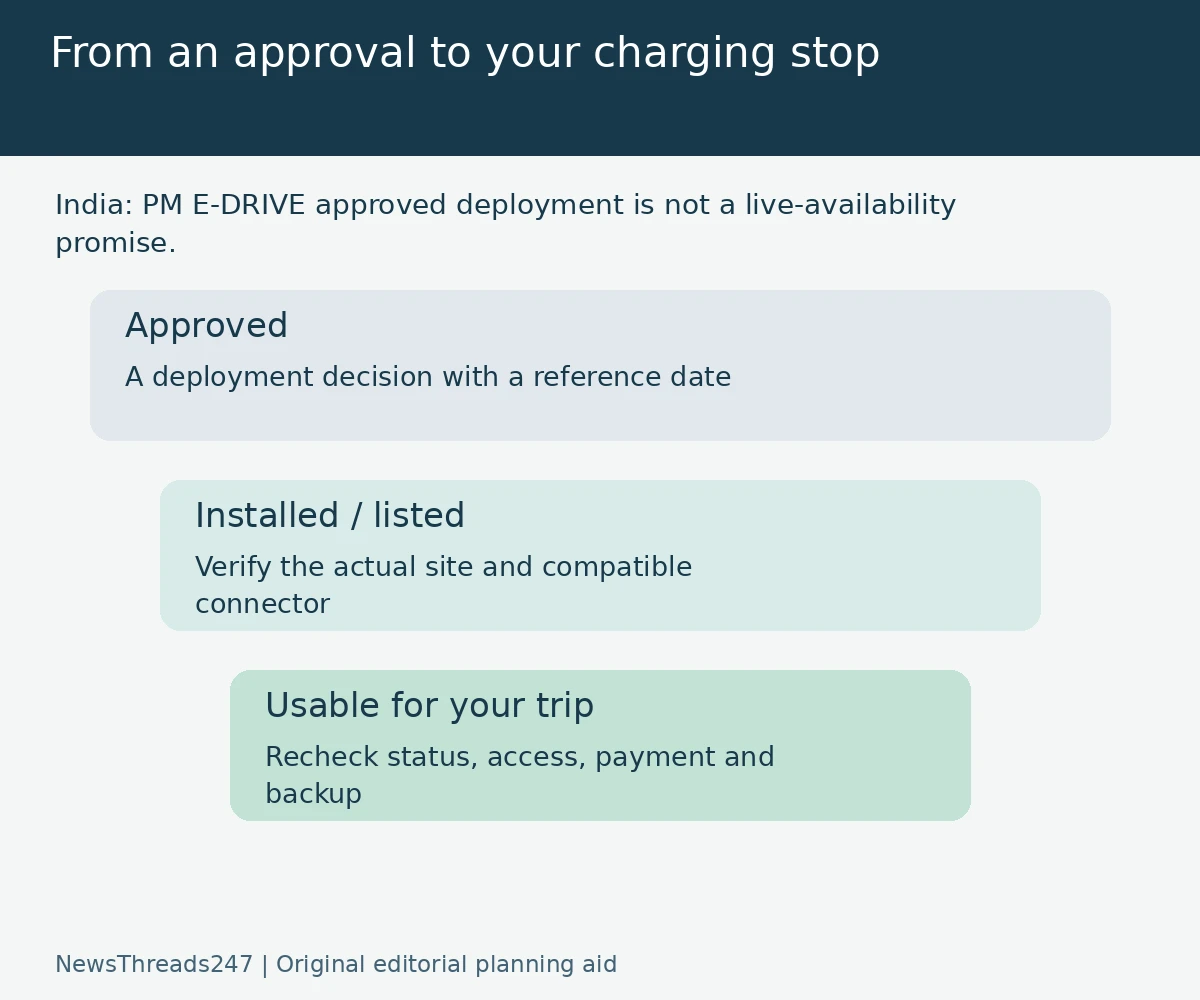
An approved EV charger is not automatically a usable stop for your next journey. India’s October 1, 2026 PM E-DRIVE backgrounder says ₹851 crore had been approved for deployment of 8,147 chargers to three oil marketing companies and ten states as of September 28. It does not say all 8,147 were installed, operating or available to your vehicle on that date.
That distinction matters when planning a trip in India. Expansion funding is useful infrastructure news; your travel decision depends on an individual stop. Before relying on it, establish the actual connector, current status, entrance and operating access, payment route and an alternative you can reach. National totals cannot supply those answers.
Read the date and the unit before using the headline
The same official backgrounder identifies ₹2,000 crore earmarked for public EV charging under PM E-DRIVE. Keep that wider allocation separate from the ₹851 crore approved figure. Neither is a count of chargers verified live today. The September 28 reference date also belongs beside the 8,147 figure whenever it is repeated.
A station, charger, connector and parking bay are not interchangeable planning units. A location pin can represent a site, while the connector you need may be occupied or unavailable. Do not add together differently labelled network counts to produce a supposed national number of usable stops. For a driver, the first useful unit is the specific compatible connection at the place you can actually access.
Use the operator’s current information
Tata Power’s EZ CHARGE feature guide describes route planning, connector filters and a live map with availability information. It lets users compare routes and adjust detour limits. Those are tools for narrowing the choice, not evidence that every charger shown will remain free until you arrive.
Statiq’s own app page similarly describes real-time station status, routing, payments and directions to the exact charger within a location. These are operator descriptions, not first-hand testing by NewsThreads247. Features can depend on the station, account and current app; verify what is actually offered for the stop you select.
Begin with the vehicle’s supported connector and charging instructions, then read the station listing. If a map result is ambiguous, resolve that ambiguity with the operator rather than deciding from a charger photograph. A high power label is not enough to establish compatibility or your car’s charging speed. Our explainer on vehicle and charger power limits covers that separate issue.
Make a stop record, not a screenshot collection
For each planned stop, keep a short record: operator and site name, exact entrance or directions, suitable connector, status and time checked, payment method, access conditions and backup. This is an editorial planning worksheet. It is not a claim that any named operator supplies all those fields in one screen.
Check access as carefully as the pin. Ask whether the charger is public at your intended arrival time, whether a gate or car park has separate hours and whether parking or entry charges apply. Read the station’s current tariff and any session conditions before authorising payment. This article quotes no universal charging rate because it has not verified one for your particular site.
Prepare the supported payment route while you have time and connectivity. Confirm that the relevant app account or other supported method works for you; do not wait until the battery is low to discover which operator runs the charger. Save the operator’s official assistance route from its current app or website. Never substitute a payment link sent by an unknown person for the published station process.
A backup should change the route decision
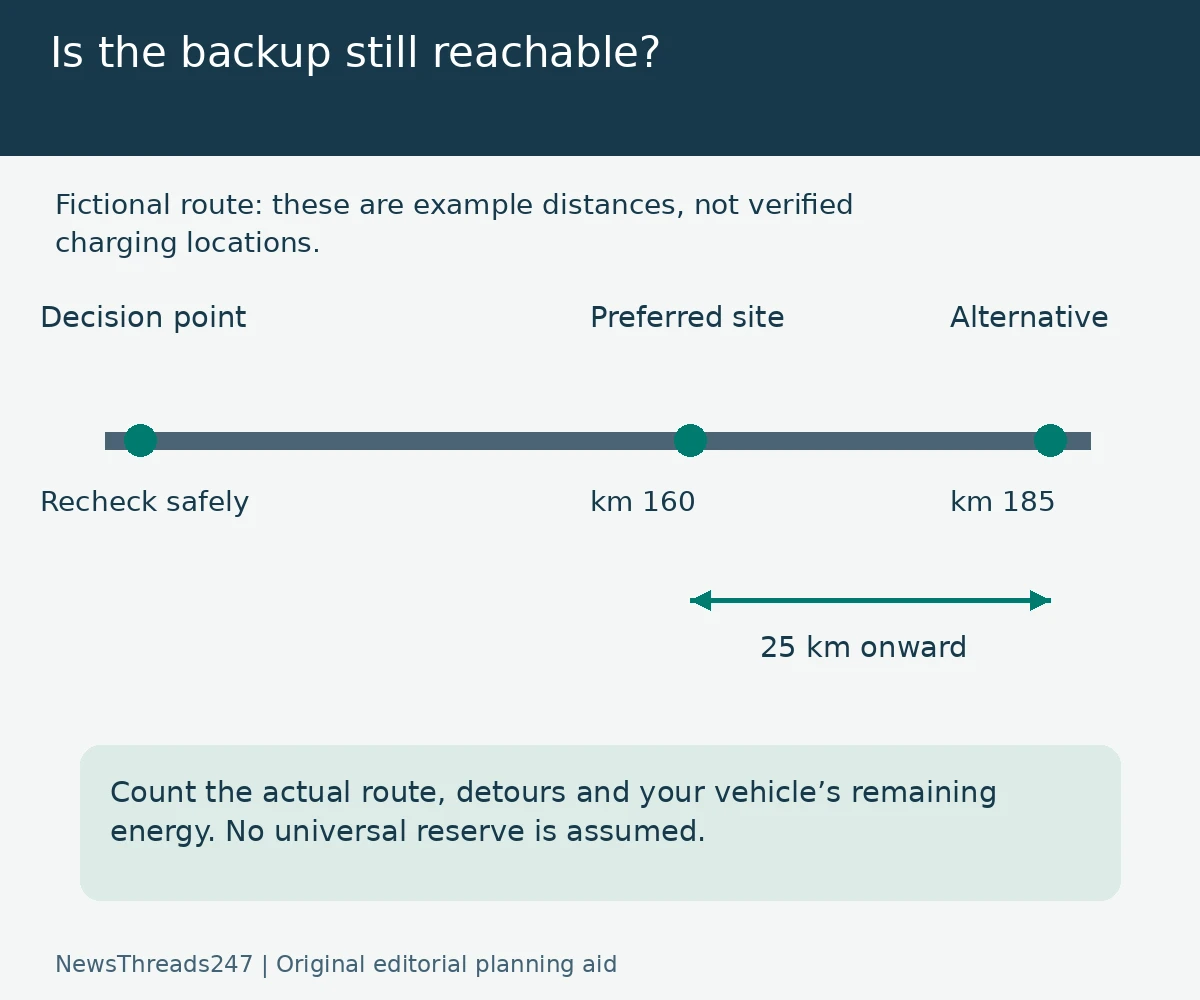
Consider a fictional journey with a preferred charging site at kilometre 160 and a second site at kilometre 185. The second is not a useful fallback merely because it appears next on the map. The driver needs to assess whether it remains reachable from the first site with an appropriate reserve for the actual vehicle and conditions. This example assigns no universal range or reserve percentage.
If the second site requires travelling back across a highway or a long detour, include that route in the decision. Straight-line distance between pins can conceal the journey you would actually have to make. A closer alternative earlier on the route may be more practical than one beyond a difficult stretch, depending on current conditions and the car’s remaining energy.
Plan a decision point before the preferred stop. At a safe place, recheck its status and the alternative before committing to the next leg. Ask a passenger to handle the check where possible, or stop safely; do not operate an app while driving. The point is to leave a usable choice, rather than discover a problem after all convenient options are behind you.
Separate live status from arrival certainty
A live reading is time-stamped information about now. It is not a reservation unless the operator has explicitly confirmed a reservation with terms you can read. If booking is offered, check the particular station, time window, cancellation conditions and what happens if you arrive late. Do not infer a booking from a general feature announcement.
Recent driver comments can suggest questions about an entrance, a recurring queue or an unclear bay. Treat them as leads to verify, not proof of present uptime or a measured reliability ranking. Conversely, one reassuring comment does not cancel a current operator fault indication. Give the latest actionable site information more weight than a broad network-growth claim.
If a charging session fails, use the station’s supported instructions and assistance process. Do not improvise with damaged equipment, unsuitable adapters or electrical repairs. Record the station identifier and exact displayed message for support. A travel plan should include time for uncertainty without pretending that a fixed extra number of minutes guarantees the journey.
What a useful departure check looks like
Before leaving, review the main stop and backup together. You should be able to explain where you will enter, what connection you need, how you will start and pay, when the latest status was checked and where you will go if the plan changes. Recheck time-sensitive details shortly before travel; saved notes from a previous trip are not a current availability check.
The expansion programme can improve future choices. For today’s driver, a defensible plan is still built one stop at a time. Choose a route whose actual access and alternatives you understand, rather than treating an approved-deployment total as a promise about the next charging bay.
Sources and visual credits
Checked October 28, 2026: PIB’s October 1 PM E-DRIVE backgrounder, Tata Power EZ CHARGE and Statiq’s published feature information. The approval figures refer to September 28, not today’s operating network. No chargers, app accounts, tariffs or routes were field-tested for this article; the kilometre example is fictional. Featured art is AI-generated conceptual artwork of an unbranded EV. The two original graphics are planning aids, not a map, live-status display or operator interface.