
A charging station says 150 kW. Your electric car shows a much smaller number. Before blaming the charger—or paying for a more powerful home wallbox—check which part of the charging system is setting the limit.
The station’s rating is a ceiling, not a promise. The car must support the charging method and power available, and its battery must be able to accept that power at that moment. This guide explains the distinction for buyers planning home charging in India; installation requirements and vehicle specifications must be checked locally.
AC and DC charging use different paths
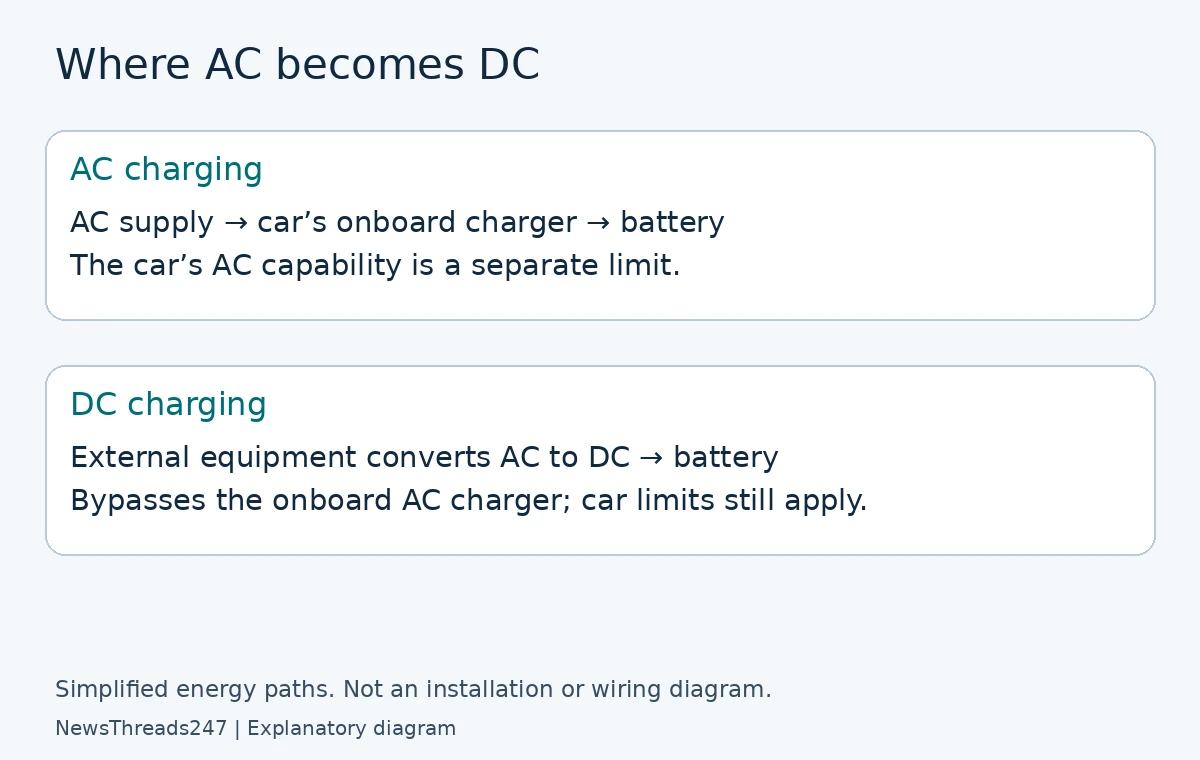
An EV battery receives direct current. With AC charging, conversion happens in the vehicle’s onboard charger. With DC charging, conversion happens outside the vehicle, bypassing that AC conversion equipment. Kia’s explanation of AC and DC charging describes this difference. Its UK model examples should not be treated as specifications for an Indian variant.
That distinction matters when reading a brochure. Find the AC input specification and DC charging specification separately. A large DC figure does not establish the speed the car can accept from a home AC wallbox. Ask for the specification for the exact battery, variant and model year you intend to buy.
A higher-rated AC wallbox does not upgrade the car
Suppose a hypothetical car supports no more than 7 kW AC in the installation being considered. Connecting it to equipment labelled 22 kW does not turn its onboard charger into a 22 kW unit. Actual compatibility also depends on the electrical supply, phase configuration, installation and equipment limits.
Treat a proposed upgrade as a question to investigate: which existing constraint will it remove? If the vehicle is already the limiting part, spending more on the wallbox may not shorten charging for that vehicle. Future-car compatibility can be a separate reason to buy, but should be labelled as a future requirement rather than a current speed benefit.
Power is not the same as energy
Kilowatts, written kW, describe power: the rate of energy transfer. Kilowatt-hours, written kWh, describe an amount of energy. A battery capacity and a charger rating therefore cannot be compared as if they were the same measurement.
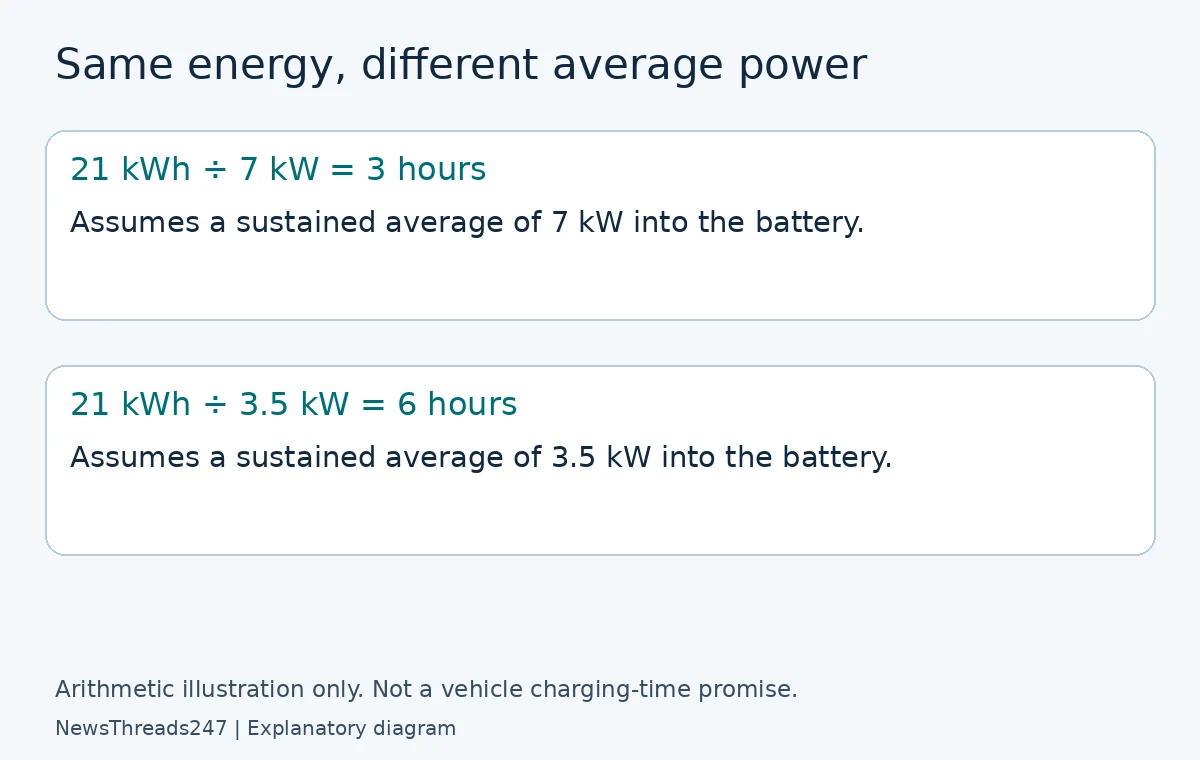
For a deliberately simplified example, assume you need to add 21 kWh and could sustain an average of 7 kW into the battery. Dividing 21 kWh by 7 kW gives three hours. At an average of 3.5 kW, the same calculation gives six hours. These are arithmetic illustrations, not charging-time claims for a named car.
If the quoted power is measured at the wall rather than delivered into the battery, conversion losses and auxiliary energy use must also be considered. Do not apply a guessed universal loss percentage. Use the manufacturer’s charging-time conditions and real installation assessment.
Why DC charging power changes during a stop
The battery’s state of charge and temperature affect what it can accept. The car manages the requested charging power, so its advertised peak need not last throughout the session. EVgo’s charging guide explains these limits and why a more powerful station cannot force a lower-capability vehicle to charge faster.
For trip planning, compare charging-time claims across the same starting and finishing battery percentages. A 10–80% claim cannot be compared directly with a 0–100% claim. Check the required charger and temperature conditions, too. An impressive peak number alone does not tell you how long your planned stop will take.
Questions to settle before buying home equipment
Ask the vehicle seller for the exact AC charging capability, supported supply configuration, connector and included charging equipment. Ask the installer to explain the capacity available at your parking space, the installation work required, and whether household loads affect the proposed arrangement. Obtain a written scope rather than accepting the wallbox’s headline number as the whole answer.
Plan around the energy you need to replenish during the hours the car normally stays parked. Someone who can leave the car connected overnight may have a different requirement from someone who has only a short charging window. Work through that routine before purchasing extra power that the car or supply cannot use.
If a session looks unexpectedly slow
First record whether it is AC or DC, the starting battery percentage, the displayed power and any vehicle or station warning. Compare those details with the correct vehicle manual. Check the charging limit or schedule you selected, then consult the charging operator or vehicle support team if the result remains unexplained.
A single low reading does not diagnose a fault. Equally, repeated interruption, a damaged connector or a safety warning should not be dismissed as normal charging behaviour. Follow the equipment’s stop instructions and seek qualified support; do not attempt electrical repairs or bypass protection.
Sources
Kia: AC versus DC charging; EVgo: electric vehicle charging basics. Technical background applies broadly; local vehicle specifications and installation advice must be verified separately.
Charging capability is one part of a buying decision. Assess crash-test applicability separately: our guide to reading a Bharat NCAP rating explains why the tested variant matters.
Visual credits: the featured car image is an AI-generated conceptual illustration, not a named model or a documented installation. The two explanatory diagrams were created for this article; the charging-time figures are arithmetic examples.