
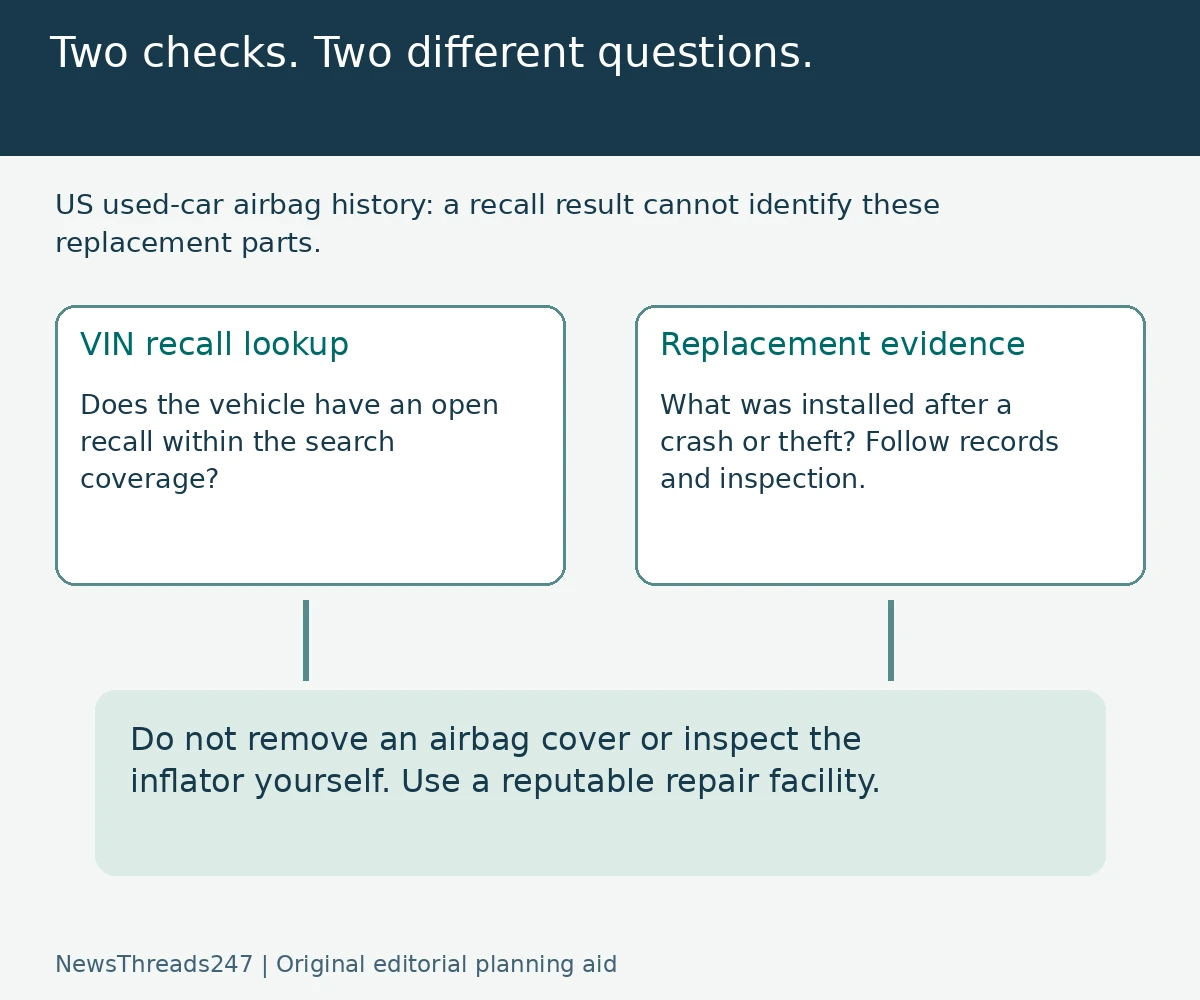
A US used car can show no open safety recall and still need its replacement-airbag history checked. NHTSA’s current warning about inflators marked DTN60DB explains why: these aftermarket parts are not tied to the vehicle’s VIN. A recall lookup cannot establish whether one was installed after a crash or theft. Do not remove an airbag cover or try to inspect the inflator yourself.
The practical question for a buyer is therefore more specific than “Has this model been recalled?” Ask whether the airbags were ever replaced, who supplied the parts and what written evidence connects the repair to this particular car. When the history raises a concern, arrange inspection by the manufacturer’s dealership or a reputable independent mechanic before treating the paperwork as settled.
What the latest warning actually says
In its September 3, 2026 alert, NHTSA reported an eleventh death associated with a defective replacement inflator, following an August 27 crash involving a Chevrolet Equinox. Earlier fatal cases involved Chevrolet Malibu and Hyundai Sonata vehicles. Those names describe known incidents; they are not a complete list of cars that could contain a replacement part.
This is a continuing warning, not an announcement of a new death today. The agency’s current information also says that a vehicle confirmed to contain a DTN60DB inflator should not be driven until genuine replacement parts are installed. The owner should discuss safe transport with the repair facility rather than assuming that a short drive is acceptable.
NHTSA’s general airbag guidance explains that airbags work with seat belts and that a deployed airbag cannot be reused. A tidy steering-wheel cover does not document which replacement equipment is underneath it. Neither the appearance of the cabin nor a seller’s confidence is a parts record.
Build a repair trail for this car
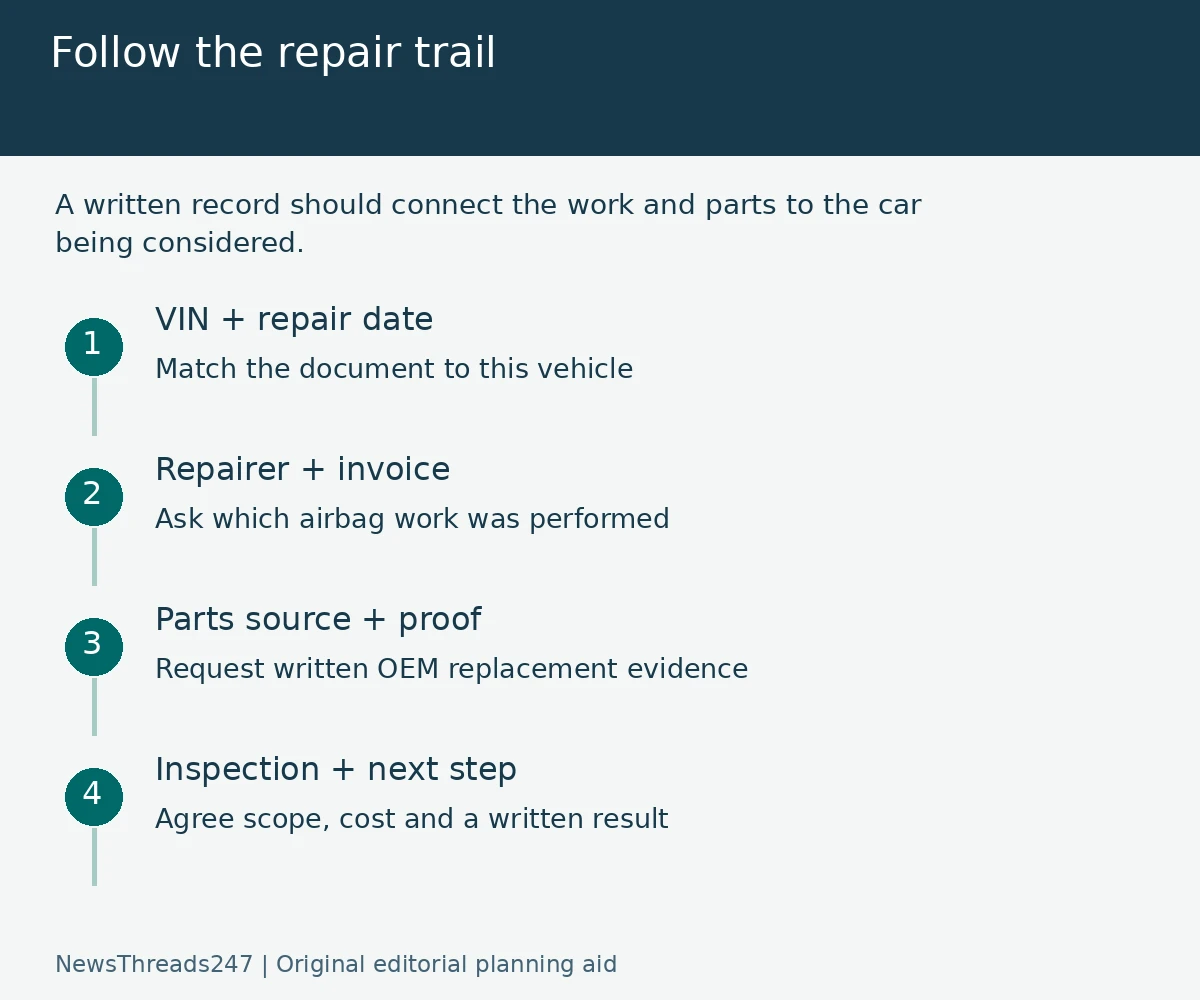
Start by matching the VIN on the documents to the car being offered. Ask the seller for the collision-repair invoice and any airbag replacement records. A useful enquiry names the repair date, repairer, part supplier and part description; it does not stop at an invoice line that merely says “body work”. If the seller does not have the records, record that as unknown rather than silently changing it to “never replaced”.
NHTSA’s April 27 technician guidance suggests asking an independent repair shop for written proof that an OEM replacement part was used. Where an insurance claim paid for the repair, it also suggests asking the insurer whether an OEM replacement airbag was verified. OEM means original equipment manufacturer; a familiar vehicle badge on an invoice is not, by itself, that verification.
Keep the questions separate. “Was the collision repaired?” asks about a job. “Which airbag equipment was supplied?” asks about parts. “Has a qualified technician checked the concern?” asks about the inspection. An answer to the first does not automatically answer the other two.
A history report is a lead, not an inspection
Review the report for a deployment, crash, total-loss or theft entry and compare the dates with the seller’s records. The technician guidance cautions that commercial history reports may not capture every crash. A missing entry therefore should not cancel a known repair invoice or a clear admission that an airbag was replaced.
The Federal Trade Commission’s used-car guide makes a broader point: a history report does not replace an independent inspection, even when a dealer calls a car certified or supplies a warranty. Ask for a written inspection report identifying the car and VIN. Explain the airbag-history concern when booking; do not assume a generic pre-purchase appointment includes the specific work needed here.
Our guide to clean titles and flood-damage checks addresses a separate used-car problem. The shared lesson is to match each question to the evidence that can answer it. A title record, a recall result and a repair inspection have different purposes.
Two fictional listings show the decision
Imagine Listing A has a report showing an earlier airbag deployment. The seller provides a collision invoice, but its parts description is unclear. A clean recall search does not close that gap. The next useful step is to ask for the parts documentation and have a reputable repair facility assess the specific concern; it is not to ask the seller to dismantle the steering wheel for a photograph.
Listing B has a documented replacement with genuine OEM parts from the manufacturer’s dealership. That is materially different evidence from an unexplained replacement bought online. It still does not certify the condition of the rest of the vehicle. These examples are an editorial decision aid, not findings about a real seller or a guarantee that a particular car is safe.
Agree on scope and cost before the appointment
NHTSA’s consumer information says the owner is responsible for the inspection and, if necessary, replacement costs in this situation. Do not assume this works like a familiar manufacturer recall repair. Ask the facility what it will inspect, what records it needs, what it will charge and how it will document the result. There is no verified universal inspection price to quote here.
If a dealer will not permit an independent inspection, the FTC suggests considering another dealer. If moving the car is restricted, ask about a qualified mobile inspection or a facility chosen by you. Avoid making an irreversible purchase decision while the very check you requested remains unresolved.
If you already own the vehicle, the useful output is a documented next action: records requested, inspection booked or a repair plan based on an actual finding. Keep any confirmed suspect-part report with the service documents and follow NHTSA’s official reporting instructions. A photograph, warning-light reset or seller assurance is not a substitute for that process.
Sources and visual credits
US guidance checked October 28, 2026: NHTSA’s September 3 alert, current replacement-inflator information, April 27 technician guidance and general airbag page; FTC used-car guidance. This article does not diagnose a vehicle or provide DIY airbag instructions. Featured artwork is an AI-generated conceptual illustration of an unbranded car. The two original graphics organise records and decisions; they do not depict or identify a real inflator.