
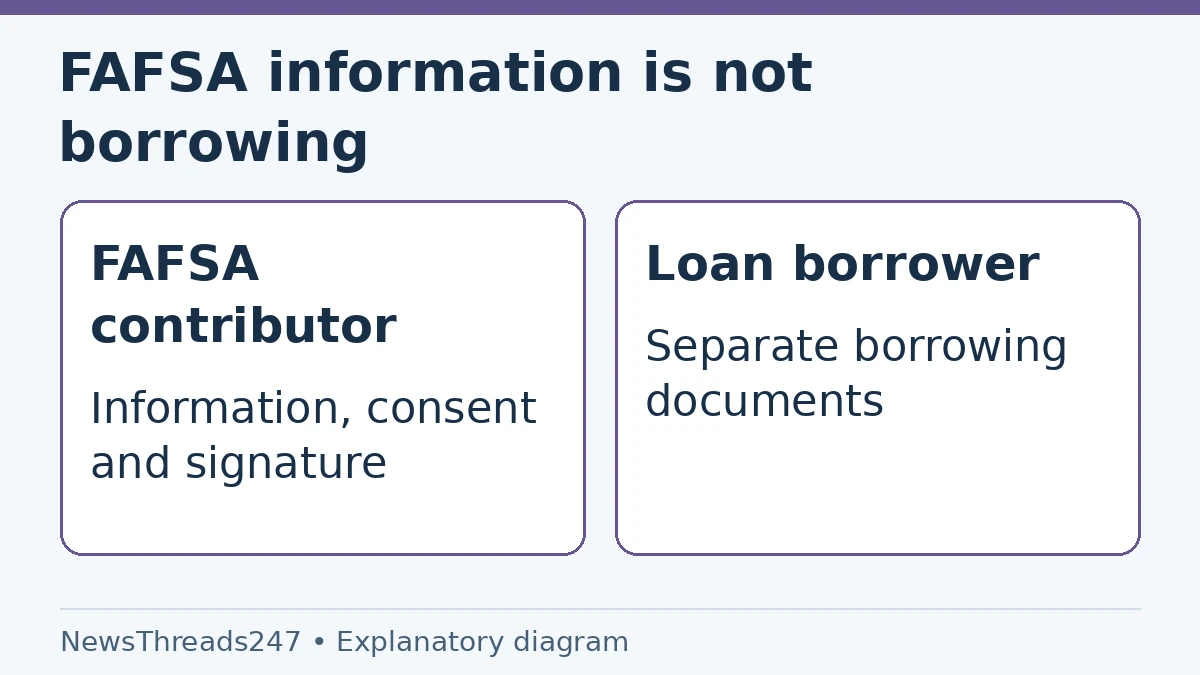
A parent opens a FAFSA invitation and hesitates at the word ‘contributor’. Does accepting mean agreeing to pay the college bill? No. Supplying the required information on a student’s FAFSA form does not, by itself, make a parent responsible for the student’s education costs. Borrowing is a separate decision with separate documents.
That distinction can prevent a useful financial-aid application from stalling for the wrong reason. It does not mean the form is optional where parent information is required. This guide explains the US federal application process checked on October 26, 2026, including the current 2027–28 materials. It does not establish an individual student’s eligibility or promise an award.
What the invitation actually asks you to do
Federal Student Aid’s parent instructions distinguish contributing information from taking out a loan. A required contributor provides their own information, consent and approval for the federal tax-information transfer, and the relevant signature. A parent who separately takes a parent PLUS loan assumes responsibility for that loan; merely completing FAFSA sections is not that agreement.
Explain the distinction before sending the invitation. ‘I need your required FAFSA section’ is clearer than ‘I need you to contribute to college’. The latter sounds like a request for money and can create a family argument about a decision the invitation is not actually asking the parent to make.
Keep three questions apart: whether the student is eligible for aid, which people must contribute information, and whether anyone will later accept borrowing. A completed form helps the aid process move forward. It does not answer all three questions or establish that the eventual college cost is affordable.
Choose the aid year before troubleshooting the invitation
The application year describes the period for which aid is sought. Check the student’s intended attendance period against the form selected, then use the instructions for that year. Do not repair an invitation in one application while assuming it completes another year’s form.
The Department of Education’s FAFSA process guidance says the 2027–28 form uses 2025 tax information. A more recent tax return is not automatically the correct substitute. The form’s specified reporting year and the family’s circumstances today are different inputs to the process.
For current context, the Department’s 2027–28 preview presentation was updated October 5, 2026. It includes contributor invitations and changes to submitted forms. That update is a reference point for this guide, not a claim that a new aid deadline or loan offer was announced today. Confirm school and state deadlines separately.
Invite the required person, using separate accounts
Start with the form’s own questions about dependency and family circumstances. Do not choose a contributor solely because that person is easiest to reach, claims the student for tax purposes or has the most convenient email address. Federal Student Aid links a ‘Who’s My FAFSA Parent?’ tool from its parent instructions for families that need help identifying the right parent.
The FAFSA checklist explains inviting a required parent or spouse through the contributor-invite section using their email address. Tell them which student and aid year the invitation concerns. If there are two children applying, keep their applications and invitation codes distinct.
Each contributor should use their own StudentAid.gov account. Help a family member understand a screen without sharing passwords, security codes or account ownership. If a parent has no Social Security number, use Federal Student Aid’s instructions for that situation; do not enter another person’s number to make a field accept an answer.
Accept the invitation, then finish the actual section
Current parent instructions describe accepting the invitation from the email or using the invitation code through the official FAFSA acceptance route. Open StudentAid.gov yourself if you are uncertain about a message’s authenticity. Verify the student and form before entering personal information.
Accepting an invitation is only a doorway into the application. Review the assigned information, supply the required consent and approval, and complete the signing and submission steps shown for your section. Closing the browser after opening the invite is not evidence that the contributor’s work is finished.
The Department’s process guidance sets out this sequence explicitly: account access, review, information and consent, then digital signature and submission. Ask the student to check the form’s status after the contributor finishes. The useful confirmation is what the application records, not that everyone remembers clicking an email.
Separate these four milestones
| Milestone | What it means | What it does not mean |
|---|---|---|
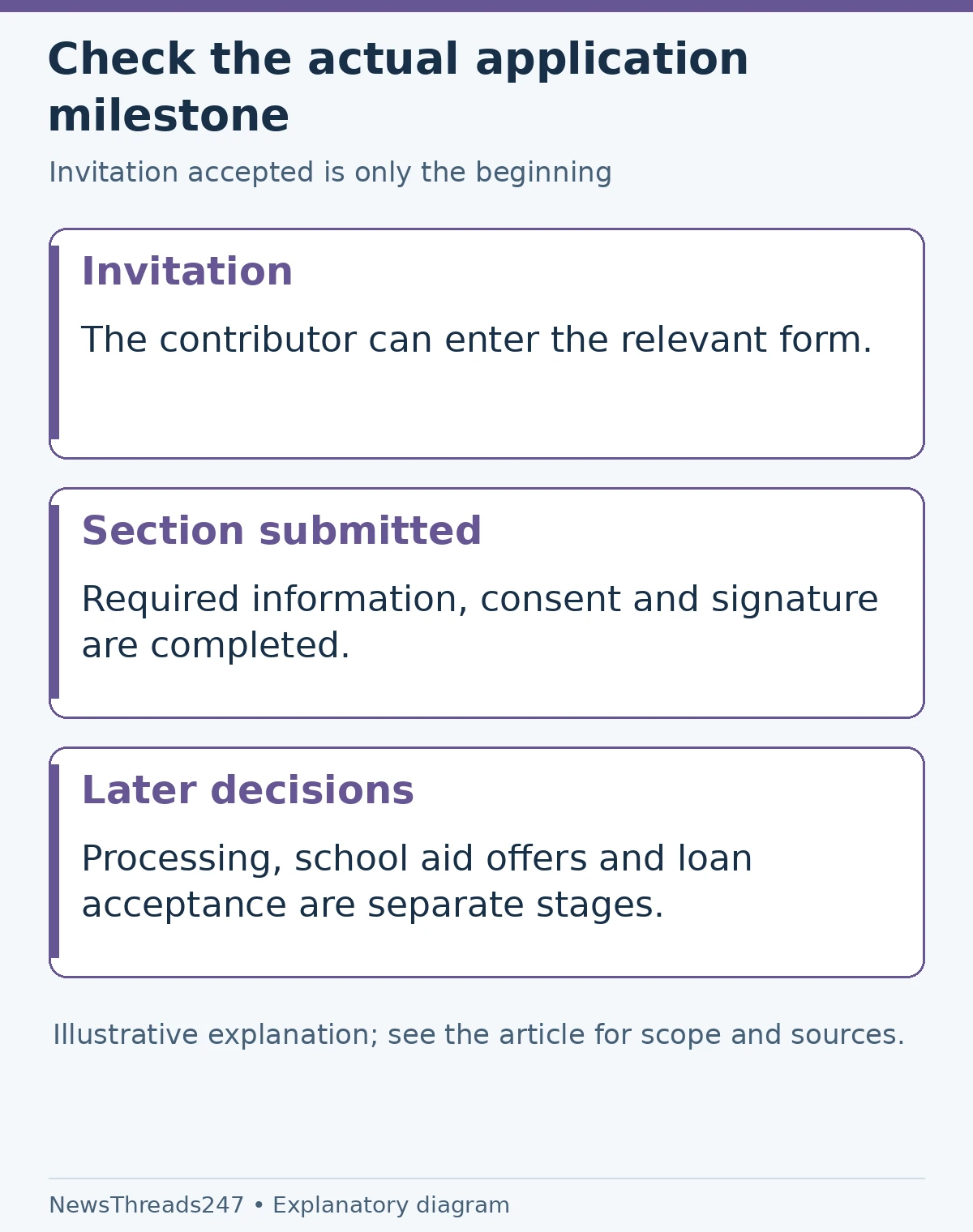
| Invitation accepted | The contributor can enter the relevant form | Their section is necessarily complete |
| Contributor section submitted | Required work for that section was sent | The school has offered aid |
| FAFSA processed | The application has moved through processing | Every award and college cost is settled |
| Loan documents accepted | A separate borrowing commitment may arise | This happened merely by accepting the FAFSA invite |
Imagine a student whose parent accepted the email invitation on Saturday but did not sign the section. On Monday, the student says the parent ‘already did FAFSA’. The repair is to inspect the section’s outstanding tasks and finish them, not to send several duplicate invitations or assume the college has lost a completed application.
Missing invitations need a precise check
First compare the invitation destination with the contributor’s actual email address. Check whether the student is looking at the intended aid year and whether the contributor is opening the correct student’s form. Use the official account and invitation route rather than repeatedly forwarding an old email without reading it.
If the wrong person was invited, consult the current correction instructions. The 2027–28 preview includes a scenario for replacing an invited contributor; that is a different task from creating another student account. Save the support reference and describe the exact screen and status if assistance is needed.
Do not send tax records, identity documents or invitation codes in a public help thread. A useful support request can identify the aid year, the stage at which the process stopped and the wording of an error, with private details removed. Provide sensitive information only through the official secure process that requests it.
When circumstances do not fit the ordinary route
The FAFSA checklist says required consent and approval remain relevant even where someone did not file a tax return. ‘No tax return’ and ‘no consent needed’ are not interchangeable. Follow the form’s questions and the official guidance for the contributor’s actual situation.
If income has fallen or other financial circumstances have materially changed, the Department instructs families to complete the application as directed and contact the school’s financial-aid office about an adjustment. Do not silently replace the specified tax-year information with a figure that seems more representative today.
Parent refusal, inability to contact a parent, unusual circumstances and a student’s dependency status require their own guidance. They should not be collapsed into ‘apply as independent’. Ask the financial-aid office what documentation and route apply. An Indian student considering US study must also check federal eligibility; planning to attend a US college does not by itself make every international applicant eligible.
Use the completed record for the next college decision
Keep the submission confirmation, the aid year and any outstanding school requests together. Compare eventual aid offers with actual costs and borrowing terms before deciding how to fund attendance. The FAFSA contributor step is important precisely because it belongs to an application process, rather than replacing the decisions that follow.
College eligibility is a separate check too. Our US college accreditation guide distinguishes checking an institution from checking the programme and professional goal. A form being accepted does not settle those academic questions.
Sources and visual credits
Sources: Federal Student Aid’s parent instructions and FAFSA checklist; the Department of Education’s FAFSA process toolkit and October 5, 2026 preview update, linked above and checked October 26. This is general application guidance; the current form and school instructions control individual cases. Featured image: AI-generated conceptual illustration. Process and milestone diagrams: NewsThreads247.