
A college website displays an accreditation badge beside a promising career description. That badge may answer a question about the institution while leaving your intended programme, transfer plan or professional licence unresolved. Before paying a deposit, identify precisely what is accredited and what you need the qualification to do.
For a US college, start with the institution’s legal name, the relevant accrediting organisation and the current record. Then check the programme and any professional licensing requirements separately. This is useful to US residents and Indian applicants considering US study; it does not establish how a US qualification will be recognised for employment, further study or a regulated profession in India.
An institution and a programme are different units
The US Department of Education distinguishes institutional accreditation from specialised or programmatic accreditation. Institutional accreditation concerns the institution. Programmatic accreditation concerns a particular professional or specialised programme, school or other defined unit. The Department’s accreditation explanation is a starting point for understanding that distinction.
Do not assume every course at an institution has a separate professional accreditation, or that every field needs the same kind. Ask what applies to the actual credential and intended profession. A short certificate, a degree and a licensure-preparation programme can have different purposes even when the same college offers them.
The Database of Accredited Postsecondary Institutions and Programs, or DAPIP, contains information reported to the Department by recognised agencies. The Department does not itself accredit colleges. A search result should be read for the named institution, agency, scope and status rather than reduced to “the government approved this degree”.
Begin with the exact institution, not an agent’s brand
Record the legal institution awarding the qualification, its address, the campus or delivery arrangement, the credential’s full name and the proposed entry term. Compare those details with the institution’s own records. A recruitment company’s name may be much more prominent in advertising than the university that will appear on the certificate.
Then record the accreditor’s full name. Follow the record back to that organisation’s own directory and, where relevant, the Department’s information on recognition. A logo copied into a brochure is not a substitute for a current directory entry. If names or addresses differ, ask for a written explanation before treating them as the same entity.
The Council for Higher Education Accreditation provides its own directory of CHEA-recognised accrediting organisations. CHEA recognition and US Department of Education recognition are distinct processes. Check which recognition the claim actually describes; do not turn two different lists into an unsupported ranking of colleges.
Write the outcome you need in one sentence
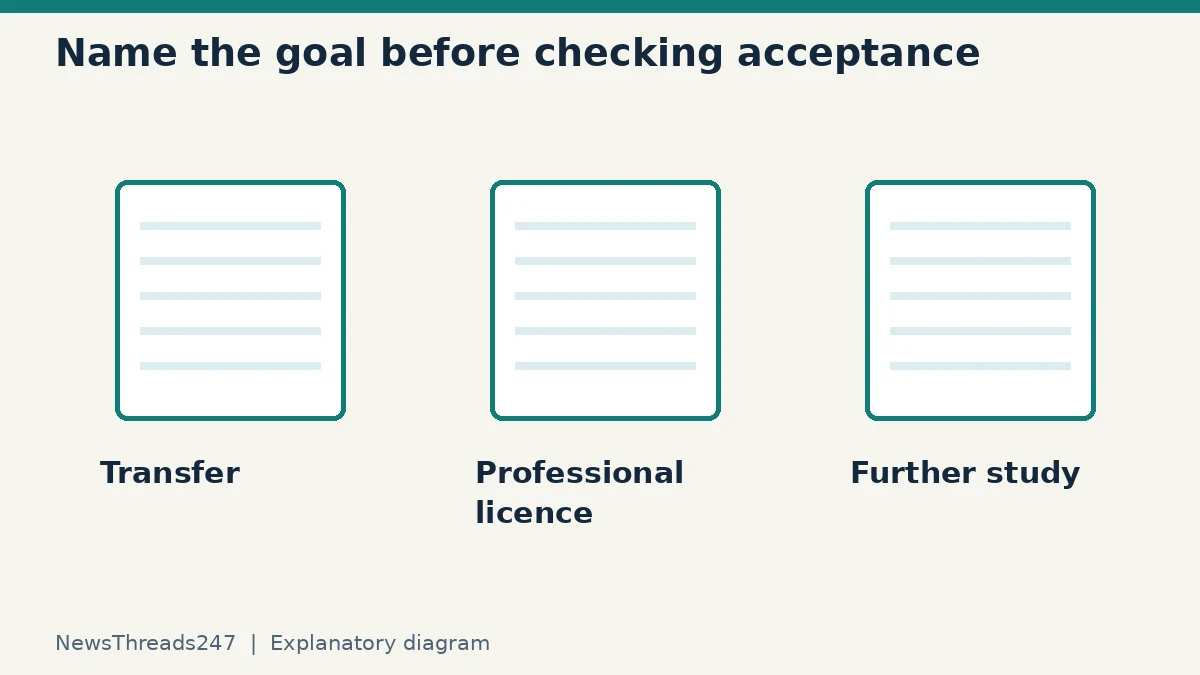
A verification exercise becomes much clearer when the intended outcome is explicit: “I want these modules to count towards this named degree”, or “I want this programme to meet the educational requirement for this licence in this state.” Those questions are more useful than asking whether a college is “valid everywhere”.
If you want to transfer later, ask the receiving institution about the specific courses and credential. If you want a regulated career, ask the relevant licensing authority about the programme and jurisdiction. If an employer or postgraduate institution will evaluate the qualification, ask about its requirements before committing to a course built around another purpose.
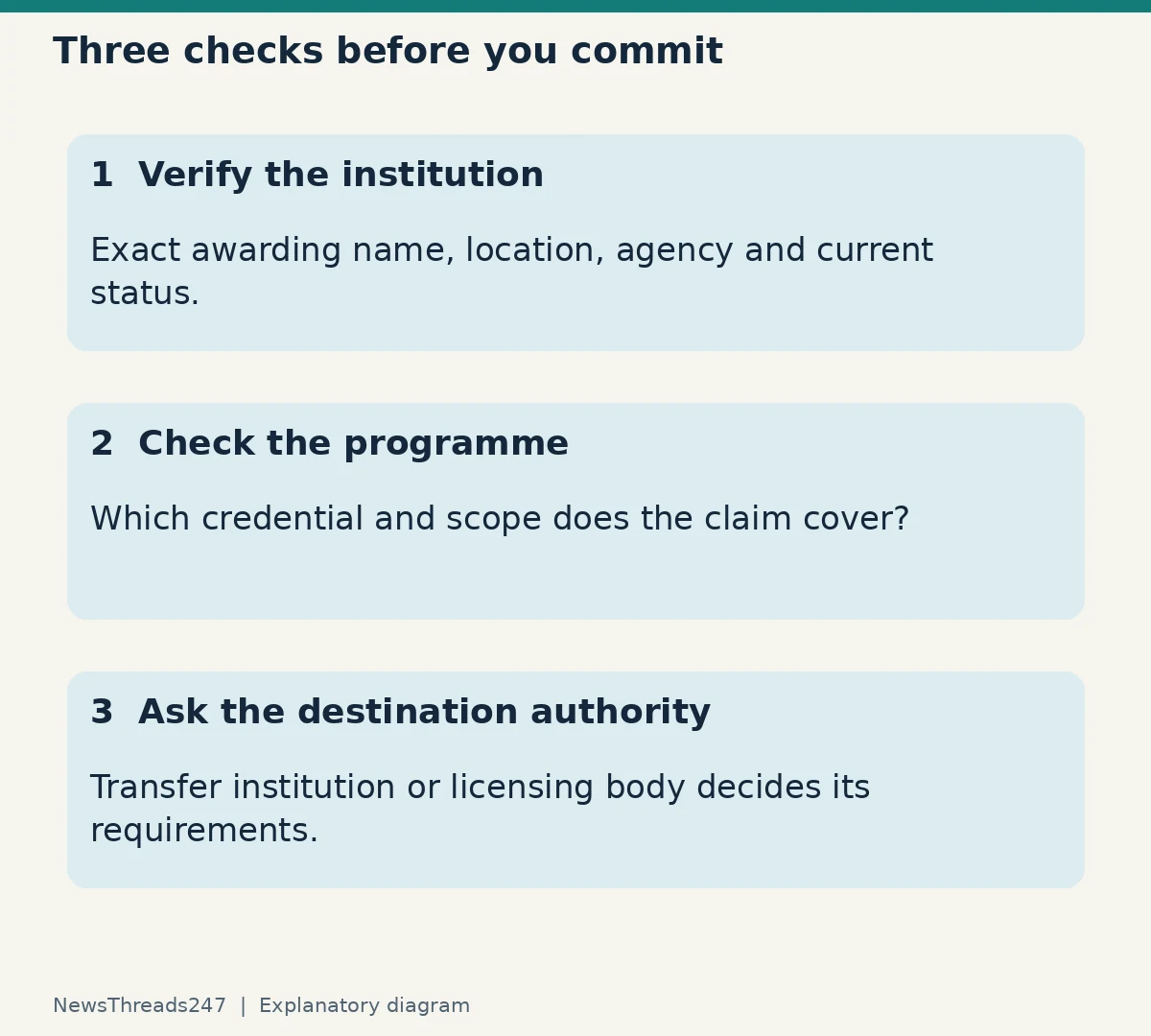
The Department cautions that accreditation does not automatically ensure credit acceptance or employer acceptance. CHEA’s transfer-credit resource addresses the separate transfer issue. An institution’s accreditation is relevant evidence, but it cannot stand in for the receiving institution’s decision about your transcript.
A fictional transfer plan shows the gap
Suppose a student plans to complete a year at College A and then enter a particular degree at University B. College A supplies evidence of institutional accreditation. The student still needs University B to explain whether the proposed courses will transfer, whether they satisfy degree requirements or only electives, and whether limits or minimum grades apply.
The distinction can change the cost calculation. Credit that is accepted generally may not replace a required module in the intended major. A promise of “up to one year of transfer” is too vague to establish that the student will finish a named degree a year sooner. Request a course-by-course or pathway-specific explanation where available, and keep its conditions.
This is an illustrative decision problem, not a report about either real institution. It shows why the right follow-up question concerns the destination and the programme rather than a second copy of the first college’s badge.
A professional goal needs a jurisdiction check
A programme may describe itself as career-focused without establishing eligibility for a licence in every state or country. Identify where you intend to practise and contact the authority that grants the licence. Ask about education, supervised practice, examinations and any other relevant requirements rather than assuming that graduation completes the process.
The Higher Learning Commission’s student guidance directs licensure questions to the agency or state granting the professional licence. This is particularly important for a student who expects to move. A statement about one jurisdiction should not be silently carried into another.
For an Indian applicant, keep US accreditation and recognition for the intended use in India as separate questions. This article does not claim a US directory entry establishes Indian equivalence or eligibility for an Indian regulated profession. Obtain guidance from the authority responsible for the specific use and qualification.
Keep a small evidence file before paying
Save the institution’s current accreditation page, the directory record, the programme description and any written answer about your goal. Note the access date and the entry term. Keep the refund and cancellation terms with the same file, so a clarification arriving later can be assessed before a payment becomes difficult to recover.
A useful question to admissions is: “Please identify the awarding institution and current accreditor for this credential, and explain which record covers this campus and delivery mode.” For a transfer destination, replace that with the exact proposed courses. For licensing, address the licensing authority rather than relying only on a sales representative.
Do not accept an unanswered question as a positive answer. If a record cannot be found, names conflict or a response describes a different credential, pause the decision and seek clarification. The absence of an immediate result does not by itself prove a fraud; it does mean you have not completed the verification you need.
Read dates and changes with care
Accreditation is a status that can change. A screenshot from a former student or an old brochure may be genuine yet insufficient for a new enrolment. Read notices and scope information from the responsible agency, and ask how any change affects your proposed start date. Do not guess the consequences of a technical status label.
Our India online-degree recognition guide addresses a different system: UGC-DEB recognition for the relevant programme and period. It should not be used as a substitute for a US institutional or programme check.
References and limits
The Department of Education, DAPIP, CHEA and Higher Learning Commission resources linked above were checked against available current records on 25 October 2026. No college is being endorsed or accused here. This guide supplies a verification method; only the appropriate institution, accreditor or licensing authority can answer the specific status and acceptance question for your case.