The university’s name is familiar. The fee can be paid in instalments. A counsellor says the online degree is recognised. Before committing money and several years of study, ask for the record that connects that university to your exact programme, study mode and admission session. That is where a reassuring sales conversation becomes a decision you can check.
Quick answer: In India, verify the university and the specific online or Open and Distance Learning programme through the UGC Distance Education Bureau, using the session in which you intend to enrol. Compare that record with the university’s own notice. Create the required DEB ID through the official process, and keep the recognition evidence with your admission documents.
Match the course, mode and session—not just the university
A broad claim such as “UGC approved” leaves important questions unanswered. The UGC’s published FAQs explain that recognition is programme-specific and that the issuing university is responsible for verifying an individual degree. Checking permission to offer a programme and verifying somebody’s completed certificate are therefore different tasks.
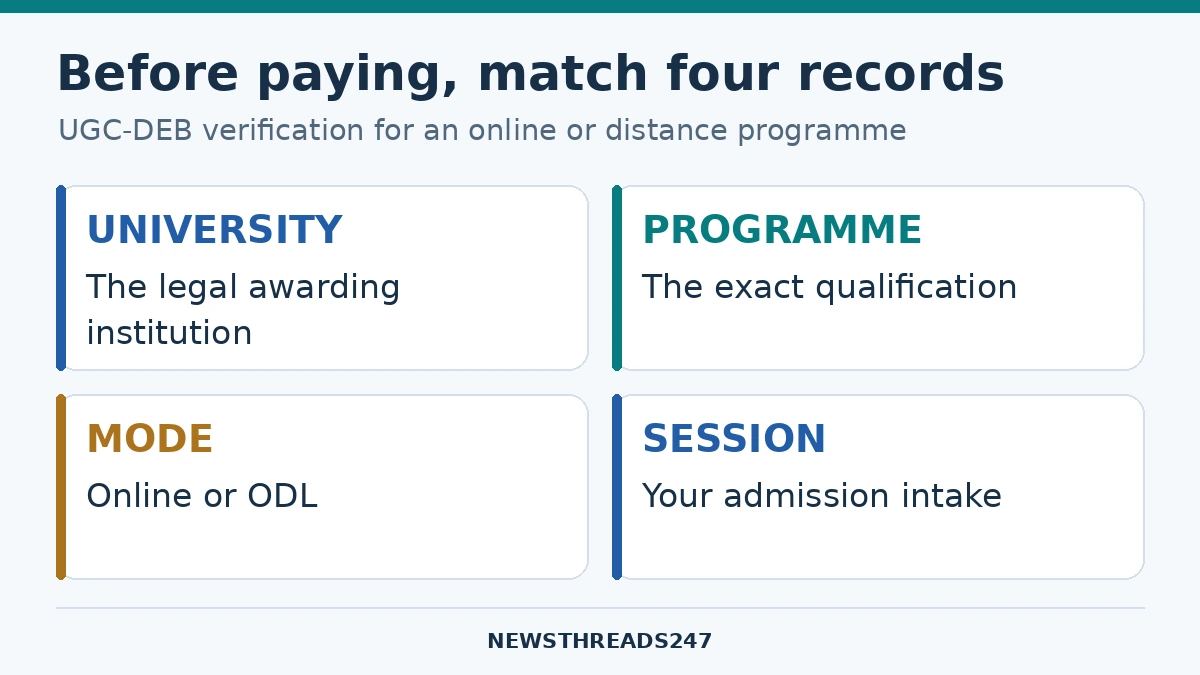
| Detail | What you need to match |
|---|---|
| University | The legal name of the institution that will award the qualification. |
| Programme | The exact degree or postgraduate diploma, rather than a broad subject or marketing label. |
| Mode | Online or Open and Distance Learning (ODL), as shown in the relevant official record. |
| Admission session | The academic year and intake/session covering your admission. |
Write those four details at the top of your comparison notes. Keep the proposed specialisation, duration and awarding institution alongside them. If a salesperson uses a shorter course name, ask the university to explain how it maps to the title in the official recognition record. Similar wording is a reason to clarify, not a reason to guess.
What the current admission notice tells you
On 23 October 2026, the official DEB ID portal displayed 13 October 2026 as the last date to admit learners for the August 2026 ODL/online session. That date has passed. This article is not an announcement that the intake remains open.
If someone offers admission now under that session, ask for the applicable subsequent official notice before paying. For another intake, verify its own dates and recognition records. Do not carry a deadline from one session into another, or treat a payment link that still works as proof that admission is permitted. Recheck notices when you are ready to apply.
How to make a useful recognition check
Start with the offer you are actually considering
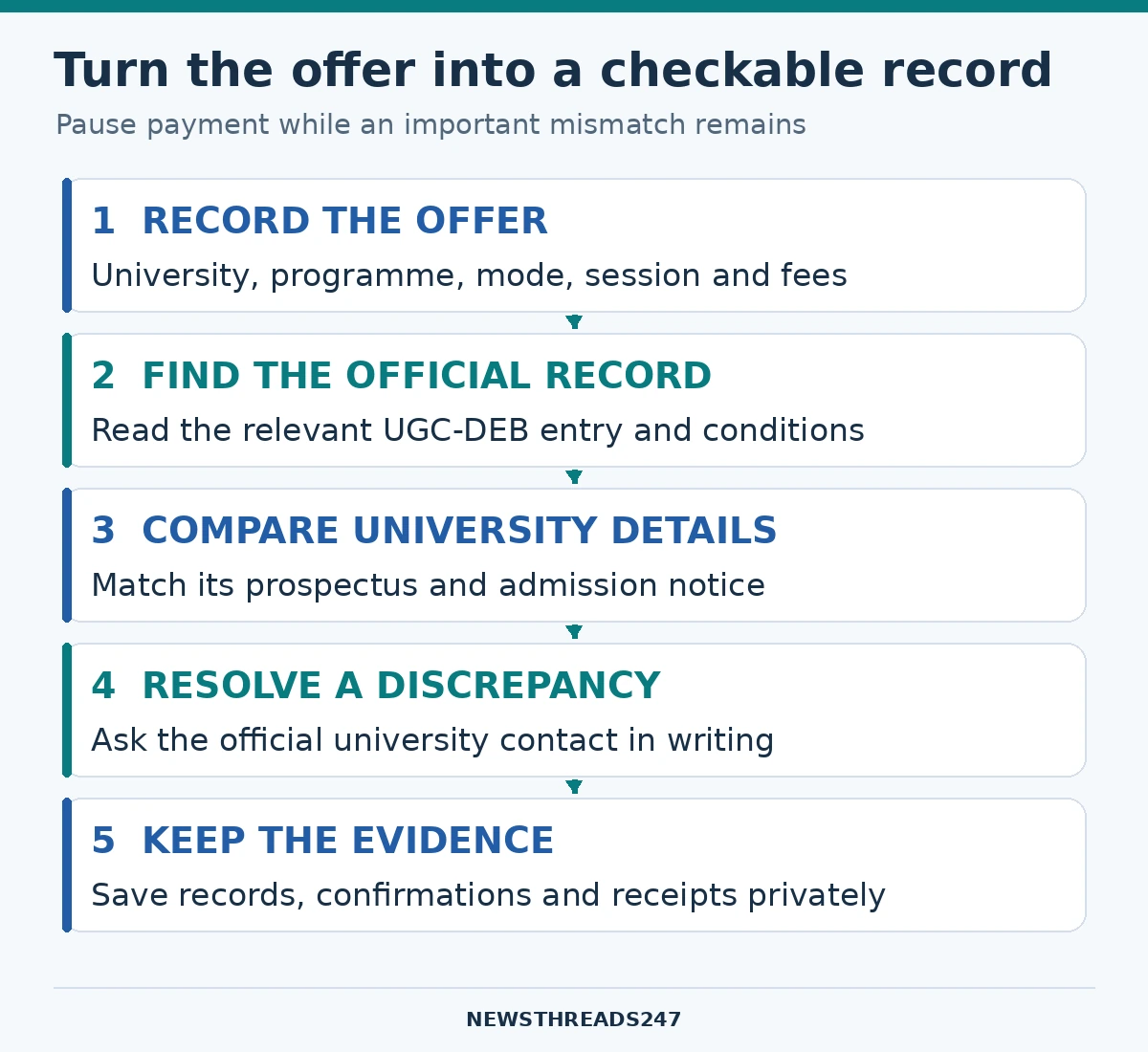
Save the university name, exact programme title, mode, proposed session, fee sheet and the URL where you were asked to apply. Separate a university’s own admission page from a comparison site or counselling page. The latter may help you discover a course, but your final record should identify who is admitting you and who will award the qualification.
Read the relevant UGC-DEB entry
Open the official UGC-DEB programme list independently and locate the recognised or entitled institutions/programmes for the relevant mode and session. Compare the entry with your notes. Read the linked recognition letter and its conditions where available. If the page is difficult to search, try the university’s full legal name and examine the relevant session documents rather than accepting a search-engine snippet.
The DEB student FAQs direct learners to check session-specific recognition, the institution’s website, prohibited programmes, the ban on franchising arrangements and territorial-jurisdiction requirements for ODL. A counsellor’s assurance cannot resolve a discrepancy between those records.
Ask for the missing link in writing
If the programme is absent, the session differs, or the record shows ODL while the offer says online, pause the payment. Ask the university’s officially published admissions contact to identify the applicable entry and explain the difference. A record you cannot locate is not enough evidence to label an institution fraudulent; it is enough reason to withhold a commitment until the position is clear.
Keep a dated copy of the answer and the document it relies on. “The application has been submitted” and “approval is expected” describe an incomplete process. Ask for the recognition or entitlement applicable to your proposed admission, rather than a prediction about a later decision.
DEB ID, ABC ID and a marksheet serve different purposes
The official DEB ID explanation describes an identifier for learners entering ODL/online programmes and says it remains valid across that learning lifecycle. Its purpose includes helping learners identify recognised or entitled institutions and approved programmes. It is not the qualification you are enrolling to earn.
The student FAQs say a DEB ID is required for enrolment and is created using an ABC ID; an ABC ID can be created through DigiLocker. Follow those official routes yourself. Do not treat the successful creation of an identifier as an admission letter, proof that fees reached the university or confirmation that every programme advertised to you is covered.
If your identity details are wrong, the DEB portal advises checking and correcting the ABC/APAAR record before creating or updating the DEB ID. For a separate problem with an issued school or university document, see our guide to a marksheet that is missing from DigiLocker. An identity-data correction and a missing academic record may need different support routes.
A fictional offer shows why the details matter
Imagine a learner receives an offer for an online master’s degree starting in a particular session. The brochure names a real university, but the attached letter concerns a different programme and an earlier ODL intake. The brochure may look convincing; the documents still do not answer the learner’s question.
The useful response is specific: “Please provide the official record covering this degree, online mode and my proposed admission session.” If the university supplies a matching record, save it and continue checking the other admission conditions. If the answer repeats the university’s general standing, the original gap remains. This example is illustrative and does not describe any named institution.
Recognition and suitability are separate decisions
The DEB’s regulatory FAQs describe the conditions under which recognised ODL/online undergraduate and postgraduate degrees, and specified postgraduate diplomas, are treated as equivalent to corresponding conventional awards. They also list prohibited disciplines and research programmes. UGC’s current institutional instructions specify that allied and healthcare programmes covered by the NCAHP Act, 2021, including Psychology as a specialisation, cannot be offered in ODL/online mode from the August 2026 session onwards. Do not rely on an older brochure for a new admission in these subjects.
Once recognition is established, ask whether the course suits your purpose. Read the actual eligibility notice for the job, professional registration or further study you have in mind. Check subject requirements, marks, practical components and any applicable regulator’s conditions. A general equivalence provision does not promise selection, professional registration or acceptance for every overseas purpose.
Compare the teaching arrangements too: assessment method, live-class expectations, examination arrangements, support contacts and the time you can realistically study. These are questions for the university’s published prospectus and admission terms. A recognised programme can still be a poor fit for your timetable or learning needs.
Keep an admission evidence folder
- The recognition/entitlement record covering your programme, mode and session, including its conditions.
- The university’s prospectus, eligibility rules, fee schedule and written refund terms.
- Your official application, admission confirmation, DEB ID details and university receipts.
- Written clarification of any discrepancy, with the date and the university contact used.
Keep sensitive identifiers in private storage. If you seek help publicly, redact them. Save documents while they are available rather than relying on a page remaining unchanged. The folder gives you a clear account of what was offered, what you checked and what you paid.
Already paid? Establish what has been recorded
Contact the university through details you located on its official website. Ask whether it has recorded your application and payment, what session and mode it has assigned, and which recognition record applies. Keep receipts and correspondence with the intermediary too. If the university has no record, preserve that response and request an explanation from the recipient of the payment.
Use the institution’s published grievance and refund process for the issue you can document. A recognition question, an unauthorised payment and a disagreement about course delivery are different complaints. Do not assume a refund is automatic, and do not pay an additional “validation” charge merely to make the earlier payment seem secure.
Two questions applicants often ask
Does recognition in an earlier year cover my new admission?
Do not assume so. Check the session for which you are seeking admission. The DEB distinguishes a university’s earlier recognition from its status for a later session. Existing learners should examine the rules and conditions applying to their own admission rather than infer that a later change automatically invalidates their award.
Can UGC verify my individual marksheet?
UGC can explain recognition status; its FAQs direct individual qualification verification to the issuing university or institution. Ask the issuer for its verification procedure, especially when an employer or another university needs confirmation.
Sources and editorial note
Official guidance checked on 23 October 2026: UGC-DEB portal; regulatory FAQs; student FAQs; About DEB ID; DEB ID and admission notice; UGC verification FAQs. The comparison workflow and fictional example are NewsThreads247 editorial guidance. This article does not certify any institution or individual qualification. Recheck the official records for your actual admission date.