
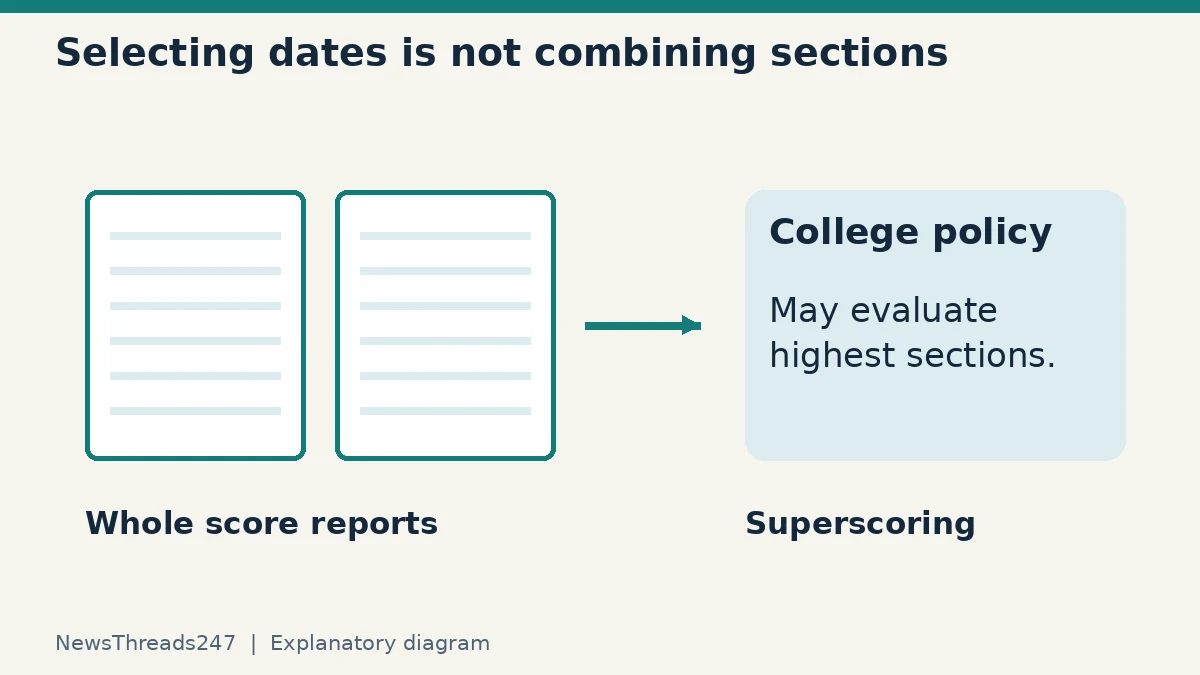
Your best SAT Math score is from one sitting and your best Reading and Writing score is from another. You may be able to benefit from both, but you cannot create a custom College Board report containing only those two sections. Score Choice selects complete test dates. Superscoring is what a college does with scores under its own policy.
That distinction matters for applicants in the United States and India preparing US college applications. Before paying for a report or deciding to omit a test date, read each recipient’s current admissions and scholarship instructions. A feature in the score-sending account does not overrule a college’s requirements.
Why this is timely for the autumn application round
College Board’s current score-release calendar lists 16 October 2026 as the student release date for the 3 October SAT Weekend sitting. It lists 20 November for the 7 November sitting. Those are release dates, not promises that an individual college will have processed a report by its deadline.
If you are preparing an application now, keep three dates separate: the test, the release of its scores and the recipient’s deadline for receiving or reporting them. A later test can be available on College Board’s calendar yet arrive too late for a particular admissions round. Ask the institution if its written policy does not explain the situation; do not infer an extension from a testing calendar.
Two decisions made by different people
Score Choice lets students choose scores by SAT test date. College Board warns that some colleges and scholarship programmes require all scores. It also says the option is not available for the free score sends selected when registering for SAT Weekend or taking in-school testing. Review the exact transaction rather than assuming all score sends have identical controls.
Superscoring describes a recipient combining the highest section scores across sittings under its policy. It does not mean College Board replaces the scores from your actual test dates with a newly taken examination. An institution that does not superscore may instead consider a complete sitting or apply another published approach.
College Board’s SAT Weekend score-sending guidance explicitly says students cannot choose Math from one date and Reading and Writing from another as separate pieces of a score send. The whole SAT from a selected date is sent. This is the practical reason that “send my superscore” can be an imprecise instruction.
A worked example: a higher combination is not a new test
Suppose an applicant has these entirely fictional results. In Sitting A, Reading and Writing is 680 and Math is 740, giving a total of 1420. In Sitting B, Reading and Writing is 720 and Math is 710, giving 1430. The highest sections combine to 720 plus 740, or 1460.
The applicant has not earned a 1460 single-sitting score. A recipient that permits superscoring could evaluate that 1460 combination under its rules, usually needing the relevant information from both sittings. A recipient considering the best complete sitting would see 1430 as the higher of the two totals. A recipient requiring all dates still expects its policy to be followed.
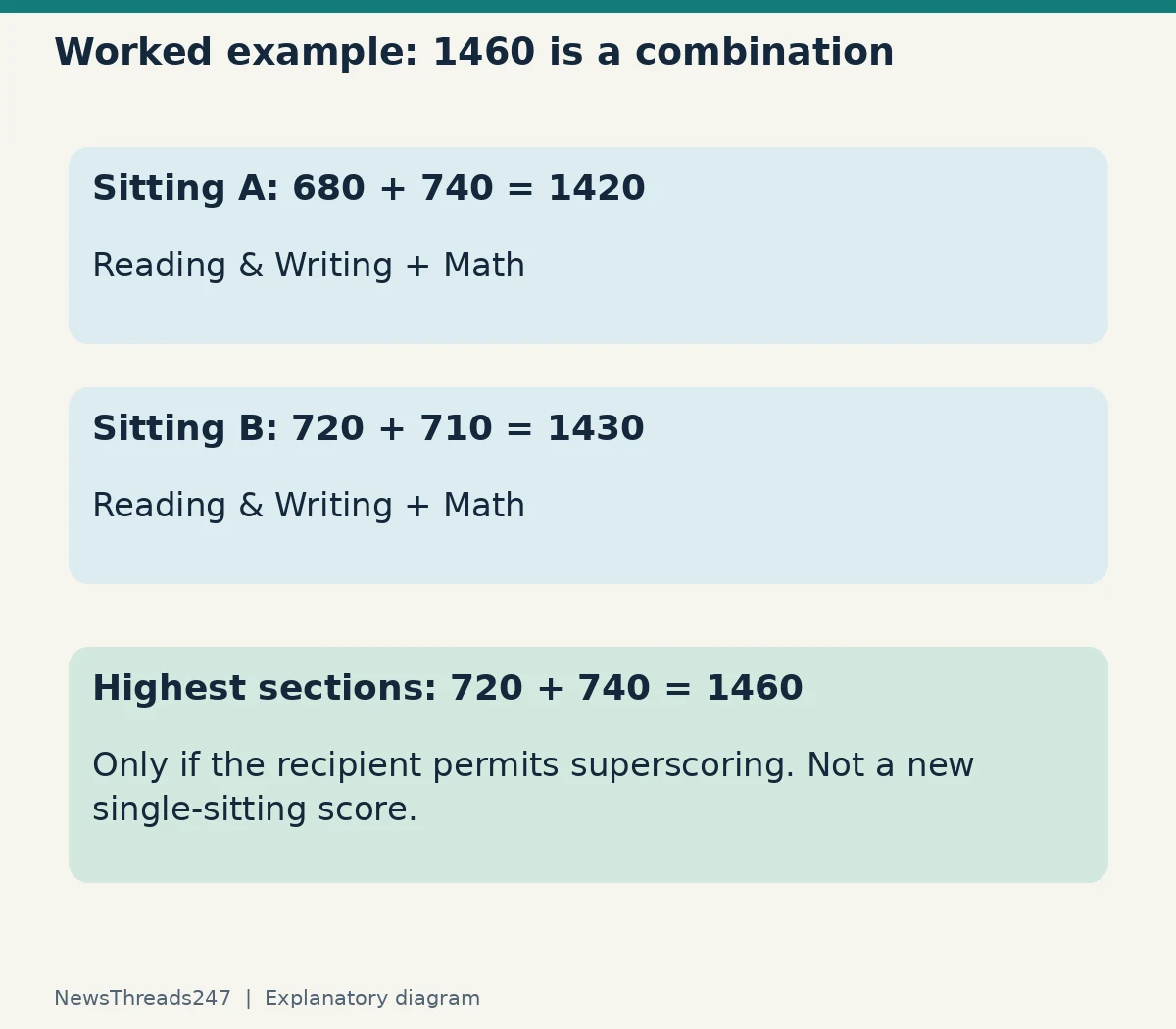
This example is arithmetic, not an admissions prediction. It says nothing about whether either score is competitive for a particular programme, whether testing is required, or whether a scholarship evaluates scores in the same way as admissions. Keep each of those questions separate.
Build a recipient sheet before opening the checkout
Create one row per college or scholarship. Record the exact institution and programme, application round, testing requirement, whether self-reporting is accepted initially, official-report requirements, superscoring policy, any all-scores rule and the relevant deadline. Add the official page URL and the date you checked it. Leave an uncertain field marked “ask admissions”; do not fill it using a general list from an earlier year.
Two organisations can appear to have the same test policy while using different procedures. One might accept self-reported scores for an initial review and require official reports later. Another might need the official report at an earlier stage. The college’s current instructions decide the process; a successful score-send order proves only that you placed that order.
For a scholarship with separate instructions, make a separate row even if it is connected to the same university. This prevents an admissions rule being silently copied into an award application. If the policy is unclear, ask a narrow question identifying your entry term and round, rather than “Do you accept SAT scores?”
Check the reports you are actually sending
After choosing the recipient, review the selected test dates and the order summary. Confirm that the institution is the intended destination, not another campus or similarly named organisation. Keep the confirmation and use the recipient’s application portal to follow up when its stated processing time has passed.
If you want a college to consider your strongest sections from two dates, first establish that its current policy permits that combination. Then follow its required reporting method for those dates. Do not exclude a sitting merely because one of its sections is lower if that omission would conflict with an all-scores requirement or remove the stronger section you need.
College Board calls Score Choice a free option, but that does not make every additional score report free. Its fee explanation separates the choice feature from the cost of score sends. Check current checkout information rather than relying on an old fee quoted in a guide.
Avoid turning a reporting question into a rushed retake
A superscore calculation can help you understand existing results. It cannot establish that taking the SAT again is necessary, affordable or useful before a deadline. Start with the institution’s testing policy and the time available for a new score to be received. A later sitting with a higher result is of little use to a round that cannot accept it.
For an Indian applicant, do not map SAT reporting rules onto NTA results. Tests use different score systems and recipient processes. Our NTA percentile-versus-percentage explanation covers another common interpretation problem, but its scoring framework does not explain an SAT superscore.
If an application is already submitted
Check the college portal and its update instructions before sending duplicate messages or reports. If a score or date was entered incorrectly, contact admissions through its published route, state the correction clearly and keep a copy. Do not assume a new official report automatically edits a self-reported field in an application.
The useful final check is specific: have you supplied the scores this recipient asks for, through the method it accepts, by the applicable deadline? That question is more reliable than trying to find one universal rule for every US college.
References
College Board’s Score Choice, SAT Weekend sending-scores, score-release calendar and Score Choice fee pages are linked at the relevant claims above. Guidance checked on 25 October 2026; verify each recipient’s policy for your entry year before acting. No individual institution’s admissions outcome or superscoring policy is assumed here.