
The money has left your bank account, the shopkeeper has no confirmation, and a queue is forming behind you. Paying again may feel like the quickest escape. First establish what happened to the original transaction: a debit, an app status and a merchant’s receipt are different pieces of evidence, and one cannot reliably stand in for the others.
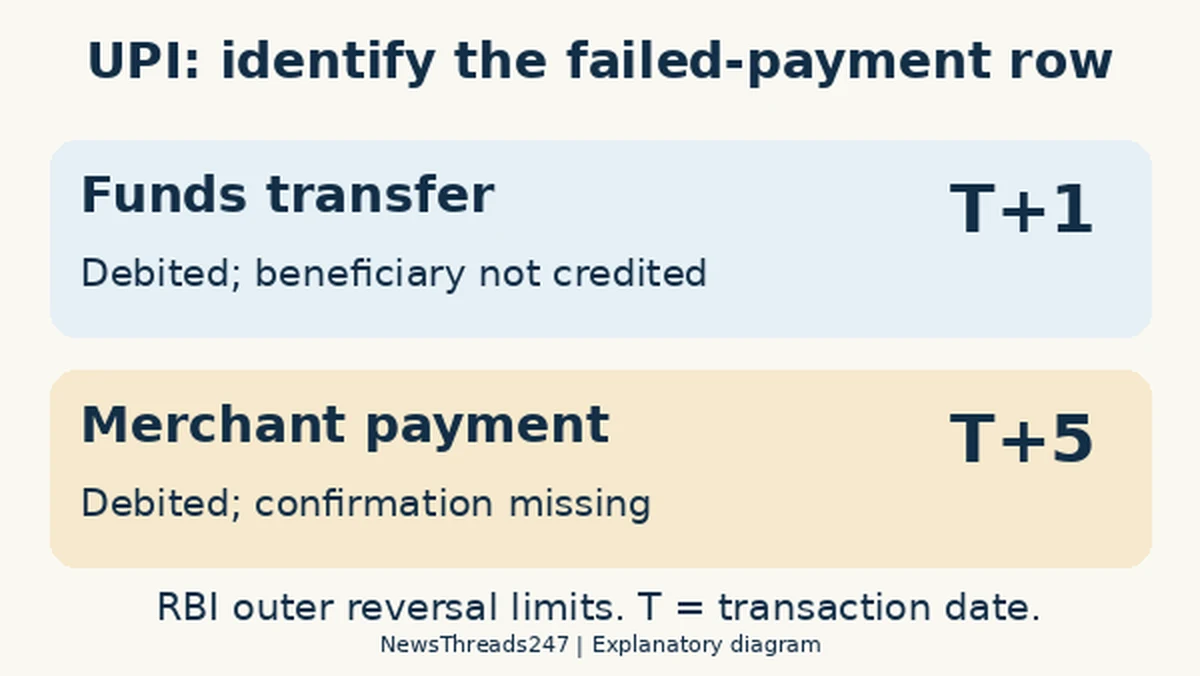
For domestic UPI failures, the RBI’s reversal deadline depends on the incident. A funds transfer debited without credit to the beneficiary has a T+1-day reversal provision if the credit cannot be completed. A merchant payment debited without confirmation at the merchant location has a T+5-day auto-reversal provision. T means the transaction’s calendar date. The specified compensation is ₹100 per day beyond the applicable limit, not an automatic reward whenever a payment fails.
Start with the transaction record, not a second attempt
Open the payment’s details in the app used to send it. Record its status, amount, date, time and transaction reference. Compare the debit with your bank’s account record, then ask the recipient or merchant to check their actual receipt or bank record. A notification arriving late is not the same as proof that the payment never arrived.
Axis Bank’s UPI support page distinguishes the T+1 and T+5 timelines for person-to-person and person-to-merchant failures. The underlying RBI circular of September 20, 2019 states the precise incident categories. These rules are being explained as existing provisions checked on October 25, 2026; they are not a new refund scheme announced today.
If goods or a booking are involved, explain the disputed status before agreeing to another payment. If you decide to pay again, keep a record linking the second payment to the same purchase and obtain the merchant’s acknowledgement. That record can help resolve a duplicate-payment question later; it does not guarantee that either transaction will be reversed automatically.
Match the failure to the right row
| Incident described in RBI’s UPI table | Outer reversal timeline | Compensation beyond that limit |
|---|---|---|
| Account debited; beneficiary not credited in a funds transfer | T+1 day, if credit cannot be completed | ₹100 per day of delay |
| Account debited; confirmation not received at merchant location | T+5 days | ₹100 per day of delay |
The framework covers domestic transactions with both originator and beneficiary in India. It concerns failures not attributable to the customer. A successful payment to a person you chose by mistake, a refund after returning goods and an unauthorised transaction raise different issues. Do not assign every payment complaint to the merchant-failure row simply because a purchase was involved.
‘Pending’ is a status to investigate, not a final diagnosis of which rule applies. Ask the bank to identify the transaction’s final status and applicable failure category. The RBI describes the deadlines as outer limits and expects faster resolution where possible. There is no need to wait until a deadline has passed before documenting a problem or seeking support.
A calendar example makes the difference visible
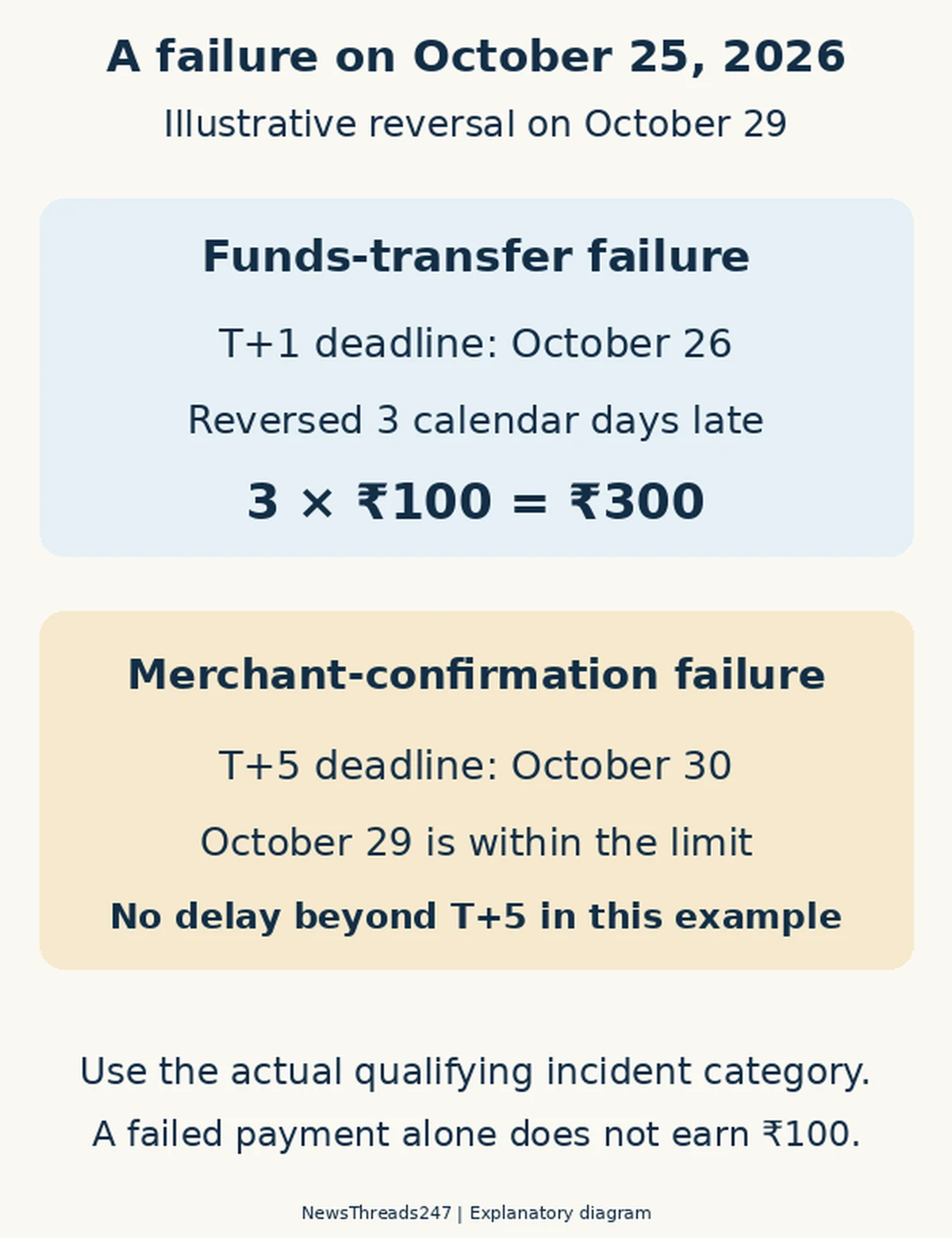
Suppose a qualifying funds-transfer failure occurs on Sunday, October 25, 2026. T+1 is Monday, October 26. If the reversal is completed on October 29, that is three calendar days beyond the T+1 limit: ₹100 multiplied by three gives ₹300 under that row’s delay calculation. This is a worked example, not a decision about a real claim.
For the merchant-confirmation failure described in the other row, the same October 25 transaction date gives a T+5 limit of October 30. An October 29 reversal would not exceed that limit. The same debit date and reversal date can therefore produce different compensation outcomes because the incident category differs.
Count from the transaction date, not the day you first complained. The circular uses calendar dates, so a weekend is not a reason to silently restart the count on Monday. Keep the actual reversal credit date as well as the app’s latest message. If a bank’s calculation differs from yours, ask it to explain the category and dates it used.
What to put in a useful bank complaint
Submit the complaint through the app’s transaction-specific help route and the linked bank’s published grievance channel as appropriate. NPCI’s participant responsibilities, published by Google Pay, explain that users can raise UPI complaints through their PSP or third-party app and describe escalation through the participants. Preserve the reference number from each step.
Give the bank a compact factual record: the transaction reference, amount, date and time, the sending account identifier required by its secure form, the recipient or merchant details, the observed status and the debit evidence. Add whether the recipient confirms receipt, whether you paid a second time and any earlier complaint number. Keep full account details and screenshots out of public comments.
A focused request might read: ‘Please trace this transaction and confirm its final status, the applicable failed-transaction category, the reversal date and any delay compensation payable.’ If the principal amount has returned but compensation appears missing, say so explicitly rather than describing the entire payment as still lost.
The RBI circular says applicable compensation should be credited without waiting for a separate customer claim. That does not remove the value of a documented complaint when the credit is absent or the incident has been classified incorrectly. Ask for a written response and retain it with the original transaction record.
Escalate through the current process
Follow the bank or payment provider’s grievance process and keep its acknowledgement. If the response is unsatisfactory or the applicable waiting period has passed, check the current admissibility requirements through RBI’s Complaint Management System. The Ombudsman route has eligibility and filing conditions; a payment being late does not by itself establish that every proposed complaint is immediately admissible.
The 2026 Ombudsman framework published by Standard Chartered also explains the scheme and links to RBI’s complaint portal. Check the current RBI filing instructions rather than relying on an old social-media summary. In an escalation, include the original complaint date, the institution’s response and the exact remaining issue. A chronology is easier to assess than several screenshots without labels.
A refund promise should not become another debit
Do not disclose a UPI PIN, OTP, password or screen-sharing access to someone promising to release the reversal. Use contact details from the bank or app itself rather than a phone number posted in a public reply. A stranger asking you to authorise a payment is not evidence that the original transaction is being refunded.
If the issue is actually an unintended transfer to the wrong recipient, follow the app and bank’s relevant complaint route promptly. Google Pay’s wrong-transfer guidance says a UPI transfer cannot be cancelled after entering the PIN. Do not assume the failed-transaction auto-reversal timeline will undo a completed transfer you authorised.
A recurring debit is another separate problem. Our UPI AutoPay mandate guide explains reviewing and cancelling future payment instructions. Cancelling a mandate does not resolve the status of a payment that has already been processed.
Keep the case open until the record agrees
A resolved case should have a clear outcome: the recipient was credited, the debit was reversed, or the bank explained another supported result. Reconcile the amount in the account and any applicable compensation with the written response. Save the final reference before deleting evidence from the phone.
Sources and illustration credits
This guide explains domestic Indian UPI failures using the RBI circular, bank support and participant guidance linked above, checked on October 25, 2026. It is general information, not a guarantee of eligibility or recovery in an individual dispute. Featured image: AI-generated editorial illustration, not an app screenshot. Original explanatory diagrams: NewsThreads247.