
A Monday meeting has been at 6:30 pm in India for months. The US organiser still calls it the 9 am meeting. After the November 1 clock change, both descriptions will no longer point to the same moment: 9 am in New York will be 7:30 pm IST. The decision your team needs to make is which side’s local time should stay fixed.
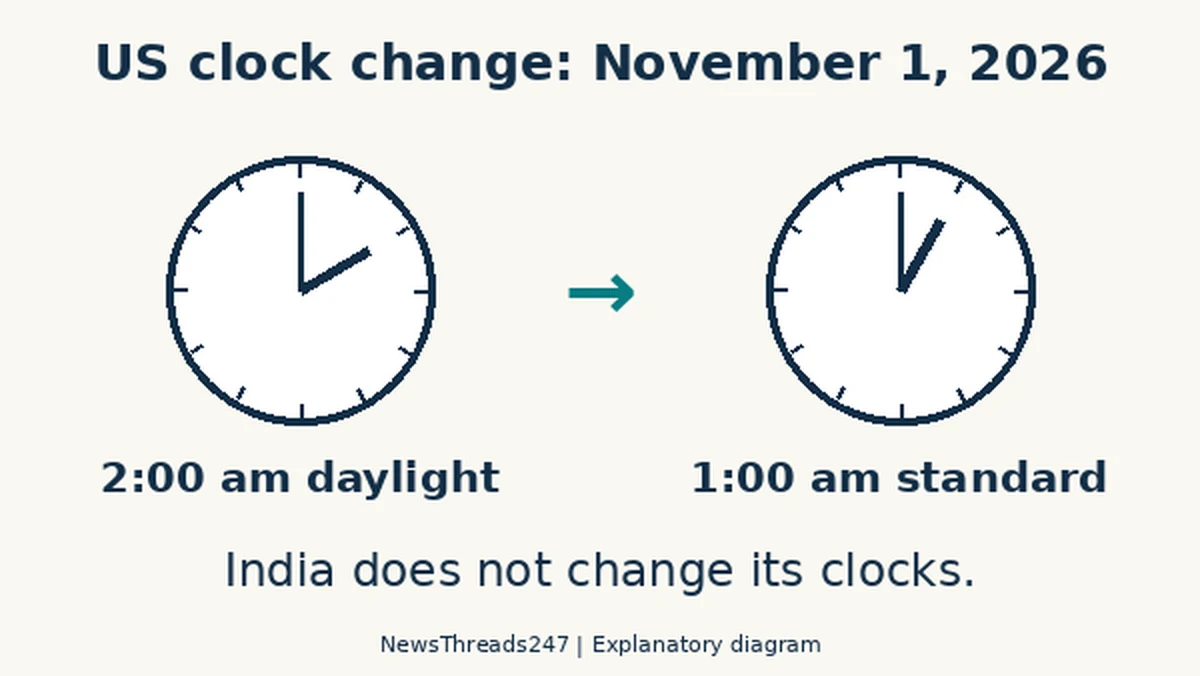
Most US locations that observe daylight saving time return to standard time on Sunday, November 1, 2026. At 2 am local daylight time, the clock returns to 1 am. India does not make that seasonal change. For work calls, interviews and classes spanning the two countries, check the first appointment after the switch rather than assuming an old conversion still applies.
The US changes its clock; India’s meeting time can still move
The National Institute of Standards and Technology’s 2026 schedule confirms November 1 as the end of US daylight saving time. Its rules describe the repeated hour and the areas that do not observe the change. This is the published schedule checked on October 25, not an announcement that every US location changes clocks.
India Standard Time is UTC+5:30, as explained by CSIR–National Physical Laboratory. New York changes from UTC−4 to UTC−5. The gap therefore grows from nine and a half hours to ten and a half hours. If the New York appointment stays at 9 am, the Indian attendee joins one hour later by the Indian clock.
The reverse arrangement is equally possible. If a team deliberately keeps its call at 6:30 pm IST, New York participants join at 8 am after the switch, rather than 9 am. Neither choice is inherently wrong. An invitation becomes confusing when its description promises one arrangement and its recurrence follows the other.
Compare actual cities before and after the change
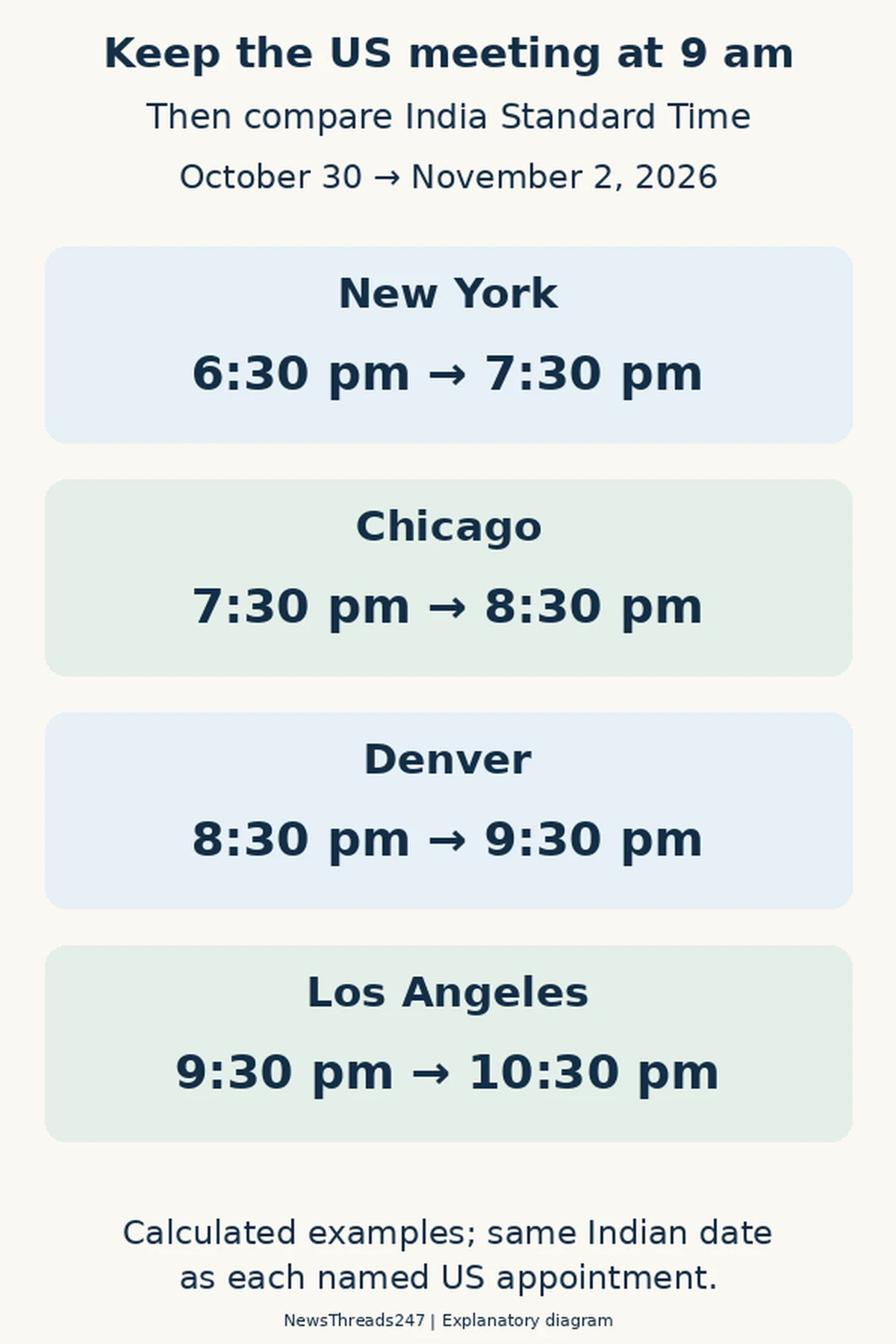
Here are calculated conversions for a 9 am appointment in six US cities, using Friday, October 30 and Monday, November 2. The Indian dates are the same as the US appointment date except where the table says otherwise. These are appointment examples, not claims about anyone’s working hours.
| 9 am in this US city | October 30: India time | November 2: India time |
|---|---|---|
| New York | 6:30 pm IST | 7:30 pm IST |
| Chicago | 7:30 pm IST | 8:30 pm IST |
| Denver | 8:30 pm IST | 9:30 pm IST |
| Los Angeles | 9:30 pm IST | 10:30 pm IST |
| Phoenix | 9:30 pm IST | 9:30 pm IST |
| Honolulu | 12:30 am IST, October 31 | 12:30 am IST, November 3 |
Phoenix and Honolulu are useful checks against the shorthand that ‘US time changes’. The US Naval Observatory notes that Hawaii and most of Arizona stay on standard time. Arizona has an important exception: the Navajo Nation observes daylight saving time. Use the actual location rather than extending the Phoenix row to every address in Arizona.
Find the time zone attached to the recurring event
Open the event details, not just its short title. Identify the organiser, the event’s time zone, the date of the next occurrence and the local time shown for each participant. A title such as ‘9 am EST’ may be informal shorthand used throughout the year; do not treat those letters as a reliable description of the saved event.
In a location-based zone such as America/New_York, a recurrence can follow New York’s local clock through seasonal changes. A fixed UTC time represents another arrangement. Google’s calendar documentation explains the role of time zones in expanding recurring events. The practical question is whether your series follows a place’s changing clock or a fixed worldwide instant.
Google Calendar’s time-zone help also explains how an event appears in each attendee’s local zone. That automatic display is useful, but it cannot settle which local hour your team intended to preserve. Confirm the organiser’s choice before creating a second invitation that conflicts with the first.
Send one clear confirmation, then inspect the result
For an illustrative New York–India team, a precise message would be: ‘From Monday, November 2, this call remains at 9 am New York time, which is 7:30 pm India Standard Time. Please check the updated series.’ If the Indian hour is the priority, state that instead: ‘The call remains at 6:30 pm IST; New York attendees join at 8 am.’
Include the first affected date. Ask someone in each location to open that occurrence and confirm the displayed time. If the organiser edits a repeating series, check whether the change applies to one event, future occurrences or the whole series in the calendar being used. Follow that product’s controls carefully rather than making an unnecessary change to past records.
Compare the calendar entry with any booking portal, interview confirmation or class timetable. A manually typed email can disagree with the invitation attached to it. Resolve the inconsistency through the organisation’s verified contact route; do not quietly choose the more convenient time and hope the other party made the same choice.
Interviews, deadlines and travel need the date as well as the hour
A deadline at 11:59 pm in a US city may fall on the next calendar day in India. A meeting at 9 am in Honolulu does so in the examples above. Write out the date and zone when recording an important appointment. ‘Tomorrow evening’ loses its meaning quickly in a conversation across countries.
For an interview, save the invitation, the employer’s stated zone and any written clarification. If a scheduling page offers a city selector, verify that it reflects your intended location. For a formal deadline, use the organisation’s actual instructions; a meeting conversion is not permission to submit later or assume a grace period.
If the appointment is close to the repeated 1 am hour on November 1, request an unambiguous confirmation that includes the UTC offset or a properly zoned calendar invitation. There are two local occurrences of that hour in places making the change. Ordinary daytime examples avoid that ambiguity, but an overnight operation or travel connection may not.
Check device settings without moving every clock yourself
NIST explains that its internet time services distribute UTC while a computer’s operating system applies the local-zone and daylight-saving rules. Keep the operating system’s time-zone information current and check the selected location. A correct synchronised instant can still be displayed under the wrong city setting.
Do not change an Indian device’s clock by an hour to compensate for a US meeting. Fix the event or its zone instead. If an older device disagrees with an updated calendar, compare both against a reliable time source and check its manufacturer’s instructions. Our Android update-status guide explains why different update screens can describe different parts of a phone.
A small handover that prevents a missed call
Before the final working day of October, record the first post-change meeting date, its anchor city, its time in both locations and the person responsible for the series. Check recurring interviews, client calls and class sessions individually. A shared note is helpful only after it agrees with the actual invitation.
Sources and illustration credits
This guide uses the NIST and US Naval Observatory rules, CSIR-NPL’s IST explanation and Google’s calendar documentation linked above, checked on October 25, 2026. The table is an original calculation using location-based time zones. It covers the named US cities and India; other countries and territories can follow different rules. Featured image: AI-generated editorial illustration. Context and comparison diagrams: NewsThreads247.